Friday, December 4, 2009

NFL All-Rookie Team Of 2009


It may be early still, but I am going to name my 2009 NFL All-Rookie Team.

Quarterback : Matthew Stafford - The Lions set a NFL rookie record with five touchdown passes in one game, which also tied a team record. He leads all rookie quarterbacks in attempts, completions, passing yards, touchdown passes, and passing yards per game.

Running Back : Knowshon Moreno - The Broncos first round draft pick leads all NFL rookies with 688 yards so far.

Running Back : LeSean McCoy, Philadelphia
- The Eagles second round draft pick has 528 rushing yards while playing a part time role much of the season until recently.

Wide Receiver : Percy Harvin, Minnesota - The Vikings first round pick does a bit of everything. He has 42 receptions, 91 yards on 11 carries, and five touchdowns.

Wide Receiver : Austin Collie, Indianapolis - The Colts fourth round draft pick has been a huge help towards the Colts undefeated season. He leads all rookies with 43 catches and has four touchdowns already.

Tight End : Brandon Pettigrew, Detroit - Despite missing two games, the Lions second first round draft pick leads all rookie tight ends with 30 receptions and has two scores.

Tackle : Michael Oher, Baltimore - He has started in all games. Mostly at right tackle for Baltimore this year, and including a few at left tackle when incumbent Jared Gaither was hurt. He shut down All-Pro Jared Allen one game, and has been largely spectacular most of the season.

Tackle : Eben Britton, Jacksonville - The second round draft pick has started in every game he has played, missing one from injury. He and first round pick Eugene Monroe should bookend each other for a long time.

Guard : Louis Vasquez, San Diego - Despite missing weeks two and three from injury, this third round pick has started every game and is a big part of the Bolts resurgence.

Guard : Andy Levitre, Buffalo - The second round pick has started all games for the Bills, and recently showed his versatility by moving to left tackle to replace the injured Demetrius Bell for awhile. He and fellow rookie guard Eric Wood, the first round pick who started every game until he broke his leg week ten, should anchor the Bills trenches for years.

Center : Alex Mack, Cleveland - He has struggled at times, but his future appears bright. He has started every game for the Browns so far.

Defensive Tackle : Roy Miller, Tampa Bay - The third round pick has 25 tackles and two sacks so far.

Defensive Tackle : Terrance Knighton, Jacksonville
- The Jags third round draft pick leads all rookie defensive linemen with 29 tackles.

Defensive End : Matt Shaughnessy, Oakland - The Raiders third round draft pick has 16 tackles and two sacks.

Defensive End : Everette Brown, Carolina - The first round draft choice has 15 tackes, two forced fumbles, and 1.5 sacks.

Outside Linebacker : Brian Orakpo, Washington - The Redskins first round draft pick leads all rookies with seven sacks, which is also the 12th most in the league.

Outside Linebacker : Brian Cushing, Houston - The first round pick leads all rookies with 99 tackles, which is the fifth most in the league. He also has recorded a safety, three interceptions, 1.5 sacks, and defended 12 passes.

Middle Linebacker : James Laurinaitis, Saint Louis - The Rams second round draft pick is second amongst all rookies with 85 tackles, which is the 12th most overall. He also has two interceptions and a sack.

Safety : Louis Delmas, Detroit - The Lions second round pick is third in rookie tackles with 61 tackles, and he has a sack, interception, and touchdown off of a fumble recovery.

Safety : Jarius Byrd, Buffalo - The Bills second round draft pick is leading the NFL with eight interceptions.

Cornerback : Jacob Lacey, Indianapolis - The undrafted free agent, along with third round pick Jerraud Powers, might be the most valuable rookies to the Colts. Both were thrown into the starting lineup after injuries decimated the secondary. He is fifth amongst rookies with 56 tackles, Powers is fourth with 58, and he has an interception and 11 passes defended.

Cornerback : Vontae Davis, Miami - The first round draft pick has two interceptions, one returned for a touchdown, and he and fellow rookie Dolphin CB Sean Smith appear to have the staring jobs locked up for years ahead.

Kick Returner : Percy Harvin - He has two touchdowns already, which leads the NFL, as does his 29.8 per return average.

Punt Returner : Quan Cosby, Cincinnati - The undrafted free agent is second in the NFL with 30 returns, and third with 335 yards. His 11.2 yards per return leads all rookies.

Kicker : Ryan Succop, Chiefs
- The seventh round selection leads all rookies with 65 points, and has missed just four kicks, one from being blocked, all season.

Punter : Kevin Huber, Cincinnati
- The Bengals fifth round choice leads all rookies with 54 punts for 2,453 yards, as well as 18 punts inside the 20-yard line.


Now on with my week 13 picks.

I went 8 - 5 last week, dropping me to 109 - 50.


Philadelphia Eagles @ Atlanta Falcons

Both teams are in desperation mode right now. A loss will cripple their playoff hopes. The difference is that Atlanta is hurting at quarterback and running back right now.

Eagles 34 Falcons 17


Tampa Bay Buccaneers @ Carolina Panthers


The Bucs are not a great team, but their coaching issues a big part of the problem. Carolina has underachieved all season. Some Panther fans are happy that Matt Moore may start at quarterback this week, while others think it won't matter. Moore is an unknown X-factor, due to his throwing only 69 balls in three years. A toss up, but thinking promising Tampa Bay QB Josh Freeman will get the win.

Buccaneers 17 Panthers 16


New England Patriots @ Miami Dolphins

Miami has had some positives this year. They got their young quarterback playing experience, and witnessed the rebirth of running back Ricky Williams. Unfortunately, the Patriots will be too much to handle for the Phins.

Patriots 26 Dolphins 16


Saint Louis Rams @ Chicago Bears

Running back Steven Jackson is beat up and hurting, but the Rams keep giving him the ball. A big reason is that he is their only weapon, and he is second in the NFL in rushing yards right now. Chicago is in a turmoil of their own, and fans are calling for massive changes from the coaching staff to the roster. This is a game Bears QB Jay Cutler steps up.

Bears 23 Rams 17


Detroit Lions @ Cincinnati Bengals

The Bengals need this win bad to maintain a hold of the AFC North. Detroit should consider shutting down prized rookie Matthew Stafford for the year, because he is beat up.

Bengals 27 Lions 13


Tennessee Titans @ Indianapolis Colts

The Colts are undefeated for a few reasons besides talent. They are reliant and never quit. Titans QB Vince Young has rallied the team to five straight wins, with running back Chris Johnson a big reason behind it. If Johnson gets off in this game, like he has been doing all season, the Titans have a good chance to deal the Colts that first loss of 2009.

Titans 26 Colts 24


Oakland Raiders @ Pittsburgh Steelers


The Raiders have recently shown a little improvement on offense after a quarterback change. It still isn't enough to deal with an angry and desperate Pittsburgh team clinging to playoff hopes.

Steelers 31 Raiders 13


New Orleans Saints @ Washington Redskins

I expect a very good Redskins defense to keep this close, but Washington can never close out a game because of terrible coaching.

Saints 26 Redskins 20


San Diego Chargers @ Cleveland Browns


The Bolts are missing three starters on defense, but they have good depth. Their offense has been on fire lately, and will be too much for the worst team in football.

Chargers 41 Browns 9


Denver Broncos @ Kansas City Chiefs


Denver is still very much in control of their playoff destiny, but they need to keep winning to stay ahead of teams nipping at their heels. Kansas City is not one of those teams.The Chiefs are trying to finish strong, so it won't be an easy win for Denver.

Broncos 23 Chiefs 17


Houston Texans @ Jacksonville Jaguars

After losing their last three games, Houston has pretty much buried their playoff hopes. They either rally this week or go home. Jacksonville was absolutely horrible last week in their loss to the 49ers, and this inconsistency has been the theme of the young team all year.

Texans 27 Jaguars 24


Dallas Cowboys @ New York Giants

Dallas needs this win to keep a game ahead of the Eagles for the race to the NFC East crown. The Giants lose this week, they are pretty much done. The Jints have failed to dominate the trenches lately, and Dallas needs to take advantage of that.

Cowboys 31 Giants 23


San Francisco 49ers @ Seattle Seahawks

The Niners still have faint hopes in winning their division, while Seattle does not. San Francisco is better in the trenches, and they should ride running back Frank Gore's back to victory.

49ers 27 Seahawks 20


Minnesota Vikings @ Arizona Cardinals


Game Of The Week


This is a scrum that sees two record setting quarterbacks with a Super Bowl ring in their resume. Minnesota has an excellent defense, so Arizona must run the ball well to give balance to their offensive attack. The Cardinals have a good defense themselves, and both can be explosive on special teams. The sharpness of Cards QB Kurt Warner will be key.

Cardinals 38 Vikings 34


Baltimore Ravens @ Green Bay Packers

This will be a very fun game to watch. The defensive weakness of the Ravens is pass defense, which is the Packers strength. The Packers have a good defense, but their offensive line is the key to this game. Baltimore has a very good front seven, and that should make the difference.

Ravens 27 Packers 23


NFL Power Rankings


1. New Orleans Saints

2. Indianapolis Colts

3. Minnesota Vikings

4. New England Patriots

5. Cincinnati Bengals

6. San Diego Chargers

7. Dallas Cowboys

8. Pittsburgh Steelers

9. Philadelphia Eagles

10. Denver Broncos

11. Baltimore Ravens

12. Green Bay Packers

13. Arizona Cardinals

14. Atlanta Falcons

15. Tennessee Titans

16. New York Giants

17. Jacksonville Jaguars

18. Miami Dolphins

19. San Francisco 49ers

20. Houston Texans

21. New York Jets

22. Seattle Seahawks

23. Carolina Panthers

24. Chicago Bears

25. Kansas City Chiefs

26. Oakland Raiders

27. Buffalo Bills

28. Detroit Lions

29. Washington Redskins

30. Tampa Bay Buccaneers

31. Saint Louis Rams

32. Cleveland Browns

Wednesday, December 2, 2009

The ALMOST All-Time Seattle Seahawks Defense

Defensive Tackle : Cortez Kennedy


This selection may seem ludicrous because Kennedy is bound for Canton soon. At the time of this publication, he has yet to be, so he makes this team easily.

He was Seattle's first round draft pick in 1990, and was the third player chosen overall. He was brought along slowly in his rookie year, starting in just two if the 16 games he played., and he recorded a career low one sack. It was the only season in which he did not start in every game that he played. Now a full time starter in 1991, he made his first Pro Bowl after getting 6.5 sacks and 73 tackles.

Kennedy had the best year of his career in 1992. He was named NFL Defensive Player of the Year by the Associated Press after setting career high marks of 14 sacks and 92 tackles. He was named to the Pro Bowl as well as First Team All-Pro.

He was named First Team All-Pro over the following two years, as well as to the Pro Bowl, getting 10.5 sacks and 131 tackles over that time. He continued to be named to the Pro Bowl in 1995 and 1996, getting 14.5 sacks and 91 tackles total in those two years.

He was injured in 1997, and was able to play just eight games. He still had two sacks. They were the first games he had missed in his career, and it seemed to have an effect on him for the rest of his career.

Kennedy did return to the Pro Bowl in 1998 despite getting just two sacks and 30 tackles in the 15 games he played. He also took a fumble 39 yards for the only touchdown of his career. He rebounded strong the next year with 6.5 sacks, 61 tackles, and two interceptions. He was named to his last Pro Bowl as well.

Though he started in all 16 games during the 2000 season, he matched his career low of one sack and had just 32 tackles. He also snagged the last interception of his career and chugged for a career long 14 yards. After sitting out the 2001 season, he announced his retirement.

There has been no defensive tackle in Seahawks history than him. His eight Pro Bowls and three First Team All-Pro nods are both the second most in team history. His 58 sacks are the most by any defensive tackle in team history, and fourth best ever overall. His 568 career tackles also ranks fourth best in team history, and is the second most by any Seattle defensive lineman.

Cortez Kennedy is a member of the Seahawks Ring Of Honor, and is on the first team of the NFL 1990's All-Decade Team. Expect him to be one day a member of the Pro Football Hall Of Fame as well.


Defensive Tackle : Joe Nash


Nash was signed as an undrafted free agent rookie by the Seahawks before the 1982 season. He got one start that year, in the seven games that he played in the strike shortened season, and recorded a sack.

Seattle then had him start eight games the next year at nose tackle, splitting duties with Manu Tuiasosopo, and he had three sacks. Seattle won their first ever playoff game that year and eventually reached the AFC Championship before losing.

The Seahawks then decided to make him a full time starter. He responded with his only Pro Bowl season in 1984. He had seven sacks and a career best three fumble recoveries. One of the fumbles he recovered was taken in for a touchdown by him. He, along with cornerback Dave Brown and kicker Norm Johnson, made the Pro Bowl that year. It was just the third time in team history any player was given this honor.

Nash followed that up with nine sacks the next season, an excellent number for a nose tackle. He then had 10.5 sacks over the next three years, despite missing five games because on injuries.

Seattle ran their base 3-4 defense fot the last time in 1989. Nash had a stellar year, with eight sacks and a career best 92 tackles. The Seahawks then switched to the 4-3 defense in 1990 because they had just drafted defensive tackle Cortez Kennedy in the first round that year.

Now playing defensive tackle, Nash had just one sack. Seattle decided they wanted more of a pass rush the next year, so they moved defensive end Jeff Bryant into Nash's position and placed Tony Woods into Bryant's slot. It was the first year in Nash;'s career that he failed to record a sack. This experiment lasted just one year.

Defensive end Jacob Green left the team, so Bryant was inserted into his spot. Nash was starting again. He had 4.5 sacks that season. The 1993 season saw him record just half a sack, but he did intercept the only pass of his career and rumbled 13 yards for the last touchdown of his career.

After two sacks the next year, he had one in 1995. He also did not start in five games. He played in just eight games as a reserve the next season, then retired.

Joe Nash was the first defensive lineman in Seahawks history to be named to the Pro Bowl. His 218 games played in Seattle is a team record, and his 47.5 career sacks still ranks sixth best in franchise history. His 743 career tackles is the second most in team history, and the most ever by any Seahawks defensive lineman.

There has been no nose tackle in Seahawks history better than him. He was durable, strong, and an stellar sack master. He has 37.5 of his sacks playing nose tackle over seven years, which is a superb rate for the position. There is a reason the man was a fan favorite and lasted 15 years with the team. It was because he was excellent.

Sam Adams, Rocky Bernard, and John Randle deserve mention.


Defensive End : Jacob Green


Green was a first round draft pick of the Seahawks in 1980, and he was the tenth player chosen overall. He started in 13 of the 14 games he played as a rookie, then in all 16 games the following year. He had 18.5 sacks total during that time.

The NFL began keeping quarterback sacks as a statistic in the strike shortened season of 1982, and Green had three in the nine games he played that year. He had perhaps his best season the next year when he had a career high 16 sacks. He also intercepted a pass and took it a career long 79 yards for a touchdown. The Seahawks won their first ever playoff game that year and reached the AFC Championship before losing to eventual NFL Champion Los Angeles Raiders.

Teamed with 1982 first round draft pick Jeff Bryant, the two were fast becoming one of the best defensive end tandems in the league. The two would be paired up until 1992.

Green had 13 sacks and career high four fumble recoveries in 1984, then had 13.5 sacks the next year. He also scored two touchdowns. One came off a 19 yard interception return, and the other came off a 79 yard fumble recovery return. Both the touchdown off interception and fumble recovery led the NFL that year, as did his 79 yards off of fumble recoveries.

He was finally named to his first Pro Bowl in 1986 after having 12 sacks. He repeated that honor in the strike shortened 1987 season after getting 9.5 sacks in 12 games played. It would be the last time he made the Pro Bowl in his career.

Green scored the last touchdown of his career the next year, and also had nine sacks. Fans began to wonder if he was slowing down in 1997 after he had just three sacks, but he rebounded the next season with 12.5 sacks. He then had six sacks and the last interception of his career in the 1991 season.

It was also his last year in Seattle. He joined the San Francisco 49ers for the 1992 season, but suited up for two games and did not record any statistics. It is the only season of his career in which he failed to record a sack. He retired afterwards.

His 97.5 official sacks are the most in Seattle history, and was the third most at the time of his retirement. It still ranks 25th all-time. If all of his 118 career sacks counted, he would rank 14th on the all-time sacks list.

He was the first defensive end in Seahawks history to make the Pro Bowl, and his two appearances rank second most by any defensive end in team history. He is the only defensive lineman in team history with two touchdowns off of interceptions, and is tied for fifth most by and defender in franchise history. His three interceptions is tied with Cortez Kennedy as the most by any Seahawk lineman ever. His two touchdowns off of fumbles is tied with Michael Sinclair as the most ever by a Seattle defensive lineman, and is also the second most in franchise history.

Jacob Green is most likely the best defensive end that ever wore a Seahawks uniform.


Defensive End : Michael Sinclair


Sinclair was a sixth round draft pick by Seattle in 1991, and was the 155th player chosen overall. He spent his rookie year riding the bench mostly, but he did have one sack.

The next year saw him play just nine games, as he was used as pass rush specialist and had eight sacks. He had 4.5 sacks the next year in a reserve role again.

Seattle then inserted him into the starting lineup for the 1995 season, and he had 5.5 sacks. Business picked up for him the next year when he had 13 sacks and was named to his first Pro Bowl. He went back to the Pro Bowl in 1997 after getting 12 sacks and scored a touchdown off a fumble recovery.

The best year of his career may have been in 1998. He had a career best 16.5 sacks that led the NFL. He also had a career high 42 tackles.. He was named to the last Pro Bowl of his career that year as well.

He stayed with Seattle for three more years and had 13 total sacks over that time. He scored the last touchdown of his career in 2000 when he took one of his career high four fumble recoveries for a score. He signed with the Philadelphia Eagles for 2002, but played just four games. It was the only season he failed to record a sack. He then retired.

Michael Sinclair's 73.5 sacks with Seattle is the second most in franchise history. His three Pro Bowl appearances are the most by any defensive end in the teams history. He is certainly one of the best defensive ends the Seahawks ever had.

Jeff Bryant and Tony Woods deserve mentioning.


Outside Linebacker : Chad Brown


Brown was drafted in the second round of the 1993 draft by the Pittsburgh Steelers. He was the 44th player chosen overall. Pittsburgh started him in nine of the 16 games he played as a rookie at inside linebacker in the Steelers 3-4 defense. He had 3 sacks.

He stayed there for the next two seasons, getting 14 sacks and an interception. Pittsburgh advanced to Super Bowl XXX after 1995, but lost. Brown had missed six games because of injury that year, but returned in time to help Pittsburgh capture the AFC crown.

Pittsburgh moved him to outside linebacker in 1996, and he responded with a Pro Bowl year with a career high 13 sacks in the 14 games he played. He also had two interceptions and was named First Team All-Pro.

He joined the Seahawks in 1997 and had 6.5 sacks. He also led the NFL with two fumble recoveries returned for touchdowns. The 1998 season was the best of his career. Brown racked up a career best 117 tackles to go with 7.5 sacks and an interception. He was named to the Pro Bowl and First Team All-Pro.

His last year as a Pro Bowler was in 1999. He had 5.5 sacks. The next year saw him score the last touchdown of his career, off a fumble recovery, and have six sacks. After 8.5 sacks in 2001, he missed eight games because of injuries the next year. He still managed six sacks in the eight games that he did play. After seven sacks and the last interception of his career in 14 games 2003, he was only able to suit up for seven games the next year, due to injury, and have one sack.

Brown signed with the New England Patriots in 2004 and started in five games before losing his starters job. He spent the rest of the year on special teams. He rejoined the Steelers the next year and had the last sack of his career after nine games before being injured for the rest of the year. He then rejoined the Patriots for two games in 2007 before being released.

Though some may remember Brown's early years in the famed "Blitzburgh" defense the Steelers ran, he had his most productive seasons in the eight years he spent with Seattle. His three touchdowns off fumbles is the most in team history, and is tied for the third most in NFL history.

He is still ranked third in franchise history in tackles and fumble recoveries, and is fifth in sacks. His 48 sacks is the most by any linebacker in team history. His two Pro Bowl years are the most by any Seattle outside linebacker, if you do not count Rufus Porter's Pro Bowl years as a special teams contributor.

Through all the fine outside linebackers in Seahawks history, Chad Brown is probably the best ever.


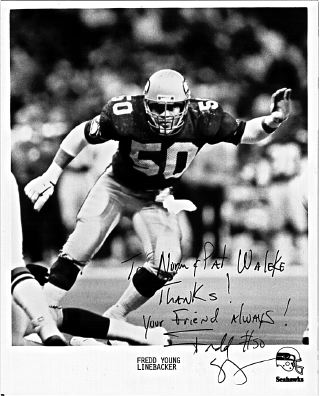
Middle Linebacker : Fredd Young


Young was drafted in the third round of the 1984 draft by Seattle, and was the 78th player chosen overall. He spent his rookie year as a reserve, yet recorded a sack. He was a special teams star for the Seahawks, and became the first player in AFC history to be named to the Pro Bowl as a special teams contributor.

He was inserted into the starting line up in the third game of the next year, and responded with another Pro Bowl season. He also contributed three sacks. He played in 15 games in 1986 and had six sacks. He was also named to the Pro Bowl yet again.

The strike shortened 1987 season was his last as a Pro Bowler. He was also named First Team All-Pro. He suited up for 12 games and had a career high nine sacks. He also had the first interception of his career, which he returned 50 yards for the only touchdown of his career.

He joined the Indianapolis Colts in 1988, and stayed with them for three mostly injury plagued years that saw him miss seven games and three starts. He contributed two sacks and two interceptions, then retired after the 1990 season.

Many Seahawks fans recall Young for more than his four Pro Bowls in his four years with the team. He was a ferocious hitter whose hits are still shown on NFL Films. His three Pro Bowl appearances as a middle linebacker are tied as the most in team history with Lofa Tatupu, and tied with Julian Peterson and Tatupu as the most by any linebacker in team history.

If you count the year he made it on special teams as a linebacker, which the league does, it is the most ever in Seahawks history. His 19 sacks are the most by any middle linebacker in team history as well.

Seattle has had quite a few good middle linebackers in their history, but perhaps none are better than Fredd Young.

Keith Butler, Shelton Robinson, and Dave Wyman all deserve mention.


Outside Linebacker : Rufus Porter


Porter joined Seattle as an undrafted free agent rookie in 1988. He saw limited action on defense that year, but soon became a star on special teams. He was named to the AFC Pro Bowl Team as a special teams contributor.

Chuck Knox, the Seahawks coach, knew he had to get Porter on the field more often. Knox started him three times at linebacker in 1989, but mostly used him as a pass rushing specialist. Porter came through with a career best 10.5 sacks that year. He kept starring on special teams and was named to his second, and last, Pro Bowl. He was also named First Team All-NFL and First Team All-AFC by Pro Football Weekly.

Seattle named him a starter in 1990, but Porter missed four games because of injury. He was able to contribute five sacks and a career high four fumble recoveries. He missed one game the next year, but piled up ten sacks and had his first interception of his career.

The 1992 season was the only year of his career that he played a full season as a starting linebacker, and he had 9.5 sacks. He started in six of the seven games he played in an injury plagued 1991, getting one sack and interception. After an interception and 1.5 sacks in 15 games the next year, he joined the New Orleans Saints.

His two years with the Saints saw him miss five games and start in just 21 games. He had three sacks his first year in New Orleans and none the next year. He found himself on the Tampa Bay Buccaneers in 1997, where he had half a sack in the 11 games he played. He then retired.

Rufus Porter's place in Seahawks is secure, and his 37.5 sacks with the team are the second most ever by any Seahawks linebacker.

Julian Peterson, Bruce Scholtz, Terry Wooden, and Anthony Simmons all deserve mentioning.


Strong Safety : Ken Easley


Easley was the first round draft pick of the Seattle Seahawks in 1981, and was the fourth player chosen overall. Blessed with great speed and a 32-inch vertical jump, the Chicago Bulls drafted him in the tenth round of the 1981 NBA Draft as well.

Seattle started him immediately, and the move paid off handsomely. He started all 14 games he played, intercepting three passes for a career high 155 yards. One was returned for a career long 82 yard touchdown. He also recovered a career high four fumbles. United Press International named him AFC Defensive Rookie of the Year.

The 1982 season in the NFL is most remembered for being shortened due to a players strike. It is also the first season Easley was named to the Pro Bowl, the second Seahawk to ever be named to a Pro Bowl in team history, after he had four interceptions and the first two sacks of his career. He would be named to the Pro Bowl for the next three seasons as well.

Not only was he awarded Pro Bowl honors over these three years, he was also named First Team All-Pro in each year. No other Seahawk defensive back has done this, and it ranks as the second most in franchise history still today. His four consecutive Pro Bowls was also a team record at the time.

The 1983 season saw Seattle hire Chuck Knox as their head coach. Easley intercepted the ball seven times and had a career best three sacks that season as the Seahawks made the playoffs for the first time ever.

The Seahawks won their first ever playoff game by walloping the Denver Broncos 31-7. Easley contributed a sack and helped stifle the Broncos all game. Seattle rode that momentum by reaching the AFC Championship before losing.

Easly had the best season of his career in 1984. He has a career high ten interceptions and two touchdowns, both of which led the NFL. Seattle also asked him to return punts that year, and he had a career high 18 returns for 194 yards. He was named the NFL Defensive Player of the Year for his efforts.

The Seahawks won 12 games that year. It was the highest win total for them until their 2005 team won 13 and reached the Super Bowl. They got revenge on the Raiders in the first round of the playoffs by winning 13-7. Easley provided a key interception that was returned 26 yards to help the team. Seattle would lose the next week to the Dolphins.

He missed three games the next year, yet had two interceptions and two sacks. Though he missed six games in 1986 because of an ankle injury, he still managed two interceptions and a sack. However, the ankle injury would come back to haunt him later on in his career.

He returned to the Pro Bowl in 1987 after getting four interceptions. The ankle was still bothering him, and he missed four games. He was also held out of the starting lineup for a game for the first time since his first game in college. Seattle made the playoffs,but lost. It was the last game he ever played again.

Seattle then traded him to the Phoenix Cardinals for the rights to quarterback Kelly Stouffer. Stouffer had been the sixth player overall drafted the season before, but sat out the entire season because he and the Cardinals were unable to agree to terms of a contact.

When Easley arrived for his physical in Phoenix, the Cardinals doctors found that he had a kidney disease. It was later determined his disease stemmed from taking too many Advils when he was attempting to play on his injured ankle, which was what the Seahawks medical staff had been advising him to do over that time.

Easley was forced to retire as a player. He later settled with the team out of court over the Advil fiasco that robbed him of his kidney and playing career. He would undergo a successful kidney transplant in 1990. He was jogging within four months of the surgery, then won a golf tournament within six months.

His 32 interceptions are the fourth most in team history, and his 538 yards returned off interceptions is the third most. The three touchdowns he scored off of interceptions is the second most, and his 11 fumble recoveries is the fifth most by any Seahawks defender. No other defensive back in Seahawks history has gone to the Pro Bowl more than him, and only three other players in team history have more appearances.

Kenny Easley is a member of the Seahawks Ring Of Honor, and is a member of the NFL 1980's All-Decade First Team. He is the only member of the unit to yet be inducted into Canton.

Easley is the not only the best strong safety of the 1980's, but he is the best safety in that decade and in Seahawks history.

Robert Blackmon deserves mention.


Free Safety : John Harris


Harris was drafted in the seventh round by the Seahawks in 1978, and was the 178th player chosen overall.

He won the starting job right away and had four interceptions in his rookie year, His second season was plagued by injuries, as he was only able to start in six of the 14 games he played that year. He never missed a game or start again while he was in Seattle. He still managed two interceptions.

Following six interceptions in 1980, he had the best year of his career in 1981 while teamed with rookie Kenny Easley at safety. Harris set career highs with ten interceptions for 155 yards and two touchdowns. One interception was returned a career long 42 yards. He also recovered a career high three fumbles.

After four interceptions in 1982, he matched his career high mark of three fumble recoveries the next year, returning them for a career best 62 yards. He also had two interceptions. The Seahawks won their first ever playoff game that year and eventually reached the AFC Championship before losing

The 1984 season saw him have six interceptions and record the only quarterback sack of his career. Seattle won 12 games that year. It was the highest win total for them until their 2005 team won 13 and reached the Super Bowl. They won in the first round of the playoffs, then lost the next week.

After intercepting seven passes in 1985, he joined the Minnesota Vikings the next year. He had three interceptions but missed one start in the 16 games he played. It was the first time he had missed a start since 1979. He then started in all 12 games he played in the strike shortened 1987 season, yet he still had three interceptions.

Harris picked off three balls the next year, but missed his first three games since 1979. He also missed a start in one of those games. He retired at the conclusion of the season.

He had at least two interceptions in all of his 11 seasons in the league, and ended up with 50 in his career. His 41 interceptions in Seattle is the third most in franchise history.

John Harris teamed with Easley to give the Seahawks perhaps the best safety tandem in the league for many years, and he might be the best free safety to have ever played for the team.

Eugene Robinson and Darryl Williams also were excellent, and surely deserve mention.


Cornerback : Dave Brown


Brown was picked by the Pittsburgh Steelers in the first round of the 1975 draft, and was the 26th player chosen overall.

He played sparingly at defensive back for the powerhouse Steelers at defensive back, but helped as a return specialist. He returned 22 punts for 217 yards, both are career highs, and returned the only six kickoffs of his career for 126 yards. Pittsburgh would go on to win Super Bowl X that season.

He was then picked in the 1976 Expansion Draft by the Seattle Seahawks. Though he started right away at cornerback and intercepted four balls, he also returned the last 11 punts of his career for 74 yards. He also recorded the only safety of his career.

He had four more swipes the next season, including scoring the first touchdown of his career. After 14 interceptions over the next three years, he missed his first six games of his Seattle career in 1981 after getting two interceptions. They would be the only games he missed with the Seahawks.

His best season was in 1984, which happened to be his only Pro Bowl year. It was the first time a Seahawk cornerback had been named to the Pro Bowl and All-Pro. He, along with nose tackle Joe Nash and kicker Norm Johnson, made the Pro Bowl that year. It was just the third time in team history any player was given this honor.

He had a career highs with eight interceptions for 179 yards and an NFL leading two touchdowns that came in one game.

Brown tied an NFL record with two interceptions returned for touchdowns during their November 4th, 1984 victory over the Chiefs, including a career long return of 90 yards.

Over the next two years, he had 11 interceptions and score a touchdown in each year. He was also named All-Pro in 1985. He then opted to sign with the Green Bay Packers in 1987. He missed his first four games that year for the first time since 1981, but still managed three interceptions. After three more the next year, he had six interceptions in 1989. He then retired.

Brown is seventh all-time in NFL history with 62 career interceptions. His 50 INTs as a Seahawk still stands as the team record. His five career touchdowns are the most ever by any Seattle defender.

In 1992, Brown was inducted into the Seattle's Ring of Honor.

Dave Brown may never get inducted into Canton, but his stats are certainly worthy of induction. He was solid and steady. I consider him more spectacular than flashy, even though he did score five touchdowns and have an amazing total of 62 interceptions. He always got the job done.


Cornerback : Keith Simpson


Simpson was the Seahawks first draft pick in 1978, and he was the ninth player chosen overall. Seattle used him as an extra defensive back for 13 games in his rookie year, yet he was able to intercept two balls. One was returned 40 yards for a touchdown.

He was put at strong safety the next year, and ended up staring in 11 of the 15 games he played. He swiped a career best four balls that year. His 1980 season saw him play 16 games the only time in his career, and he picked off three more passes.

Seattle was looking to upgrade their secondary and decided to move Simpson to cornerback and draft Ken Easley to play strong safety. The move was a good one for the team, and Simpson had two picks that year.

After no turnovers in the strike shortened season of 1982, Simpson had four interceptions in 1983 despite being injured much of year. He missed two games, and started just six. Seattle would go on to play the AFC Championship Game, but lose.

His best season was in 1984. He matched his career high of four interceptions, and had a career best 138 yards gained from the interceptions. He led the NFL with two touchdowns scored off of interceptions, including a career long return of 76 yards.

He lost his starting job to Terry Taylor, who was a first round draft pick in 1984, so he played as an extra defender. He failed to accrue a turnover for just the second time in his career, but he did contribute a career high three quarterback sacks. When the season was over, he retired.

Keith Simpson's 19 career interceptions still rank seventh best in Seahawk history, and his six sacks are the most recorded by any cornerback who has played in Seattle. His three touchdowns off of interceptions are the second most in team history.

His versatility and big play ability has him remembered as one of the best Seahawks defensive backs ever.

Patrick Hunter, Willie Williams, Terry Taylor, Dwayne Harper, and Shawn Springs deserve mention.


Punter : Rick Tuten


Tuten was signed as a free agent rookie by the Philadelphia Eagles for two games in the 1989 season. The Eagles used four different players that year as a punter. Tuten punted the ball seven times that year, and averaged a career low 36.6 yards per attempt. He was then released by Philadelphia.

He was signed by the Buffalo Bills two games into the season the next year. The Bills had drafted John Nies in the sixth round that year, but were unhappy with his production. They carried Tuten on the roster for a few more weeks before deciding to cut Nies. Tuten then was the punter the rest of the year, and averaged 39.8 yards on 53 attempts. Buffalo would go on to play in Super Bowl XXV that year, but would lose to the New York Giants 20-19.

Chris Mohr would replace Tuten on the Bills next year, and spend ten seasons with the team. Now a free agent again, Tuten waited for a team to give him a shot. The Seahawks 1991 season saw them already use two punters in six games, and head coach Chuck Knox was not pleased with either. Seattle then signed Tuten for the rest of the year. He averaged 43 yards on 49 punt attempts.

The Seahawks then used him a lot in 1992. He punted the ball an NFL leading 108 times, which is the fourth most in NFL history. His 4,760 yards also led the NFL, and is still the third most punting yards in a single season in NFL history.

He led the NFL in punting yards again in 1993 with 4007 yards on 90 punts. He also had the first punt of his career blocked that season.

Tuten made his only Pro Bowl squad in 1994 after punting 91 times for 3,905 yards. Tuten also scored on a two point conversion that year. He is the only punter in Seahawks history to be given a Pro Bowl honor.

He followed it up with perhaps the best season of his career in 1995. He led the NFL with a career high 45 yards per punt on 83 attempts. He also led the NFL with a career long 73 yard punt.

After having the last punt blocked of his career in 1996, Tuten was injured after 11 games the next season. The Seahawks then signed veteran Jeff Feagles during the offseason, and released Tuten. He then signed with the Saint Louis Rams for the 1998 season and punted the ball 95 times for the 4-12 Rams.

Saint Louis had a dramatic rebound in 1999, winning 16 games. Tuten was injured in the eighth game, and spent the rest of the year on injured reserve. The Rams went on to win Super Bowl XXXIV, thus giving Tuten a ring for being a member of the team. He then retired after the season.

His 554 punts for 24,266 yards are the best in Seahawks history, as is his 73 yard punt. His Seahawks career average of 43.8 yards per punt is the second best in franchise history by anyone with two or more punts. His career average of 43.4 is the 27th best in NFL history, his 741 punts is the 42nd most ever, and his 32,190 punting yards is the 41st most in professional football history.

Rick "Bootin" Tuten is easily the greatest punter in Seahawks history.

Jeff Feagles, Herman Weaver, and Jeff West deserve mention.


Kick Returner : Steve Broussard


Not to be confused with the punter Steve Broussard who had three punts blocked in the four games he played for the 1975 Green Bay Packers.

This Broussard was a first round draft pick by the Atlanta Falcons in 1990. He started a career high ten times in the 13 games he played as a rookie, but split carries with Mike Rozier. He set career best marks of 126 carries for 454 yards that season.

He started just six games over the next three injury plagued seasons with Atlanta, where he missed 11 games over that time. Atlanta released him after 1990, and he was signed by the Cincinnati Bengals for the 1991 season. After catching a career high 34 passes and scoring the only two point conversion of his career that year, he joined the Seahawks for the 1992 season.

Seattle installed Broussard as their kick returner, despite the fact he returned just ten kickoffs in the five years he has previously played. He responded by averaging 24.7 yards on 43 returns. He had 43 returns the next year as well, despite missing four games. One return went for 86 yards.

The best year of his career was in 1997. He set career bext marks of 50 kickoff returns for 1,076 yards. He also scored a career high six touchdowns as a third string running back behind Chris Warren and Lemar Smith.

He followed that up the next year by scoring on a 90 yard touchdown off of a kickoff return. He also averaged a career high 26.9 on 29 returns. After the 1998 season ended, he retired.

His 3,900 kickoff return yards for the Seahawks is the most in franchise history.

Charlie Rogers deserves mention, and is probably the best all around return specialist in Seahawks history.

Monday, November 30, 2009

The ALMOST All-Time Seattle Seahawks Offense


REMEMBER : This is a continuing series paying tribute to NFL legends who are not, and perhaps never will be, members of the Pro Football Hall Of Fame.


Quarterback : Dave Krieg


Kreig was an undrafted free agent rookie the Seahawks signed in 1980. He is the second and last player in the NFL to play college football at the now defunct Milton college. The first player was defensive end Dave Kraayeveld, who played with Seattle for 12 games in 1978.

Krieg spent the first four years of his career as a reserve, though he began to get more starts in 1983 when he started half of the season. He led the NFL with a touchdowns percentage of 7.4. With him at the helm, Seattle reached the AFC Championship after winning the first two playoff games ever in franchise history.

He was named the full time starter the next season, and he responded with his first Pro Bowl season. He tossed a career best 3,671 yards and 34 touchdowns. He also led the NFL with a career high 24 interceptions. Seattle won 12 games that year, a franchise record that stood until 2005.

Seattle won just eight games in 1985, and Krieg was sacked 52 times. The 455 yards he lost off of those sacks led the NFL. It was an NFL record then, and is still the fourth most yards lost ever.

He led the NFL in touchdowns percentage in 1987 and 1988. Though he missed seven games in 1988, he was named to the Pro Bowl. He would attain that Pro Bowl honor for the final time of his career in 1989.

Krieg threw more interceptions than touchdowns over the next two years, though he did lead the NFL with a career best 65.6 completion percentage. In 1990, he was sacked by Hall Of Famer Derrick Thomas a record seven times in one game. Seattle decided not to renew Krieg's contract when it expired at the end of the 1991 season.

He joined the Kansas City Chiefs in 1992, and started the whole season. He led the Chiefs to ten wins, but they lost in the first round of the playoffs. The Chiefs then brought n Hall Of Fame quarterback Joe Montana for the 1993 season, relegating Krieg to backup status. Montana was injured often that year, and Krieg started six games. He also had to come off the bench in each playoff game that Kansas City played, throwing a touchdown each time.

Krieg then joined the Detroit Lions for one year in 1994. He started in the last seven games of the year, and set Lions franchise records with a quarterback rating of 101.7, which was a career best, and throwing just three interceptions all year. He led the team to a playoff birth, but they lost in the first round.

Detroit would not commit to his being named starter, so Krieg joined the Arizona Cardinals for the 1995 season. The team struggled to only four wins, and Krieg led the NFL with 53 sacks for minus 380 yards. He left Arizona at the end of the year, then joined the Chicago Bears for the 1996 season. He started 12 games for the Bears, winning six.

He then joined the Tennessee Oilers to back up Steve McNair in 1997. He did not play much that year, attempting two passes. He attempted just 21 the next season, but did lead the Oilers to a comeback win after McNair was hurt in one game. He retired after the year was completed.

Dave Kreig is not only all over the Seahawks record books, he is all over the NFL record books. He ranks 12th all-time in NFL history in passing attempts, completions, and passing yards. He is tenth all-time is passing touchdowns.

He also has the most yards lost from sacks in NFL history, and was sacked the second most ever in league history. Krieg is also third all-time with the most fumbles ever, and second in fumble recoveries.

No other Seahawk quarterback has thrown for more yards, touchdowns, interceptions, or won more games than Dave Krieg, though Matt Hasselbeck may soon to surpass the passing yardage mark.

Jim Zorn deserves mention.


Fullback : John L. Williams


Williams was a first round draft pick of the Seahawks in 1986, and was the 15th player chosen overall. Though the Seattle offense featured Pro Bowl running back Curt Warner, Williams offered them a versatile dimension the team was lacking.

He was starting right away, running for 538 yards and catching 33 passes in his rookie year. It was the only season of his career that he failed to score. He piled up 500 yards the next year, despite missing four games due to injury. He had career longs on a 48 yard run and 75 yards reception.

The 1988 season may have been his best. He gained a career high 877 yards rushing at a 4.6 yards per carry average, and had 651 yards on 58 receptions. His 1,528 yards from scrimmage that year was a career high total, as was the seven touchdowns he scored that year.

He scored seven times again the next year, and he also a career high 76 receptions. He had 71 catches the next year, gaining a career high 699 yards. He also rushed for 714 yards, and was given his first Pro Bowl nod.

The 1991 season was his second and last Pro Bowl season. He gained 741 yards and had 61 receptions. He was never the same running threat again after that year, but maintained his excellence in the passing attack.

After 132 receptions and six touchdowns over the next two years, he joined the Pittsburgh Steelers for the 1994 season. He was used mainly as a pass receiver by the Steelers in his two years, catching 51 balls his first year with the team. He showed signs of slowing down in 1995, having career lows of 24 receptions and 110 rushing yards.

The Steelers made it to Super Bowl XXX that year. Williams had scored on a run in their first round playoff victory over the Buffalo Bills. Pittsburgh lost in the Super Bowl, and Williams retired at the conclusion of the game.

He leads all Seahawks running backs with 471 receptions for 4,151 yards receptions and also 123 games played. His 76 catches in 1989 is the most ever by a Seattle running back, and he owns the top three slots for receiving years by a running back. His six touchdown reception in 1989 is the most ever by a Seahawks running back.

He currently ranks third on the franchise list in receptions, fourth in rushing yards, and sixth in receiving yards.

John L. Williams is not only the best pass catching back in Seahawks history, he may be the most complete running back who ever played for them. He easily is the best fullback they ever had.

Mack Strong, Dan Doornink and David Sims all deserve mention.


Halfback : Shaun Alexander


Alexander was the Seahawks first round draft pick in 2000, and he was the 19th player chosen overall. He sat on the bench most of his rookie year, gaining 313 rushing yards.

He was eventually anointed the starter the next year, and he led the NFL with 14 rushing touchdowns. He also ran for 1,318 yards and caught 44 balls. One run went for a career long 88 yards. He scored 18 times total the next year, including having a career high 59 receptions for 460 yards.

He was awarded his first Pro Bowl honor in 2003 after gaining 1,435 rushing yards and scoring 16 times. He went back to the Pro Bowl the next year after running for 1,696 yards and leading the NFL with 20 total touchdowns.

The best year of his career was in 2005. He led the NFL with a career high 370 carries for 1,880 yards and 27 rushing touchdowns. His 28 total touchdowns led the league, and did his 117.5 rushing yards per game. He also averaged a career best 5.1 yards per carry.

He led the Seahawks into Super Bowl XL by running for 132 yards and two touchdowns in the NFC Championship Game against the Carolina Panthers. Seattle lost in the Super Bowl, even though Alexander gained 95 yards on 20 carries.

He was named Most Valuable Player of the NFL that year, and he is the only Seahawk to have ever won the award.

Seattle then signed him to the biggest contract in team history before the 2006 season. He was guaranteed $15.1 million on a eight year contract worth $62 million.He was injured that year and missed six games. He was still able to gain 896 yards in that short time. He was injured the next year again, and missed three games. Seattle, sensing he was done, then released him.

He signed with the Washington Redskins for four games in 2008, and ran for a career low 24 yards on 11 carries. Washington then cut him. Though Alexander has not officially retired, in hopes of latching on with another team, his football career appears over.

He is the franchise leader with 9,429 rushing yards, 2,176 carries, 100 rushing scores, longest run from scrimmage, rushing yards per game, total touchdowns in a career and season, rushing touchdowns in a season, rushing attempts in a season, and rushing yards in a season.

Shaun Alexander is perhaps the best running back the Seahawks ever employed.

Curt Warner, Chris Warren, Sherman Smith, and Ricky Watters deserve mention.


Wide Receiver : Brian Blades


Blades was second round draft pick by Seattle in 1988, and he was the 49th player chosen overall. He started seven games that year, but did catch a career best eight touchdowns on 40 receptions. He averaged a career high 17.1 yards per reception as well.

He started all but two games the next year, and caught 77 balls for 1,063 yards and five scores. He was given his only Pro Bowl nod that year as well.

After catching 119 balls over the next two years, he was injured in 1992 and was only able to play six games. He rebounded in 1993 by setting a then-team record of 80 receptions. He broke that record the next year with 81, as well as gaining a career best 1,086 yards. After getting 77 balls for 1,001 yards in 1995, his production began to drop off.

His next two years were bereft with injuries, and he missed five games in each year. He caught 73 balls over that time. One reception went for a career long 80 yards. He then caught a career low 15 passes the next year. It was also the only year he failed to reach the end zone. Seattle then cut him before the start of the 1999 season.

The 581 receptions for 7,620 yards that he had with Seattle is the second most ever in franchise history. His 34 receiving touchdowns ranks fifth best.

Brian Blades was a terrific possession receiver that several Seattle quarterbacks relied on yearly. After Hall Of Famer Steve Largent, he is the best receiver in Seahawks history.


Wide Receiver : Darrell Jackson


Jackson was drafted in the third round of the 2000 draft by Seattle, and was the 80th player picked overall. He ended up starting ten games that season, and caught 53 balls and six touchdowns.

Now firmly entrenched in the starting lineup, he caught 70 balls for 1,081 yards and eight scores. He had 62 catches the next year, then snagged 68 balls for 1,137 yards and nine scores in 2003. He also averaged a career best 16.7 yards per catch that year, which included a career long 80 yard catch.

His best season was in 2004. He set a team record with 87 receptions, which has now been surpassed, for a career best 1,199 yards. He also scored seven times. Jackson then got hurt in 2005, and was never quite the same again.

He caught 38 balls in the six games he played, helping Seattle reach Super Bowl XL. He tied a Super Bowl record with five receptions in the first quarter, but most Seahawks fans recall a suspect pass interference call on him in the end zone in the quarter that negated a score.

He missed three games the next year, but managed to catch a career high ten touchdown passed on 63 receptions. Seatle then traded him to the San Francisco 49ers for the 2007 season. He had 46 receptions for the 49ers that year, then was released. He signed on with the Denver Broncos 2008 season, and had a career low 12 receptions. He was released after the season, and is currently a free agent.

His 441 receptions as a Seahawk is the fourth most in team history. His 6,445 receiving yards is the third most, and his 47 touchdown receptions are the second most.

Though Seattle has had quite a few excellent receivers in their history, no one can dismiss Darrell Jackson's very productive seven years with the team. He is surely one of the best receivers to have played in Seattle.

Sam McCullum, Daryl Turner, Koren Robinson, Joey Galloway, and Bobby Engram deserve mention. Alex Bannister made the Pro Bowl as a special teams star in 2003.


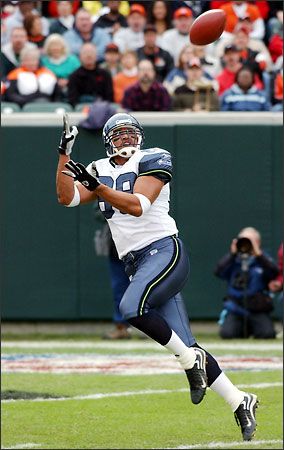
Tight End : Itula Mili


Mili was drafted in the seventh round by Seattle in 1997, and he was the 174th player chosen overall. He played just seven games that year, but did manage a 20 yard reception.

Over the next three years, he was primarily a reserve. He had 41 receptions and six touchdowns over that time. He became more of a starter in 2002, when he started 12 games and had 43 receptions for a career best 508 yards. He started 12 games again the next year, and had a career best 46 receptions and four touchdowns.

He went back to being a reserve in 2004, but did start four games and have 23 receptions. He was hurt the next year, and recorded no statistics for the only time in his career. After playing ten games in 2006, catching ten balls, he was released by Seattle.

Mili's 1,743 receiving yards and 13 touchdowns are the most by any tight end in Seattle history. His 164 receptions is just two behind Christian Fauria as the most ever by a Seahawk tight end. His 46 receptions in 2003 was a team record for tight ends until it was surpassed by John Carlson in the 2008 season by nine. His four touchdown receptions in 2003 equaled a team record for tight ends set by Mike Tice in 1991 until it was surpassed by Jerramy Stephens five in 2005.

The Seahawks have mostly used the tight end as just a blocker in their 33 years of play, but no one has yet to surpass the numbers that Itula Mili put up for them.

Charle Young, Jerramy Stevens, Mike Tice, and Christian Fauria deserve mention.


Tackle : Steve August


August was the Seahawks first round draft pick in 1977, and he was the 14th player chosen overall. He spent his rookie year on the bench, seeing action in just six games.

He was named the teams starting right tackle in 1978, an honor he would hold onto the rest of his Seahawks career. He was responsible for protecting left handed quarterback Jim Zorn's blind side until 1981, and for most of 1982 and 1983.

One of the highlights of his career occurred in 1981. He caught a tipped pass and rambled nine yards before being tackles. Another highlight for him was the 1983 season, where he missed one game. The Seahawks won their first ever playoff game that year and reached the AFC Championship before losing to eventual NFL Champion Los Angeles Raiders.

After starting the first six games of 1984 for Seattle, he joined the Pittsburgh Steelers. He started one of the five games he suited up for the team. He then retired from the game.

Offensive linemen often get overlooked by fans, but their contributions are the primary reason offenses are successful. Seattle had an offense led by star running back Curt Warner and Hall Of Fame wide receiver Steve Largent, but it was because of men like Steve August that they were successful.


Tackle : Ron Essink


Essink was drafted in the tenth round of the 1980 draft, the 265th player chosen overall. He had went to college at Grand Valley State, where he was the first player from the school to be drafted and to play in the NFL.

He spent his rookie year primarily as a reserve, but he did start three times. He also caught a three yard pass for a touchdown on a tackle eligible play.

He was named a starter at left tackle the next year, and he would start in every game he played until he retired. During his time with Seattle, he helped the team win their first three playoff games. He was also an integral part of their 1984 team that won 12 games, which was the most wins in team history until they won 13 in 2005.

He was responsible for protecting right handed quarterback Dave Kreig's blindside for parts of 1980 to 1983, and in Kreig's Pro Bowl year in 1984. Essink played 12 games in 1985, but then got hurt and missed the rest of the year. He then retired from the game.

Ron Essink may be the second best left tackle in Seahawks history behind future Hall Of Famer Walter Jones.

Howard Ballard deserves mention.


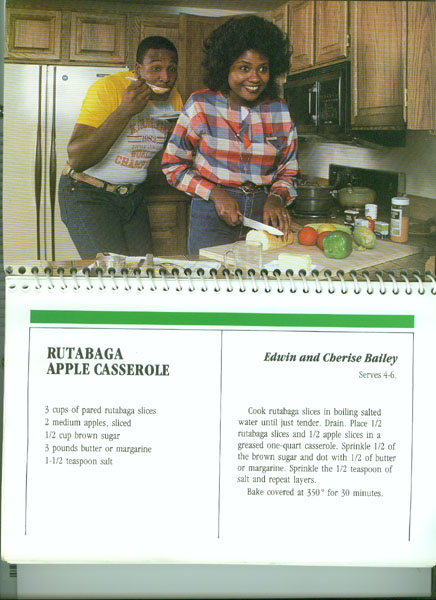
Guard : Edwin Bailey

Edwin and wife Cherise pose for a calender fundraiser

Bailey was a fifth round draft pick of the Seahawks in 1981, and he was the 114th player chosen overall. He earned a starting job right away with the team and held it until the 1983 season.

That year saw newly hired Seattle head coach Chuck Knox bring in Reggie McKenzie with him. McKenzie, a famed member of the Buffalo Bills "Electric Company", had played five years under Knox in Buffalo up until 1982.

McKenzie took over Bailey's left guard spot in 1983, but Edwin did start two games that year. Seattle ended up winning their first ever playoff games before losing in the AFC Championship to eventual NFL Champion Los Angeles Raiders.

Bailey played 12 games the next year, and started in eight. Seattle won 12 games that year, a franchise record until 2005, and won a playoff game before their season ended. McKenzie retired after that year, so Bailey was back in the starting lineup for good.

He started in every game that he played until he retired with Seattle. In 1986 he ran a ball for three yards. He ended up getting injured in 1990, and missed five games. After starting the first three games of 1991, he was injured again and missed the rest of the year. He then retired.

Edwin Bailey was a long time stalwart of the Seahawks for 11 seasons. He was a solid technician who helped lead running back Curt Warner have his best years. He is surely one of the best guards in the teams history.


Guard : Chris Gray


Gray was drafted by the Miami Dolphins in the fifth round of the 1993 draft by the Miami Dolphins. He was the 132nd player chosen overall.

He got on the field for just five games as a rookie, but started in two of the 16 games he played the next year. He earned the starting job at right guard, but missed 11 games over two years. He then joined the Chicago Bears in 1997 for eight games.

Seattle picked him up in 1998, and he started 34 games at center over the next three years. He was then moved to guard for the 2001 season, where he would stay until his retirement.

The Seahawks won a franchise record 13 games in 2005, and captured their only AFC title. Gray was a key member of an offensive line that paved the way to seeing running back Shaun Alexander won the MVP Award that season.

He suffered a back injury in 2007, and decided to retire just before the 2008 season started. He had started in every game but one for Seattle since the 2000 season.

Chris Gray was known for much more than his dependability. He was extremely versatile, and played every position on the offensive line in a Seahawks uniform. His streak of 121consecutive starts at guard/ center is a club record. He certainly is one of the best to have played in Seattle.

Bob Newton, Bryan Millard, and Pete Kendall all deserve mention.


Center : Robbie Tobeck


Tobeck joined the Atlanta Falcons in 1994 as an undrafted free agent rookie. He got on the field for five games that year.

Atlanta started him at guard the next year, a job he would hold the next three years. He did catch two passes in 1996, including one for a 14 yard touchdown. He was moved to center in 1998, where he stayed the rest of his career.

He joined the Seahawks in 2000, but got on the field for just four games. He was inserted into the starting lineup the next season, and remained there the rest of his career.

The best year of his career was in 2005, when he was named to the Pro Bowl. He is the only center in Seahawks history to have achieved this honor. Seattle won a club record 13 games that year, and reached their first Super Bowl game.

After starting the first eight games of the 2006 season, he was injured in the eight game and missed the rest of the year. He then retired as probably the best center in Seattle history.

Blair Bush
and John Yarno deserve mention.


Kicker : Norm Johnson


Johnson was signed as a free agent rookie in 1982 by the Seahawks. Though he had just 43 points in the strike shortened season that was nine games long, he did complete the only pass of his career for 27 yards.

After scoring 103 the next season, he had one of the best years of his career in 1984. He scored 110 points and was named First Team All-Pro. He is still the only placekicker in Seahawks history to be named to the Pro Bowl. He, along with cornerback Dave Brown and nose tackle Joe Nash, made the Pro Bowl that year, which was just the third time in team history any player was given this honor.. His two field goals against the Los Angeles Raiders in the AFC Wildcard Game was the difference in Seattle's 13-7 victory. It was the first playoff win in the franchises history.

The 1986 season was his first that he did not miss an extra point attempt, for he had missed once in each of the four years. He also made a career best five field goals of 50 yards or longer that year on seven attempts, which led the NFL. It is also the third most by any player in NFL history.

Though the 1987 season was know for being a strike year for NFL players, Johnson sat out just two games. He then scored 177 points over the next two years, including 105 points scored in 1988.

The 1990 season was his last in Seattle, and the year he would miss an extra point attempt in his career. He made 301 consecutive extra point attempts over the next nine years, which is the third best streak in NFL history. It was also the fifth season he scored over 100 points in his nine years with the team.

He joined the Atlanta Falcons as a free agent in 1991. He scored 95 points, and ounted for the first time in his career with a 27 yard attempt. He had his last career punt attemp the next year, which went 37 yards. He also scored 93 points.

The 1993 year was his best as a Falcon, and it was the last time he would go to the Pro Bowl in his career. Johnson led the NFL in field goal percentage after missing just once in 27 attempts.After a solid 1994 year, he left the Falcons for the Pittsburgh Steelers.

The timing of the signing could not have worked out better for Pittsburgh. Johnson led the NFL with 34 field goals on 41 attempts, both of which are career best totals. He also had a career high 141 points that season, which was second behind Dallas Cowboys Hall Of Famer Emmitt Smith's 150 points. His 141 points is ranked 27th as the most points scored in a season in NFL history.

Pittsburgh would go to play in Super Bowl XXX that year, as Johnson made seven field goals in the post-season. The Steelers would lose to the Dallas Cowboys 27-17 in the game.

Johnson missed just eleven field goal attempts over the next three years, making 71 of them. Pittsburgh decided to release Johnson after 1998, when they drafted Kris Brown. The Philadelphia Eagles then signed Johnson to a contract for the 1999 season.

He was the placekicking specialist that year, while second year pro David Akers was used as a kickoff specialist. Johnson played in 15 games that year, scoring 79 points, before relinquishing his duties to Akers. He then retired.

The 810 points that Norm Johnson scored with the Seahawks is the most in franchise history. Five of his seasons are amongst the top 18 greatest scoring years in Seattle history, and his 1984 season is still ninth best.

Johnson attempted 477 field goals in his career, which is the 12th most ever in NFL history. His 366 made field goals in the tenth most ever. His 638 extra point conversions are the sixth most ever, as is his 644 extra point attempts. He ranks 21st all-time in extra point percentage, and 48th all-time in field goal percentage. It is easy to see why he was dubbed "Mr. Automatic" by Seahawks fans.

His 1,736 points is still the eight most in NFL history, though John Kasay has a chance to pass his this year. Norm Johnson spent half of his 18 year career as a Seahawk, and is the best placekicker they ever had.

Todd Peterson
and Josh Brown deserve mention.


Punt Returner : Joey Galloway


Galloway was the Seahawks first round draft pick in 1995, the eigth player chosen overall that year. They put him to work immediately that year. He caught 67 passes for 1,039 yards and seven touchdowns. He ran the ball 11 times for a career high 154 yards, including a career long 86 yard touchdown run. It was the longest of the 1995 NFL season. He also returned a career high 36 punt returns, including a career long 89 yard touchdown return. It also led the NFL that year.

He carried the ball a career high 15 times the next year, as well as catching 57 balls for seven touchdowns. Galloway also scored on a punt return of 88 yards on just 15 returns. . He did not return punts in 1997, but he found time to catch 72 passes for 1,049 yards and a career high 12 touchdowns.

He had 25 punt returns in 1998, and took two in for touchdowns. This led the league. He also caught 65 balls for 1,047 yards and ten scores. Galloway asked Seattle for a raise, but was refused. He decided to sit out the first eight games of 1999. When he joined the team, he started in just four of the remaining eight games.

Still unhappy with his contract, Galloway was traded to the Dallas Cowboys before the 2000 season for two first round draft picks. In his first game with Dallas, he blew his knee out in the fourth quarter after catching four passes and scoring once. He sat out the rest of the season.

Galloway returned to Dallas in 2001 and stayed with them until 2003. He led the NFL with a 19.8 yards per catch average in that 2003 season. Dallas then traded him to the Tampa Bay Buccaneers for a disgruntled Keyshawn Johnson. The Buccaneers got the better end of the deal, because Galloway's career was revitalized by the trade.

Though he missed six games that year because of an injury, he did catch five touchdown passes and return the last punt for a touchdown in his career. He followed that up with a career best 83 receptions for 1,287 yards. He also scored ten times.After catching 119 passes for 13 touchdowns over the next two years, Galloway spent 2008 most injured. It was the first season in his career he failed to reach the end zone.

Tampa Bay released him after the season, and he was signed by the New England Patriots for the 2009 season. He played in two games and caught seven balls before the Patriots released him. Though he has yet to announce his retirement, it is unlikely the 39 year old Galloway will play again.

Of the 675 career passes he caught, 283 of them came with Seattle. It is the seventh most in team history. His 37 touchdown receptions are the third most in Seahawks history. His four touchdowns off of punt returns is the most in franchise history, and his two punt return touchdowns in 1998 is a team record. His 823 punt return yards with Seattle still ranks fifth best in team history.

Though Joey Galloway wore a Seattle jersey for just five years, there was perhaps no player more exciting than him over that time for the team.

Paul Johns, Nate Burleson, Bobby Engram, Charlie Rogers
, and Bobby Joe Edmonds all deserve mention. Edmonds is the only All-Pro return specialist in Seahawks history.

Friday, November 27, 2009

NFL Seperation Week


Tampa Bay Buccaneers @ Atlanta Falcons

The Bucs are an ugly football team right now, and are led by a coach who appears clueless and out of his league. Atlanta is desperately trying to get into the playoffs since their division appears to have been won by New Orleans. The return of star running back Michael Turner for Atlanta gives the team the balance it seeks on the offensive attack.

Falcons 31 Buccaneers 17


Carolina Panthers @ New York Jets

Both teams have just four wins and are seemingly finishing this season for pride and job security right now. Neither team has played as well as they had hoped, so it will be interesting to see if they have given up hope or are angry.

Panthers 27 Jets 24


Seattle Seahawks @ Saint Louis Rams

These are two teams that should play their youngsters and see what positions need help for 2010, because this season is over as far as playoff hopes are concerned. If you watch this game, you may be watching a few players finishing up their careers for the next six weeks. Some of them will be watching with you, because they are on injured reserve.

Seahawks 24 Rams 10


Miami Dolphins @ Buffalo Bills

The Dolphins are clinging to their slight playoff hopes right now, and will be facing a Bills team that is hurting all over. Buffalo will possibly be missing a starters on defense, and appear to not like any of the quarterbacks on their roster to lead the offense. Expect Miami to try to grind them into submission.

Dolphins 26 Bills 16


Washington Redskins @ Philadelphia Eagles

The Redskins wish their season was over about a month ago. The team has been victimized by bad coaching, a bad front office, and a plethora of injuries. The ones that are healthy enough to suit up are playing for their careers now. Philadelphia has been immensely inconsistent all season, and have also been hit hard by the injury bug. Still, the Eagles are very much in the playoff hunt and really need this win a lot more than Washington does.

Eagles 23 Redskins 17


Cleveland Browns @ Cincinnati Bengals

Fans of the Browns got very excited last week to see their team score one point less in one game than they had in seven other games total this year. There are three reality checks to damper that happiness. One is that the Browns lost the game anyways. Another is that they won the only game of their season in one of those seven weeks. The final reality check is that they scored those 37 points against the Detroit Lions. Cincinnati is not Detroit in geography nor on the gridiron. The Bengals are also mad they lost a winnable game to the unpredictable Raiders last week. Expect them to vent their anger on their inter-state rivals.

Bengals 37 Browns 6


Indianapolis Colts @ Houston Texans

Houston is on the verge of oblivion right now for the 2009 season. They have dropped to third place in their division, and see the resurgent Tennessee Titans charging hard behind them. Pile on the loss to the former Houston Oilers, now the Titans, at home on national television last Monday, and you see a season the Texans were not hoping for. This game is their season most likely, and facing the undefeated Colts is a daunting task with everything on the line.

Texans 34 Colts 30


Kansas City Chiefs @ San Diego Chargers


The Chiefs are playing spoiler right now, ask the Steelers, because there is nothing left for them to play for other than pride and job security. They do present a problem for the suddenly hot Chargers. San Diego is aware what their divisional rivals did last week, and should be prepared.

Chargers 31 Chiefs 20


Jacksonville Jaguars @ San Francisco 49ers

Do not look now, but the Jaguars are in second place in their division and very much in the playoff hunt. Jack Del Rio has done a great job keeping his team competitive as he rebuilds the roster. Watching the youngsters step up has inspired Jacksonville two games above .500.The 49ers still have a glimmer of hope to win the very weak NFC West, but it is faint. This game will be run heavy, so the battle in the trenches is key.

Jaguars 28 49ers 27


Chicago Bears @ Minnesota Vikings

Chicago traded away a lot to get Jay Cutler to quarterback the team. It has not worked out well for them this season, and now all they have left to play for is pride. It may not be enough to defeat a Vikings team that is rolling in every aspect of the game every week thus far.

Vikings 38 Bears 27


Arizona Cardinals @ Tennessee Titans

The Cardinals are riding a three game winning streak, and have taken a commanding three game lead in their division. However, their leader Kurt Warner is battling symptoms of a mild concussion and is questionable this week. It may be smart to sit him this week against a rejuvenated and hungry Tennessee Titans, and go with flop Matt Leinhart at quarterback instead. I doubt Warner will sit, so this has the makings of an exciting game. Chris Johnson cannot be stopped, and is a leading candidate on many peoples MVP ballots. The insertion of Vince Young at quarterback was a brilliant demand by owner Bud Adams that has made him look like Nostradamus almost.

Titans 34 Cardinals 30


Pittsburgh Steelers @ Baltimore Ravens

A few weeks ago, this game had a look like it could have a great impact on who sat on top of the AFC North. How can time change things drastically? Well, the Ravens are at .500 and might be a loss away from losing any chance of making the playoffs. Pittsburgh, the defending champions, are just one game better than Baltimore. Instead of fighting for the division, these teams are fighting to stay alive for the 2009 season. Bruises will be plentiful for each team, because they do not like each other. Baltimore is looking to settle a score with Steelers team that ended their season last year.

Ravens 30 Steelers 28


New England Patriots @ New Orleans Saints

Game Of The Week

This will be an interesting battle, and finally Monday Night Football can claim to have a game worth watching for all football fans this season. New Orleans put their undefeated season up against a Patriots team that still struggles in short yardage situations. New England should take advantage of a depleted Saints defense that recently rehired the washed up Mike McKenzie to bolster their beat up secondary. Randy Moss should have a few big play opportunities available.

Patriots 37 Saints 27


Last week, including Thanksgiving, I went 14 - 4. I am now 101 - 45 overall.


NFL Lucubrations


This might be one of the most mediocre seasons the NFL has had in recent memory. After ten games, there are 14 teams over the .500 mark. Of those teams, four of them have a winning percentage of .600 or less. Most teams have been struggling to stay healthy on the eve of the league thinking of shortening training camps and extending the seasons.

What has been the most obvious flaw in the game the NFL pushes out today is poor fundamentals. Even after the league has revamped their rule books to cater to a group of mostly average quarterbacks and players who rely on kill shots over proper tackling technique, you are left still seeing sloppy football games each week.

Offensive linemen, who hold every play, are now less important to protecting the quarterback than the NFL. The hit zone on the quarterback has now shrunk to the coffee can strike zone of baseball so that points can be put up on the board with much more ease. Even special teams has been effected by changes from a group of men largely consisting of guys who haven't put on pads since school yard days.

Though it is understandable the NFL is trying to progress with society, the failure to hold onto old school principles has helped the game suffer to the point it now resembles basketball with a helmet. To show further example, many players go out on Sunday without hip or thigh padding, because they rather protect up high where most end up head hunting.

The NFL probably doesn't see this, much like they did not see their game stagnating in the 1960's. This allowed the fourth version of the American Football League to gain a following and then later force a complete alignment between the two leagues. Other previous leagues that competed against the NFL had forced the NFL to immerge some of those defunct leagues into theirs, but not all like the AFL did.

Now the United Football League has just completed their first season with an overtime championship game. The difference between the UFL and other leagues that competed against the NFL in the past is that the UFL is being almost marketed as a minor leagues for the NFL by some. The UFL refers to itself as a complimentary addition, though they have several rules different. Their overtime rule is like the college rule, where both teams get a chance to play offense.

The UFL might now have a chance to survive with the NFL shortening training camps. There will be even more excellent football players available after the NFL makes cuts faster, many will happen because of the lack of opportunity many will get with less time in camp or exhibition games. Then there is the chance the NFL players could strike after 2011, much like they did in 1982 and 1987. The NFLPA is advising cut players from going to the UFL, which echoes the same message the league gave to players when they jumped to the AFL in 1960.

If the UFL plays this smart, much like the AFL did in the 1960's, they could offer much needed competition to the perceived fat and lazy NFL. Perhaps the UFL can go a step further and enable the defenses to play less inhibited, unlike the castrated version of defense in the NFL. If the 2009 season keeps wafting along in a uninspiring waddle for the NFL, fans will begin to look more into the other option. Much like they did for the AFL only 40 years ago. The timing of the AFL anniversary and the UFL inception is no coincidence.

Perhaps some of you readers will find this installment of Lucubration tinged with unrealistic hope for more well played football, and perhaps even a few will nod in agreement on some avenues that were attempted to be taken. The ones that are skeptical need only look at the 12 teams in the NFL that were born in other leagues. The AFC itself houses only six teams that have just played in their league alone, though the Bengals franchise is still considered an AFL franchise on paper.

Some say more is better, and this can apply to professional football too. The UFL should continuing applying wrinkles to their game to attract fans. One suggested wrinkle is to apply some old school playing that thr NFL once lived and breathed on. It can work, much like how the AFL once showed the NFL that lots of scoring can bring in fans. It did.


NFL Power Rankings


1. New Orleans Saints

2. Indianapolis Colts

3. Minnesota Vikings

4. New England Patriots

5. Cincinnati Bengals

6. Pittsburgh Steelers

7. San Diego Chargers

8. Dallas Cowboys

9. Atlanta Falcons

10. Denver Broncos

11. Philadelphia Eagles

12. Baltimore Ravens

13. Green Bay Packers

14. Arizona Cardinals

15. Jacksonville Jaguars

16. New York Giants

17. Miami Dolphins

18. Houston Texans

19. Tennessee Titans

20. San Francisco 49ers

21. New York Jets

22. Seattle Seahawks

23. Carolina Panthers

24. Chicago Bears

25. Oakland Raiders

26. Kansas City Chiefs

27. Buffalo Bills

28. Detroit Lions

29. Washington Redskins

30. Tampa Bay Buccaneers

31. Saint Louis Rams

32. Cleveland Browns