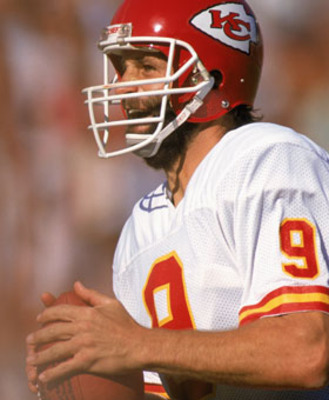
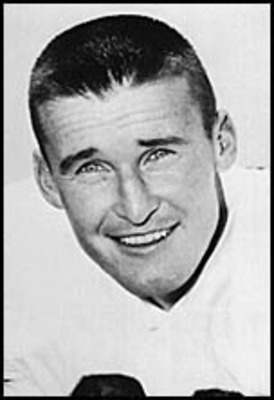
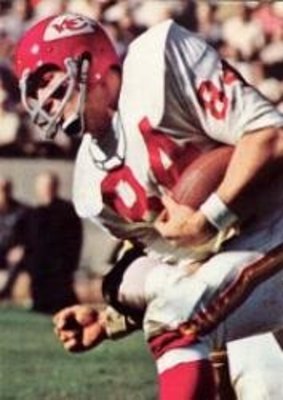
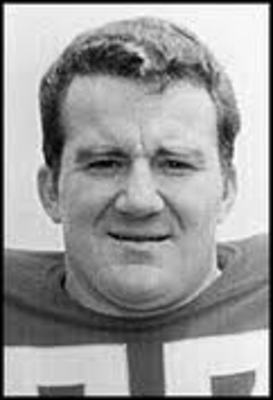
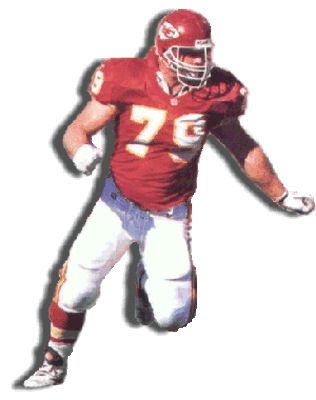
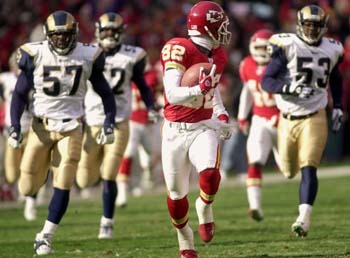
Quarterback : Bill Kenney
Kenney was drafted by the Miami Dolphins in the 12th round of the 1978 draft. He was the 333rd player chosen overall, the second from last pick that year.
He actually ended up being Mr. Irrelevant for that draft, because the last pick of the draft never signed with the team due to injury. The Dolphins cut him in training camp, so Kenney tried out for the Washington Redskins the next year and was cut again.
In 1980, he made the Kansas City Chiefs roster as a backup. Kenney ended up starting three games that year due to an injury to the Chiefs starter Steve Fuller. He won two games and tossed five touchdowns.
Kenney started 13 games next year, tossing nine touchdowns and 16 interceptions, and won eight games. In the strike-shortened season of 1982, he tossed seven scores in the seven games he played.
Kansas City then used their first round draft pick of 1983 on Todd Blackledge, another quarterback. Kenney responded by having the best season of his entire career and set career best marks in most areas.
His 603 attempts for 346 completions led the NFL. He also threw for 4,348 yards and 24 touchdowns, as well as rushing for three more scores.
He was named to the Pro Bowl, and is the only Mr. Irrelevant to have done so.
He was on his way to matching those totals the next year, but got injured and missed half of the season. He threw for 2,098 yards on 151 completions and 15 touchdowns. The 1985 season saw Kenney start in ten games and toss 2,536 yards and 17 touchdowns.
He started 16 games over the next two years, getting 28 touchdown passes on 4,029 yards. After starting in five games in 1988 and not throwing a touchdown, the Chiefs waived Kenney.
He joined the Washington Redskins as a third-stringer in 1989, but never saw action. He then retired from the NFL.
Bill Kenney held the Chiefs record for most passing yards in a season for 11 years and still ranks behind Hall Of Famer Len Dawson and former Pro Bowler Trent Green in most categories in Kansas City Chiefs history.
He is certainly one to never forget.
Trent Green, Elvis Grbac, Cotton Davidson, Mike Livingston, and
Steve Bono deserves mention.
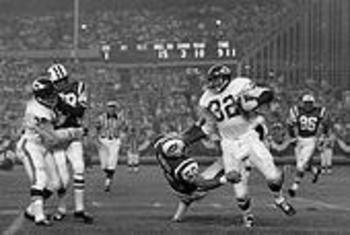
Fullback : Curtis McClinton 
McClinton was drafted in the 10th round of the 1960 NFL Draft by the Los Angeles Rams. He had two years of college eligibility left, so he returned to school and was later a 14th-round pick of the 1961 AFL Draft by the Dallas Texans.
He signed with the Texans at the end of the 1961 season. He became a huge part of the 1962 team, being named AFL Rookie of the Year and to the Pro Bowl after forming a dynamic backfield with halfback Abner Haynes.
McClinton would then be named MVP of the 1962 AFL All-Star game.
Haynes, who also was a Pro Bowler and the first AFL Rookie of the Year ever, would often follow the great blocking of McClinton to pick up big chunks of yards.
The Texans won the AFL title that season, their last in Dallas. McClinton had a game-leading 24 carries, as the Dallas ground game lead the Texans to victory.
The team would relocate to Kansas City after the game. The 1965 season may have been the best of McClinton's career. He led the AFL with six rushing touchdowns, caught a career best 37 passes for three more scores, and led the team with a career best 661 rushing yards.
The Chiefs won the AFL title again in 1966, and McClinton was named to the Pro Bowl after leading all Kansas City running backs in receiving and grabbing a career best five touchdowns.
The Chiefs faced the NFL's Green Bay Packers in now what is referred to as Super Bowl I. McClinton became the first AFL player to ever score in a Super Bowl by catching a seven-yard pass to tie the game early in the second quarter.
After making the Pro Bowl in 1967, he got hurt and was replaced by rookie Robert Holmes in 1968. Kansas City used him as a reserve fullback and tight end the next year, taking advantage of his excellent blocking abilities.
He spent the entire 1969 season blocking, never touching the ball all season. The Chiefs would go on the win Super Bowl III and McClinton retired after the game.
When he retired, he was second on the Chiefs all-time rushing list. He still ranks eighth best. No Chiefs fullback has been to the Pro Bowl as much as McClinton.
Not only is Curtis McClinton a member of the Chiefs Hall of Fame, but he is easily the greatest fullback in franchise history.
For those clamoring for the legendary Christian "The Nigerian Nightmare" Okoye at this slot, he did play fullback often. However, his greatest moments happened in one-back sets, making him also eligible as a halfback on this team.
Robert Holmes, Christian Okoye, Mack Lee Hill, and
Tony Richardson deserves mention.
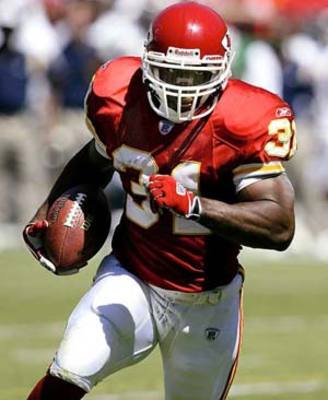
Halfback : Priest Holmes 
Holmes went undrafted in 1997, so he signed with the Baltimore Ravens. He did not play much as a rookie, returning just one kickoff for 14 yards.
Things changed the next year immensely after the Ravens got rid of their 1996 backfield. Holmes became the primary back and ran for 1,008 yards.
Not only is he the first 1,000-yard back in Ravens history, but his 227 yards on 38 carries in the 11th week against the Cincinnati Bengals was a team record until Jamal Lewis set an then-NFL record with 295 yards in 2003.
Holmes spent 1999 banged up and Errict Rhett got most of the carries. Holmes still piled up 557 yards on just 89 carries, an outstanding 5.7 yards per carry average.
Baltimore drafted Lewis in 2000 and named him the starter. He responded with 1,364 yards, which helped the Ravens win Super Bowl XXXV. Holmes was still an important part of the offense, despite the fact Lewis touched the ball primarily.
Holmes ran for 588 yards and caught 32 passes, yet the Ravens rarely used him as they went from a Wild Card team to champions.
Now a free agent and disillusioned with his role, Holmes signed a contract with the Chiefs that was a relatively paltry sum. The move turned out to be a revelation for both Kansas City and Holmes.
He led the NFL with 1,555 yards on a career high 327 carries. He also caught 62 balls, and his 2,169 yards from scrimmage led the league.
While Holmes was named First Team All-Pro and to the Pro Bowl in 2001, he would duplicate those honors in each of the next two seasons as well.
The 2002 season may have been the best of Holmes career, despite the fact he missed the final two games because of injury. He was named the NFL Offensive Player of the Year.
He ran for a career best 1,615 yards, averaged a career best 115.4 yards rushing per game, caught 70 passes, and led the NFL with 21 rushing touchdowns and 2,287 yards from scrimmage.
Holmes followed that up with an NFL record 27 rushing touchdowns in 2003, as well as catching a career best 74 balls.
While his record of 27 rushing touchdowns was broken in 2005, Holmes is tied with Emmitt Smith for the record as the only players in NFL history in consecutive season to have 20 or more rushing scores.
Holmes was having perhaps the best season of his career in 2004. In eight games, he had piled up 892 yards, ran for 14 touchdowns, and led the league with an average of 111.5 yards rushing per game. He was given the Ed Block Courage Award for his heroics both on and off the gridiron.
He was hurt during the eighth game against the Tampa Bay Buccaneers and was lost for the season. Holmes came back the next year, but suffered an injury to his spine in the seventh game and was out for the season.
After sitting out of the entire 2006 season, Holmes tried to play in 2007. He appeared in four games, starting two. Averaging a career low three yards a carry and failing to reach the end zone for the first time since his rookie season, he retired.
No other Chief has run for more yards or touchdowns than Holmes. His 86 career rushing scores n the 14th most in NFL history.
While Kimber Anders ties Holmes with the most Pro Bowls by a halfback in Chiefs history, Holmes is the only one with three First Team All-Pro nods.
Despite carrying the ball just three years for the Ravens, he still ranks fourth in franchise history for career rushing yards.
The Chiefs have had a bevy of great running backs in their history, so there really is no wrong selection here. I chose Holmes for his historic four seasons for the Chiefs, something we may never see duplicated again.
Abner Haynes, Mike Garrett, Ed Podolak, Barry Word, Kimble Anders, Larry Johnson, Joe Delaney, Tony Reed, and
Christian Okoye deserves mention.
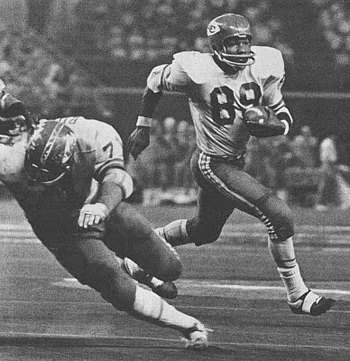
Wide Receiver : Otis Taylor 
Taylor was drafted in the fourth round of the 1965 AFL Draft by the Chiefs and the 15th round of the NFL Draft by the Philadelphia Eagles.
In those days, the NFL would "babysit" drafted players in hopes of keeping them from AFL scouts. However, Taylor crawled out of his hotel window to talk to legendary Chiefs scout Lloyd "Judge" Wells.
Wells ended up signing such great players like Hall of Famers Buck Buchanon, Willie Lanier, and Emmitt Thomas, along with many other great players.
The NFL was behind the times in those days when it came to small predominantly black colleges, something the AFL never was, despite having had several legendary players excel on their fields from those schools in the past.
Philadelphia not only lost Taylor to the AFL, they later cut sixth-round pick Garry "Ghost" Garrison and watched him become a Pro Bowl receiver for the San Diego Chargers. Rick Redman, a tenth-round selection, became a Pro Bowl linebacker for the Chargers.
Now a Chief, Taylor paired up with Pro Bowlers Chris Burford and Frank Jackson to give Hall of Fame quarterback Len Dawson an exciting trio of receivers.
While he was a reserve his rookie season, he still grabbed 26 passes, was second on the team in touchdown catches, and impressed everyone with his excellent and aggressive blocking.
Kansas City made him a starter in 1966, so Taylor tied Burford for the team lead of 58 receptions and eight catching scores. He also gained 1,297 yards, a whopping 22.4 yards per catch average that led the AFL, and was named a Pro Bowler and honored as a First Team All-Pro.
In the AFL title game that year, the Buffalo Bills did a good job on the Chiefs ground game. So Taylor and Burford became the primary weapons. Taylor caught five balls for 78 yards and a score as the Chiefs prevailed.
The victory propelled them into a Super Bowl I match up with the NFL's Green Bay Packers. Taylor caught four balls for 57 yards, but the Chiefs stopped the Chiefs running game cold and ended up winning 35-10.
He caught a career best 59 balls in 1967, leading the AFL with a career best 11 touchdown catches, but was somehow left off the Pro Bowl squad. He next two years were injury filled, causing him to miss three contests each year.
Yet he got healthy in time for the Chiefs playoff run in 1969. He caught just two passes in Kansas City's divisional playoff victory over the New York Jets, but they went for 74 yards and helped set up scoring opportunities.
Dawson completed just seven passes against the Oakland Raiders in the championship game, but Taylor grabbed three for 62 yards and helped set up key scored in the Chiefs 17-7 win.
In Super Bowl V against the Minnesota Vikings, he grabbed six balls for 81 yards. His 46-yard touchdown catch in the fourth quarter is an NFL Films staple, and it helped the Chiefs seal the franchises only Super Bowl victory.
Taylor went to the Pro Bowl again in 1971 after catching 57 passes for a league leading 1,110 yards. He also led the NFL with an average of 79.3 yards caught per game. He was also honored with his last First Team All-Pro nod.
The 1973 season was his last as a Pro Bowler, where he again caught 57 balls. Dawson began to lose starts to Mike Livingston, and running back Ed Podolak became Livingston's primary pass target.
After missing four games in 1974, he suited up for one game the next year and then retired.
No other Chief had more receptions or touchdown catches when he left the game. Though tight end Tony Gonzales has passed him in receptions and touchdowns caught, Taylor still ranks second and heads the list of all Chiefs wide receivers.
His three Pro Bowls and two First Team All-Pro honors also heads the list amongst all Chiefs receivers.
Ex-Chiefs owner Lamar Hunt often said Taylor deserved induction into the Pro Football Hall of Fame.
Not only was Taylor a great blocker with a fiery disposition, he was incredibly acrobatic and had enough speed to stretch the seam of the defense.
His career average of 17.8 yards on 410 receptions shows this. He was an extremely reliable receiver who the running backs depended on as much as his quarterback.
But Taylor was more than just a receiver and blocker. A wonderful athlete, the Chiefs had him carry the ball 30 times for 161 yards and three scores with them over the years.
Many Chiefs fans and observers will agree that Otis Taylor is the best wide receiver in team history.
Wide Receiver : Chris Burford 
Burford was a ninth-round draft pick of the Cleveland Browns in the 1960 NFL Draft. He decided to sign with the Dallas Texans in the American Football League.
While having a sturdy build of 6'3" 220, Burford was far from a speedster. He was an incredible possession receiver who ran precision routes.
He caught 46 passes as a rookie while averaging a career best 17.2 yards per reception. Burford made his only Pro Bowl the next year after leading the team with 51 catches and gain a career high 850 yards.
Business began to pick up in 1962 when the Texans signed future Hall of Fame quarterback Len Dawson. He and Burford showed that they obviously spent several extra hours working on precision and timing.
The Texans won the AFL title in 1962 and Burford was named First Team All-Pro after leading the AFL with a career best 12 touchdown catches.
His 1963 season was his best, catching a career high 68 passes for 824 yards and nine touchdowns.
While having previously teamed up with Pro Bowler Frank Jackson at receiver, Burford was then teamed with Otis Taylor in 1965. While Burford led the team in receptions that season, despite missing three games, he and Taylor shared the title of most receptions in 1966.
The Chiefs won the AFL championship that year, propelling them to face the NFL's Green Bay Packers in Super Bowl I. While the Chiefs lost 35-10, Burford did leads the team with four catches for 67 yards.
He played one more season, catching a career low 25 balls, then retired.
His 391 career receptions was a team record until Taylor passed him with 19 more in 1974. Yet he still ranks fourth best to this day, and his 55 receiving touchdowns ranks third best.
Not only was Chris Burford the very first Pro Bowl and First Team All-Pro receiver in franchise history, his excellent route running and receptions along the sideline are still legendary.
He is a member of the Chiefs Hall of Fame. Some say that the Dawson to Burford connection along the sidelines ranks right with the immortal Johnny Unitas to Raymond Berry connection.
Carlos Carson, Andre Rison, Frank Jackson, Stephone Paige, Henry Marshall, Eddie Kennison, and
J.T. Smith deserves mention.
Tight End : Fred Arbanas 
Before Tony Gonzales came to Kansas City to begin a career that will probably end up in Canton, many Chiefs backers had long been asking the Pro Football Hall of Fame to induct Arbanas.
He was drafted by the Dallas Texans in the seventh round of the 1961 AFL Draft. The Saint Louis Cardinals drafted him in the second round of the NFL Draft, but didn't offer as much money as the Texans did.
Arbanas quickly exploded onto the AFL scene and was the top tight end of the league immediately.
He was named to the Pro Bowl in five of his first six seasons as a player. He was also named First Team All-Pro three times.
He was an outstanding blocker and a big threat in the passing game. While most tight ends in his era were possession receivers, Arbanas could get deep and stretch the seam of the defense.
Not only did this free up receivers from being double-teamed, it opened up the excellent Kansas City ground attack even more.
His finest season may have been in 1964, where he matched his career high mark of 34 receptions. He also had a career best eight touchdowns and 20.2 yards per catch average.
He did not play the Pro Bowl that year because an injury late in the season caused blindness to his left eye for a lengthy period of time.
Besides being a great player, most people associated with the Chiefs in his era speak of what a great teammate and leader Arbanas was.
He was admired for his indomitable drive and will to win. Arbanas also had the propensity to come up huge in the Chiefs biggest games. His 29-yard touchdown catch in the 1966 AFL title game got the Chiefs on the board early in their 31-7 victory.
Injuries began to take their toll in 1968, which led to a decline in production as a receiver. Yet his blocking and leadership was as valuable as ever.
In his last three seasons, before retiring after the 1970 season, Arbanas caught 35 passes. His final year saw him miss the only eight games of his career.
Arbanas retired with a Super Bowl ring and three AFL Championship rings. His 198 catches for 3,101 yards and 34 touchdowns were all Chiefs records for a tight ends then, as were his five Pro Bowls and three First Team All-Pro nods.
While Gonzales has passed him in most categories, he still ranks second in those surpassed. Yet his career average of 15.7 yards per catch is easily better than the 11.9 Gonzales averaged.
What makes it much more impressive is the fact Arbanas dealt with a ten-yard chuck rule his whole career, while Gonzales just dealt with the five-yard rule put in place in 1978. His 34 touchdown receptions also rank the fifth best in Chiefs history.
Not only is Arbanas a member of the Chiefs Hall of Fame, but he was named the starting tight end on the AFL All-Time Team that was selected by the Pro Football Hall of Fame voters.
Fred Arbanas is the greatest tight end in AFL history, yet his numbers also measure up to Hall of Famers John Mackey and Mike Ditka. Those two are considered by many as the best NFL tight ends in the 1960's.
While Gonzales may now be called the best tight end in Chiefs history, Arbanas, a much better blocker, is not far behind.
Walter White and
Jonathan Hayes deserve mention.
Tackle : Jim Tyrer 
Tyrer was drafted in the third round of the 1961 American Football League draft by the Dallas Texans, the first draft the AFL ever held. He was the 22nd player chosen overall. He was also drafted in the 14th round of the NFL draft by the Chicago Bears.
Tyrer was named the starting left tackle immediately by the Texans, now in their second year of existence under the leadership of future Hall of Fame head coach Hank Stram. The Texans would go on to win the AFL Championship in 1962, as Tyrer was named to his first of nine straight Pro Bowl honors.
Hall of Fame owner Lamar Hunt, a founder of the AFL, was unhappy with attendance despite winning the title. Though he wanted to keep the team in Dallas, he decided to move the team to Kansas City and rename them the Chiefs because he was tired of sharing the same stadium, the Cotton Bowl, with the Dallas Cowboys of the NFL and suffering from low attendance figures.
Tyrer was unaffected by the transition, as he received the first of six straight First-Team All-Pro nods in 1965, establishing him as the top left tackle in all of professional football.
The Chiefs would win the 1966 AFL title, but it was also the first season the AFL and NFL decided to hold a championship game between the two leagues. Kansas City faced the Green Bay Packers of the NFL but lost the game 35-10.
In 1967, Hunt was watching his children play with a toy called a Super Ball. He then had the idea of calling the AFL and NFL title game the Super Bowl. The Chiefs would reach this game in 1969, the last one player between AFL and NFL teams before the two leagues merged.
It was also the season where Tyrer was named the AFL Offensive Lineman of the Year. Kansas City would win Super Bowl IV, dismantling the Minnesota Vikings 23-7. It has, so far, been the last Super Bowl in which the Chiefs have appeared in.
Tyrer missed two games in 1973 for the first time in his career. His string of 180 straight games played is the third-longest streak in club history, and he started in each one of them. Kansas City thought the 34-year old was nearing the end of his career because he had finished his second season where he failed to make the Pro Bowl. They traded him to the Washington Redskins.
He played in every game for the Redskins in 1974, though he mainly served as a back up to Ray Schoenke. He did, however, start in one game. Washington won their division, but were bounced from the playoffs in the first round by the Los Angeles Rams. Tyrer decided to retire at the end of the year.
Despite being the best left tackle in AFL history, he has yet to be inducted into the Pro Football Hall of Fame. Though he was a finalist once in 1981, no player in the history of professional football has more accolades than Tyrer and has failed to be inducted.
One reason may be because of the reason he died in 1980. Suffering from depression, Tyrer committed suicide after killing his wife. Though depression was not much of a subject to speak about in that era, it is as though the Hall of Fame voters have kept him out of Canton due to perhaps their lack of knowledge of this subject.
In recent years, professional football has almost begrudgingly acknowledged depression and the fact that it can occur after severe head trauma over a long period of time. "Post Concussion Syndrome" is the commonly used term and these effects have been brought to light by gridiron legends who have suffered from it following their football careers.
Hall of Famers like John Mackey and Mike Webster are two who have suffered from this type of trauma. A game thought to be so violent that NFL Commissioner Roger Goodell was seen on television contemplating banning the three-point stance from the game in an attempt to reduce head injuries.
Tyrer played in an era where offensive linemen were instructed to use their heads as weapons. They were told to bury their heads into the chests of defenders first.
This was also an era where offensive linemen were not allowed to use their hands like they do in the current game. They had to put their arms in the shape of a chicken wing, as they relied on quick feet and strong shoulders to take control of their opponents.
Opposing defensive ends were allowed to use their fists back then, and the head slap move was perhaps the most used method to beat blockers. While unable to defend themselves, offensive linemen lead with their heads as they had been taught.
Defenders would attempt to counteract this by dodging blockers, then slapping them upside their heads to get the blocker off balance. In doing so, they were given a clearer path to those who possessed the football.
Though Tyer regularly faced the opposing teams' best pass rushers, he was unflappable and consistent. Men like Hall of Famer Elvin Bethea, Rich "Tombstone" Jackson, Larry Eisenhauer, and Ben Davidson were just a few of the stellar defensive ends he faced each week for several seasons.
Davidson is the man who Tyrer admitted was the toughest opponent he faced. The respect was mutual. Davidson called Tyrer a "mountain of a man," though Davidson stood 6'8" and weighed 275 lbs., himself.
"He was easily the best blocker I ever faced," Davidson recalls. "He had power and finesse. He could have made an excellent guard, too. We were friends off the field, as Tyrer was all about good sportsmanship. "We used to go to the AFL All-Star games together on a bus. We would joke if either he or my teammate, Hall of Famer Jim Otto, had the biggest head in football. I often would say at banquets that Tyrer basically wore a big red trash can as a helmet when he played."
Davidson believes that Tyrer has long deserved his induction into Canton, as does Bethea. Bethea was inducted himself in 2003.
"Tyrer was the pioneer of big offensive tackles. He was the best blocker I ever faced" Bethea said. "I used to try to run as fast as I could upfield to get around him, but it rarely worked. It pissed me off that I couldn't defeat him, as I could with other left tackles regularly."
Bethea also admits he feared facing Tyrer. "He was THE preeminent left tackle in all of football. All other blockers I faced in the NFL were mediocre compared to him. He would just swamp me each game to where I would be lucky to beat him even once in a game," he said.
Paul Zimmerman, a Hall of Fame voter and writer for Sports Illustrated, has often said Rich "Tombstone" Jackson was the greatest pass rusher in pro football history and has long lobbied for his induction into Canton. Jackson, though he would like to be inducted himself, also has a tremendous amount of respect for Tyrer.
"It is a travesty that Jim Tyrer has yet to be inducted into Canton," he said. "He was one of the first big offensive linemen with quick feet to play pro football. Besides having good feet, he was crafty and smart. "You had to be prepared facing him, as the Chiefs won-loss record was proof of how excellent their players were. Tyrer was the top offensive lineman I ever faced, and that included the AFL and NFL."
Larry Eisenhauer, whose four Pro Bowls are tied with Bob Dee and Richard Seymour as the most in Patriots franchise history, also echoes Davidson, Bethea, and Jackson in thinking that Tyrer should have been inducted into the Pro Football Hall of Fame long ago.
"He was the best I ever faced," Eisenhauer recalls. "He was equally excellent run blocking and pass blocking. He was a very strong man, and I never looked forward to facing him. I really cannot believe he has not been inducted into Canton yet. He was the best left tackle in AFL history."
Tom Keating was a two-time Pro Bowl defensive tackle who played on two AFL Championship teams.
"Jim Tyrer was one of the most dominant tackles in all football," he said. "When I was with the Raiders, Ben and I rarely ran stunts against Ed Budde and Tyrer. If I went first in the stunt, Jim would close down and I was faced with 6'6" and closer to 300 lbs. I was 6'2" and weighed 247 lbs."
"If Ben went first (took an inside rush), I had to loop way outside and by the time I got outside, Lenny Dawson was throwing the ball. Ben and I had much better luck one-on-one with Ed and Jim."
"Jim was a excellent drive blocker and was good at hooking the defensive players," said Keating. “He deserves induction into Canton."
If Tyrer has the respect of his peers, many who are amongst the finest to ever play, then it adds to further confusion as to why he has yet been given his long awaited induction.
One theory is a lingering disrespect to the American Football League itself. NFL players were told back then that the AFL was an inferior brand of football, full of players who lacked the skills to play in the NFL.
Homer Jones, a Pro Bowl wide receiver of the New York Giants, is known as the man who invented spiking the football after a touchdown and holds the record for most yards per catch for a career.
"We were told the AFL was a Mickey Mouse organization yearly to keep us from wanting to play there, even for more money. When we finally faced those guys, we realized that they were as good as us. Maybe even better in some areas," he said.
Jackson recalls his Denver Broncos played the first preseason contests between the two leagues.
"We played against both the Detroit Lions and Minnesota Vikings," he said. "We weren't always the best team in the AFL, never winning more than seven games in a season in the entire time we spent in the AFL. We were told we had no chance against the NFL, but we won both games."
The AFL has just 30 players in the Pro Football Hall of Fame who once played in their league. Several joined the league just before the merger, having played the majority of their careers under the NFL umbrella. Only one, Billy Shaw, was inducted despite having played his entire career in only the AFL. At his ceremony, he was forced to wear a jacket that had the NFL logo emblazoned on it.
"There may be a lingering AFL disrespect when it comes to voters," said Ed Budde, an offensive guard also on the AFL's All-Time First Team and teammate of Tyrer for eleven years. He played alongside Tyrer and went to seven Pro Bowls himself.
"Jim played at a top level with great skill for a long time. His body of work is proof of his excellence, and he should be inducted into Canton," he said.
Many football fans and his peers believe Budde should also be inducted, but he has somehow not yet been given this honor.
For some reason, Canton has become the NFL Hall of Fame, instead of the Pro Football Hall of Fame. Though several players spent time in other leagues, the Hall of Fame seems to make sure these contributors' biographies concentrate mostly on their NFL exploits.
The Cleveland Browns, who dominated the All-American Football Conference, never get their true respect as a dynasty because they came from another league initially.
There is a long list of AFL players awaiting induction into Canton to this day, as inferior modern players go in ahead of them. One theory for this is that the NFL still is upset at being forced to merge with the AFL, because the upstart league was taking viewers and money away from them.
Voters living in the wallets of the NFL have chosen to ignore gridiron excellence for fear of losing their positions. Positions they no longer sit in with the pure intentions they once held.
Though many feel the way Tyrer's life ended was the reason for his exclusion from the Hall of Fame thus far, it also points out another hypocrisy of Canton. When Michael Irvin was inducted in 2007, it was met by a huge backlash from NFL fans who couldn't understand his induction ahead of Art Monk and others, because of his notorious lifestyle as opposed to the squeaky clean lifestyle of others.
The official reason given for Irvin's induction is that garnering the honor is based on a player's body of work on the field, not off of it. If this truly is the case, then it shows the flaw in logic for omitting Tyrer thus far.
"It is time to wipe the slate clean and induct him," says Davidson. "Life goes on. These types of events happen daily. We are turning him into a Pete Rose by excluding him, though everyone knows he should be in."
Depression was an issue people in Tyrer's era dealt with internally; it was not as acceptable to seek help for it as it is today. He battled it as his business ventures failed and he struggled to keep his four children enrolled in private schools.
"We didn't make a lot of money," Davidson remembers, "so we worked extra jobs to make ends meet. I worked with several teammates as valets at a race track. We would park the customers' cars, then sprint back as a way to keep in shape. I remember one time I was riding a bus to an AFL All-Star game with Jim. I was telling him of my post-career plans of being a landlord. He proceeded to tell me of all of these plans he had. He kind of made me feel inadequate, my owning apartment buildings. I also thought perhaps he was too spread out in his interests and might be too aggressive."
As his financial situation suffered, his depression worsened to the point it led to his death.Though none of his family members saw it coming, most acknowledged that he was depressed at the time.
"I felt my dad's mental state at the end of his life must have been impaired and that very well could have been as a result of the trauma his brain experienced during his football career", says Brad Tyrer, the oldest son of Jim and Martha.
One thing all of his children have done is forgive him for that fateful day. They still love their father and hope to see Canton finally give him his long overdue earned respect. "Dad belongs there, but I am unsure if the voters will ever put him in," says Brad.
Pete Duranko was a defensive end for seven seasons with the Denver Broncos. Not only was he a friend, having had dinner with Tyrer and their wives, but he faced him several times on the field.
"He was the best offensive tackle ever, and one of the best to ever have played football," Duranko says enthusiastically. "He didn't get his full recognition because he was on those excellent Chiefs teams, but he was load to deal with."
Duranko has spent his post-football career working with players who suffer from depression and also deals with his own health issues and depression.
"It creeps up on you" he said. "People, especially the voters, do not understand mental illness. Jim was a strong man who did his best to hide his disease. He didn't want people to know he was depressed and preferred to try to deal with it himself. "When we were in the game, if you didn't play, you'd go highway. Meaning you got released. This made you play through all sorts of injuries, especially concussions."
Duranko is yet another of a long line of players who feel Tyrer deserves induction into the Pro Football Hall of Fame. A list that includes Hall of Famer Willie Lanier and Fred Arbanas. Arbanas, a six-time Pro Bowler and member of the AFL All-Time Team and Chiefs Hall of Fame, was Tyrer's roommate for ten years and perhaps his best friend on the team.
While many of those close to Tyrer feel head injuries suffered while playing football contributed to his depression, there are some who are unsure. Al Lundstrom is Tyrer's brother-in-law and played football with him at Ohio State University.
"Jim was smart, hard to move, was fast on his feet, and was also very big. Many players were unable to use the head slap on him because of his height. Though he was depressed about his financial situation, I am not convinced his depression was brought on by post-concussion syndrome," he said.
Even if he did not suffer from a head injury after his career, his accolades speak loudly for a long overdue respect that should be attained now. The voters really have no excuse nor reason not to bestow it.
If it is AFL disrespect, the building clearly has a sign that says PRO FOOTBALL Hall of Fame, NOT the NFL Hall of Fame. The American Football League certainly played pro football, as their two Super Bowl wins in four meetings with the NFL prove.
No player in the history of professional football, who is able to be voted into Canton, has attained more accolades than Tyrer and has failed to be inducted by the voters yet. He was named All-AFL in each of the eight seasons he played in the league
Canton is full of players with much less accomplishment and respect. Many defensive ends who faced him state he was the best offensive tackle ever in AFL history. Even better than Hall of Famer Ron Mix or eight-time Pro Bowler Winston Hill, who also awaits his induction.
If the excuse of the voters is that they have not forgiven him for how his life ended 30 years ago, they fail to realize it has been three decades and it is time to forgive...especially having hurriedly inducted a questionable character like Michael Irvin.
If an induction into Canton truly is about what a player does on the gridiron alone, their exclusion of Tyrer becomes more ludicrous and has to bring into question what reasons the voters have used to prevent his induction.
Tyrer, himself, once described what playing offensive tackle was like. “You have to have a certain personality to be an offensive lineman. You have to be orderly, disciplined. You have to take the shots like a hockey goalie. It's a passive violence. You build up anxiety. But when you finally get a clear shot at a guy, you say, 'Take this for all of those.' ”
Not only did his opponents "Take it for all of those," but he gave it better than anyone who ever played his position in the entire history of the American Football League. He had no peer at his position.
Quite simply, he was the best to ever suit up at left offensive tackle for the Chiefs or the AFL. Tyrer is a member of the Chiefs Ring of Honor and Hall of Fame.
As time passes, not only do we tend to forget the life of Jim Tyrer and how it ended, but we also tend to forget all of his excellence attained in the game of football. The voters of Canton can be held guilty of this, especially the Seniors Committee. A committee whose sole job is not to forget greats.
All you have to do is look at the career of Tyrer to see how great he was, because it is in plain black and white print. There are few who ever played his position in the history of pro football to succeed on his level.
Of the 11 men who were voted into Canton so far as offensive tackles, nine have fewer accolades than Tyrer. Only Lou "The Toe" Groza has appeared in as many Pro Bowls, though he was named to two less First-Team All-Pro Teams. Anthony Munoz is the only offensive tackle in Canton who has more combined Pro Bowls and First-Team All-Pro honors than Tyrer.
"A travesty," as Rich Jackson states, might be too light a word for Tyrer's exclusion from Canton. Utterly disgusting, distasteful, and disrespectful may be more apt.
If his own family can forgive him and move on, it is time the voters do so as well. There is no player right now in the entire history of professional football more deserving of induction into the Pro Hall of Fame than Jim Tyrer.
Tackle : Willie Roaf 
Roaf was drafted in the first round of the 1994 draft by the New Orleans Saints, where he was the eighth overall selection. The Saints immediately installed him as their starting right offensive tackle.
Over the next eight seasons, Roaf played left offensive tackle, missed just three games, and went to the Pro Bowl seven times. He was also named First Team All-Pro twice.
He was named to the NFL's 1990s All-Decade Team as a starter, but suffered an injury seven games into the 2001 season and missed the rest of the season.
The Saints organization made the mistake of thinking the injury would affect his play, because they traded him to the Chiefs before the 2002 season for just a conditional draft choice.
Roaf proved New Orleans woefully wrong by playing four seasons for the Chiefs and being named to the Pro Bowl each year. He was named First Team All-Pro after the 2004 season as well.
The 2005 seasons was his last. Even though he went to the Pro Bowl, Roaf missed six games because of injury. He then decided to retire, having gone to the Pro Bowl in 11 of his 13 seasons played.
Even though he played just half of the decade, his excellence had him named to the second team of the NFL's 2000's All-Decade Team.
His seven Pro Bowl games as a Saint in the most in that franchises history. His four Pro Bowls with the Chiefs is second only to the legendary Jim Tyrer as the most by an offensive tackle for the team.
Willie Roaf will soon be inducted into the Pro Football Hall of Fame, but he wins a spot on this team until then.
John Alt, Dave Hill, Jeff Cornilison, Matt Herkenhoff, and
Irv Eatman deserve mention.
Guard : Ed Budde 
Budde was the first-round draft pick of the American Football League's Dallas Texans in 1963. He was the ninth player picked overall. He was also a first-round draft pick of the Philadelphia Eagles in the NFL, where he was the fourth player picked overall.
The Texans became the Kansas City Chiefs before the 1963 season began. Budde's impact was immediate. He was named to the AFL All Star team in his rookie year.
Budde went on to have the second longest tenure in Chiefs franchise history, behind Chiefs Pro Bowl punter Jerrel Wilson.
Budde was fast and explosive. He would pancake most of his opponents with regular proficiency. He had the quickness to get to the next level to clear even a wider path for his team mates.
He was also technically sound and rarely let his opponent sack the Chiefs quarterback.
Budde went to seven Pro Bowls in his first nine seasons. He was hurt in 1975 and only played one game. After returning the next year to play 11 games, Budde retired after the 1976 season. He is a member of the Chiefs Hall of Fame.
He played in six AFL All-Star games. He was named to the Sporting News AFL All-League team in 1969.
Budde was the first offensive lineman to be selected by the Associated Press as an Offensive Player of the Week. He is considered to be one of the greatest guards to have ever have played in the AFL by many.
Budde helped lead the Chiefs to two American Football League Championships wins and a victory in Super Bowl IV. He was named to the AFL’s All-Time Team by the Pro Football Hall of Fame. His son, Brad Budde, also played guard with the Chiefs for six seasons.
Ed Budde may be the greatest offensive lineman to have ever played for the Chiefs. That is quite a statement when you recall the long list of NFL greats who have been Chiefs.
He was very athletic and strong. He did not miss a game his first nine seasons, and missed just three games in his first 12 years.
He was the anchor of a great Chiefs offensive line that featured such greats as Pro Bowl center Jack Rudnay, perennial Pro Bowl offensive tackle Jim Tyrer, offensive tackle Dave Hill, guard George Daney and Pro Bowl tight end Fred Arbanas. All, except Daney, are members of the Kansas City Chiefs Hall of Fame.
Tyrer and Arbanas are also members of the AFL All-Time Team team.
Perhaps, due to all of the great Chiefs players during Budde's era, Canton has overlooked his place in history? If you look at all of his accomplishments on the gridiron, it should be a fairly easy decision to induct him into the Pro Football Hall of Fame.
Guard : Dave Szott 
Szott was drafted by the Chiefs in the seventh round of the 1990 draft. He impressed the coaches quickly and ended up starting 11 games in his rookie year.
He remained a constant force in the Chiefs offense the next eight years, missing just two games over that time.
He was named First Team All-Pro after the 1997 season, the first Chiefs guard to get this honor since Ed Budde in 1969. He got hurt in the first game of the 1998 season and missed the rest of the year.
After playing in 14 games the next year, he got hurt in the first game of the 2000 season and missed the rest of the year.
Szott joined the Washington Redskins the next year and started every game. He then went to the New York Jets in 2002 and got hurt in the fourth game, which caused him to miss the rest of the season.
After starting 15 games in 2003, the 36-year old Szott retired. In 2006, he became the Jets team chaplain.
Szott's humanitarian work with those afflicted with cerebral palsy had him win the Ed Block Courage Award twice in his career. He was a tough player who is amongst the finest guards in Chiefs history.
Billy Krisher, Marvin Terrell, and
Tom Condon, now a famous players agent, deserve mention.
Center : Jack Rudnay 
Rudnay was drafted in the fourth round of the 1969 draft. He did not join the Chiefs until the 1970 season because he hurt his back in the 1969 College All-Star game and had to sit out the entire year.
He began to take starts from incumbent starter E.J. Holub as a rookie, quickly meshing in with Chiefs legends Jim Tyrer, Ed Budde, and Dave Hill.
Rudnay was named the starter the next year, an honor he help the rest of his career. He missed one game that season, the only game he missed until 1980.
Rudnay was quickly recognized as one of the top centers in the NFL, but Hall of Famer Jim Otto and Bill Curry blocked his path to the Pro Bowl. That changed in 1973 when Rudnay made the first of four straight Pro Bowls.
Hall of Famers Mike Webster and Jim Langer then went to go to the Pro Bowl instead. He missed four games in 1980, the last games he missed in his career. It ended a streak of 144 games.
He retired after the 1982 season having played 178 games, the third most ever by a Chiefs offensive linemen and the most ever by a Chiefs center.
Jack Rudnay is inducted into the Chiefs Hall of Fame and he is certainly the best center in franchise history.
Jon Gilliam, E.J. Holub, Kendall Gammon, and
Terry Grunhard deserve mention.
Defensive Tackle: Bill Maas 
Maas was the Chiefs first-round draft pick in 1984, the fifth player taken overall.
He became an instant star for the team at nose tackle, being named the NFL Defensive Rookie of the Year despite missing two games.
After a career-high seven sacks in 1985, he matched that total the next season and was awarded his first Pro Bowl nod. He went back again in the strike-shortened 1987 season after getting six sacks and scoring a touchdown off of a fumble recovery.
Maas got off to a fast start in 1988, getting four sacks and a safety in his first seven games. He then got hurt in the eighth game and missed the rest of the season.
The 1989 season was the first year in his career he didn't have a sack, as it was shortened to 10 games because of injury. He did score the last touchdown of his career off of a fumble.
Kansas City moved him to defensive end in 1990. He got 5.5 sacks and a safety that season. After an injury-filled 1992 season, he joined the Green Bay Packers.
He spent most of the year backing up John Jurkovic at nose tackle, though he did start three games. After having just the second year of his career without a quarterback sack, he retired.
His 40 career sacks is tied with Mike Bell as the seventh most in team history, and is the most by either a defensive tackle or nose tackle.
Bill Maas is the only nose tackle in Chiefs history to make the Pro Bowl. He was the first Chief ever to win a Rookie of the Year Award, and he might be the best nose tackle in franchise history.
Defensive Tackle: Curley Culp 
Culp was drafted in the second round by the Denver Broncos in 1968, where he was the 31st player picked overall.
He was was traded to Kansas City after the 1968 draft for a fourth round pick in the 1969 draft. That pick turned out to be offensive guard Mike Schnitker, who played with the Broncos from 1969 to 1974.
Culp found his way into nine games during his rookie year. He broke out in his second year in the AFL, as he was named to his first Pro Bowl team and helped the Chiefs get to Super Bowl IV.
It was in that game, the 3-4 defense was born.
Hall of Fame Head Coach Hank Stram decided to put Culp right over Minnesota Vikings Pro Bowl center Mick Tingelhoff. Culp's immense strength and quickness overwhelmed Tingelhoff to the point where he began to command double, sometimes triple teams.
This freed Hall of Famers like Buck Buchanan, Willie Lanier, Bobby Bell, along with Pro Bowl safety Johnny Robinson, to make plays as the Chiefs shut down the Vikings and won 23-7.
Culp would go on to play the 1971 Pro Bowl. He was twice honored as the Associated Press Defensive Player of the Week during his tenure in Kansas City and led the 1973 Chiefs in sacks with nine. He would play in Kansas City until the beginning of 1974.
Culp had signed on to play in the World Football League for 1975, so he was traded four games into the season to the Houston Oilers in one of the most lopsided trades in NFL history.
The Oilers also acquired Kansas City's 1975 first-round selection, which turned out to be Pro Bowl linebacker Robert Brazile, for defensive end John Matuszak.
Culp was the ingredient Houston needed to excel in the Oilers' 3-4 defense. He was named to the 1975 Pro Bowl and was chosen NFL Defensive Player of the Year by the Newspaper Enterprise Association.
Culp also received the George Halas Trophy after accumulating 11.5 sacks, an unheard-of statistic for a nose tackle.
Teamed with Hall of Fame defensive end Elvin Bethea and great linebackers like Brazile, Ted Washington Sr., and Gregg Bingham, Culp helped lead some excellent Oilers teams that went to a AFC Championship game.
In 1975, he recovered a career-high three fumbles and took one 38 yards for the only touchdown of his NFL career. In 1977, Culp snared the only interception of his career and rumbled 25 yards.
Culp was named to Pro Bowls from 1975 to 1978 while in Houston. In 1979, he was named Second Team All-Conference by both the UPI and Associated Press.
By 1980, he was battling injuries and started just five of 10 games in Houston. The Oilers released him during 1980, and he was claimed by the Detroit Lions.
He finished that year in Detroit, starting in two of three games. Culp tried to play in 1981, but ended up playing just two games before retiring.
Culp was named by the Sporting News to the All-Century Teams of both the Kansas City and Houston/Tennessee franchises.
He was voted by a panel of former NFL players and coaches to Pro Football Weekly's All-Time 3-4 defensive team.
He was be inducted into the Kansas City Chiefs Hall of Fame. The Tennessee Titan are said to be working on creating their own team Hall of Fame and Culp will certainly be inducted into it one day as well.
Trying to summarize Culp's career may be best said by his comrades.
Chiefs Pro Bowl center Jack Rudnay said, "Every center in the league should have to go against Curley in order to know what it’s like to go against the very best.”
Hall of Fame Center Jim Otto claimed, "Curley Culp was perhaps the strongest man I ever lined up against."
Culp was once reported to have broken the helmets of three teammates during a scrimmage at Arizona State University. He had tremendous leverage to go with his massive strength and superior quickness.
There was a time some thought he benefited from lining up next to Buchanan, but he showed in Houston that he was still an unstoppable force.
Often facing multiple blockers on each snap of the ball, he used his wrestling knowledge to sift through the opponents on his way to the ball.
I find it amazing Culp hasn't been inducted into Canton. He was the key person who popularized the 3-4 with his intelligence and abilities.
Former Oilers head coach Bum Phillips once said, "Curley made the 3-4 defense work. He made me look smart."
Well, the Hall of Fame voters certainly look anything but smart. You see politics involved too much in the Canton voting process. I've been told by certain voters that they are disgusted with this process themselves.
It is as if some voters don't want too many players from one team. Look how long it took for Chief Emmitt Thomas to get inducted, and how Chiefs legend Johnny Robinson somehow hasn't been yet.
He did excel with two teams, so whatever the hold up is by the voters is unacceptable. Curley Culp should have been inducted into the Pro Football Hall of Fame by now.
Dan Saleaumua, Joe Phillips, John Browning, and
Paul Rochester deserve mention.
Defensive End: Jerry Mays 
Mays was drafted in the fifth round of the 1961 AFL Draft by the Dallas Texas, as well as in the 11th round of the NFL Draft by the Minnesota Vikings.
Having been born and raised in Dallas, he signed with the Texans. His rookie year saw Mays used as a reserve who played all over the defensive line. He had the only interception of his career that season.
The Texans plugged him into the starting lineup at defensive tackle in 1962. He responded with a Pro Bowl season, helping the Texans capture the AFL crown. He stayed at defensive tackle until 1964, when he again made the Pro Bowl.
The Chiefs then moved him to defensive end in 1965. Mays would go to the Pro Bowl the next four years and would be named First Team All-Pro twice.
In the 1966 season, he had a key sack in the AFL title game and shared a sack in Super Bowl I. Though he did not go to the Pro Bowl in 1969, he came up big when his team needed him most.
Mays had a sack in their AFL Championship win against the Oakland Raiders, and another sack in their Super Bowl V win over the Minnesota Vikings.
The 1970 season was his last as a player, one that saw Mays make the Pro Bowl yet again. He then retired.
Jerry Mays is a member of the starting unit on the AFL All-Time Team and was the third person to be inducted into the Chiefs Hall of Fame.
He never missed a game in his entire 10 seasons, which covered 140 games. His seven Pro Bowls is only exceeded by the eight of Hall of Famer Buck Buchanan. His five Pro Bowls as a defensive end is only matched by Neil Smith as the most ever in franchise history.
Many people believe the only reason Mays is not inducted into the Pro Football Hall of Fame is the same reason Johnny Robinson has yet to go in.
With Buchanan, Willie Lanier, Bobby Bell, and Emmitt Thomas inducted from that defense, it is as if Canton put a quota on the unit and a limit has been reached.
Yet there is no doubt Mays belongs. Not only is he one of the very best defensive lineman in AFL history, Mays is one of the greatest Chiefs ever.
Defensive End: Neil Smith 
Smith was drafted by the Chiefs in the first round of the 1988 draft. They had to swap positions in the draft with the Detroit Lions to make Smith the second overall selection.
He spent his rookie year sharing starts with Mike Bell, Leonard Griffin and Mike Stensrud, starting in seven of the 13 games he appeared in. Smith was given the starting job full-time the next year, a duty he would hold eight seasons.
While Smith was excellent at rushing the passer, he was an all-around athlete that could burn an offense several ways. He picked off four balls in his career, scoring once. Smith also took one of his 12 fumble recoveries in for a touchdown. He was also strong against the run.
But his intelligence set him apart from many of his peers.
Smith liked to flinch at opposing linemen, causing them to move and get called for false starts. He was so good at this that the NFL banned it in 1998, dubbing it the "Neil Smith Rule."
His prime years saw him get named to the Pro Bowl five straight seasons, beginning in 1991. After getting 14.5 sacks in 1992, along with a career-high 77 tackles, he led the NFL with a career-best 15 sacks the next year. It also was the lone time he was honored as a First Team All-Pro.
He had double-digit sacks for four straight years until 1995.
Smith left Kansas City after the 1996 season to play with the Denver Broncos. He shared the team lead of 8.5 sacks with Alfred Williams and Maa Tanuvasa as he made his final Pro Bowl squad that year.
Denver got into the playoffs as a Wild Card team that year, eventually facing the Chiefs in a divisional playoff game. Denver won 14-10, thank to two key sacks by Smith.
He came up with another important sack in the Chiefs' 24-21 victory over the Pittsburgh Steelers in the AFC Championship Game. Smith then recovered a fumble in the Broncos 31-24 Super Bowl XXXII win over the Green Bay Packers.
Denver repeated as champions the next season as Smith continued to be an important part of their defense. In the Broncos' playoff win over the New York Jets, Smith scored the final points of the game by taking a fumble 79 yards for a touchdown.
After becoming a part-time starter in 1999, he joined the San Diego Chargers in 2000. He appeared in 10 games and retired after failing to record a sack for the first time in his career.
His 104.5 career sacks still ranks 19th best in NFL history.
The 85.5 sacks he had with Kansas City is the second most in team history and the most by a defensive lineman. His 12 fumble recoveries is the second most by a Chiefs defensive lineman.
Neil Smith is inducted into the Chiefs Hall of Fame and member of the second unit on the NFL's 1990s All-Decade Team. He is certainly one of the best defensive ends in franchise history.
Mel Branch, Art Still, Gary Stills, Mike Bell, Wilbur Young, Aaron Brown, Jared Allen, and
Eric Hicks deserve mention.
Outside Linebacker: E.J. Holub 
After a legendary collegiate career that had Holub inducted into the College Football Hall of Fame, the native Texan was drafted by the Dallas Texans in the first round of the 1961 AFL Draft, where he was the eighth overall selection. The NFL's Dallas Cowboys made him their second-round pick.
He was put at left outside linebacker, where he would go to the Pro Bowl in three of his first four years. He missed the 1963 Pro Bowl because of injury, but earned his second consecutive First Team All-Pro honor that year.
It may have been his best year, as he had a career-best five interceptions. But perhaps his career highlight to that point happened when the Texans won the 1962 AFL title. Holub had a key interception and returned it 43 yards to set up a score.
He switched to right outside linebacker in 1965 and went to the Pro Bowl the next two years. In the Chiefs' Super Bowl I loss in 1966, Holub collected a quarterback sack.
Holub had been playing on wobbly knees heroically the last few seasons. When his knees caused him to miss five games in 1967, Kansas City switched to the offensive side of the ball to play center.
Though he never went to the Pro Bowl in his three years at center, his leadership and toughness drew the admiration of both teammates and peers. Holub was the starting center of the 1969 Chiefs team that won Super Bowl V.
His balky knees forced to retire after the 1970 season, but he is the only player to have not only started on both sides of the ball in Super Bowl history, he is the only one to have started at two separate positions.
Holub's five Pro Bowls are behind Hall of Famers Bobby Bell and Derrick Thomas as the most in franchise history, as is his two First Team All-Pro nods.
E.J. Holub is a member of the Chiefs Hall of Fame and one of their greatest players.
Middle Linebacker: Sherrill Headrick 
Headrick joined the expansion Dallas Texans as a free agent in 1960. He quickly won a starting job at middle linebacker and was named First Team All-Pro as a rookie.
His 1961 season may have been the best of Headrick's career. He returned both of his interceptions for touchdowns and was even asked to return a pair of punts. Headrick was named First Team All-Pro and went to the first AFL All-Star Game.
The 1962 season saw the Texans win an AFL title. He once again was named First Team All-Pro and went to the AFL All-Star Game. He was solid the next two years, and Headrick took another interception in for a score in 1963.
He returned to the Pro Bowl in both 1965 and 1966. The 1967 season was his last with the Chiefs.
Kansas City had just drafted Willie Lanier that year, a player who would later be inducted into the Pro Football Hall of Fame as a middle linebacker.
Injuries also began to take a toll on Headrick. Nicknamed "Psycho" by his teammates, Headrick played through a long list of injuries and would take the field never wearing hip pads.
Hall of Fame coach Hank Stram was quoted as saying Headrick played with the highest threshold he had ever seen.
Headrick played with a broken neck, an infection in his mouth, and various other ailments. He once was seen with the bone of a finger pierced through the skin, Headrick popped the bone back into place between plays.
The style of play left him bound to a wheelchair in his final years of life before dying on cancer in 2008.
He joined the expansion Cincinatti Bengals in 1968 and retired after being healthy enough to play just eight games. Cincinnati had also just drafted a rookie middle linebacker named Bill Bergey, who would later go to five Pro Bowls.
Not only was Headrick one of the first Chiefs to ever go to the Pro Bowl or be named First Team All-Pro, his three First Team All-Pro ties Lanier as the most ever by a Kansas City middle linebacker. His four Pro Bowls are second to Lanier as the most by a Chiefs middle linebacker.
Sherrill Headrick is a member of the Chiefs Hall of Fame and is one of the toughest and best linebackers in the history of their team.
Tracey Simien, Marvcus Patton, Gary Spani, and
Dino Hackett deserve mention.
Outside Linebacker: Jim Lynch 
Despite a College Football Hall of Fame career that saw him win the 1966 Maxwell Award, the NFL did not attempt to draft Lynch in 1967.
The Chiefs made him a second-round pick in the 1967 AFL Draft three picks ahead of Chiefs Hall of Fame middle linebacker Willie Lanier.
After starting three games as a rookie, he earned the starting job in 1968 and held it the rest of his career. It was also perhaps the best season of his career. He grabbed a career-best three interceptions, returning one for the only touchdown of his career.
Lynch was awarded his only Pro Bowl that year. While Lanier and fellow Hall of Fame linebacker Bobby Bell got most of the press, Lynch was a solid all-around linebacker himself. He was a steady and consistent force.
In a playoff loss to the Miami Dolphins in 1971, the longest game ever played in NFL history, Lynch had an interception. He never missed a game until his final season in 1977, where he missed three but matched his career best total of three interceptions.
Since retiring, he was inducted into the Chiefs Hall of Fame and won the 1992 NCAA Silver Anniversary Award.
His 14 fumble recoveries is the fifth most by a defender in Chiefs history. The 17 interceptions he had is the third most ever by a Chiefs linebacker. Jim Lynch is one of the best defensive players to ever have played for Kansas City.
Walt Corey, Whitney Paul, and
Donnie Edwards deserve mention.
Strong Safety: Johnny Robinson 
Robinson was a first-round pick of the Detroit Lions in 1960. He was the third player picked overall. He opted to go to the fledgling American Football League, where he was a territorial pick of the Dallas Texans.
Under Hall of Fame coach Hank Stram, Robinson started his pro football career as a halfback. He rushed for 458 yards in his rookie year, at an average of 4.7 yards per carry, and also caught 41 passes for 611 yards that accrued an impressive 14.9 yards per catch average.
Robinson also returned 14 punts for 207 yards at an outstanding 14.8 return average, and returned three kickoffs for 54 yards. He scored four touchdowns rushing, four touchdowns receiving, and returned a punt for a score.
In 1961, Robinson rushed the ball less. He had 52 carries for 200 yards and scored twice via the run while catching 35 passes for 601 yards, which is an exceptional yards per catch average of 17.2, for five touchdowns.
He only returned two punts that year and would only be asked to return four more his entire career.
In 1962, Robinson was moved to strong safety on defense by Stram. It turned out to be a great move for the Texans.
Though he did catch the last pass of his career on offense for 16 yards, he also picked off four passes. Robinson helped the Texans win the AFL Championship by picking off two balls in the title game.
The Texans moved to Kansas City after that season and were renamed the Chiefs. In 1965, Robinson picked off 5 passes and returned them for 99 yards.
The 1966 season was one of Robinson's best. He set a career high in interceptions with 10, and returned them for 136 yards, while scoring the only defensive touchdown of his career via an interception.
He helped lead the Chiefs to the first Super Bowl ever against the Green Bay Packers. He followed that with 11 interceptions the next two seasons.
In 1969, Robinson set a career high with 158 yards off eight interceptions. The Chiefs would go on to beat the Minnesota Vikings in Super Bowl IV.
Robinson would intercept a pass and recover a fumble that game while playing with broken ribs, which helped keep the Vikings from scoring more than seven points.
He then had a great year in 1970, when the AFL merged with the NFL. He tied his career high with 10 interceptions. He also had 155 interception return yards and took a fumble 46 yards for the last touchdown of his professional career.
In 1971, Robinson had four interceptions. His last game came on Christmas Day, when the Chiefs and Miami Dolphins played the the longest game in NFL history. It was also the Chiefs' last home game in Municipal Stadium. Robinson retired during the off season.
Johnny Robinson hold the Chiefs franchise record for a safety with 57 interceptions for his career. He ranks second overall in interceptions behind Hall of Fame cornerback Emmitt Thomas in Chiefs history.
He is still ranked tenth all-time in NFL history in career interceptions, tied with four other players.
His 43 interceptions in the AFL ranks third all-time in the league's history. He led his team in interceptions five times in his career.
He is a member of the All-Time All-AFL Team and one of only 20 players who were in the AFL for its entire 10-year existence.
Robinson was a six-time American Football League All-Star selection and is credited by many to have redefined the role of the strong safety in professional football.
His career was more than spectacular. He was the consummate team player who did whatever it took to help his team win, whether it was on offense, defense or special teams.
His stats do not lie, and his impact on the game is immeasurable. He belongs in Canton.
Lloyd Burris, Jim Kearney, and
Greg Wesley deserve mention.
Free Safety: Deron Cherry 
Cherry went undrafted in 1981, so he signed by the Kansas City Chiefs as a free agent punter, but was cut at the conclusion of the preseason. Cherry was signed by the Chiefs in late September as a safety after injuries hit the position.
Cherry has been often called one of the top free safeties in NFL history. He was a seven-time Pro Bowler in his 11-year career.
Cherry's 15 career fumble recoveries place him in a three-way tie for the Chiefs record. He ranks third on the Chiefs list of most interceptions, and is only the 26th player in the history of the NFL to reach the 50 interception plateau.
In 1987, he was selected to the Chiefs 25-year All-Time Team, and named the Chiefs NFL Man of the Year. In 1988, Cherry won the Byron "Whizzer" White Humanitarian Award. When the NFL named the 1980s All-Decade Team, Cherry was amongst those selected.
Cherry picked off a pass early into his rookie year, then waited until his third season to get another. That year, he picked off seven passes. He would pick off seven passes in each of his next two seasons as well.
He scored the only touchdown of his career in his fifth season. Cherry then picked off nine passes in his sixth season, which led the entire NFL that year. He followed that up with three interceptions in the strike-shortened season of 1987.
He picked off seven passes, once again, the following season. His final NFL season saw him pick off four passes. Though he was never asked to punt in the NFL, Cherry did return seven kickoffs for 145 yards in his first four seasons.
Cherry topped 100 tackles six times in his career and accumulated 927 unofficial tackles in his career. Cherry led Chiefs in tackles four times and in interceptions on six occasions.
When Cherry joined the Chiefs, they had an exceptional defense. The secondary was led by Gary Barbaro, who played Cherry's position. Lloyd Burris was a newly drafted strong safety who started right away.
Teamed with cornerbacks Eric Harris and Gary Green, the Chiefs often picked off passes. Barbaro, a three-time Pro Bowler in his seven seasons, bolted for the United States Football League in 1983.
Cherry and Burress would form one of the NFL's best safety tandems until they retired together in 1991. The pair picked off 72 passes for five touchdowns, recovered 24 fumbles, and went to eight Pro Bowls in the 145 games they played together.
Cherry is a class act. His play on the gridiron was spectacular, but he never was one to blow his own horn.
He preferred to donate his free time to charities and is still active with many organizations. He became a part-owner of the Jacksonville Jaguars in their 1995 expansion year also.
When you look at his career, it can be lauded for several areas of excellence. If you just stick to his gridiron play, you see him on the 1980s All-Decade team, as well as seven Pro Bowls, to go with 50 interceptions.
Whatever the hold up for his induction has been, there can be no excuses nor reasoning. Deron Cherry epitomizes the definition of what a football player should strive to attain to be in the Pro Football Hall of Fame.
Gary Barbaro, Dave Webster, Jerome Woods, Mike Sensibaugh, and
Bobby Hunt deserve mention.
Cornerback: Albert Lewis 
Lewis was drafted in the third round of the 1983 draft by Kansas City. He spent his rookie year as a reserve, but still managed four interceptions.
Three-time Pro Bowler Gary Green then joined the Los Angeles Rams after the season, elevating Lewis into the starting lineup. He was soon joined by rookie Kevin Ross to help safeties Deron Cherry and Lloyd Burruss form the best secondary in football for many years.
His 1985 season may have been his best. Lewis had a career-high eight interceptions and 74 tackles, while scoring a touchdown off of a fumble recovery.
Starting in the strike-shortened 1987 year, Lewis began a run of four straight Pro Bowls. He would be named First Team All-Pro in his final two Pro Bowl years.
But Lewis was much more than a shut-down cornerback. He also was magnificent on special teams. He blocked 11 kicks or punts in his career, and scored a touchdown off of one in 1993. He also recorded a safety in 1988.
Yet, despite all of his greatness, the Chiefs thought his career was winding down after an injury filled 1991 season. They drafted Dale Carter in the first round in 1992, and had him split time with the 33-year old Lewis.
Ross played a lot of free safety in 1993, so Lewis started in 13 of the 14 games he played and led the team with six interceptions.
He then left the team to become a member of the Oakland Raiders, who were in their last season at Los Angeles in 1994.
Teamed with Pro Bowler Terry McDaniel, and joined by Lionel Washington, the Raiders had a very experienced and effective secondary that season.
Washington then retired, but Lewis and McDaniel remained a solid tandem until 1997. Now 38 years old, Oakland moved Lewis to free safety in 1998. He responded by taking one of his two interceptions 74 yards for the final touchdown of his career and the only one to come off of a pick.
He retired after the season with 42 career swipes, 38 of which happened with the Chiefs. It is the second most by a cornerback in team history, and it ranks fifth best overall.
His four Pro Bowls is only exceed by the five Hall of Famer Emmitt Thomas had as a cornerback for the Chiefs. Yet his two First Team All-Pro nods are the most ever by a Kansas City cornerback.
Lewis is a member of the Chiefs Hall of Fame. Hall of Famer Jerry Rice is one of many wide receivers to have said Lewis was the toughest cornerback they ever faced.
In 2008, the NFL Network listed the duo of Lewis and Ross as one of the greatest cornerback tandems in NFL history.
There is no question that Albert Lewis is one of the greatest cornerbacks in Chiefs history.
Cornerback: Kevin Ross 
Ross was the Chiefs seventh-round pick in 1984, and he quickly impressed the team so much that he earned a starting job in training camp.
His inclusion helped make a young secondary perhaps the best in the NFL. All four members of the secondary, Albert Lewis, Deron Cherry, Lloyd Burruss, and Ross, would go on and be named to the Pro Bowl in their careers.
Besides being exceptional thieves in the passing game, they were incredibly stout against the run. Ross had a career-best six swipes in his rookie campaign, returning one 71-yards for a touchdown. He also had 98 tackles, which led the secondary.
Though he was just 5'9" 185, Ross was a very physical player who thrived in bump-and-run coverage. His excellent athleticism allowed for this, because playing bump-and-run defense in the offensive friendly five-yard chuck rule is very difficult.
He racked up a career-high 111 tackles in his second season. Ross would pile up 90 or more tackles seven times in his career, getting to the century mark three times and missing it two more times by three tackles total.
The Chiefs also started to use him in blitz packages. He had two sacks in 1986, while scooping up a fumble and running it in for a touchdown. Ross was also a tough guy, missing just five games in his first 13 seasons.
Despite missing the first game of his career in 1988, he still had 99 tackles. Ross would go to his only two Pro Bowls the next two seasons, a reward for being one of the best cornerbacks in football in his first seven seasons.
He continued to excel in a Chiefs wonderful secondary that would lose Cherry and Burruss to retirement after the 1991 season. Kansas City drafted Dale Carter in the first round of the 1992 draft, so they moved Ross from the right cornerback to the left side for the first time in his career.
He had a career-low 58 tackles there, but did take his lone interception 99 yards for the last touchdown of his career. Lewis left the team after that year, and the secondary was now in disarray. Ross had to split time at cornerback and free safety to try and help the defense that year.
He then left the Chiefs to join the Atlanta Falcons. Atlanta decided to line Ross up at strong safety, even though his size was not conducive to the position. Yet he responded with six interceptions and 190 tackles in his two seasons with the Falcons.
He then joined the San Diego Chargers for the 1996 season to play free safety. The 34-year-old had a respectable season, getting 88 tackles, while forcing two fumbles and picking off a pair of passes.
Ross went back to the Chiefs in 1997. Kansas City had a pair of Pro Bowl cornerbacks in Carter and James Hasty, as well as a Pro Bowl free safety in Jerome Woods. Ross appeared in just five games, the only year of his career he failed to pick off a ball.
He retired after that year with 38 career interceptions, five sacks, and three touchdowns. Ross had 30 interceptions with the Chiefs, which ranks seventh best overall in team history and third best amongst all Kansas City cornerbacks.
His 827 official tackles are the most in franchise history, exceeding Hall of Fame linebacker Derrick Thomas by 185 tackles. The 12 fumbles he recovered is tied with Lewis as the most ever by a Chiefs cornerback.
When you look at the history of the Chiefs, it is filled with excellent cornerbacks. Kevin Ross is one of the very best to have ever donned their uniform.
Gary Green, Dale Carter, James Hasty, Eric Warfield, Dave Grayson, Duane Wood, and
Fred Williamson deserve mention.
Kicker : Nick Lowery 
Lowery came to the NFL as an undrafted player, but he would soon become the first professional athlete who graduate from Harvard's Kennedy School of Government.
Raised in Washington D.C., he tried out for the Washington Redskins but was cut. He then got a job with the New England Patriots for two games in 1978.
While he made all seven extra points, Lowery missed his two field goal attempts. The Patriots cut him and he was out of football until 1980.
The Chiefs had just parted ways with Hall of Famer Jan Stenerud after the 1979 season. Stenerud signed with the Green Bay Packers and lasted four years there. He then played two years with the Minnesota Vikings before retiring.
Lowery won the job in camp, and held it the next 14 seasons. His teammates called him "Nick the Kick".
Consistency and excellent accuracy was his calling card, no matter where on the field Kansas City asked him to perform. He led the NFL in field goal percentage three times with them, and led the league in field goal attempts and makes once as well.
The 10 field goals he missed in 1981 and 1984 was the most he ever had with the team. Yet he made his first Pro Bowl in 1981.
Lowery had at least 100 points 11 times with the Chiefs. He had 97 in another season, and had 83 and 74 in the two strike-shortened seasons.
The 1990 season was probably his best. He made an NFL-leading 34 field goals on a career high 37 attempts. His 139 points led the NFL, and he was honored as First Team All-Pro and the Pro Bowl that year.
The Chiefs let him leave after the 1993 season, the year he won the Byron "Whizzer" White Award for his humanitarian work, so he signed with the New York Jets.
Lowery kicked three seasons for the Jets before retiring after the 1996 season. When he retired, Lowery held several NFL records for a kicker.
He still ranks in the top 13 in points scored and extra points and field goals made. He ranks 29th in career extra point percentage, and 33rd in field goal percentage.
Lowery is a member of the Chiefs Hall of Fame, and he was nominated for the Pro Football Hall of Fame in 2007.
While he attempted 26 fewer field goals as a Chief than Hall of Famer Jan Stenerud, he made 50 more than the Chiefs legend. Lowery missed four extra points in 483 attempt, while Stenerud missed 15 in 409 attempts.
He made eight more kicks from 50 or more yards than Stenerud, even though he had 11 less attempts. He also made more field goals at a higher percentage than the Hall of Famer on 26 less attempts.
The three Pro Bowls Lowery accrued as a Chief are two less than Stenerud, but his two First Team All-Pro nods are one more than the Hall of Famer.
His 212 games with Kansas City is the second most in team history. Of his 1,711 career points, 1,466 came as a Chief. It is the most in team history, as 1,231 of Stenerud's 1,699 career points was with Kansas City.
It is hard to say Lowery is the best kicker in team history, considering Stenerud is the only pure placekicker inducted into Canton. Also, the playing conditions were extremely different in both players eras.
But is is not hard to say he had a career at least equal. That, along with all of the team records he holds, puts him on this Chiefs team.
Tommy Brooker deserves mention.
Punter: Jerrel Wilson 
Wilson was drafted in the 11th round of the 1963 AFL Draft by the Chiefs, and in the 17th round of the NFL Draft by the Los Angeles Rams. He was listed as a running back on draft day.
He was an all-around great athlete who hailed from Southern Mississippi University. A decade later, that school would produce another great athlete named Ray Guy. Guy was the first punter drafted in the first round and is considered the best in NFL history.
While Hank Stram did hand Wilson the ball 22 times in his career, and well as have him catch five balls and throw three passes, the Hall of Fame coach decided Wilson would best help the Chiefs as a punter.
Wilson also returned a kickoff as a rookie, one of the few full-time punters in football history to be asked to perform this duty. Yet his high and booming punts is where he garnered most notice.
Nicknamed "Thunderfoot" by his teammates, he led the AFL in punting average twice and the NFL three times. He also led both leagues in total yards punted once, and his 72-yard punt as a rookie led the AFL. He also ran in a pair of two-point conversions in his career.
Stram often said Wilson was the best punter he ever saw play and was, in his opinion, the best kicker in NFL history.
Wilson was named the first-string punter on the AFL All-Time Team, but he made his first Pro Bowl after the two leagues merged. From 1970 to 1973, he represented the Chiefs as the AFC punter in the Pro Bowl.
He played 15 seasons with the Chiefs, amassing 203 games. It was a team record at the time, and still ranks third most in franchise history. He averaged over 41 yards per punt in 14 seasons, and over 44 yards seven times.
After Wilson averaged a then-career low 39.9 yard per punt on a career high 88 attempts in 1977, the Chiefs let him go and sign with the New England Patriots.
He played one year, averaging a career worst 35.6 yards per punt. He also attempted the only extra point of his career that season, but missed. Wilson then retired, holding virtually every punting record in Chiefs history.
He was the first Pro Bowl punter in team history. The Chiefs have had just one other, Bob Grupp, who made it once in 1979.
No other Kansas City player has ever punted the ball more or for more yards than Wilson. He is so high on the list that it will take a very long time to be supplanted.
Not only is Jerrel Wilson the greatest punter in Chiefs and AFL history, but he truly is right up there with fellow alumni Guy as perhaps the best ever to have played the position.
Bob Grupp deserves mention.
Return Specialist : Dante Hall 
As most Chiefs fan know, this franchise has been blessed with a ton of utterly fantastic return specialists. Yet Dante Hall was so good at returning either punts or kicks, he will own this spot all by himself.
Hall was selected in the fifth round of the 2000 draft by Kansas City. He played just five games as a rookie, handling special teams duties in a part-time fashion.
The Chiefs sent him to NFL Europe to refine his skills. Hall led the league in kickoff returns was was second in all-purpose yards. When the 2001 season began, he was Kansas City's full-time return specialist.
Kansas City did not just have him return kicks. Hall, a wide receiver, also ran the football a lot in the beginning of his career. He had 11 attempts in 2001, then 16 the next year. He had 54 attempts in his career.
Hall was a possession receiver whose 40 catches in 2003 was his best. He caught 162 passes for nine scores in his career, at an average of 10.8 yards per catch.
Yet it was his return ability that cemented his place in NFL history as one of the greatest ever. He had several nicknames like "The Human Torch", or "The Human Joystick", or "The X-Factor".
He exploded on the NFL in 2002, his first Pro Bowl season. He led the NFL with two touchdowns off punt returns and scored another one off a kickoff return.
The 2003 saw him make the Pro Bowl for the final time, as well as garner his only First Team All-Pro honor. It also may have been the finest season of his career.
Hall led the NFL with a career best 2,446 all-purpose yards. He again led the NFL with two punt return scores, which included a league leading 93-yard return that was the longest of his career. He also led the NFL with a career best 16.3 yards per punt return.
Hall also led the NFL with two kickoffs returned for touchdowns. This includes a career long 100-yard return that led the league.
He somehow did not make the Pro Bowl in 2004 after leading the NFL in all-purpose yards, kickoff attempts and yards, and scoring twice off of kick returns.
Hall was second in the NFL in all-purpose yards the next year, while scoring once off a kick return. The 2006 season was his last with the Chiefs, where he took a punt return in for a touchdown.
He then was traded to the Saint Louis Rams for a pair of draft picks. Injuries curtailed his Rams career, forcing him to miss 17 games over two seasons.
He was able to return a punt 85-yards for a score and a kickoff 84-yards to set up a score in his time with the team. Hall retired after the 2008 season, but he still holds several Chiefs records.
His two years with two punt and kickoff returns for scores in a season is the most in team history. He holds the top four spots for most kickoff returns in a season and four of the top five in all-purpose yards. Jamaal Charles' 2009 season ranks second.
Hall's 16.3 average on punt returns is the best in Chiefs history by anyone with nine or more returns. Hall ranks first in Chiefs history in kickoff returns, kickoff return yards, and kickoff returns for touchdowns.
His five punt returns for touchdowns is the most in team history, and he ranks third in total punt return yards. The six punt returns for scores in his career is the eighth most in NFL history. His six off of kickoffs is the third most ever.
He ranks fifth in NFL history with kick and punt returns and yardage. His 12 non-offensive scores ranks ninth best ever, and his 10,136 career kickoff return yards ranks fourth best.
He also ranks in the top-34 in all-purpose yards, career punt return yards, yards per touch, and longest punt return ever.
Hall was a special player despite having just six healthy seasons. His place in the history of professional football is securely placed amongst the greatest ever.
He is a member of the NFL's 2000s All-Decade Team and should one day soon be inducted into the Chiefs Hall of Fame.
Tamarick Vanover, whose eight career touchdown returns would place him at the top of most teams lists,
J.T. Smith, Johnny Robinson, Willie Mitchell, Dale Carter, Noland Smith, Abner Haynes, Ed Podolak, Paul Palmer, and
Dave Grayson deserve mention.