There Are The Best Oilers And Titans Who Are Not, And Maybe Never Will Be, Member Of The Pro Football Hall of FameQUARTERBACK : Steve McNair
McNair was the Oilers first draft pick of the 1998 draft, and he was the third player chosen overall.
He spent his first two seasons primarily sitting and leaning the game. He did start in six of the 13 games he played in over that time, winning four.
The Oilers moved to Tennessee for the 1997 season, and they made McNair the full time starter. He led the team to an 8-8 record, after throwing for 2,665 yards and 14 passing touchdowns. He also set career bests of 101 rushing attempts for 674 yards and eight scores. He also led the NFL with a 6.7 yards per rushing attempt average.
The Oilers went 8-8 again the next year, but McNair showed steady improvement. He threw for 3,228 yards and 15 touchdowns. He also ran for 559 yards and four scores, while averaging a career high 7.3 yards per rushing attempt. One of his runs was career long 74 yards.
The Oilers then changed their name to the Titans for the start of the 1999 season. McNair ran for 337 yards, and matched his career high of eight rushing touchdowns in the 11 games he played that year. He also tossed nine touchdowns as he led the Titans to nine wins. Tennessee would go on to appear in Super Bowl XXXIV but lose.
McNair got his first Pro Bowl nod in 2000. He led the Titans to 12 wins in the 15 games he started in. He also tossed 15 touchdown passes that year. The Titans won just seven of the 15 games McNair started the next year, but he did throw for 3,350 yards and 21 touchdowns. He also rushed for five more scores.
McNair was now in the prime of his career. His 2002 season saw him set career bests of 492 attempts for 301 completions with 3,387 yards. He also tossed 22 touchdowns, and ran for three more. It was also the last time in his career he would run for over 400 yards. In fact, he never ran for more than 139 yards again.
The pinnacle of his career was in 2003. Despite missing two games, he led the NFL in yards gained passing attempt, adjusted yards gained per passing attempt, yards gained per completion, net yards gained per passing attempt, adjusted net yards gained per passing attempt, and quarterback rating.
His 229.6 yards gained per game was a career best, as was his 24 passing touchdowns. He was named to his second Pro Bowl and shared the 2003 Associated Press NFL MVP Award with Peyton Manning of the Indianapolis Colts.
The 2004 season saw McNair lose eight games to injury. He rebounded the next year with his last Pro Bowl season. Despite the fact he missed two games, and the fact the Titans won just four of the games he started, McNair threw for 3,161 yards and 16 scores. He also rushed for his last score as a Titan.
Before the 2005 season began, the Titans traded McNair to the Baltimore Ravens for a fourth round draft choice in the 2007 draft. McNair was named the starting quarterback immediately by the Ravens.
He responded by leading Baltimore to a 13-3 record. It would be the fourth and final time that he would play in every game in a season. He ran for his final career rushing touchdown, and threw for 3,050 yards and 16 scores. After an injury plagued 2007 season that saw McNair play just six games, he retired.
His 27,141 career passing yards as a Oiler/ Titan is the second most in franchise history behind Hall Of Famer Warren Moon. His 156 passing touchdowns is third behind Moon and Hall Of Famer George Blanda. His 83.3 quarterback rating is the best in franchise history for anyone who threw over 677 passes for the team. He ranks ninth on the teams all-time rushing board, and leads all quarterbacks in that category. His 36 rushing touchdowns is the third most in team history.
Steve McNair may never be inducted into Canton, but his toughness and leadership will not soon be forgotten. He is a member of the teams Ring of Honor, and one of the teams legends.
Dan Pastorini and
Pete Beathard deserve mention.
FULLBACK : Tim Wilson
Wilson was drafted in the third round of the 1977 draft by the Oilers, the 66th player chosen overall.
He was probably the best blocking back of his era. He was Earl Campbell's personal bodyguard and best friend. They were known throughout Houston as the "Blues Brothers".
Weighing 10 lbs less than the Tyler Rose, Wilson would squash lineman, linebackers, and defensive backs to pave the way. Earl would stomp on the remains on his way to the end zone.
Tim was also an adept receiver. He caught 94 passes his first four seasons before being asked to only block as defenses changed strategies to stop Campbell. In 1982, he did not touch the ball at all. He scored nine touchdowns in four of his six seasons with the team..
When he left for the New Orleans Saints in 1983, Campbell followed him in 1984. Wilson retired after that season. Tim has passed away since, but Earl is the godfather to his son Josh Wilson. Josh currently starts at cornerback with the Seattle Seahawks.
Charley "The Human Bowling Ball" Tolar, Hoyle Granger, and
Dave Smith all deserve mention.
RUNNING BACK : Eddie George
George was the Oilers first round draft choice of the 1996 draft, and was the 14th player chosen overall.
He was put to work right away by the Oilers. He carried the ball 335 times for 1,368 yards and eight touchdowns. He also had a career best 4.1 yards per rushing attempt. One run of 76 yards was his career long. He was named the NFL Offensive Rookie of the Year by the Associated Press that season.
When the team moved to Tennessee the next year, George's workload increased. He carried the ball 357 times for 1,399 yards and six touchdowns. He also scored another touchdown off of one of his career low seven receptions. He was honored with a Pro Bowl nod, something he would attain in each of the next three seasons as well.
After getting 1,294 yards the next year, George led the newly named Titans to magical season in 1999. He had 1,304 rushing yards and nine touchdowns, matching his career high of 4.1 yards per rushing attempt. He also caught 47 balls, scoring a career high four touchdowns on a career best 458 yards.
The Titans would ride George to Super Bowl XXXIV, where they would lose to the Saint Louis Rams 23-17.
He then followed up that season with the best year of his career. He led the NFL with a whopping 403 rushing attempts, and gained a career best 1,509 yards. He also scored a career high 14 touchdowns via the ground, and had a career best 50 receptions for two more scores.
The 2001 season saw George fail to gain over 1,000 yards for the first time in his professional career. He averaged a paltry three yards on 315 attempts, gaining 939 yards. He also scored five times.
He rebounded the next year with 12 rushing touchdowns on 343 attempts and 1,165 yards. He also scored his last two receiving touchdowns on 36 catches. His rushing yards per attempts averaged improved slightly to 3.4 yards.
George gained 1,031 yards, in 2003, on 312 attempts to go with five scores. It would be the last time he would gain over 1,000 yards, and his last season with the Titans. Battling various foot and leg injuries, George had averaged about 3.3 yards per rushing attempt in his last four years with the club. When the Titans ownership asked George to take a pay cut, he refused. He was then released.
The Dallas Cowboys then signed him to a contract for the 2004 season. Starting in eight of the 13 games he played in, George gained 432 yards on 132 attempts. He scored the last four touchdowns of his career as well. He then retired.
Eddie George is a member of the teams Ring of Honor, and his 10,009 rushing yards, 74 total touchdowns, and 2,733 rushing attempts are the most in team history. His 64 rushing touchdowns are the second most, just nine behind Hall Of Famer Earl Campbell's 73 scores.
Sid Blanks, Lorenzo White, Billy Cannon, Ode Burrell, Mike Rozier, and
Woody Campbell are just a few great Oilers backs who deserve mention.
WIDE RECEIVER : Charley Hennigan
Hennigan was a 25 year old undrafted rookie when he joined the Oilers in the fledgling AFL's first season. He was a biology teacher in high school at the time, and carried his annual pay stub of $2,700 in his helmet to drive him to succeed in football.
He immediately became the teams top weapon in the passing game. He caught 44 passes for 722 yards and six touchdowns in his rookie year. He also scored the first touchdown in franchise history by catching a 43 yard pass from Hall Of Famer George Blanda in the first quarter of the teams first game ever, which was versus the Oakland Raiders.
The Oilers would go on to win the first championship game in league history that year, an achievement they would attain again the next year.
That 1961 season was perhaps Hennigan's best. He caught 82 balls, and led the league with 1,746 yards. He scored a career best 12 touchdowns, and averaged a career high 21.3 yards per catch. His 1,746 total yards from scrimmage and 124,7 yards gained per game also led the league, and were career best marks.
He was named First Team All-Pro that year, and made his first AFL All-Star team. He achieved both honors again the next year after catching 54 balls for 867 yards and eight scores. The Oilers went to their third straight championship game that year, but lost to the Dallas Texans in the longest championship game in professional football history.
Hennigan then caught 61 passes for 1,051 yards and ten touchdowns in 1963. One pass went for a career long 83 yards. He was again named to the AFL All-Star Team.
His 1964 season was one that made history. He became the first player in professional football history to have over 100 receptions, when he had 101 total. It led the AFL, as did his 1,546 receiving yards. His 110.4 yards receiving per game also led the league. Hennigan also scored eight times. He was named to his last First Team All-Pro honor, and once again made the AFL All-Star Team.
The 1965 season was his last as an All-Star. He caught 41 passes for 578 yards and four touchdowns. He retired after catching 27 balls and three touchdowns the next season.
Hennigan still has the most receiving touchdowns in franchise history with 51. His 6,823 receiving yards still ranks fourth overall, and his 410 receptions still ranks sixth best overall.
He is the first professional player to ever have two seasons of over 1,500 receiving yards. He is the only player with three 200 yard receiving games and eleven 100 yard receiving games in a season. His 272 yard receiving game in 1961 versus the Boston Patriots is an AFL record.
Charley Hennigan is a member of the AFL Hall Of Fame, the AFL All-Time Team, and the Oilers/ Titans Ring of Honor. He should be in Canton too.
He is definitely the greatest receiver in the history of the Houston Oilers, and even the Tennessee Titans.
WIDE RECEIVER : Ken Burrough
Burrough was drafted in the first round of the 1970 draft by the New Orleans Saints. He was the 14th player chosen overall.
The Saints struggled to two wins that year, and Burrough got just 14 receptions for two scores. He also returned a career best 15 kickoff returns at a 19.9 yard per return average.
The Saints then traded him to the Oilers after the season. He stepped right in at Houston and caught 25 balls and returned the last eight kickoff returns of his career. He then followed that up with 26 catches the next year. He scored four times, and averaged 20 yards per catch.
After catching 79 passes over the next two seasons, as well as running for a score, he exploded in 1975 with his first Pro Bowl season. He snagged a career best 53 passes, and led the NFL with a career high 1,063 yards. His 75.9 receiving yards per game also led the league. He averaged 20.1 yards per catch, and had a career high eight touchdowns.
His 1976 was also exceptional. He caught 51 balls for 932 yards and seven scores. Somehow he was overlooked for a Pro Bowl nod that year, but he did attain it for the final time in his career the next season. He had 43 receptions for 816 yards and eight touchdowns. One catch went for a career long 85 yards.
After snaring 47 balls the next year, Burrough had 752 yards on 40 receptions in 1979. He had 4 catches for 91 yards the next year, but was injured in the second game and missed the rest of the season.
He returned for the 1981 season, and caught 40 balls for 668 yards and seven touchdowns. He then retired with 408 career receptions. At the time of his retirement, it was the second most in team history and just two catches behind Charley Hennigan.
With the rule changes that make it easier for receivers to get open, as well as allowing quarterbacks to throw, after 1979, Burrough is still ranked seventh all-time in franchise history for receptions. His 47 career touchdown receptions is still second in team history, his 6,906 receiving yards is still third in team history, and his 16.9 yards per receptions average is better than all players with more than 180 receptions.
Ken Burrough is remembered by many for his 00 jersey, but he is also one of the best receivers in the Houston Oilers history.
Jerry LeVias, Curtis Duncan, Drew Hill, Ernest Givens, Derrick Mason, Haywood Jeffires, Bill Groman, Billy "White Shoes" Johnson, Charley Frazier, Webster Slaughter, Jim Beirne, and
Willard Dewveall all deserve mention.
TIGHT END : Frank Wycheck
Wycheck was drafted in the sixth round of the 1993 draft by the Washington Redskins, the 160th player chosen overall.
He started in eight of the 18 games he played for Washington over two seasons, catching 23 balls, returning four kickoffs, and scoring once.
The Redskins then released Wycheck after the end of 1994, and he was quickly picked up by the Oilers. Starting in ten games that season, Wycheck grabbed 40 passes and a touchdown. He also scored on a one yard rushing attempt, the only touchdown of his career via the ground game.
Now firmly entrenched as the Oilers tight end, he snagged 53 catches to go with a career best six touchdowns in 1995. It was also the last year the Oilers would be in Houston.
The Oilers moved to Tennessee after that year, and Wycheck was an ambassador of the team. He moved into the Nashville area and was active in the community. This act has kept Wycheck popular in the area even today.
His first year in Tennessee saw him catch 63 passes for 748 yards and four scores. His 11.9 yards per catch average was the best of his career, as was a 42 yard pass he caught during the year.
His best season as a player may have been in 1998. He has a career bests of 70 receptions for 768 yards. He also scored twice, and was named to his first Pro Bowl.
The Oilers would then decide to change their names to the Titans before the 1999 season.
He returned to the Pro Bowl that year after getting 69 catches for two scores. He also threw a 61 yard touchdown pass. Wycheck's ability to throw set up the most famous professional football play in Tennessee history later that year.
The Titans would make it to the playoffs that year, a large part in thanks that they did not lose a game on their home field. The faced the Buffalo Bills first, and were losing by one pint with 18 seconds to go.
Buffalo kicked off, and the ball was quickly handed to Wycheck by the sideline. He then threw a lateral pass across the field to teammate Kevin Dyson. Dyson, who was standing alone at the time, then took off 75 yards for the winning score. The play was dubbed "The Music City Miracle".
The momentum of the win helped propel the Titans eventually into Super Bowl XXXIV, where they lost to the Saint Louis Rams after coming up one yard shy of tying the score as time expired.
Wycheck made his last Pro Bowl in 2000. He matched his career high of 70 receptions, while scoring four times. He also completed both of his passing attempts for 53 yards and a score. He had 60 catches the next year with another four scores, and completed his only passing attempt for 21 yards. He would throw two passes the next year, completing one for 13 yards.
After 40 receptions in 2002, he started in just six of the ten games he played in 2003. He was able to catch just 17 balls that year, then he retired.
Wycheck's 482 receptions with the Oilers/ Titans are the most by any tight end in the teams history, and the third most receptions by any player ever for the franchise. He also holds the team record for having at catch in 99 consecutive games.
He is one of just five tight ends in NFL history to have at least 500 career receptions.
Frank Wycheck is a member of the teams Ring of Honor.
Alvin Reed, Willie Frazier, and
Bob McLoud all deserve mention as well.
TACKLE : Leon Gray
Gray was a third round draft pick of the Miami Dolphins in the 1973 draft. He was the 78th player chosen overall. He was then traded to the New England Patriots.
Gray started his career at guard, and started in eight of the nine games he played in during his rookie campaign. The Patriots then moved him to tackle the next year, and he remained there the rest of his career.
In the 1976 season, Gray was named to his first Pro Bowl. He repeated that honor again in 1978, as well as being named First Team All-Pro. He was promised a raise of salary by the Patriot, but the ownership reneged. Gray then demanded to be traded.
He was traded to Houston, where he stepped right in and was named to the Pro Bowl again. He also was named First Team All-Pro. He would repeat those honors again the next season.
Gray missed two games in 1980 because of injury, but he was still named First Team All-Pro. It would be the third and final time he would attain this award. He missed the Pro Bowl game because of injuries. He would return to the Pro Bowl the next year for the final time in his career.
Gray then joined the New Orleans Saints in 1982, and appeared in seven games. After playing in 11 games the next season, he retired.
His two First Team All-Pro selections are the second most in team history by an offensive tackle.
TACKLE : Al Jamison
Jamison joined the fledgling Oilers in 1960 as an undrafted rookie. Prior to joining the team, he played a few weeks with the Montreal Allouetttes in 1959, before having to leave the team to attend to his sick father. He started right away at left tackle for the Oilers, and was named First Team All-AFL his rookie year. Houston would go on to win the first AFL Championship title that year.
Jamison again was named First Team All-AFL in 1961, and played in his first All-Star game. Houston went on to win their second straight AFL title.
Though he made the First Team All-AFL again in 1962, as well as being an AFL All-Star, Jamison retired from football after the Oilers lost in the championship game to the Dallas Texans. He had suffered a back injury in college that got progressively worse as he played each year.
His three First Team All-Pro selections are the most in team history by an offensive tackle.
Al Jamison is now a judge at Colorado County in Columbus, Texas.
Walt Suggs, Brad Hopkins, Glenn Ray Hines, Michael Roos, and
Rich Michael deserve mention.
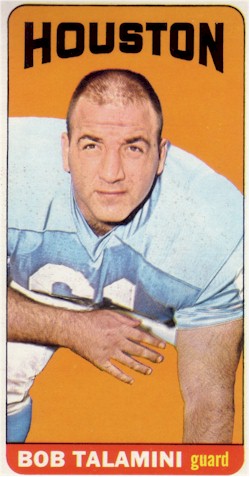
GUARD : Bob Talamini
Talamini was drafted in the 24th round by the expansion Houston Oilers in the fledgling American Football League before the 1960 season. He was a territorial draft selection, and was the third from last player chosen overall.
When he arrived in Houston, the Oilers had already been in training camp for over a week. Over 300 players were at the camp, yet the league rules stipulated that only 35 players could make each roster. After standing out immediately, Talamini was soon told by head coach Lou Rymkus that he would start.
The Oilers started 17 rookies in their inaugural season, nine alone just on offense. They were led by quarterback George Blanda, a wash out in the NFL who would revitalize his career in Houston and end up in the Pro Football Hall Of Fame. The only only other veteran on offense was seventh year tight end John Carson. Carson had been a Pro Bowl player in 1957 with the Washington Redskins, and would retire from the game after his lone season in the AFL.
Houston was a well balanced team that was equally adept in all facets of the game. They went 10-4 in their first season, then beat the Los Angeles Chargers to capture the first ever AFL Championship. They repeated as champions the next year by defeating the Chargers again in the championship game. Talamini was named to the All-AFL Second Team by both the UPI and the league in 1961.
Houston went to a third consecutive championship game after the 1962 season, but lost in double overtime to the Dallas Texans 20-17. Lasting just six seconds short of 78 minutes, it is still the longest championship game ever played. The Texans would relocate to Kansas City after the game, and rename themselves the Chiefs.
Talamini was named to the All-AFL First Team after that season, and would garner this award every year that followed up until 1967.
Though the Oilers failed to achieve their previous successes, they were a high scoring team over the next several seasons. One of the teams strengths was their rushing attack, which was led by Talamini's blocking prowess. He was excellent versus the pass rush, and was special when it came to pulling out and leading on sweeps.
After the 1967 concluded, he approached Adams for a pay raise. Despite coming off of six consecutive Pro Bowl seasons, at the young age of 28, he was denied his request. Talamini then asked for his immediate release from his contract.
Joe Spencer was an assistant coach on the New York Jets in 1968. He had worked with the Oilers a few years earlier, and was familiar with Talamini. Spencer called him and asked if he would be interested in joining the Jets. Talamini agreed to after being promised a pay raise, so the Jets gave Houston cash for his contract.
The 1968 season was a magical season for the New York Jets. This was a franchise who had struggled to stay in existence just a few years earlier due to poor attendance and play on the field. Things changed when they drafted Joe Namath in 1965. Namath, a future Hall Of Fame quarterback, brought the team a lot of publicity and credit as the Jets slowly built a winning team.
The Jets won their last four games of the year, and finished 11-3. They then faced the Oakland Raiders, a team that handed them their last loss, in the AFL Championship Game. New York won 27-23 on a late fourth quarter touchdown pass from Namath to Hall Of Fame wide receiver Don Maynard. The victory propelled the Jets into Super Bowl III, where they faced the heavily favored Baltimore Colts.
New York won the game 16-7, and became the first AFL team to be declared world champions. They won by creating five turnovers on defense, and controlling the ball on offense. The offensive line was led by Talamini and Winston Hill. They paved the way for running back Matt Snell to gain 121 yards on 30 rushing attempts, as well as helping Snell score the teams only touchdown off of a four yard run.
Though he was just 30 years old, and had been on three championship teams in his nine years, Talamini decided to retire from the game to be with his family.
Bob Talamini is a member of the American Football League All-Time Team, and is on the second unit. He is also a member of the AFL Hall Of Fame.
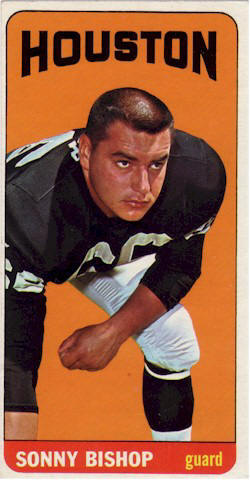
GUARD : Sonny Bishop
Bishop was drafted by the San Diego Chargers in the 11th round of the 1962 AFL Draft, and was the 88th player selected overall. He was also drafted in the 18th round of the NFL Draft by the Cleveland Browns that year, the 249th player chosen overall.
He ended up with the Dallas Texans that season due to the 1962 Equalization Draft, and was a reserve. The Texans would go on to win the AFL Championship by defeating the Oilers in the longest championship game in professional football history. Bishop is credited with a reception in that game which lost six yards.
Bishop then joined the Oakland Raiders the next year, and earned a starting job. He then was traded to the Oilers for Billy Cannon. He stepped right in as a starter for Houston.
The UPI named Bishop to their All-AFL Second Team after the 1964 season, and the New York Daily News did the same after the 1965 season.
He made his only All-Star Team after the 1968 season, but he was also named to the Sporting News All-AFL Second Team after the 1969 season. He then retired from the game.
Pro Football Hall Of Fame guards like Bruce Matthews and Mike Munchak, along with AFL Hall Of Fame guard Bob Talamini, are considered the best in franchise history, yet Sonny Bishop was an excellent player as well.
Benji Olson also deserves mention.
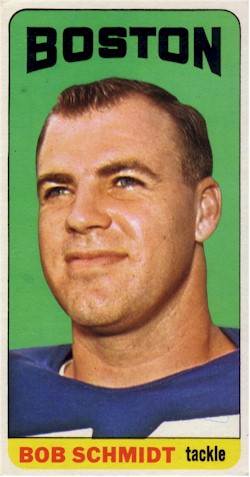
CENTER : Bob Schmidt
Schmidt was drafted by the Chicago Cardinals in the 14th round of the 1958 NFL Draft. He was the 159th player chosen overall. He did not make the Cardinals team and was out of football that season.
He joined the New York Giants the next season, and spent the next two years as a reserve. He then joined the Oilers for the 1961 season.
Schmidt was named the starting center that year, and was honored with being placed on the AFL All-Star Team. Houston would go on and win the AFL Championship that year, their second straight title.
Schmidt made the AFL All-Star Team again in 1962. The Oilers would reach the title game again, before losing to the Dallas Texans in the longest professional football championship game ever played.
The 1963 season would be Schmidt's last as both an AFL All-Star and as a member of the Oilers. He joined the Boston Patriots the next season, but was moved to tackle because the Patriots already had All-Star Jon Morris starting at center.
After not playing in 1965, Schmidt joined the Buffalo Bills for the 1966 season. He then played in just seven games the following year, and decided to retire at the conclusion of that 1967 season.
Bob Schmidt's three All-Star appearances are the second most by any center in Oilers history. Hall Of Famer Bruce Matthews spent five years at center for the team, and was honored five times.
Carl Mauck, Bobby Maples and
Mark Stepnoski all deserve mention.
DEFENSIVE TACKLE : Curley Culp
Culp was drafted in the second round by the Denver Broncos in the 1968 AFL Draft. He was the 31st player picked overall. Culp was was traded to Kansas City after the 1968 draft for a fourth round pick in the 1969 draft.
Culp found his way into nine games during his rookie year, then broke out in his second year in the AFL. He was named to his first Pro Bowl team and helped the Chiefs get to Super Bowl IV. It was in that game the 3-4 defense was born.
Hall Of Fame head coach Hank Stram decided to put him right over Minnesota center Mick Tingelhoff. His immense strength and quickness overwhelmed Tingelhoff to the point where Culp began to command double, sometimes triple teams. This freed Hall Of Famers like Buck Buchanan, Willie Lanier, Bobby Bell, and SS Johnny Robinson to make plays as the Chiefs shut down the Vikings and won 23-7.
Culp would go on to play the 1971 Pro Bowl. He was twice honored as the Associated Press Defensive Player of the Week during his tenure in Kansas City and led the 1973 Chiefs in sacks with nine.
Culp would play in Kansas City until the beginning of 1974. Culp had signed on to play in the World Football League for 1975, so he was traded four games into the season to the Houston Oilers in one of the most lopsided trades in NFL history.
The Oilers acquired Kansas City's 1975 first round selection (which turned out to be OLB Robert Brazile), along with Culp, for Defensive End John Matuszak. Culp was the ingredient Houston needed to excel in the Oilers 3-4 defense. Curley was named to the 1975 Pro Bowl and was chosen NFL Defensive Player of the Year by the Newspaper Enterprise Association. Culp also received the George S. Halas Trophy after accumulating 11.5 sacks, an unheard of statistic for a nose tackle.
Teamed with Hall Of Fame defensive end Elvin Bethea and great linebackers like Brazile, Ted Washington Sr., and Gregg Bingham, Culp helped lead some excellent Oilers teams that went to a AFC Championship game.
In 1975, Culp recovered a career high three fumbles and took one 38 yards for the only touchdown of his NFL career. In 1977, Culp snared the only interception of his career and rumbled 25 yards. Culp was named to Pro Bowls from 1975 to 1978 while in Houston. In 1979, Culp was named Second Team All Conference by both the UPI and Associated Press.
By 1980, Culp was battling injuries and started just five of ten games in Houston. The Oilers released him and he was claimed by the Lions. He finished that year in Detroit, starting in two of three games. Culp tried to play in 1981, but ended up playing just two games before retiring.
Curley Culp was named by the Sporting News to the All-Century teams of both the Kansas City and Houston/Tennessee franchises. He was voted by a panel of former NFL players and coaches to Pro Football Weekly's All-Time 3-4 defensive team. He is also a member Kansas City Chiefs Hall of Fame, and will one day surely be a member of the Oilers/ Titans Ring of Honor.
Trying to summarize Culps career may be best said by his comrades. Chiefs Hall Of Fame Center Jack Rudnay said, "Every center in the league should have to go against Curley in order to know what it’s like to go against the very best.” NFL Hall Of Fame Center Jim Otto claimed, "Curley Culp was perhaps the strongest man I ever lined up against."
Culp had tremendous leverage to go with his massive strength and superior quickness. Often facing multiple blockers each snap of the ball, Culp used his wrestling knowledge to sift through the opponents on his way to the ball. He was the key person who popularized the 3-4 defense with his intelligence and abilities. Oilers Head Coach Bum Phillips said, "Curley made the 3-4 defense work. He made me look smart."
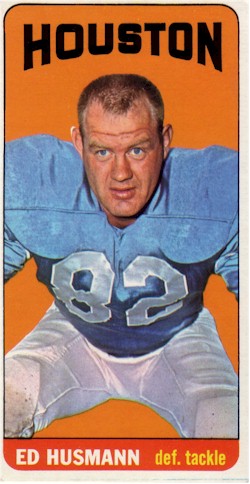
DEFENSIVE TACKLE : Ed Husmann
Husmann was drafted in the ninth round of the 1953 draft by the Chicago Cardinals, and was the 99th player chosen overall.
He started his career on offense playing guard in his rookie year. He then was switched to defense the next to play middle guard the next season. Husmann was hurt in the fourth game of 1958, and missed the rest of the year. He was then moved over to defensive tackle for the rest of his career.
The Dallas Cowboys joined the NFL in 1960, and held an expansion draft. They selected Husmann off the Cardinals. After going winless in their inaugural season, Husmann left the Cowboys to join the Oilers.
He started right away for Houston, and was soon a defensive star of the team. He made the AFL All-Star Team, and helped the Oilers repeat as champions. In the championship game against the San Diego Chargers, Humann played so well that he finished second in voting for the most valuable player award.
The 1962 season saw him get selected First Team All-Pro, as well as going back to the AFL All-Star game. Houston would go back to the championship game, but lose to the Dallas Texans in the longest played championship game in professional football history.
He garnered his last All-Star nod in 1963, yet played two more seasons as a key part of the Oilers defense before retiring after the 1965 season.
Ed Husmann brought veteran leadership and All-Star ability to the Oilers. He is certainly one of the best players to ever don the franchises jersey. His three Pro Bowls are the second most by any defensive tackle in the franchises history, and one behind Curley Culp.
Albert Haynesworth deserves mention.
DEFENSIVE END : Ray Childress
Though Childress could easily be listed as a defensive tackle in this team, due the the fact he enjoyed his greatest successes at that position, I put him at defensive end on this team because he spent his five seasons in the NFL at this position.
Childress was the Oilers first round draft choice of the 1985 draft, and was the third player chosen overall. He was immediately inserted into the starting line up, playing defensive end on the left side of the ball, and racked up an impressive 135 tackles and 3.5 quarterback sacks.
He may have had his best season in 1986. He had five sacks, yet he also racked up a whopping 172 tackles. It is a career best tackle total in a single season for him, and the most in a single season by any lineman in the history of the franchise. Despite missing three games the next season, he had six sacks and 69 tackles.
His first Pro Bowl season was the 1988 year. He had seven fumble recoveries that year, which is two shy on the NFL record for opponent recovered fumbles . He had three in one game versus the Washington Redskins, which is tied with many others as the most opponent recovered fumbles in NFL history. Childress also had 8.5 sacks that year as well.
He missed two games the next year, but still had 8.5 sacks. The Associated Press named him Second Team All-NFL, and the UPI named him Second Team All-Conference. It was his last year as a full time defensive end, because the Oilers would switch from their base 3-4 defense to the 4-3. Childress was then moved inside to play the tackle position.
The change of positions did not slow Childress down. It actually enhanced his abilities even more. He went back to the Pro Bowl in that 1990 season, after getting eight sacks and recording the only safety of his career. He was named First Team All-NFL by both The Sporting News and the Pro Football Writers.
After returning to the Pro Bowl the next year, getting seven sacks despite missing a game, Childress had his best season as a defensive tackle in 1992. He had a career best 13 sacks, and also had an impressive 90 tackles. He scored a touchdown after rumbling eight yards off of a fumble recovery. He was named First Team All-Pro, and returned to the Pro Bowl a third consecutive season.
The 1993 season was his last to make the Pro Bowl. He had nine sacks, and scored the last touchdown of his career off of a fumble recovery. After getting six sacks the next year, Childress was only able to play in six games in the 1994 season. The Oilers were then forced to release him after that season because of salary constraints in the salary cap system just implemented by the league. He signed with the Dallas Cowboys for the 1996 season, but was only able to play in three games, getting one sack, before being injured for the year. He then retired from the game.
His 858 tackles with the team are officially the most in franchise history, and sixth unofficially. His 75.5 quarterback sacks are the second most in team history behind Hall Of Fame defensive end Elvin Bethea's 105, yet only Childress' stats are officially recognized by the NFL. His 19 forced fumbles are the second most in team history, and his 19 fumble recoveries is the fourth most in team history and the most ever by any defensive player. His seven fumble recoveries in 1988 is the most by any player in one season in team history, and his three fumble recoveries in one game is also the best in team history.
It is safe to say that Ray Childress is one of the best defensive players in the history of the Oilers. He is a member of the 1990's All-Pro Team, and should one day soon be a member of the Oilers/ Titans Ring of Honor.
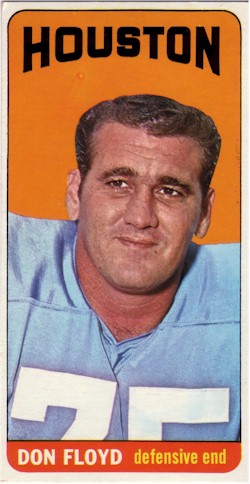
DEFENSIVE END : Don Floyd
Floyd was drafted in the second round of the 1960 NFL Draft by the Baltimore Colts, and was the 23rd player chosen overall. He was also a territorial draft pick of the expansion Oilers of the fledgling AFL.. Floyd was a native of Texas, and attended college at Texas Christian University, so he opted to join the Oilers instead.
He was named a starter day one, and stood out immediately in his rookie year. As a key member of the Houston defense, the Oilers went on to win the first AFL Championship over the Los Angeles Chargers.
The Oilers repeated as champions the next year, beating the since relocated San Diego Chargers again. Floyd was liked up next to newly acquired defensive tackle Ed Husmann on the right side. Both men were chosen as AFL All-Stars that year, with Floyd being named First Team All-AFL as Husmann made the second team.
Both men were named All-Stars again in 1962, as well as being honored as First Team All-Pros. Floyd intercepted the only four passes of his career that year, returning them for 50 yards. One interception was returned for a touchdown. The Oilers would make it to their third straight championship game, but lose in the longest championship game ever played in pro football history.
He missed five games the next year because of a broken jaw, but was still named to the New York Daily News All-AFL Second Team. He rebounded to play a full season in 1964. He was named to the UPI All-AFL Second Team. He scored the last touchdown of his career off of a blocked kick as well. His 1966 season was cut short after six games from injuries, so he retired from football after playing in 12 games the next year after the Oilers lost to the Oakland Raiders in the AFL Championship Game.
Don Floyd is a member of the AFL Hall Of Fame and the Oilers All-Time Team. He was fast, strong, and athletic. He was also exceptional at blocking kicks throughout his career, and is certainly one of the best players to ever have worn an Oilers jersey.
Jevon Kearse, Kyle Vanden Bosch, Pat Holmes, Sean Jones, and
William Fuller deserve mention.
OUTSIDE LINEBACKER : Robert Brazile
Brazile was a first round pick by the Houston Oilers in the 1975 NFL Draft. He was the sixth player picked overall. Brazile was part a deal former Oilers coach Sid Gillman had made at the end of 1973. The Oilers acquired Kansas City's 1975 first round selection, along with Nose Tackle Curley Culp, for Defensive End John Matuszak.
New head coach/general manager Bum Phillips switched Houstons base defense from the from a 4-3 to a 3-4. Brazile is credited by many to be most important in making the 3-4 popular by his ability to rush the quarterback from his outside linebacking position.
Brazile was the NFL's Defensive Rookie of the Year award in 1975. He was named to the Pro Bowl in each of his first seven seasons. Brazile was a key member of Oilers teams that went to back-to-back AFC Championship games in 1978 and 1979.
In 1984, Braziles wife died in a car wreck. He retired immediately from the NFL. Brazile was chosen on the 1970's NFL All-Decade Team. He is the only linebacker from that team not in Canton.
Many may remember his moniker in the NFL. Brazile was nicknamed "Dr. Doom" by his team mates after being tossed out of a game in his rookie year for hitting Washington Redskin Quarterback Billy Kilmer in the head. Some may recall the time he bulldogged Dallas Cowboys Hall of Fame Running Back Tony Dorsett by the facemask.
Brazile was a vicious hitter. He was equally excellent is pass coverage and run support as he was rushing the passer. He didn't always play on good teams, so he wasn't given the nation wide notice, during that era, he deserved. For some bizarre reason, the Oilers/ Titans have yet to place their greatest linebacker into the teams Ring of Honor yet.
Since the NFL did not record sacks as a statistic until 1982, his impact on the game may not be fully realized by newer fans. Those who saw Brazile play knew he was always one of the better defensive players in the NFL in his era year in and year out. Ask his peers.
MIDDLE LINEBACKER : Gregg Bingham
Bingham was the Oilers fourth round draft pick in the 1973 draft, and was the 79th player chosen overall. He earned the staring job immediately, and intercepted two passes in his rookie year.
Houston then switched to the 3-4 defense under defensive coordinator Bum Phillips in 1974. Bingham would switch from MLB to LILB that year, and he responded with a career high four interceptions. Phillips was then promoted to head coach the next year, replacing Hall Of Famer Sid Gillman, and Bingham flip-flopped with Steve Kiner to the right side. He matched his career high mark of four interceptions, and returned them for a career best 57 yards.
He stayed at RILB until 1978, picking off four passes over that stretch of time. In 1977, he scored the only touchdown of his career off of a 34 yard fumble recovery return. He moved back over to the left side for one season in 1979. He picked off three balls, returning one a career long 54 yards. He then moved back to the right side for one season in 1980 before moving back to the left side for the remainder of his career. He retired after the 1984 season.
Bingham was an amazing athlete, and a bona fide tackling machine. His 1,970 career tackles, though unofficial because the NFL did not recognize tackles as statistic then, is easily the most in Oilers history. His 21 interceptions is most by any linebacker in team history, and his 14 fumble recoveries is tied with Robert Brazile as the most by a linebacker in team history.
He was such an exceptional athlete that he was listed as the teams third string quarterback for years until rosters expanded to allow for teams to carry a third quarterback. He even took three snaps during a game once, handing the ball off each time. He also never missed a game in his entire career, except for a few games during the strike shortened season of 1982.
Though Greg Bingham was never honored with a Pro Bowl nod, he was one of the best at his position for years. He had the respect of his opponents, and Hall Of Famer Al Davis once said, " He is well known for his cunning and guile and it wouldn't surprise me if he made every tackle". Bingham is a member of the Oilers All-Time Team, and hopefully will soon be inducted into the franchises Ring of Honor.
Garland Boyette, Al Smith, John Grimsley and
Dennit Morris all deserve mention.
OUTSIDE LINEBACKER : George Webster
Webster was the very first player ever chosen by the Oilers in their first NFL Draft. It happened in 1967, and he was the fifth player chosen overall. Though the Oilers were still members of the AFL, the two leagues combined their drafts toi ready themselves for their impending merger.
He starred right away on the gridiron for Houston. In an exhibition game against the Dallas Cowboys in his rookie year, he chased down Hall Of Fame wide receiver Bob Hayes from behind. "Bullet" Bob Hayes was an Olympic Gold Medal sprinter as well.
This was a prelude of things to come for Webster. He averaged over ten tackles a game in his rookie year, helping the Oilers have the top rated defense in the AFL that year. He was named the UPI AFL Rookie of the Year, First Team All-Pro, and an AFL All-Star that season. The Oilers went on to lose in the AFL Championship to the Oakland Raiders.
He was named First Team All-Pro and AFL All-Star again in each of the next two seasons as well. In the seventh game of the 1970 season, he suffered a leg injury that would put him on the shelf for the remainder of the year. He played in ten games the next year, missing four due to injury.
After playing five games for Houston in 1972, he was traded to the Pittsburgh Steelers. He stayed with them until the 1973 season, backing up Hall Of Famer Jack Ham and All-Pro Andy Russell. He then joined the New England Patriots in 1974, and started in 12 of the 14 games he played. He started in all ten games he played in 1975 before being injured. Returning the next year, he started in three of the 13 games he played. He then retired.
Some may remember Webster suing the NFL for an increase in pension in 1989. He had lost use of a hand, knee, ankle, and foot from injuries sustained in his career. The difference in money between a football related disability to a non football related disability was $3,250 a month back then. He lost his case, but it once again shone a spotlight on a flawed system that the NFL runs in their seemed mission to disrespect the players who made the game it is in both monetary and cultural status.
George Webster passed away in 2007, but he is still known as one of the greatest linebackers in Oilers history. He is the only linebacker to have been named First Team All-Pro three times, and he is tied with five others as the most nods in team history for such an award. He is a member of the AFL All-Time Team, the AFL Hall Of Fame, and hopefully soon a member of the teams Ring of Honor.
Ted Washington and
Keith Bulluck deserve mention.
John Henry Mills was a special teams star worth noting.
STRONG SAFETY : Jim Norton
Norton was a seventh round draft pick of the Detroit Lions in the 1960 NFL Draft. He was also drafted as a territorial pick in the inaugural season of the American Football League by the Dallas Texans. He opted to sign with the Houston Oilers instead.
Norton first played cornerback with the Oilers. Playing as a reserve in his rookie year, he managed one interception. It was the lowest season total of his career, as the Oilers would go on to win the first AFL Championship.
Norton was moved to strong safety the following year, and was named a starter. He responded with a career high nine interceptions for a career best 150 yards. He also assumed the punting duties, and averaged 40.7 yards per punt on 48 attempts.
The Oilers wound up winning the 1961 AFL Championship as well. His punting in that game was an integral reason for Houston's win in a low scoring affair dictated by field position. Norton was named to his first AFL All Star Team that year.
In 1962, Jim swiped eight more passes, and punted the ball 56 times for a 41 yard average. Three interceptions came in a crucial late season win over Denver, enabling the Oilers to get into the playoffs. The Oilers made it to the 1962 AFL Championship Game, a double overtime loss that was the longest game in AFL history. Norton again was named to the AFL All Star Team.
Norton was again named to the AFL All Star Team in 1963, as he stole six passes and has a 43 yard punting average on 65 attempts. He even caught a 15 yard pass.
He punted the ball a career long 79 yards in 1964, averaging 41.2 yards on 55 attempts, and intercepted the ball twice.
In 1965, Norton led the AFL with 85 punts for 3,711 yards. He averaged 43.7 yards per punt. All were career highs for Jim. He also had seven interceptions that season as well.
He had four picks in 1966, gaining 125 yards. He also averaged 42.1 yards per punt on 69 attempts.
Norton made his last AFL All Star Team in 1967, as he had 6 interceptions and averaged 42.6 yards per punt on 71 attempts. He also scored the only touchdown of his career, which came off of an interception.
The 1968 season was Jim's last as a player. He punted 73 times for a 41.2 yards per punt average. He intercepted the ball twice, and caught a pass for 20 yards. He retired after that season.
Jim Norton's 45 interceptions are the most in AFL history. It is also the most in Oilers/ Titans franchise history. His 592 interception return yards are the second most in the franchises history behind Hall of Famer Ken Houston.
His 519 punts were the most in franchise history until 2004, when Craig Hentrich passed him. He ranks third in AFL history in punts as well, and finished his career with an average of 42.1 yards per punt.
He never missed one game in his entire career, even once after suffering a major concussion. What makes this feat even more amazing is the fact Norton never wore any hip or thigh pads. He averaged over an interception every 3 games he played in his career, an amazing rate.
Norton's number 43 was the first jersey ever retired in Oilers/ Titans history.
He was nicknamed "The Blade", due to his physique. His teammates also called him "tough as nails," "half-psycho," "crazy," and "masochistic". He was known for his fearless play, and for having a nose for the ball.
Norton seemed to be in on virtually every defensive play the Oilers made throughout his career. He had at least an interception in every year of his career. He was one of the big reasons for the Oilers dominance in the early days of the AFL.
Jim Norton certainly belongs in Canton, and is a member of the franchises Ring of Honor. He is one of the greatest players in the teams entire history.
Blaine Bishop, Keith Bostic, and
Chris Hope all deserve mention.
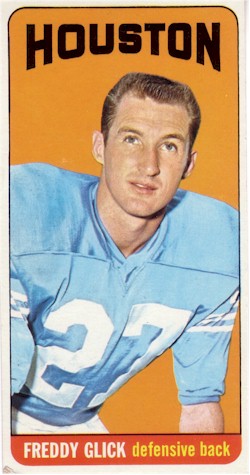
FREE SAFETY : Fred Glick
Glick was drafted in the 23rd round of the 1959 NFL Draft by the Chicago Cardinals, and was the 266th player chosen overall.
He played in just one game in his rookie year, due to injury, then moved with the team to Saint Louis for the 1960 season. He appeared in four games for the Cardinals that year, which was also an injury plagued season for him. He was later cut to make room for future Hall Of Fame safety Larry Wilson.
He then joined the Oilers in the AFL in 1961. Playing in twelve games, Glick swiped four passes. He was named the full time starter that year, and would hold that honor until he retired. He helped the Oilers capture their second consecutive AFL Championship with an interception in the game.
The 1962 season saw Glick make his first AFL All-Star Team. He had three interceptions that season, returned 12 punts and one kickoff. He was credited with being in on 27 tackles in one game that year also.
The Oilers made it back to the AFL Championship Game, but lost to the Dallas Texans in the longest championship game ever played in professional football history.
His best season was 1963. He intercepted a career best 12 balls for 180 yards and recovered three fumbles. He also scored the only touchdown of his career off an interception. Glick also returned a career high 20 kickoffs for 451 yards, and returned a career high 19 punt returns for 171 yards. He was named to the All-Star Team for his efforts.
The 1964 season would be his last as an AFL All-Star. He had five interceptions, returned six punts, and returned one kickoff. He would return seven punts and four kickoffs the next year before giving up those duties for good. He also had two interceptions in that 1965 season.
After intercepting four passes in ten games in 1966, Glick retired from the game with 30 interceptions. It is the third most interceptions still in the history of the franchise.
His 12 interceptions in 1963 is the most in AFL history in a single season, and is tied with Mike Reinfeldt as the most in a single season in franchise history.
Glick and Jim Norton made up perhaps the best safety tandem in the AFL's history. They both went to the All-Star game together two straight years, and are both in the teams record books as two of the top three interceptions leaders in a career with the team.
Fred Glick is a member of the Oilers All-Time Team.
Marcus Robertson, W.K. Hicks, and
Mike Reinfeldt deserve mention.
CORNERBACK : Tony Banfield
Banfield joined the Oilers in 1960 as an undrafted rookie for the expansion club in the fledgling league.
He played in 11 games as a reserve, in his rookie season, yet still managed to grab three interceptions. The Oilers would go on and win the first AFL Championship that year.
Banfield was named a starter the next season, and responded with career bests of eight interceptions for 136 yards. One interception was returned a career long 58 yards. He was named to the AFL All-Star Team, as the Oilers would go on and repeat as AFL champions.
He followed that up in 1962 with another All-Star nod. He had six interceptions, and returned a blocked punt 58 yards for the only touchdown of his career. Houston would return to the championship game, but lose to the Dallas Texans in the longest championship game ever played in professional football history.
The 1963 season was his last as an AFL All-Star. He had seven interceptions that season. He then did not play in the 1964 season, but returned to play in 1965. Banfield had three swipes that year, then decided to retire.
When he did retire, his 27 career interceptions was the most in franchise history. Fred Glick would supplant him the next year, however Banfield is still tied with Darryl Lewis and W.K. Hicks for having the fourth most interceptions.
Tony Banfield is a member of the Oilers All-Time Team, and one of their finest cornerbacks to ever don the teams jersey.
CORNERBACK : Zeke Moore
Moore was drafted by the Oilers in the fifth round of the 1967 AFL Draft, and was the 127th player chosen overall.
He spent his first two seasons as a reserve on a loaded Oilers secondary that featured Hall Of Fame safety Ken Houston, Norton, Farr, and Hicks. Houston decided to use him as a return specialist.
Though he did return five punts for 82 yards as a rookie, he also returned 14 kickoffs for 405 yards. His 28.9 per return average led the AFL, and one return went 98 yards for a touchdown.
He returned a career best 32 kickoffs for 787 yards the next year, a 24.6 yards per return average, as well as one punt return. He would return just 18 kickoffs and seven punts the rest of his career.
The reason was that the Oilers moved Moore into the starting lineup in 1969. He rewarded Houston by making the last AFL All-Star Team before the league merged with the NFL for the 1970 season. Moore had four interceptions, one of which was returned for a touchdown, and was one of three Oilers defensive backs to make that All-Star Team.
Moore followed that up by making the first Pro Bowl after the merger in 1970. He had a career high six interceptions that year, and he joined Ken Houston as the lone Oilers representatives in the Pro Bowl game. It was Moore's last Pro Bowl nod, though he would remain a stalwart in the Oilers secondary until 1977.
After three interceptions in 1971, he was injured and appeared in just eight games the following season. He did not accrue any interceptions in that year not the next. In 1974 he intercepted two balls, and returned one for a touchdown.
He had one of his finest seasons in 1975. Moore grabbed five interceptions, and he returned them for a career best 137 yards. One interception was returned a career long 74 yards.
After one interception the next year, he had three in 1977. Moore also scooped up a fumble and returned it for an NFL long 68 yards for the last touchdown of his career. He then retired with 24 career interceptions, which is still the ninth most in team history.
Miller Farr, W.K. Hicks, Chris Dishman, Mark Johnston, Greg Stemrick, Darryll Lewis, Pete Jaquess, and
Samari Rolle all deserve mention.
PUNT RETURNER : Billy "White Shoes" Johnson
Johnson was a 15th round draft pick by the Houston Oilers in 1974. He was the 365th player picked overall despite the initial objections of GM/Head Coach Sid Gillman, a Hall Of Famer, who didn't want a "midget" on his team.
He made the team as a return man and stood out immediately. He was given the moniker "White Shoes" in high school when he wore the white cleats, as opposed to most wearing black cleats.
In his first four seasons, he returned five punt returns for touchdowns, as well as two kickoff returns. In 1975 he tied an NFL record with four kickoff returns for touchdowns in a season.
He would celebrate his touchdowns with the "Funky Chicken" dance. This dance, coupled by his shoes, made him a fan favorite across the league.
He was used as a third down slot receiver in multiple WR sets mostly. He caught 113 balls with seven touchdowns his first three years. He was used as a possession type due to the teams offensive scheme, but he also ran the ball for a touchdown once.
He caught 20 balls his fourth year for three touchdowns at a 20 yards per catch average. He also took a reverse 61 yards for a touchdown, the last rushing touchdown of his career. In his fifth NFL season, in 1978, he blew out his knee during the fifth game. He managed to play in just two games the following season due to its lingering effects. In 1980, he returned to be used only as a third WR. He caught 31 balls for two touchdowns.
Disenchanted with his role, Billy bolted for the Canadian Football League to play for the Montreal Allouetttes. That year in Montreal, Billy caught 65 passes for 1,060 yards and five touchdowns.
He returned to the NFL in 1982, signing with the Atlanta Falcons. He played nine games that year and only caught two passes. He did return 24 punts at an impressive clip of 11.4 yards per return average.
"White Shoes" was used as the Falcons full time punt returner in 1983. He also started at wide receiver. He caught a team and career high 64 passes while scoring five touchdowns total. One touchdown was via a punt return. He was named to the Pro Bowl.
He won the Pro Bowl MVP when he took a punt 90 yards for a touchdown, as well as accumulating 159 total return yards. Both are still Pro Bowl records.
Johnson got off to a good start in 1984 by catching 24 balls for three touchdowns, as well as a touchdown on a punt return. He was injured the sixth game of the year and did not return until 1985. He was used very sparingly as a punt returner that year, instead focusing on his wide receiver duties. He caught 62 passes for a career high 830 yards to go with five touchdowns.
He was hurt the following year and caught only six passes and took eight punt returns in four games. He came back to play 12 games in 1987, and returned 21 punts and caught eight passes.
He left the Falcons, but tried to play for the Washington Redskins in 1988. He played only just one game and took four punts, returning three of them for 26 yards. He then retired.
Billy "White Shoes" Johnson was named to both the NFL's 1980's All-Decade Team, and to the 75th Anniversary All-Time Team. He set seven team records in Houston and four in Atlanta, and held the NFL record for punt return yardage when he retired. He is still ranked third All-Time in punt return yardage in NFL history. He still holds the Oilers/ Titans record for punt return yardage.
"White Shoes" may be known to many fans as an innovators of the touchdown dance. He is credited as being one of the first, but certainly his can stake claim to having been the best ever. Celebrations with more choreography may have been employed since then, but it is much like the students trying to emulate the master. He was not just a crowd pleaser with his dance, he was a premier return specialist who took eight kicks to the end zone in his career.
He certainly is the best punt returner Oilers fans ever saw. He should be in the teams Ring of Honor and in Canton. He is the only member of the NFL's 75th Anniversary All-Time Team not yet inducted into the Pro Football Hall Of Fame.
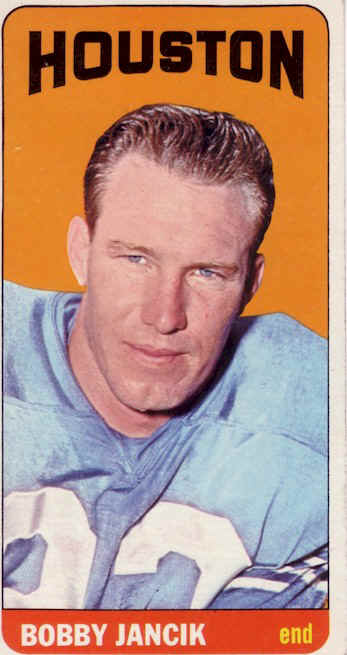
KICK RETURNER : Bobby Jancik
Jancik was a 19th round draft pick of the Houston Oilers in the 1962 AFL draft, the 151st player chosen overall.
He played six seasons with the Oilers, and is one of the best kick return specialists in AFL history.
Jancik led the AFL in kickoff return average as a rookie with 30.3. He led the AFL in the next year with a career high 45 kickoff returns for a career best 1,317 yards. His 29.3 kickoff return average also led the AFL.
In 1964, he scored the only touchdown of his career by taking a punt for a league leading 82 yards. Jancik also had a career best 18.3 average on 12 punt returns. He also caught one pass for 14 yards.
In 1966, Jancik led the AFL with 34 kickoff returns for 875 yards. Bobby then retired after the 1967 season. He did intercept 15 passes in his career as a cornerback, as well as averaging 9.7 yards on 67 punt returns.
His career average on kickoff returns is an exceptional 26.5 on 158 attempts. The 4,185 kickoff return yards he accumulated in his career still is a franchise record.
KICKER : Al Del Greco
Del Greco joined the Green Bay Packers as an undrafted rookie free agent in 1984. He played in nine games, replacing Eddie Garcia after the seventh game, and made all 34 of his extra point attempts. He also made nine of his twelve field goal attempts.
After scoring 95 points for the Packers the next year, he scored 80 points in 1986. Del Greco then got off to a bad start for the Packers in 1987, making five of his ten field goal attempts. Green Bay released him, so the Saint Louis Cardinals signed him to replace rookie Jim Gallery to finish the season.
He stayed with the Cardinals as they moved to Phoenix, Arizona for the 1988 season. He stayed with the club until the end of the 1990 season, then was replaced by Greg Davis. Del Greco then was signed after the tenth game of that season by the Oilers to replace rookie Ian Howfield.
Playing against the Dallas Cowboys in his first game with Houston, he made four field goals, including a 52 yard attempt and a game winning attempt in overtime. He endeared himself immediately to the Oilers fans that day, and would kick with the Oilers until he retired after the 2000 season.
His best season may have been in 1998, when he led the NFL with 36 made field goals on 39 attempts. He also scored a career best 136 points that year. By the time he retired, Del Greco held team records of points scored in a career, points scored in a single season, field goals attempted and made over a career, extra points made and attempted over a career, and field goals made in a season.
Del Greco missed just two extra point attempts in his time with the team, and only 49 field goal attempts. His 83.4 field goal percentage is the best by any kicker in franchise history with more than 139 attempts, and his extra point percentage of 99.4 is the best ever of anyone with more than 80 attempts.
He is a legend in Tennessee many remember in the Titans magical 1999 season. In their run to the Super Bowl, he made four field goals in a playoff game against the Indianapolis Colts. Two were at distances of 43 yards and 49 yards. His 43 yards field goal in Super Bowl XXXIV had tied the score at 16-16 in the fourth quarter against the Saint Louis Rams, which set the stage for the Rams winning pass of 73 yards from Kurt Warner to Isaac Bruce.
Al Del Greco may be the greatest place kicker in Oilers/ Titans history.
Toni Fritsch and
Rob Bironas deserve mention. Fritsch led the NFL in field goal percentage three times in his five years with the team, and is the first Pro Bowl kicker in team history. Baronas was the second kicker to accomplish this.
PUNTER : Craig Hentrich
Hentrich was drafted by the New York Jets in the 1993 draft, the 200th player chosen overall, but was beaten out by Louie Aguiar for the job.
He made the Green Bay Packers team in 1994, and punted 81 times at an average of 41.4 yards per attempt that season. He had his first two punts blocked the next year, but he was also asked to fill in as a place kicker several times. He made all five of his extra point attempts, and made three of his five field goal attempts.
He served as the teams punter and kickoff specialist in the Packers championship season of 1996. He averaged 42.4 yards on 68 attempts, as Green Bay went on to win Super Bowl XXXI. After averaging 45 yards on 75 attempts the next year, he left the team to sign with the Titans as a free agent for the 1998 season.
That season saw him lead the NFL with a career best 47.2 yard average on 69 attempts. He also missed his only field goal attempt, but did complete a pass for 13 yards. Hentrich was named First Team All-Pro, and was given his first Pro Bowl nod for his efforts.
He followed that up with a career high 90 punts in 1999. One went for a career best 78 yards, as he averaged 42.5 yards per attempt. The Titans would go on to appear in Super Bowl XXXIV, but lose to the Saint Louis Rams.
Hentrich continued to punt with the Titans over the next several years, and had the last punt block of his career in 2002. He then was awarded his final Pro Bowl honor in 2003. He averaged 43.9 yards on 71 attempts, made four of five field goal attempts, and the last extra point attempt of his career. He also attempted a career high five passing attempts, and completed two for 25 yards.
He attempted four passes the next season, and completed two for ten yards. He also made his last field goal on three attempts, to go with 73 punt attempts for an average of 42.7 yards.
Hentrich has stayed with the Titans up until this current 2009 season. He contemplated retirement after the 2008 year, but signed a one year contract. After averaging nine punts at an average of 46.9 yards, he was injured for the first time in his career. He was placed on the injured reserved list, thus ending his season and perhaps his NFL career.
Hentrich is the Titans all-time leader in punts and punting yards. His 78 yard punt is the second longest in team history, and is one yard short of Jim Norton's team record. His 42.9 yards per punt average is the best by any punter in franchise history with more than 311 attempts. Greg Montgomery averaged 43.6 yards on 310 attempts.
It is safe to say Craig Hentrich is the best punter in the history of the Tennessee Titans.
Jim Norton and
Greg Montgomery deserve mention