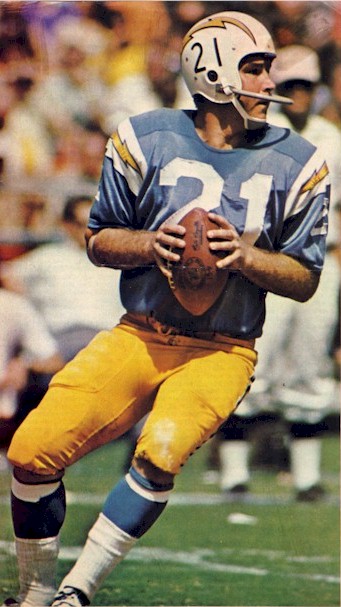
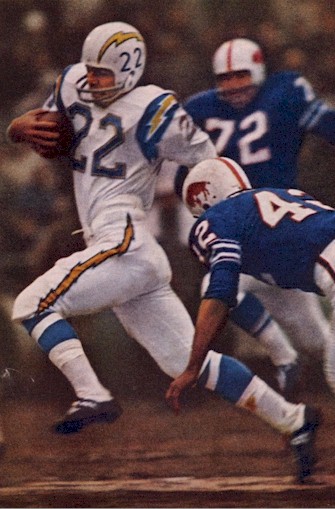
This is a team of the best Chargers who are not, and may be never will be, members of the Pro Football Hall of FameQuarterback : John Hadl
Hadl was drafted in the third round of the 1962 AFL Draft by the Chargers. He was also drafted in the first round of the NFL Draft by the Detroit Lions that year, the tenth player chosen overall.
Having been an All-American player at both halfback and quarterback in a collegiate career that ended up with induction into the College Football Hall of Fame, Detroit told Hadl they were going to use him much like the Green Bay Packers used Hall of Famer Paul "Golden Boy" Hornung.
The Lions had just acquired Pro Bowl quarterback Milt Plum in a trade and had Earl Morrall as his backup. They also drafted quarterback Eddie Wilson in the second round, though Wilson opted to sign with the AFL's Dallas Texans and backup Hall of Famer Len Dawson.
San Diego had Hall of Famer Sid Gillman as their head coach, the man called the father of the modern day passing game by many. Though Hadl was a running quarterback in college, he wanted the challenge of transitioning into a drop-back passer over being used in a variety of ways like Hornung was as a halfback.
Jack Kemp was a Pro Bowl quarterback for the Chargers, so the thought was Hadl would sit and learn. It did not end up that way because Kemp broke fingers on his throwing hand in the second game of the year.
Gillman attempted to hide Kemp on the waiver wire because they had just acquired quarterback Dick Wood, but the Buffalo Bills quickly grabbed him and Kemp finished the season as a Pro Bowler. Kemp would later become an AFL MVP while leading the Bills to a pair of championships.
Wood, who later became the first starting quarterback in Miami Dolphins history, was name the starter the next two games. Both times saw Hadl come off the bench to lead the Chargers to comeback wins and outplaying Wood. Gillman then decided to go with Hadl.
Though he struggled from that point on, as did the team by losing eight on their last nine games, Hadl showed a knack for throwing a beautiful deep ball to a rookie wide receiver named Lance Alworth in the four games they played together.
Gillman decided Hadl wasn't quite ready, so he signed Tobin Rote. Rote hadn't played in the NFL since the Lions released him in 1959 despite his being a Pro Bowler for the Packers in 1956 and leading Detroit to a title in 1957. He went to play in the Canadian Football League for the Toronto Argonauts and set several CFL records in his three seasons.
While Rote was named First Team All-Pro and a Pro Bowler that year, which saw the Chargers win the only championship in their franchise history, Hadl played sparingly. In their 51-10 win over the Boston Patriots in the 1963 AFL Championship Game, Hadl ran for a touchdown and threw another.
Rote got off to a rough start in the first five games in 1963, so he was replaced by Hadl. The young quarterback led the Chargers back to the title game, but was hurt in the first quarter on their 20-7 loss to Kemp and the Bills. He was still named to the Pro bowl that year.
San Diego had lost punter Paul Macguire to the Bills before that season, so Hadl took over. He attempted a career high 62 punts that year, which included a career long 72-yard boot. After punting 38 times the next year, he attempted just three punts the rest of his career.
Now firmly entrenched as the starter in 1965, Hadl led the league in passing yards, yards gained per passing attempt and completion, as well as yards gained per game. He made his second Pro Bowl, but San Diego would end the season losing to the Bills again in the AFL title game.
During this time, he and Alworth had established themselves as a deadly combination. Hadl was masterful throwing the deep ball, and players like Alworth, Gary Garrison, and Jacque MacKinnon all averaged 19 yards or more a reception in 1968. Alworth averaged 19.6 yards in his AFL career.
Between 1966 and 1968, Hadl had streaks of 19 and 16 consecutive games he threw a touchdown pass. That means he had just seven games over three years he failed to toss a score.
The 1968 season may have been one of his best. He led the AFL with a career best 3,473 yards, 27 touchdown passes, and 440 attempts. Hadl also led the AFL with 208 completions that year. He was named to the Pro Bowl that year, an honor he would duplicate the following season and be named MVP of the last AFL All-Star Game ever played.
After having a rough 1970 season where the mobile quarterback was sacked a league leading 42 times, he rebounded the next year. The 1971 season saw Hadl lead the NFL with a career best 233 completions. He also led the league in attempts, passing yards, touchdown passes, and passing yards per game. He was also named NFL Man of the Year, now known as the Walter Payton Award.
After being named a Pro Bowler in 1972, the Chargers traded him to the Los Angeles Rams for running back Bob Thomas and Pro Bowl defensive end Coy Bacon. While Bacon was effective in his three years before being traded to the Cincinnati Bengals for Hall of Famer Charlie Joiner, Thomas lasted two uneventful season with the Bolts before retiring.
One of the reasons for the trade is because San Diego had just acquired Hall of Famer Johnny Unitas. Unitas did not play as well as hoped and was replaced by rookie Dan Fouts, whose career would end with induction into the Pro Football Hall of Fame.
The trade revitalized Hadl. The Rams lost just two games all year behind his leadership. He was named the teams MVP by his teammates and won the NFC Player of the Year Award. He was also named First Team All-Pro and given his final Pro Bowl nod.
The Rams traded him to the Packers five games into the 1974 season for two first-round draft picks, two second-round draft picks, and two third-round draft picks. Though he led the team to three wins in his six games, Hadl mostly struggled.
The 1974 season did not go well for him or the Packers. While playing on a team not deep in talent, he tossed just six scores against 21 interceptions while Green Bay won just four of his 13 starts.
The Packers were in a massive rebuilding mode, so they traded Hadl to the Houston Oilers for quarterback Lynn Dickey before the 1976 season. He spent the next two years backing up Dan Pastorini before retiring.
Hadl later became Hall of Famer John Elway's first NFL quarterback coach and Hall of Famer Steve Young's first professional football coach. He has since returned to his Alma mater as an assistant athletic director.
His five Pro Bowls are the second most ever by a Chargers quarterback, one behind Fouts. Hadl is also one of the 50 Greatest Chargers, as well as having been inducted into the Chargers Hall of Fame and the San Diego Hall of Champions.
Though he was a gifted athlete, Hadl worked hard to become a great quarterback. He wore No.21 in his career, the last NFL quarterback to wear a jersey with a number that high numerically.
Many AFL observers and players believe he should have been inducted into the Pro Football Hall of Fame long ago. Not just because he was a proven winner with the necessary accolades for induction, but because of the passing attack he was in charge of.
Most of Alworth's career receptions came off his arm, and the Hall of Fame receiver has often stated Hadl belongs in Canton. Factor in the career of Garrison and all of the other weapons who excelled under his leadership, John Hadl should be inducted into Canton.
Jack Kemp, Tobin Rote, and
Stan Humphries deserve mention.
Fullback : Keith Lincoln 
Lincoln was the Chargers second round draft pick in the 1961 AFL Draft. The Chicago Bears also drafted him in the fifth round of the NFL Draft, but he chose to join San Diego.
He was not not used a lot as a rookie, but he did set a then-team record with a 91-yard reception for a touchdown. It still is the longest touchdown catch ever by a Chargers running back and is the second longest reception in team history.
San Diego had him return seven punts that year. One was returned 57 yards for a score. He would return only 18 punts the rest of his career, but the Chargers did ask him to return kickoffs frequently the next two seasons.
The 1962 season was his first as Pro Bowler. He was used as a halfback and averaged 4.9 yards on 117 carries. One run went a career long 86 yards, which led the AFL that year. He also led the league with a 103-yard kickoff return for a touchdown. This is still a Chargers record, though Darren Sproles tied it in 2008.
Lincoln's best season was probably in 1963. He ran for a career high 826 yards. The 6.5 yards on 128 carries from the fullback position is impressive in any era and led the league, as did his 76-yard run. He ran for a career best five scores that year while returning seven punts and a career high 17 kicks.
San Diego reached the AFL Championship Game that year and Lincoln exploded. He piled up 329 total yards on offense by gaining 206 rushing yards, on just 13 carries, and 132 yards on seven receptions. He scored on a 67-yard run in the first quarter and a 25-yard reception in the fourth as San Diego won 51-10.
He was again named to the Pro Bowl that year, as well as First Team All-Pro. He won the AFL All-Star Offensive MVP Award in both 1963 and 1964. He is the only player in AFL history to win the award twice by himself. Hall of Fame quarterback Joe Namath also won the award twice, but shared it in 1967 with Hall of Fame receiver Don Maynard.
Lincoln is still the only Charger to win this award by himself. Hall of Fame quarterback is the second and last Charger to win it, but he shared the award with Green Bay Packers wide receiver John Jefferson in 1982.
While making the Pro Bowl in 1964, San Diego asked Lincoln to kick too. He made 16 of 17 extra point attempts and five of 12 field goal attempts. He also completed two of four passes, one of which resulted in a 53-yard score. Lincoln would never be asked to kick again.
San Diego reached the title game in 1964 and 1965, but mysteriously did not give the ball much to Lincoln in both losses. He touched the ball nine total times. Despite running for 47 yards on three carries in the 1063 title game, San Diego decided to pass the ball most of the game.
The 1965 season was his last as a Pro Bowler for San Diego despite missing four games due to injuries. They were the first games of his career he failed to play in. Gene Foster was named the starting fullback in 1966, so Lincoln left to join the Buffalo Bills.
He beat out 1966 AFL Rookie of the Year and Pro Bowler Bobby Burnett for the starting job at halfback that season. He carried the ball a career high 158 times that year, while being used heavily in the passing game. Lincoln caught a career high 41 balls that year, averaging an impressive 13.6 yards per reception, while hauling in a career high five scores.
Buffalo was the worst team in the AFL in 1968, winning once. Lincoln was hurt early, able to appear sparingly in five games. He asked for his release, then signed again with the Chargers. He suited up for one game, then retired.
His three Pro Bowls are the most ever by a Chargers fullback and he still ranks seventh in team history with 2,698 yards rushing. His 86-yard run is still the second longest in team history. Though he never had a year where he averaged more than 11.1 carries per game, his big play ability had him often run for 100-yards on just a few attempts.
He was a rare fullback. Besides kicking, Lincoln completed eight of 17 passes for 240 yards and five touchdowns with the Chargers. He still has the most receptions ever by a Chargers fullback despite having to share the ball with many weapons in San Diego's arsenal.
Lincoln is one of the 50 Greatest Chargers, and has been inducted into both the Chargers Hall of Fame and the San Diego Hall of Champions. He is easily the best fullback in team history.
Lorenzo Neal, Brad Hubbert, Bo Matthews, Hank Bauer, and
Jacque MacKinnon deserve mention.
Halfback : Paul Lowe
Lowe signed with the San Francisco 49ers as an undrafted free agent rookie in 1959. He did not make the team, so he took a job in a mail room of a company owned by the Hilton family. Barron Hilton would found the Los Angeles Chargers in the fledgling American Football League in 1960.
After being coaxed to try out for the team, Lowe became an instant star. The first time he touched the ball, he exploded for a 105-kickoff return for a touchdown in the teams first ever preseason game.
He was named First Team All-Pro as a rookie after averaging an league leading 6.3 yards on 136 carries. The Chargers made it to the first AFL title game but lost, despite 165 rushing yards and a score by Lowe.
Lowe led the AFL with nine rushing touchdowns in 1961, a career high total. One was on a 87-yard run that is still a team record. It set the stage for perhaps the finest season of his career in 1963.
He made his first Pro Bowl after churning out 1,010 yards and eight scores, while catching a career best 27 balls. The Chargers would win the only championship in franchise history that year. Lowe ran for 94 yards, including a 58-yard touchdown, in the title game.
The 1965 season saw Lowe named the AFL MVP by both the Sporting News and UPI. He led the league with a career best marks of 1,121 yards and 80.1 yards rushing per game. He also led the AFL with six rushing touchdowns and a five yard per carry average on a career best 222 attempts.
It was the last year he was named First Team All-Pro and to the Pro Bowl. He led the Chargers in rushing the next year, but suffered through in injury-riddled 1967 season. He appeared in just seven games while missing the first seven games of career.
Dickie Post took over as the primary halfback, and Lowe still had not recovered from his injury. He played in one game for the Chargers in 1968, then was traded to the Kansas City Chiefs. He appeared in just one game for them, but returned the next season as a backup. The Chiefs would win Super Bowl IV that year and Lowe then retired.
The 4,972 rushing yards Lowe had with the Chargers was a team record until LaDanian Tomlinson passed him in 2004. It still ranks second best. Lowe's 1,202 rushing attempts is the third most by any player in AFL history.
His 38 touchdowns on the ground is still third best in team history. His two First Team All-Pro honors was a record for a Chargers halfback until Tomlinson passed him in 2007.
Paul Lowe is a member of the AFL's All-Time First Team, one of the 50 Greatest Chargers, and the Chargers Hall of Fame. The Chargers have had a ton of excellent halfbacks play for them for a few years. The best is Tomlinson, who is headed to Canton when he retires. Yet Lowe is probably the second best halfback in team history.
Dickie Post, Lionel James, Natrone Means, Mike Garrett, Marion Butts, Chuck Muncie, Gary Anderson, James Brooks, Mike Thomas, Eric Metcalf, Ronnie Harmon, Ricky Young, Earnest Jackson, Lydell Mitchell, and
Don Woods deserve mention.
Wide Receiver : John Jefferson
The Chargers first-round draft pick in 1978, "J.J." blew into the league with a force that is often remembered by those who saw him play. He was a Pro Bowler in each of his first three years, as well as being named First Team All-Pro twice.
"The Space Age Receiver" averaged 17.9 YPC in each of his first two seasons.
He caught over 1,000 yards of balls in each of his first three seasons. His catch total went from 56 to 61 to 82 in those years. Jefferson also snared 36 touchdowns those three years.
He led the NFL in touchdown catches as a rookie with a career best 13. Sports Illustrated called him the "Touchdown Man". Jefferson led the league with 13 more in 1980, as well as leading the NFL with 1,340 receiving yards and 83.8 receiving yards per game.
A prevalent theme for the Chargers in that era was disgruntled players wanting a raise in pay and having their requests denied. Jefferson was amongst these players. He was traded to Green Bay after a contract dispute in 1981.
Though he averaged about 16 YPC in his first three years as a Packer, he also battled injuries. His Packer highlights was being named the 1982 Pro Bowl MVP and in 1983, when he caught seven touchdowns on 57 receptions for 830 yards.
He played one more year there before finishing his career with the Cleveland Browns. Perhaps if Jefferson had stayed in the warm weather of San Diego and confines of Air Coryell, he would be with the legends of Canton.
His two First Team All-Pro nods are the most ever by a Chargers wide receiver. His 1,340 yards in 1980 is still the third most receiving yards for a single season in team history.
Jefferson was a key ingredient of the famous "Air Coryell" passing attack. He had two seasons where he teamed with Hall of Fame wide receiver Charlie Joiner to both having at least 1,000 receiving yards. Hall of Fame tight end Kellen Winslow joined them in 1980, becoming the first trio in NFL history to have 1,000-yards each.
Though he was a Charger just three years, John Jefferson is one of the best receivers in their franchises history. Jefferson made the greatest catch I have ever seen, a grab in the back of the end zone with one finger, while he was with the Chargers.
Not only is he inducted into the College Football Hall of Fame, Jefferson is one of the 50 Greatest Chargers.
Wide Receiver : Gary "Ghost" Garrison
Garrison was drafted in the sixth round of the 1965 NFL Draft by the Philadelphia Eagles. He did not make the team, as the Eagles ended up losing two rookie receivers who later became Pro Bowlers that year. The other was their fifth round selection Otis Taylor, who would become a star with the Kansas City Chiefs.
After not playing that year, Garrison joined the Chargers in 1966 because he had a legendary collegiate career at San Diego State University under future Chargers head coach Don Coryell. Garrison still holds the school record for career touchdown receptions.
He earned a starting job as a rookie, getting to bookend Hall of Famer Lance "Bambi" Alworth. He caught 90 passes in his first two year before earning his first Pro Bowl nod in 1968 after having perhaps the finest year of his career.
Garrison set career best marks of 52 receptions for 1,103 yards. He averaged an impressive 21.2 yards per catch and caught 10 touchdowns. One went for a career long 84 yards. He would average over 20 yards a reception in four of his next five years as well.
Nicknamed "Ghost", he averaged a career best 22.9 yards on 44 receptions in 1970, to go with a career best 13 touchdowns catches. It was the first of three consecutive Pro Bowl appearances and the last time he has over 1,000 receiving yards in one season.
After matching his career high total of 52 catches in 1972, his 1973 season was filled with injury. Garrison missed half of the season but rebounded strong the next year. The Chargers passing attack in 1975 struggled, tossing just seven scores against 15 interceptions. The 27 receptions Garrison had that year were the lowest total of his career with the exception of his injury filled 1973 season.
Garrison caught two passes for 58 yards and a touchdown in the Chargers first game of the 1976 season. He got injured in the second game, causing him to miss the rest of the season. San Diego then dealt him to the Houston Oilers. He suited up three times in 1977, then retired.
The Chargers have has a lot of incredible receivers wear their uniform. Two wide receivers and a tight end are inducted in Canton. Garrison ranks sixth best in franchise history in receptions and third in both receiving yards and touchdown catches. His 18.6 yards per catch is only surpassed by Alworth for a Charger with 113 receptions or more.
The"Ghost" is certainly one of the greatest Chargers receivers ever. He is one of the 50 Greatest Chargers, a member of the Chargers Hall of Fame and the San Diego Hall of Champions. His four Pro Bowls are the most ever by a Chargers wide receiver.
Wes Chandler, Anthony Miller, Tony Martin, Kassim Osgood, Jeff Graham, Curtis Conway, and
Don Norton deserve mention.
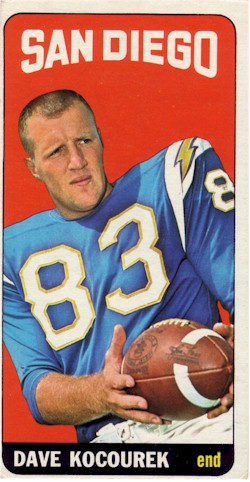
Tight End : Dave Kocourek
Kocourek was drafted by the Pittsburgh Steelers in the 19th round of the 1959 draft. He didn't make the team, so he joined the Winnipeg Blue Bombers of the Canadian Football League that year. He then left the CFL to join the Chargers in 1960.
He stepped in as a starter right away and became an important member of the Chargers exciting passing attack. Kocourek was excellent at getting deep, stretching the seam of the defense. He averaged 16.6 on 40 balls as a rookie, which was a prelude of things to come.
The 1961 season was his best. Kocourek set career high marks of 55 receptions for 1,055 yards at an average of 19.2 yards per catch. One reception went for a career long 76 yards. He was named to the first of his four consecutive Pro Bowls that season.
When the Chargers won the AFL Championship in 1963, he caught a career high five touchdowns. He matched that total again the next year while averaging 18 yards on 33 receptions. After a down year in 1965, Kocourek joined the expansion Miami Dolphins in 1966.
He then reunited with Al Davis, his receivers coach the first three years of his career, with the Oakland Raiders in 1967. He stayed with the team two years as a reserve before retiring. He was rarely used as a receiver over this time.
In his nine seasons as a player, Kocourek played in the AFL Championship Game seven times. He is the only person to ever accomplish this feat. He won a championship with both the Chargers and Raiders.
Mysteriously, Kocorek is not a member of the Chargers Hall of Fame yet. He left owning every record for a Chargers tight end. Most have been broken by Hall of Famer Kellen Winslow, but his 17.1 yards per reception average is still team records by a tight end with 113 receptions or more, and his and 76-yard catch is a record for Charger tight ends.
He has the fourth most receptions ever by a Chargers tight end, which ranks 14th best. His 3,720 yards is the third most ever by a Chargers tight end, and it ranks 11th most in franchise history. Kocourek also ranks third in touchdown receptions by a Chargers tight end, which ranks 12th best in team history.
Though Winslow is the best Chargers tight end ever, and Antonio Gates ranks second, Cockerel was a special player who had a lot of speed for a man of his size in that era. He was a big reason his teams played in so many title games. His four Pro Bowls was a record by a Chargers tight end until Winslow passed him by one.
Willie Frazier, Jacque McKinnon, Reggie Carolan, Pete Holohan, Eric Sievers, and
Freddie Jones deserve mention.
Tackle : Russ Washington
Washington was drafted in the first round of the 1968 draft by San Diego. He was the fourth player chosen overall. He was first used as a defensive tackle, where he stood out for two seasons.
Ron Mix, the Chargers Hall of Fame right tackle, had retired after the 1968 season. The Chargers wanted to protect Pro Bowl quarterback John Hadl while being teamed with Pro Bowl right guard Walt Sweeney. They decided to move Washington into the position.
He made the move look seamless, stepping in and earning a starting job right away. The 6'6" 290 lbs Washington wasn't just a road grader who flattened defenders when San Diego ran the ball, he was nimble and athletic enough to shut down the NFL's best pass rushers.
Helping Mike Garrett gain over 1,000 yards in 1972, Washington began to gain notice despite playing on a struggling team. He made his first Pro Bowl in 1974 when Don Woods won the Rookie of the Year Award on nine starts. The blocking of Washington was a critical element in Woods' success.
Washington made the Pro Bowl again in 1975, then three straight years starting in 1977. He was considered one of the best at his position. Big, strong, and tough, he had gone 12 years without missing a single game.
That changed in 1980, when he got hurt in the sixth game and had to miss the rest of the year. Though he returned the next year, Washington missed 13 games. Those 13 contests are the only games he missed in his entire career.
He retired after the 1982 season having played 200 games in 15 seasons, which includes his 28 games as a defensive tackle. His 200 games was a team record until long snapper David Binn passed it in 2006. It still is the second most ever, tied with linebacker Junior Seau.
Russ Washington is one of the 50 Greatest Chargers. He is inducted into the Chargers Hall of Fame and the San Diego Hall of Champions. There have been few Chargers as great as him.
Tackle : Ernie Wright
Wright joined the Los Angeles Chargers in their inaugural 1960 season. He earned a starting job at left tackle right away and would stay there the next eight years. The Chargers reached the first ever AFL Championship Game, but lost to the Houston Oilers.
Bookending Hall of Famer Ron Mix, the duo soon garnered respect throughout the league. Chargers head coach Sid Gillman called them "the best pair of offensive tackles in professional football".
He was named to his first Pro Bowl in 1961. The Chargers, now in San Diego, were known for their explosive and innovative offense. Wright and Mix helped this by frequently dominating their opponents, allowing the Chargers to appear in five title games in their first six years of existence.
The 1963 season is the only year the Chargers franchise won a championship. Wright was named to the Pro Bowl, helping pave the way for the most productive offense in the AFL that season.
After returning to the Pro Bowl in 1965, Wright missed the first game of his career the next year. It would be the only game that he would miss in his Chargers career. San Diego left him exposed to the Cincinnati Bengals 1968 expansion draft.
Cincinnati grabbed him right away and plugged him into the starting lineup. He started there the next three games, but got hurt for the year midway through the 1971 season. He rejoined the Chargers in 1972 as a backup, then retired at seasons end.
Not only is Wright named one of the 50 Greatest Chargers ever, but he is amongst just twenty men to have played an all 10 years that the American Football League existed. He was an important part of an offensive machine that will probably never be seen again.
Jim Lachey and
Billy Shields deserve mention.
Guard : Walt Sweeney
Sweeney was a first-round draft pick of the San Diego Chargers in the 1963 American Football League draft. He was the second player picked overall.
He did see action in his rookie year, mostly as a reserve. He got his hands on one kickoff and returned it 18 yards. The Chargers would end up winning the 1963 AFL Championship.
Sweeney was fully entrenched as the starting right guard in 1964, and finish that season being named to his first AFL All-Star Team. Sweeney would earn this distinction every year until the AFL merged with the NFL after the 1969 season.
Sweeney would then earn a Pro Bowl berth the next two seasons up to the conclusion of the 1971 season. His blocking opened up holes for such Chargers legendary ball carriers like Keith Lincoln, Jacque MacKinnon, Paul Lowe, and Dickie Post.
He also protected great quarterbacks like John Hadl, and Hall of Famers Johnny Unitas and Dan Fouts. He mostly played guard, but versatile and smart enough to play anywhere along the offensive line when injuries would knock out the other starters.
After the 1973 season, he was traded to the Washington Redskins. He started the next two seasons for the Redskins before retiring after the 1975 season. Sweeney is a member of the Chargers Hall of Fame and was named one of the 50 Greatest Chargers ever.
Sweeney is one of the finest lineman to have ever played professional football. He is a member of the AFL's All-Time Team. He has been an immense success from college to the pros. He was part of an exciting Chargers offense that was one of the best units to ever have played the game.
He was a sound technician who was very athletic. He was equally adept at pass blocking or pulling in front of some of the best rushers to have ever suited up in pads. His exclusion from Canton can only be attributed to his AFL ties.
He went to the name number of Pro Bowls as his teammate, Hall of Fame Tackle Ron Mix, but still waits to be called. Hall of Fame center Jim Ringo is the only Syracuse alumni to have played in more Pro Bowls than Sweeney. He is tied with Hall of Fame fullback Jim Brown as having the second most.
I find it amazing to see that this man has not had his long overdue induction into the Pro Football Hall Of Fame yet. This is obviously another case of being snubbed because of the NFL's hatred and envy of the AFL, though some theorize Sweeney upset a lot of football brass by once having sued the NFL over their failure to supervise coaches giving drugs to players.
As time marches on, many of the newer voters will be those with little knowledge of the AFL. Sweeney's case may get more faint as these events transpire. I suggest all real football fans to wake up the Canton voters in their represented areas. Walt Sweeney most certainly deserves induction.
Guard : Doug Wilkerson
Wilkerson was drafted by the Houston Oilers in the first round of the 1970 draft. He spent his rookie season on the bench, appearing in nine games. Houston then traded him to the Chargers before the 1971 season.
The trade became one of the biggest steals in Chargers history. Wilkerson earned a starting job immediately and held it for the next 14 years.
San Diego struggled the first half of the decade, but fortunes began to change when the hired Don Coryell as the head coach during the 1978 season. They were a run oriented offense before his arrival, and Wilkerson's blocking helped NFL Offensive Rookie of the Year Don Woods gain 1,162 yards despite just nine starts in 1974.
Now it was the age of "Air Coryell", an offense that is one of the most exciting in NFL history. A big reason for the incredible production of the offense was the excellent blocking Wilkerson provided.
Wilkerson was the steadiest on the line, as well as the most reliable. He played in 126 straight games until missing four because of injury in 1979. He would miss four games in 1983 as well, but started and played in 195 of 203 possible starts in his career.
His excellence was rewarded in 1980 with the first of three consecutive Pro Bowl nods. He was also honored as First Team All-Pro in 1982. Wilkerson played until 1984, retiring at 37-years old.
He and Walt Sweeney are the only guards in Chargers history to earn a First Team All-Pro honor. His three Pro Bowls is the third most ever by a San Diego guard. There have been few offensive linemen in the teams history as good or durable as Doug Wilkerson.
Wilkerson is one of the 50 Greatest Chargers and is inducted into both the Chargers Hall of Fame and the San Diego Hall of Champions.
Ed White and
Dennis McKnight deserve mention.
Center : Don Macek
Macek was drafted by the Chargers in the second round of the 1977 draft. He started right away at right guard and stayed there two years. When San Diego traded for Pro Bowl guard Ed White, he slid over to center.
After splitting starts with incumbent Ralph Perretta that year, he got hurt in 1979 and started just six games as Bob Rush, San Diego's first-round pick in 1977, started the rest of the year.
Macek came back in 1980 to reclaim his starting job and would hang onto it the next eight seasons. The Chargers were the most explosive offense at that time, and their excellent offensive line was a big ingredient to their attack.
While he was the starter, Macek was also often banged up and forced to miss games. In his 14 seasons, he was able to start every game in just three. From 1980 to 1987, Macek missed 18 games.
He got hurt in the fifth game of 1988, forcing him out the rest of the year. San Diego then drafted Courtney Hall to supplant the 35-year old Macek in 1989. He sat on the bench mentoring Hall that season and then retired.
Macek has been named one of the 50 Greatest Chargers and is also a member of the Chargers Hall of Fame. Not only was he a masterful technician, but he was a leader on some of the most exciting Chargers teams in NFL history.
Courtney Hall, Sam Gruneisen, and
Carl Mauck deserve mention.
Defensive Tackle : Gary "Big Hands" Johnson
Johnson was San Diego's first pick in the 1975 draft, selected eighth overall. That 1975 draft might be the best in franchise history. The Chargers had two picks in the first, second, fifth, sixth, eighth, 11th, and 13th rounds.
Ten players from the draft played in the NFL, but San Diego got a Hall of Famer, a pair of Pro Bowlers, and eight solid starters from it. Five were defensive players.
San Diego tried to bring him along slowly as a rookie, starting John Teerlink for the first five games. Teerlink, now a noted defensive line coach who has won three Super Bowls, could not keep Johnson on the bench and soon was replaced after six games.
San Diego had an exciting defensive line of Pro Bowler Coy Bacon with three rookies, Johnson, Fred Dean, and Louie Kelcher, that year. Yet they acquired Leroy Jones and then traded Bacon to the Cincinnati Bengals for future Hall of Fame wide receiver Charlie Joiner before the 1976 season.
The mammoth Jones fit in nicely and soon the Chargers had the best defensive line in the NFL. Not only was it nearly impossible to run up the middle of the San Diego defense, bit their defensive linemen were very athletic. Johnson took an interception 52 yards for a touchdown in 1978.
The 1979 season was the first of his four consecutive seasons being named to the Pro Bowl. Though sacks were not an official statistic, the Chargers piled them up in great numbers.
San Diego's front four was called the "Bruise Brothers". The quartet had 60 sacks themselves in 1980, and Johnson got 17.5 of them. He was named First Team All-Pro that year and the next season. He also intercepted another pass and ran for a touchdown in 1981.
The 1982 season was his last as a Pro Bowl player, and he recorded a safety. After the 1983 season, Johnson and Kelcher were looking to get a raise in pay. The Chargers owner, Eugene Klein, was not willing to acquiesce.
Klein had the same issue with Dean in 1981, where he ended up trading the future Hall of Famer to the San Francisco 49ers. He had already let Billy Shields, who had started at left tackle the last eight seasons, go to the 49ers along with Kelcher before the season began.
After four games with the Chargers in 1984, Johnson was traded to the 49ers and joined Dean, Kelcher, and Shields. All three happened to be drafted with him by San Diego in 1975. The ex-Chargers contributed mightily to the 49ers cause that year.
Johnson had five sacks, a safety, and scored a touchdown off a fumble recovery in his 12 games. When San Francisco got to the NFC Championship Game against the Chicago Bears, "Big Hands" had two sacks in the Niners win.
San Francisco faced the Miami Dolphins in Super Bowl XIX, Johnson had a sack as the Niners won. He played 11 games for San Francisco the next year and then retired.
His four Pro Bowls is tied as the most ever by a Chargers defensive tackle. His 17.5 sacks in 1980 is still a team record and he was credited with 67 in his Chargers career.
He, Kelcher, and Dean once all started in a Pro Bowl game. It is the only time in NFL history where three defensive linemen from the same team accomplished that feat.
Sacks were not officially recorded until 1982, so he will never be given the full credit he deserves. But Chargers fans lucky enough to have seen "Big Hands" dominate know how great he truly was. He was also one of the most beloved teammates in the Bolts locker room.
Johnson is one of the 50 Greatest Chargers and a member of the Chargers Hall of Fame, the San Diego Hall of Champions, and College Football Hall of Fame.
Defensive Tackle : Ernie "Big Cat" Ladd
Ladd was a 15th round draft pick of the Chargers in the 1961 AFL Draft. The Chicago Bears drafted him in the fourth round of the NFL Draft. At 6'9" 300 lbs, he was the biggest man in professional football at the time.
He chose to join the Chargers and stood out right away, being named First Team All-Pro as a rookie. After being named to the Pro Bowl the next year, San Diego moved him from right defensive tackle to the left side to line up next to Pro Bowler Earl Faison.
The moved paid off as the Chargers had the top defense in the league and won the AFL Championship. Ladd was one of 11 Chargers to go to the Pro Bowl that year. He went to the Pro Bowl the next two years, as well as being named First Team All-Pro.
San Diego had Ladd and Faison both wanting more money. They traded Ladd to the Houston Oilers in 1966, where he played one season. After four games with them in 1967, the Oilers traded him to the Kansas City Chiefs.
With the Chiefs, Ladd was reunited with Hall of Famer Buck Buchanan. Both had played together at Grambling State University. Buchanan was 6'7" 270 himself, giving the Chiefs the largest defensive tackle duo in pro football history. He stayed with Kansas City until 1968 before retiring.
During his rookie year, Ladd got involved with professional wrestling. He won several titles as both a singles and tag team competitor, building rivalries with some of the greatest in the business. He was a heel typically, known for his excellent oratory skills on the microphone.
He would antagonize and feud with legends like Andre the Giant, the Junkyard Dog, and Paul Orndorff. Ladd is inducted in several wrestling Hall of Fame's such as the WWE and WCW.
His four Pro Bowls is tied as the most ever by a Chargers defensive tackle.
He is one of the 50 Greatest Chargers and is inducted into both the Chargers Hall of Fame and the San Diego Hall of Champions.
Ernie Ladd was so big that Boston Patriots center John Morris said facing Ladd was like playing football in a closet. "It was dark because he blocked out the sun he was so big. I couldn't see the goalposts."
Not only has professional football not seen a character like him since, the Chargers haven't had the excellent play he brought since he left.
Louie Kelcher, Jamal Williams, Bill Hudson, Shawn Lee, and
John Parrella deserve mention.
Defensive End : Earl Faison
Faison was the Chargers first-round draft pick in 1961 AFL Draft. Despite being an All-American two-way player at Indiana University, where he he is inducted into their Hall of Fame, he wasn't drafted until the fifth round of the NFL Draft by the Detroit Lions.
He started immediately for San Diego and quickly became a star. A stunning athlete at 6'5" 270, Faison had a propensity of intercepting passes his entire career. He intercepted two passes as a rookie and was named AFL Rookie of the Year, First Team All-Pro, and a Pro Bowler.
Faison began to face multiple blockers each down because he was often harassing the opposing quarterbacks. It did not slow him down, but he missed six games his second year due to a knee injury. He still was named an Pro Bowler after intercepting a ball.
The 1963 season was the only year Faison failed to intercept a pass in his career, but he was still one of the best defensive ends in pro football. San Diego won the only title in their franchise history that year and Faison was named to the Pro Bowl and First Team All-Pro.
He was named to the Pro Bowl and First Team All-Pro in each of the next two years as well. Faison also picked off a pass each year and ran for touchdowns. He then asked for a pay raise and almost bolted to the Canadian Football League.
He was traded to the Houston Oilers because of these contract differences, but the trade was nullified when Oilers owner Bud Adams was found guilty of tampering. Faison then injured his back after three games and was released.
The Miami Dolphins signed him right away and he played six games with them. Faison intercepted a pass and took a fumble recovery for a touchdown.. Despite this, Miami tried to trade him to the Denver Broncos, but his back issues made Denver send him back to Miami.
The Dolphins then cut him, so Faison decided to retire. After a few acting stints, he got into coaching high school football. Hall of Famer Marcus Allen was his most famous student at a school that has sent 12 men to pro football.
His five Pro Bowls are the most ever by a Chargers defensive end. No other Chargers defensive lineman has scored as many touchdowns off interceptions than him, and his five interceptions with San Diego is the most by a Chargers defensive lineman ever.
His four First Team All-Pro nods are the fourth most in Chargers history. Only Hall of Famers Ron Mix and Lance Alworth, along with future Hall of Famer Junior Seau, have more.
Faison is one of the 50 Greatest Chargers and has been inducted into the Chargers Hall of Fame and the San Diego Hall of Champions.
Amazingly, he was left off the AFL All-Time Team despite having more First Team All-Pro nods than all of the four defensive ends selected, and he went to more Pro Bowls than three of them.
Sacks were not recorded in his era but Faison put up accolades worthy of induction into Canton in his six seasons. Critics who point to his 73 games played only need to look at the 68 games Hall of Famer Gale Sayers played as a rebuttal. Faison went to one more Pro Bowl than Sayers and had one less First Team All-Pro nod.
He is easily the best defensive end in Chargers history.
Defensive End : Leslie O'Neal
O'Neal was the Chargers first-round draft pick in 1986, the eighth player chosen overall. He exploded onto the NFL scene in his rookie year despite missing three games.
He intercepted two balls, returning one for a score. The 82 tackles he had were the most he ever accumulated playing defensive end, and he also tallied 12.5 sacks. O'Neal was named NFL Defensive Rookie of the Year, becoming the first Charger defender to win such an award since the 1961 season when Earl Faison won AFL Rookie of the Year.
He was unable to play the entire 1987 season because of injury. San Diego spotted him in nine games during the 1988 season, where he had a career low four sacks. They then decided to move him to outside linebacker.
O'Neal played outside linebacker for three years. He went to the Pro Bowl twice over that time and had 35 total sacks. The 96 tackles he had in 1989 was the best of his career.
San Diego had been playing a 3-4 defense. They switched to a 4-3 defense in 1992 and improved greatly on defense. O'Neal went back to defensive end and Pro Bowler Junior Seau replaced him at linebacker. Ranked 21st in scoring defense in 1991, San Diego improved to fourth best in 1992.
The 1992 season was also one of his best seasons as a player. O'Neal piled up a career best 17 sacks and was named to his first of four consecutive Pro Bowls as a defensive end.
He was the Chargers sack master over this time. He had 54 sacks over those four seasons. When his contract expired after the 1995 season, the Saint Louis Rams signed O'Neal to a free agent contract.
Though O'Neal lasted just two year with the Rams, his 1997 was excellent. He had 10 sacks, an interception, and scored off of a 66-yard fumble recovery return. Despite this, Saint Louis let him sign with the Kansas City Chiefs in 1998.
The Chiefs lined him up at both linebacker and defensive end the next two years, where he had 10 total sacks before retiring at the end on the 1999 season.
Of his 132.5 career sacks, which is eighth best in NFL history, 105.5 came with the Chargers. It is the best in team history and O'Neal is one of 24 NFL players with at least 100 sacks in a career. He ranks fourth in tackles for a Charger, but first amongst all defensive linemen.
Not only was Leslie O'Neal named one of the 50 Greatest Chargers, he is one of the best defensive players in team history.
Lee Williams, Steve DeLong, Marcellus Wiley, Ron Nery, Bert Grossman, Chris Mims, Raylee Johnson, and
Coy Bacon deserve mention.
Outside Linebacker : Woodrow Lowe
The Chargers somehow lucked into Lowe in the fifth round of the 1976 draft. It was amazing the three-time All American, who is now in the College Football Hall of Fame, lasted that long.
Lowe earned a starting job immediately and held onto it the rest of his career. While stout against the run, Lowe was an expert blitzer, lock down pass defender, and big-time playmaker who was always around the ball.
The 1979 season was one of his best. Lowe swiped a career best five balls and returned them for 150 yards. He led the NFL with two touchdowns off of interceptions. Despite an excellent year, he was left off the Pro Bowl roster.
He followed up that year with a solid 1981 season. Lowe picked off three balls and took one in for a touchdown. He was one of the top outside linebackers of the game, but Hall of Famers Jack Ham and Ted Hendricks, along with the great Robert Brazile, typically went to the Pro Bowl over that time.
The 1984 season saw him miss one game because of injury. It was the only game he missed in his 11-year career. He scored the last touchdown of his career by taking one of his three picks for a score. Lowe retired at the end on the 1986 season.
His four touchdowns is a Chargers record by a linebacker. Only three linebackers in NFL history have scored more touchdowns off interceptions than Lowe.
His 21 interceptions are the ninth most in team history, and is the most by any Chargers linebacker ever.
Lowe is one of the 50 Greatest Chargers and should one day find himself in the Chargers Hall of Fame.
There were few players more underrated than him in his era. Sacks were not recorded until 1982, so the 15 he has officially recognized are not a true indication of his greatness. Tackles were not recorded his entire career, but he was almost always in on the play.
Though he was never invited to the Pro Bowl, Woodrow Lowe is definitely one of the best linebackers in Chargers history.
Middle Linebacker : Chuck Allen
Allen was drafted in the 28th round of the 1961 AFL Draft by the Chargers. The Los Angeles Rams tabbed him in the 17th round of the NFL Draft, but he wisely chose San Diego because the Rams had Hall of Famer Les Richter at middle linebacker.
San Diego tried to bring the rookie along slowly, but Allen won the starting job for the final nine games in what was one of his best seasons. He had career best marks of five interceptions and 111 return yards. One pick was taken 59 yards for a touchdown.
He made his first Pro Bowl in the Chargers 1963 title year. Allen picked off five balls and returned a fumble 42 yards for the last touchdown of his career. He was moved to outside linebacker the next year, but was still named a Pro Bowler.
The Chargers moved Allen back to middle linebacker in 1965, where he would stay the rest of his career. While he was tough against the run, the cerebral Allen was also solid against the pass.
He missed 13 games over his last four seasons in San Diego, because of injury, after not missing a game the previous four years. San Diego traded him to the Pittsburgh Steelers before the 1970 season,
After two solid seasons in Pittsburgh, where he snagged seven interceptions, Allen joined the Philadelphia Eagles in 1972. Though he started eight games, he spent most of his time mentoring young linebackers like Steve Zabel and John Bunting.
Allen retired after the 1972 season and later became the Vice President of Football Operations for the Seattle Seahawks. His 20 interceptions are the most ever by a Chargers middle linebacker. Allen is one of the 50 Greatest Chargers and a member of the Chargers Hall of Fame.
The two Pro Bowls he went to is the most ever by a Chargers middle linebacker and he might be the best to have ever played the position for the team.
Rick Redman, Gary Plummer, and
Donnie Edwards deserve mention.
Outside Linebacker : Emil Karas
Karas was drafted in the third round of the 1959 NFL Draft by the Washington Redskins. He played 11 games, starting four, and intercepted a pass. He then bolted to the Los Angeles Chargers of the fledgling American Football League in 1960.
The Chargers had him play middle linebacker in their first year. They moved him to the outside the next year, and the move paid off. The Chargers had the top defense in the AFL and made it to the title game before losing 10-3.
He had a career high three interceptions that year and made the first of three consecutive Pro Bowls. He got hurt in 1964 and missed 10 games. The injuries lingered into the next season and Karas played just two games before retiring.
Karas is one of the few Chargers to have been on all five teams that made it to the AFL title game. His three Pro Bowls is the second most by an outside linebacker in Chargers history.
He was one of four men inducted into the inaugural class of the Chargers Hall of Fame and is certainly one of the best linebackers in franchise history.
Frank Buncom, Paul Maguire, Don Goode, Linden King, Pete Barnes, Bob Laraba, and
Billy Ray Smith deserve mention.
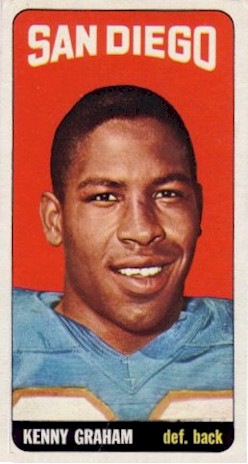
Strong Safety : Kenny Graham
Graham was drafted in the 13th round of the 1964 AFL Draft by the Chargers. The Baltimore Colts drafted him in the 12th round of the NFL Draft. He joined the Chargers, fresh off winning the AFL title.
He won the starting job in training camp and held onto it the rest of his Chargers career. Graham quickly became known for always being around the ball and delivering jarring tackles.
After four interceptions as a rookie, he made his first Pro Bowl the next year after getting a career high five picks. He scored a touchdown off an interception, a feat he would accomplish the next two years as well.
Though he did not go to the 1966 Pro Bowl, he was named First Team All-Pro after getting five more picks and scoring once. He went to the Pro Bowl every year with the Chargers except for his rookie season and the 1966 year.
The 1969 season was one of his best. Graham led the AFL with two touchdowns off his four interceptions. He also forced four fumbles and recovered four fumbles.
Despite being one of the greatest strong safeties in AFL history, the Chargers let him join the Pittsburgh Steelers in 1970. Graham got hurt in the third game and was released. The Cincinnati Bengals signed him for the final five games and he picked off three balls.
Graham then retired at 29-years old because of his injuries. His four Pro Bowls are the most ever by any defensive back in Chargers history.
His 25 interceptions are the fourth most in team history, and his five interceptions returned for touchdowns is tied as the most in franchise history.
San Diego also asked him to field punts on occasion. As a punt returner, his 38 career fair catches is a AFL record as is the 24 he had in the 1969 season.
Kenny Graham is a member of the AFL All-Time Team, but has amazingly been left out of the Chargers Hall of Fame so far. His exclusion from the 50 Greatest Chargers Team is beyond disgraceful.
Emerson Boozer, the great running back of the New York Jets, said no one hit harder than Graham. It is obvious he was dangerous around and with the ball. He is the best strong safety in Chargers history.
Rodney Harrison, Mike Fuller, Darren Carrington, and
Bryant Salter deserve mention.
Free Safety : Joe Beauchamp
Beauchamp joined the Chargers as an undrafted free agent in 1966. Halfway through the year, he found himself supplanting veteran Bud Whitehead for starts at free safety and swiped a pair of passes.
The Chargers moved him to cornerback the next year and he picked off three balls. San Diego moved him back to free safety in 1968 and he led the team with five interceptions and two fumble recoveries. Two interceptions were returned for touchdowns, which led the AFL that year.
Despite that success, the Chargers moved him back to cornerback the next three seasons. He began the 1972 season at cornerback, but was moved back to free safety, where he had a career high six interceptions and scored the last touchdown of his career off a pick.
Beauchamp stayed at free safety the next two years but was bitten by injuries. He missed nine games over that time. The Chargers moved him back to cornerback in 1975, but was only able to play eight games. He retired at the end of the year.
His 23 interceptions with the Chargers is still the sixth most in team history. The three touchdowns he scored off of interceptions in the fourth most in Chargers history.
Joe Beauchamp has not earned any accolades, but his versatility should not be forgotten. He played wherever he was told to help the team.
Charlie McNeil almost got this slot based on his amazing 1961 season where he had 9 picks for a whopping 349 yards and two scores. He still owns the record for 177 yards off interceptions in a single game. But it was his only full season played in five years, and he missed 28 games.
Though his 14 interceptions as a free safety is less than the 19 McNeil had, the fact he played three different positions in the secondary over a decade for San Diego gets him the nod here.
Charlie McNeil, Glen Edwards, Vencie Glenn, Stanley Richard, Bud Whitehead, Bob Zeman, Hanik Milligan, Pete Shaw, and
Chris Fletcher deserve mention.
Cornerback : Gill Byrd
When the Chargers made Byrd their first-round pick in 1983, they asked him to be their top cornerback almost immediately because San Diego had a pair of rookies starting that year.
He showed that he was up to the task especially in 1984. Byrd picked off four balls and returned them for a career best 157 yards. He scored twice off of interceptions, including a 99-yarder.
The Chargers were starting three rookies in the secondary in 1985, so they moved Byrd to strong safety to help the defense out. They moved him to free safety the next year for seven games. Rookie Vencie Glenn showed improvement, so they moved Byrd back to cornerback for the rest of his career.
The 1987 season was shortened four games because of a players strike. It is also the only season in Byrd's career he failed to intercept a pass. He rebounded strong by getting a career high seven interceptions in each of the next three seasons.
Byrd got his first Pro Bowl honor in 1991. After getting his second Pro Bowl nod in 1992, as well as being given the Bart Starr Man of the Year Award, he retired. He has been coaching defensive backs for the Chicago Bears since 2006.
His 42 interceptions are the most in team history and Byrd is one of the 50 Greatest Chargers and a member of the Chargers Hall of Fame.
San Diego has had quite a few excellent cornerbacks play for them and Gill Byrd might be the best of them all. He was also tough, missing just seven games in his ten seasons. The fact that he played every position in the defensive secondary shows how excellent he was.
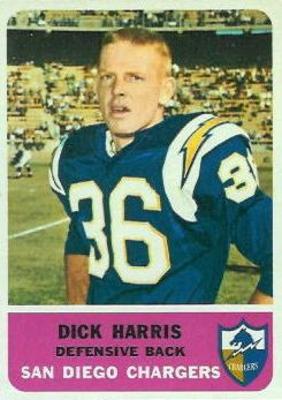
Cornerback : Dick Harris
Harris joined the newly formed Los Angeles Chargers as a free agent rookie in 1960. He was placed in the starting lineup right away. The Chargers also asked him to return 13 punts that year, a chore they would ask him to do just 14 times the rest of his career.
Where Harris excelled was on defense. The AFL did not have an All-Star game in 1960, but Harris was named First Team All-Pro after intercepting five passes and returned one for a touchdown. It set the stage for perhaps the best year of his career.
The 1961 season saw Harris grab seven picks. He returned three for touchdowns, which led the AFL and still is a Chargers record for the most touchdowns off interceptions in a single season. It is also an AFL record, though Miller Farr of the Houston Oilers matched it in 1967.
Harris was named to the first AFL All-Star game and given another First Team All-Pro honor. He followed that up with five the next year. In the Chargers 1963 championship season, Harris had a career best eight interceptions and scored the last touchdown of his career.
He got off to a fast start in 1964, picking off three balls for 82 yards in just six games. He then got hurt and missed the rest of the year. They would be the only eight games of his career that he would miss. Harris returned the next year, but found himself backing up Speedy Duncan. Harris intercepted one ball that year then retired.
His 29 interceptions are the second most in team history, and his five interceptions returned for touchdowns is tied as the most in franchise history. Those five touchdowns off of interceptions is tied with four others as the second most in AFL history.
His two First Team All-Pro nods are the most ever by a Chargers defensive back. San Diego has had several excellent cornerbacks, and the legendary Speedy Duncan was almost put in this slot. I chose Harris because he helped a young team get off the ground to excellence fast by standing out far apart from most others.
Speedy Duncan, Mike H. Williams, Willie Buchanon, Joe Beauchamp, Claude Gibson, Danny Walters, Donald Frank, Bob Howard, and
Dwayne Harper deserve mention.
Kicker : Rolf Benirschke
Benirschke was drafted by the Oakland Raiders in the 12th round of the 1977 draft. He was traded to the Chargers and supplanted veteran Toni Fritsch, who had taken over from Ray Wersching with five games left in the 1976 season.
Fritsch went on to be a Pro Bowl kicker for the Houston Oilers, and Wersching won two Super Bowls with the San Francisco 49ers.
When Benirschke joined San Diego, the famous "Air Coryell" offensive attack was a year away. After attempting 24 extra points as a rookie, it increased to 43 in 1978 after Don Coryell was named head coach six games into the season.
He also began experiencing ulcerative colitis in 1978, but was able to finish the season. Benirschke tied to play through the pain in 1979, but collapsed on an airplane after the Chargers played their fourth game.
He was diagnosed with Crohn's Disease and lost 50 pounds after having his large intestine removed. He came back later to a home game that year to cheer his team on, to the surprise of many. It inspired the team to a 35-7 drubbing of the Pittsburgh Steelers.
The disease did not hold him down. Benirschke came back strong in 1980, making a career best three field goals of over 50 yards. He also made 46 extra points for the high scoring Chargers.The 118 points he got that year was the best of his career.
San Diego was unstoppable in 1981. Benirschke led the NFL with 61 extra point attempts and 55 extra points converted. He scored 112 points that year, and his field goal against the Miami Dolphins at 13 minutes and 52 seconds in overtime sealed a Chargers win in a game famously called "The Epic in Miami".
The 1982 season is best known for being shortened to nine games because of a players strike. The strike hurt what was becoming the best year of Benirschke's career. He had 80 points in his nine games and led the NFL in extra points attempted and made. It was also his only Pro Bowl year.
Benirschke was also known for his charitable work as a player. He was honored as the 1983 NFL Man of the Year, now known as the Walter Payton Man of the Year Award.
He got hurt in the first game of the 1986 season, missing the rest of the year. He returned in 1987, but the season was shortened because of another players strike. Benirschke retired after that year.
He ranks first in Chargers history in extra point attempts and second in extra points made. Nick Kaeding passed him in 2010 in made extra points and is eight away in attempts.
Benirschke ranks second in Chargers history in field goal attempts and third in made field goals. His 766 points, which was a team record when he retired, still ranks fourth best.
The 61 extra points he attempted in 1981 is still a team record. His 55 conversions was a record until Kaeding passed it by three in 2006. His three field goals made of over 50 yards in 1980 is still a Chargers record.
He is one of the 50 Greatest Chargers and is inducted into the Chargers Hall of Fame and the San Diego Hall of Champions.
Rolf Benirschke is not only probably the toughest kicker in Chargers history, he may the best ever.
John Carney, Dennis Partee, George Blair, and
Dick Van Raaphorst deserve mention.
Punter : Darren Bennett
Bennett joined the Chargers as a 30-year old free agent rookie in 1995. He became the only Chargers punter to ever be named First Team All-Pro in his rookie year, and he was named to the Pro Bowl as well.
He became a big part of the team immediately. Bennett never averaged less than 43.9 yards per punt in his first six seasons. This includes the 1998 year where he attempted a career high 95 punts.
The 2000 season was his last as a Pro Bowler. Bennett led the NFL with a career high average of 46.2 yards per attempt. He had one of his most difficult season in 2002. The 37-year old had two punts blocked while averaging 40.7 yards per attempt. It was his lowest average with the Chargers.
He signed a free agent contract with the Minnesota Vikings in 2004 at 39-years old. He got hurt in the preseason of the 2005 season and was replaced by current Vikings punter Chris Kluwe.
Kluwe had to miss a game that year because of injury, so the Vikings called on Bennett. He played one game and punted eight times. One included a 53-yarder. Kluwe then returned, so Bennett retired.
His journey to the Chargers was a special one. Born in Australia, he had previously player 12 years of Australian Rules Football. He retired from the game because of injuries, but led that league twice in goalkicking and is considered a legend of the game.
Bennett got married and decided to honeymoon in California. He stopped by the Chargers offices asking for a tryout. The Chargers brass was impressed enough to have him play that spring in NFL Europe. He earned all-league honors and then joined the Chargers.
One of his career highlights came in 1999 when the Chargers traveled to Australia to face the Denver Broncos in the NFL's first American Bowl.
At 6'5" 235, he loved to tackle return specialists. He knocked one unconscious in his rookie year. He also brought a new style of punting to the NFL.
He used the "drop punt", which is common in Australian Rules Football. The NFL calls it a "pooch punt". Bennett was so good at it that other teams scored Australia looking for punters.
In 2005, the New York Jets signed Ben Graham, who had been playing Australian Rules Football for 12 years and is the same size as Bennett. Graham, now punting for the Arizona Cardinals, has been to the Pro Bowl and tied a record for 49 punts inside the 20-yard line in 2009.
Darren Bennett is a member of the NFL's 1990s All-Decade Team. His two Pro Bowls are the most ever by a Chargers punter and he is one of the 50 Greatest Chargers. No other Charger has more punts or punt return yards than he does, and he is probably the best punter in team history.
Ralf Mojsiejenko, Jeff West, Dennis Partee, and
Paul Maguire deserve mention.
Kick Returner : Andre Coleman
Coleman was drafted in the third round of the 1994 draft by San Diego. He spent his rookie year just returning kickoffs, which he did well at. Coleman scored two touchdowns on 49 attempts while averaging a career best 26.4 yards per return.
The Chargers made it to the only Super Bowl in their franchise history that year. They were trounced by the San Francisco 49ers, but Coleman played well. He set Super Bowl records with eight returns for 244 yards. His 244 total yards was also a record.
His highlight came when San Francisco was ahead 42-10. Coleman returned a kickoff 98 yards for a touchdown.
His second season was the best of his career. Coleman returned 62 kickoffs for 1,411 yards. Both are career highs. He also returned two for touchdowns and was asked to return 28 punts for 326 yards. He took one punt 88 yards for a score. It is tied for the third longest in Chargers history.
The 1996 season was his last as a Charger. Not only did he return 55 kickoffs, but he caught a career best 36 balls for 486 yards and two touchdowns. He left the Chargers at the end of the year to join the Seattle Seahawks.
Coleman played just three games for Seattle before being released. He signed later that year and signed with the Pittsburgh Steelers. He lasted with Pittsburgh for four games in 1998 before being cut. He then retired.
The four career touchdowns off kickoffs in tied for 16th most in the history of the NFL. It is also the most in Chargers history. He ranks second in franchise history in kickoff returns and third in kickoff return yardage.
Though Andre Coleman lasted just three years with San Diego, he had a huge impact and helped his team reach the Super Bowl. Though San Diego played poorly in the Super Bowl, he did not. He could be the best kickoff return specialist in Chargers history.
Ronney Jenkins, Speedy Duncan, Anthony Miller, Tim Dwight, Nate Lewis, Gary Anderson, Keith Lincoln, and
James Brooks deserve mention.
Punt Returner : Leslie "Speedy" Duncan
Duncan was an undrafted rookie who was signed by the 1964 San Diego Chargers. He only got to play five games as a rookie, but did manage to intercept a pass and return one of his nine kickoff returns for a career best 91 yards.
Speedy got on the field more the next year and lead the league in punt return yardage with a career best total of 464. He also led the AFL with a career high 15.5 yards per return average and two touchdowns scored off punt returns. Duncan also excelled at cornerback, grabbing four interceptions, which helped garner his first Pro Bowl honor.
Duncan was a Pro Bowler again in 1966, when he picked off a career best seven balls. He also scored on a league leading 81-yard punt return, and led the league with a 13.2 yards per punt return average.
He went back to the Pro Bowl once again in 1967, when he averaged 12.1 yards per punt return, and picked off two passes and took one interception for a league leading 100 yard touchdown return. This was a team record until 1987.
Duncan scored his last punt return TD in 1968. He took a punt for a career long 95 yards, which led the league. It is also a Chargers record. In 1969, he had six interceptions for a career best 118 yards while scoring a touchdown on a 72-yard jaunt.
He then was injured in the sixth game of the 1970 season, and missed the rest of the year. Duncan joined the Washington Redskins in 1971, and made his last Pro Bowl team after leading the NFL with a 10.6 yards per punt return average.
Washington used him as an extra defensive back, but he also scored his last NFL touchdown when he took his lone interception for a 46 yard score.
Duncan was an important member of the 1972 NFC Champion Redskins while sharing return duties with Herb Mul-Key and backing up cornerbacks Pat Fischer and Mike Bass.
He retired after the 1973 season with a 10.9 career average on 202 punt returns and four punt return touchdowns. He also had 24 career interceptions for three touchdowns, and a 25.2 average on 180 kickoff returns.
Duncan leading the league in punt return average three times is tied for an NFL record. He has the most punt returns in AFL history and is the one of three players to lead the league twice in returns.
Duncan has the most punt return yards in AFL history, as well as having the longest punt return ever. His four touchdowns is tied as the most in AFL history, as is his two in one year.
His 25.9 yards on 115 kickoff returns is the second best in AFL history for a career. His 248 combined returns is the most ever by an AFL player, and his 4,617 total combined is the second most.
The four touchdowns off punt returns is a Chargers record and he ranks second in career returns and return yards on punts. He also ranks fourth in kickoff returns and yards and his 25.3 return average is the best in Chargers history by anyone with more than 50 returns.
Besides being probably the best return specialist in Chargers history,he was a great cornerback. His 21 interceptions with San Diego still ranks seventh best in team history. His two touchdowns off interceptions is tied with 11 others as the fifth most.
His three Pro Bowls are the most ever by a Chargers cornerback.
Duncan is one of the 50 Greatest Chargers and a is member of the Chargers Hall of Fame.
Mike Fuller, Lionel James, Darrien Gordon, Eric Parker, James Brooks, Tim Dwight, Ron Smith, Kitrick Taylor, Andre Coleman, Nate Lewis, Keith Lincoln, and
Eric Metcalf deserve mention.