Monday, March 14, 2011

The Almost All-Time Miami Dolphins

Quarterback : Earl Morrall


Morrall was a first round draft pick of the San Francisco 49ers in the 1956 draft. He was mostly used as a punter in his rookie year, but he did start four games when the starter, Hall of Famer Y.A. Tittle, was injured.

He was traded to the Pittsburgh Steelers after that year, and was named to his first Pro Bowl in 1957. After starting the first two games of the 1958 season for Pittsburgh, Morrall was traded to the Detroit Lions for Hall of Famer Bobby Layne. There, he backed up Tobin Rote, Jim Ninowski, and Milt Plum until 1964.

He was traded to the New York Giants before the 1965 season. He started the entire year, and threw the longest pass of that season for 89 yards. Morrall started seven games the next year and threw a pass that is still franchise long of 98 yards to Homer Jones, the man who invented the spiking of the football after a score.

He then was dealt to the Baltimore Colts in 1968, where his career would be reborn. Hall of Famer Johnny Unitas was injured in the last preseason game and was out for the year, so Morrall became the starter. He led the Colts to a 13-1 record, tossed a career high 26 touchdown passes with a career best 2,909 yards.

He led the NFL in touchdown passes, touchdown percentage and yards gained-per-pass attempt. He was also selected First Team All-Pro and to his last Pro Bowl, while being named the 1968 NFL MVP. The Colts would go on to lose in Super Bowl III. With Unitas healthy again, Morrall started three games over the next two seasons.

In 1970, the Colts would win Super Bowl V when he was called upon again after Unitas was injured early in the game. Morrall helped the Colts beat the Dallas Cowboys 16-13.

Morrall started the first nine games of the 1971 year, leading the Colts to a 7-2 record.
He was then injured and replaced by Unitas as the Colts would go on to lose to the Miami Dolphins in the AFC Championship game.

The Colts then cut Morrall, but he was claimed by the Dolphins because their coach, Hall of Famer Don Shula, had coached him on the Colts' 1968 Super Bowl team and was familiar with the quarterback.

The move paid off early into the 1972 season, when Hall of Famer Bob Griese was injured during the fifth game. Morrall started the next 10 games and helped lead the eventual Super Bowl Champion Dolphins to the only perfect season in modern NFL history.

He took them to the AFC Championship game, but was replaced by Griese. Morrall was named the AFC Player of the Year, First Team All-Pro,, and won the first Comeback Player of the Year Award. He started one game the next year, as the Dolphins repeated as Super Bowl Champions.

Over the next three seasons, he started two games, and won both. Morrall retired after the 1976 season at the age of 42 years old. Though he started only 102 of the 255 games he played over 21 years, Morrall won 60 and tied three, while being on four Super Bowl teams..

He is an inductee of the Dolphins Honor Roll as a member of the 1972 team.

Don Strock, Jay Fiedler, and David Woodley deserve mention.


Fullback : Norm Bulaich
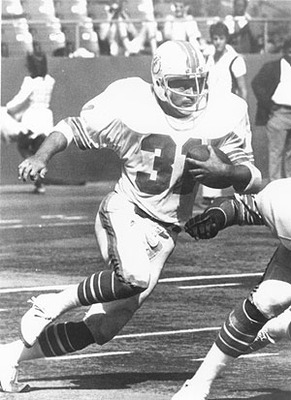

Bulaich was drafted in the first round of the 1970 draft by the Baltimore Colts. He led the Colts in rushing as a rookie, helping lead them to a Super Bowl V victory. He ran for 116 yards in the first playoff win against the Cincinnati Bengals, then his two rushing touchdowns against the Oakland Raiders provided the margin for victory.

His second season was his best. He ran for a career high 741 yards and eight touchdowns. Bulaich set a Colts record that year by running for 198 yards in one game, a team record that stood until 2000, and was named to his lone Pro Bowl appearance.

He was traded to the Philadelphia Eagles before the 1973 season and lasted there two seasons. Bulaich joined the Dolphins in 1975, backing up Don Nottingham. While Nottingham was the primary short-yardage specialist, Bulaich was second on the team with 32 receptions and still scored five times on the ground himself.

He started six games the next year and was second on the team in rushing and receiving. The 1977 season saw him place third in rushing and receiving for Miami while splitting starts with Leroy Harris. After a decrease of touches over the next two seasons, he retired.

When you talk of the great fullbacks in Miami Dolphins history, it all starts with Hall of Famer Larry Csonka. Besides Csonka, only three Dolphins fullbacks have more rushing yards and scores than Bulaich. Just two have more receptions.

There have been many Dolphin fullbacks behind Csonka that brought different skill sets to the team. Even though he didn't always start, Norm Bulaich might have had the best of all of them.

Andra Franklin, Woody Bennett, Don Nottingham, Keith Byars, and Rob Konrad deserve mention.


Halfback : Mercury Morris


Morris was a third round draft choice by Miami in 1969. He spent his first three years as a Pro Bowl kick returner, carrying the ball just 140 times. The Dolphins had a Pro Bowl duo of Larry Csonka and Jim Kiick in their backfield, so Morris special teams play was his main contribution, though he did average 6.8 yards on 60 carries in 1970.

Things changed in the Dolphins perfect 1972 season. Morris began to share carries with Kiick, getting 190 carries. He averaged 5.3 yards per carry, finishing with 1,000 yards. Morris also led the NFL with 12 rushing touchdowns and caught a career best 15 balls as he was named to the Pro Bowl.

The 1973 season was his last as a Pro Bowler, as Miami won their second straight championship. He led the NFL with an excellent 6.4 yards on 149 carries. Morris also ran for ten scores, despite playing with a neck injury. His 6.4 yards per carry is a team record and ranks 17th best in NFL history.

Morris hurt his knee in an exhibition game in 1974, limiting him to just five games and 56 carries that year. With Csonka and Kiick now gone, he became the workhorse in 1975. Morris had a career best 219 carries while gaining 875 yards.

Miami then traded him to the San Diego Chargers. Despite averaging over five yards per carry, Morris retired after one season due to the lingering effects of his neck and knee injuries.

He still ranks fourth in rushing yards in a career for the Dolphins, and his 29 rushing touchdowns is fifth best in franchise history. Morris averaged 5.1 yards per carry with Miami, easily the best in team history by anyone with more than 42 attempts. He ranks sixth in Dolphins history with 754 rushing attempts.

Though he had to share carries with a Hall of Fame fullback and Pro Bowl halfback, Morris earned his Pro Bowls with sheer determination. Blessed with blazing speed, he went from being one of the best kick returners in the league to becoming one of the best halfbacks.

He is an inductee of the Dolphins Honor Roll as a member of the 1972 team, and might be the best halfback the Dolphins ever had.

Jim Kiick, Tony Nathan, Ricky Williams, Mark Higgs, Delvin Williams, and Karim Abdul-Jabbar deserve mention.


Wide Receiver : Mark Clayton


Clayton was drafted in the eighth round of the 1983 draft by Miami. He was buried on the depth chart behind Dolphins greats Nat Moore and Duriel Harris, so Clayton returned a career high 41 punts and scored once.

Miami had also drafted quarterback Dan Marino, a future Hall of Famer in 1983. Marino and Clayton soon developed a close rapport that soon translated onto the football field. He exploded in 1984, helping the Dolphins reach Super Bowl XIX before losing.

Clayton made his first Pro Bowl by leading the NFL with 18 touchdown catches. Not only is it a team record, it was an NFL record at the time and still ranks as the third most ever. He also led the Dolphins with 73 receptions for 1,389 yards at an impressive 19 yards per catch.

He made the Pro Bowl in each of the nest two years, teaming with Marino and bookend Mark Duper as one of the most exciting passing attacks of their era. He led the NFL with 14 touchdown receptions on a career best 86 catches in 1988, then began to experience health issues.

After missing seven games over two years, Clayton rebounded with his last Pro Bowl season in 1991. He had 12 touchdown catches on 70 receptions. After missing three games because of injury in 1992, he was released.

The Green Bay Packers signed Clayton, where he started. He caught 32 balls as Sterling Sharpe was busy setting a then-NFL record with 112 receptions that year. Clayton retired at the end of the season.

No Dolphins player has more receptions and touchdown catches than him. Clayton also ranks second in receiving yardage. His 86 receptions in 1998 was a team record for ten years.

His 84 career touchdown catches still ranks 15th best in NFL history, and he ranks 47th best in receiving yards. Though diminutive, Clayton was an underdog who came from nowhere to become of of the finest wide receivers in Dolphins history.

He is a member of the Dolphins Honor Roll, and his five Pro Bowls is tied with Hall of Famer Paul Warfield as the most ever by a Dolphins receiver.


Wide Receiver : Mark Duper
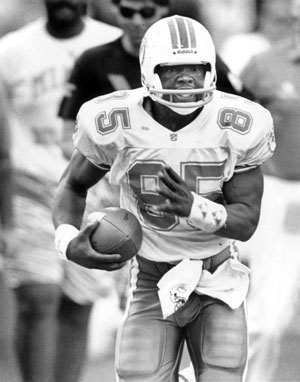

Duper was a second round draft choice of the Dolphins in 1982. Though the season was limited to nine games because of a players strike, Miami reached Super Bowl XVII before losing. Yet Duper played in just two games that season, not recording any statistics.

Business began to pick up for Duper in 1983 when the Dolphins used their first round draft pick on future Hall of Fame quarterback Dan Marino. Though he started just 11 games, Duper averaged a career best 19.7 yards on 51 receptions and scored 10 times in earning his first Pro Bowl honor.

He went back to the Pro Bowl in 1984 as the Dolphins reached Super Bowl XIX before losing. Duper was teaming with fellow wide receiver Mark Clayton as a deadly duo of 5'9" receivers nicknamed the "Marks Brothers".

Duper reached his last Pro Bowl in 1986 after catching a career best 11 touchdowns. One went for a career long 85 yards, which led the league. He caught eight touchdowns in 11 games during the strike-shortened 1987 season.

Injuries nagged him in 1988, but he came back to get 1,085 receiving yards on 70 receptions in 1991. After 44 receptions and seven touchdowns in 1993, he retired. Clayton was also released that year, effectively ending the "Marks Brothers" in Miami. Duper did reappear in 1994 to play two games with the Miami Hooters of the Arena Football League before retiring permanently.

Nat Moore almost was given this spot, and deservedly so, but we decided to let the "Marks Brothers" ride again. Duper's three Pro Bowls are the second most ever by a Dolphins wide receiver.

He has the most receiving yards in Dolphins history, and he ranks second in total receptions. Duper also has the third most touchdown catches in team history, and his 85-yard catch is the second longest by a Dolphin.

He is a member of the Dolphins Honor Roll, and one of the best receivers in Miami Dolphins history.

Nat Moore, Chris Chambers, Irving Fryar, O.J. McDuffie, Howard Twilley, Duriel Harris, Orande Gadsen, Tony Martin, Jim Jensen, Karl Noonan, and Jack Clancy deserve mention.


Tight End : Bruce Hardy


Miami snagged Hardy in the ninth round of the 1978 draft. After rarely being used as a rookie, he started the next two seasons. The following four years saw Hardy splitting starts with other players.

He was named the started in 1985 and caught 121 passes over the next three years. The 1986 season saw Hardy catch a career high 54 passes and five scores. Injuries besieged him in 1988 and 1989, limiting him to just three total games and forcing retirement.

He still ranks ninth all-time on the Dolphins reception list and leads all tight ends. He also tops the list in receiving touchdowns amongst all Miami tight ends.

When you think of all the offensive excellence the Dolphins have given the NFL, the tight end position is the one area that has yet to be truly great. The team has sent just two tight ends to the Pro Bowl a total of three times, yet neither player lasted long with the club. Bruce Hardy could be the best the Dolphins have had so far.

Ferrell Edmunds, Keith Jackson, and Jim Mandich deserve mention.


Offensive Tackle : Richmond Webb


Webb was the Dolphins first round draft selection in 1990. He was put in the staring lineup at left tackle immediately and went to seven consecutive Pro Bowls. He was quickly considered one of the best as his position, and Webb was named First Team All-Pro twice.

Though he was solid in 1997, it was the first time in his career he failed to go to the Pro Bowl. That was followed by an injury the next year that took away significantly from his game, forcing him to miss seven games. Though he returned the next season, he wasn't the same player.

Miami let Webb go to the Cincinnati Bengals in 2001. After one full season, he played in just four games in 2001. Cincinnati released him, so Webb tried out for the Dolphins but failed to make the team. He then retired.

He ranks first amongst all Dolphin linemen in consecutive starts with 118. The seven consecutive Pro Bowls he appeared in is also a team record. Webb also ranks second amongst Dolphin blockers in total starts.

His career started off destined for Canton, but his career seemed to hit the wall when he turned 30-years old. Yet there still is a chance he gets inducted one day because he was an upper echelon player for seven years and due to the fact he is a member of the 1990's NFL All-Decade Team.

Not only is Webb a member of the Dolphins Honor Roll, he might be the best offensive tackle in team history.


Offensive Tackle : Norm Evans


Evans was drafted in the 14th round of the 1965 AFL Draft by the Houston Oilers. He soon found himself in the starting lineup protecting Hall of Fame quarterback George Blanda. He also scored a touchdown off a blocked kick. Yet that still not prevent the Oilers exposing him to the expansion Dolphins before the start of the 1966 season.

Evans was plugged into the starting lineup right away and would stay there his entire career. The Dolphins would improve yearly and Evans was a big reason why. Starting in 1971, Miami reached three Super Bowl games and won the last two.

Part of the reason for their success was an offense that could run over teams with three Pro Bowl running backs while stretching the field with a Hall of Fame quarterback tossing it to a Hall of Fame wide receiver.

The Miami offensive line had two Hall of Famers, yet Evans also was sent to the Pro Bowl twice himself. He stayed a stalwart in the trenched until 1975, when the Dolphins exposed the 34-year old to the expansion draft.

The fledgling Seattle Seahawks grabbed him up and Evans would start over the next two seasons. After spending the 1977 season as a reserve for the first time in his career, he retired. He is an inductee of the Dolphins Honor Roll as a member of the 1972 team.

He never missed a game in his entire 10 seasons with Miami. Evans ranks third amongst all Dolphin linemen in consecutive starts with 91, as do his 135 total starts. There have been few Dolphins players as durable and dependable as Norm Evans.

Wayne Moore and Doug Crusan deserve mention.


Guard : Bob Kuechenberg
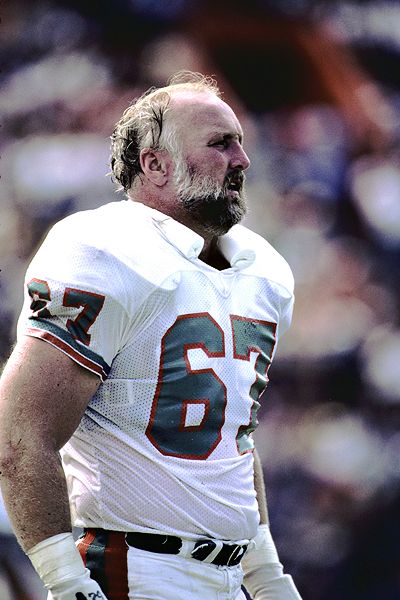

Kuechenberg was drafted by the Philadelphia Eagles in the fourth round of the 1969 draft. He quit the Eagles during training camp and the played for the Chicago Owls of the Continental Football League, the first professional football team to play on Soldier Field since the Chicago Cardinals occupied it for one season in 1959.

He signed with the Dolphins in 1970, and eventually started five games that year. He was named the full time starter at left guard the next year, remaining there mostly the rest of his career. Kuechenberg immediately earned to respect of his peers.

Miami went to the Super Bowl in his first season, where they would lose to the Dallas Cowboys. Hall of Fame defensive tackle Bob Lilly, a star with Dallas, noted that Kuechenberg was one of the best offensive linemen he had ever seen.

After the loss to Dallas in Super Bowl VI, the Dolphins went undefeated in 1972 with the top rated offense and defense in the NFL. After winning Super Bowl VII, Miami repeated as champions the very next season. The offensive line led the way for Miami, with every starter of the 1973 team having made the Pro Bowl in their careers.

He made his first Pro Bowl in 1974, something he would duplicate in three of the next four years. The 1978 season was one of his best, making First Team All-Pro after having to play several games at left tackle because of injuries.

Kuechenberg played left tackle the entire 1979 season, then moved back to guard for the rest of his career the following season. He made his final two Pro Bowls in 1982 and 1983, then retired. His six Pro Bowls are the most ever by a Dolphins guard.

He ranks first amongst all Dolphin blockers in total starts and games played. Only Hall of Fame quarterback Dan Marino has played more games with the team than Kuechenberg. His 15 seasons is ranked second behind Marino's 17 years.

He is a member of the Dolphins Honor Roll as both an individual and member of the 1972 team and has been a finalist for induction into the Pro Football Hall of Fame six times so far. It seems likely that one of the best offensive linemen in Dolphins history will eventually find himself inducted into Canton.


Guard : Ed Newman


Newman was a sixth round draft pick of the Dolphins in 1973. He did start one game as a rookie, helping Miami win Super Bowl VIII. The next five seasons were mostly spent as a reserve behind Hall of Famer Larry Little and Pro Bowler Bob Kuechenberg.

He replaced Little in 1979 and soon became an integral part of the Dolphins attack. He made the first of four consecutive Pro Bowls in 1981, establishing himself an elite NFL right guard.

The Dolphins reached the Super Bowl in 1982 and 1984, but lost both times. Newman was named First Team All-Pro in 1984, yet retired after the Super Bowl XIX defeat. He has since become a judge in Miami.

He ranks second in games played for all Miami offensive linemen. His 12 years is tied with Hall of Famer Larry Little as the most by a Dolphins lineman. The four Pro Bowls he appeared in are the third most ever by a Dolphins guard, one less than Little and two fewer than Kuechenberg.

Roy Foster and Keith Sims deserve mention.


Center : Tim Ruddy


Ruddy was the Dolphins second round draft pick in 1994. After sitting on the bench as a rookie, he was named a starter from his second year on. Called "Big Master" by his teammates, Ruddy led an offensive line that protected Hall of Fame quarterback Dan Marino.

He was durable and gifted. Besides his rookie year, Ruddy started in every game he played and missed just four games with the Dolphins. He was named to the Pro Bowl in 2000. The 2003 season was his last due to knee problems.

Center has been a strength in Miami, starting with Pro Bowlers like Tom Goode and Bob DeMarco. Hall of Famers Jim Langer and Dwight Stephenson followed. Ruddy was once named one of the 40 greatest Dolphins of all-time, cementing his legacy with the franchise always.

Jeff Dellenbach, Bob DeMarco, and Tom Goode deserve mention.


Defensive Tackle : Bob Baumhower
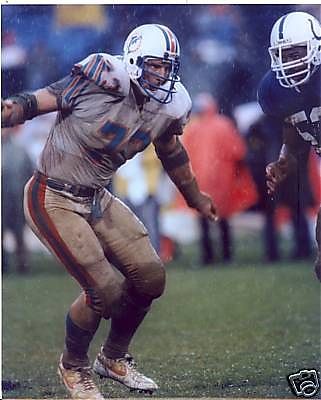

Baumhower was drafted in the second round of the 1977 draft bu the Dolphins. He was drafted to handle the nose tackle position because Miami switched to the 3-4 defense that season. He started in all 14 games he played that year.

He quickly established himself an elite player in 1978, after scoring a touchdown off a fumble and intercepting the only pass of his career. Baumhower made he first Pro Bowl the very next season. He would return to the Pro Bowl in 1981.

The NFL did not recognize sacks as an official statistic until 1982, a season marred by a players strike. Yet Miami led the league in defense behind their "Killer Bs" defense. With Baumhower manning the middle in his third Pro Bowl year, the Dolphins made it to Super Bowl XVII before losing.

His 1983 season may be considered his best. Baumhower was named First Team All-Pro for the only time in his career after getting eight sacks, an excellent number for a nose tackle. He made the Pro Bowl that year and the next after scoring on another fumble recovery.

Miami returned to the Super Bowl in 1984, but were soundly defeated by the San Francisco 49ers after a record setting performance by the 49ers offense.

Most nose tackles are squatty player with wide bases. Baumhower was not of this mold, standing 6'5" and weighing just 261 lbs. He was a master technician with superior intelligence and athleticism. Yet nose tackle is the hardest position to play in football.

Though he was named to the 1984 Pro Bowl, he decided to have knee surgery instead. Earlier that year, his streak of 125 straight starts was ended when he hurt the knee, but he got right back out there, not missing another game, and damaged it further to try to help Miami win a title. He needed help walking off the field after the loss to San Francisco.

The knee got so bad that he couldn't walk for awhile. He sat out of the entire 1985 season, but tried to return in 1986. He played 12 games that year but decided to retire because the knee was giving him problems.

He is easily the greatest nose tackle in Dolphins history, but it was a position he was not keen on playing initially. “But a lot of that was because the center and two guards I was practicing against were Jim Langer, Bob Kuechenberg and Larry Little, three All-Pros, maybe the best trio ever.", Bauhower said. "They bounced my around like a pinball. But I learned a lot, and that made playing other teams easier.”

Baumhower is a member of the Dolphins Honor Roll. His five Pro Bowls is tied for second as the most appearances by a Dolphins defensive lineman, and it is far and away the most by an interior defensive lineman.


Defensive Tackle : Tim Bowens


Bowens was Miami's first round draft pick in 1994. After getting a career best 52 tackles and two forced fumbles, he was named the NFL Defensive Rookie of the Year.

The 1997 season was one of his best. Bowens had a career high five sacks and scored a touchdown off a fumble recovery while tying his second-best career total of 48 tackles. He was named to the Pro Bowl the next season.

He returned to the Pro Bowl in 2002. What interesting about his two Pro Bowl years is that they are the only seasons of his career, excluding his last, where Bowens failed to record a sack as well as being two years that were amongst his lowest tackle totals.

Bowens hurt his back in 2003, forcing him to miss three games that year. He had missed five total in his ten years by then, showing his toughness and dependability. He played two games the next year, but retired because of his back issues.

The excellence of Bowens is especially amazing if you consider he was missing three toes on his left foot caused by a lawnmower accident as a teenager. He was the only Dolphins defensive tackle in franchise history to go to a Pro Bowl until Randy Starks went in 2010.

It is safe to say Tim Bowens is the one of the best defensive tackles in Dolphins history.

Brian Sochia, Manny Fernandez, Daryl Gardner, and Bob Heinz deserve mention.


Defensive End : Bill Stanfill


Stanfill was the Dolphins first round draft pick in 1969. Miami put him at defensive end despite his playing defensive tackle so well in college that he was inducted into the College Football Hall of Fame. Miami was intrigued by his athleticism, which once had Stanfill play quarterback in one collegiate game.

The move worked out great right away. He was named to the Pro Bowl as a rookie after scoring twice on the only two interceptions of his career. He also had eight sacks, which is still a team record by a rookie.

Miami was building a special football team at this time, and Stanfill was a key component. Stanfill would lead the team in sacks the next two years as Miami began to make an impact on the NFL. They reached Super Bowl VI in 1971 before losing as Stanfill made the Pro Bowl.

The 1972 Dolphins team is the only team in modern NFL history to have a perfect season. Though their great defense was dubbed the "No-Name Defense", people knew about Stanfill. He was named to the Pro Bowl and given his only First Team All-Pro honor.

After Miami won Super Bowl VII in 1972, they repeated as champions the next season. Stanfill went to the Pro Bowl after setting a team record with 18.5 sacks. He also set a team record with five sacks in one game.

His 1974 season was his last as a Pro Bowler. He tied his record of five sacks in a game, finishing with 10 that year. Stanfill then jammed his next during a exhibition game in 1975 that was so bad that he spent much of the next two years as a reserve before retiring.

Though the NFL did not recognize sacks in his era, Stanfill retired with a franchise leading 67.5 in 1976. It is still the fourth most in team history. His five Pro Bowls is the second most ever by a Dolphins defensive lineman.

He is a member of the Dolphins Honor Roll as both an individual and member of the 1972 team. Stanfill is also a member of the Dolphins All-Time Team. When talk of the greatest defensive end in Dolphins history is discussed, Bill Stanfill should always be the first name mentioned.


Defensive End : Jason Taylor


Taylor was drafted by Miami in the third round of the 1997 draft. He quickly earned a starting job, getting five sacks. The next year he scored a touchdown off a fumble recovery, a prevalent theme throughout Taylor's career.

He was given his first Pro Bowl and First Team All-Pro honor in 2000 after getting 14.5 sacks and scoring off another fumble recovery. Taylor would score his third touchdown off a fumble recovery the next season.

The 2002 season was one of the best in Taylor's career. He led the NFL with 18.5 sacks and was given his second Pro Bowl and First Team All-Pro honors. Though he had 13 sacks the next year, as well as recording a safety and scoring off yet another fumble recovery, he was somehow not given a Pro Bowl honor.

Taylor then went to the Pro Bowl four straight years starting in 2004. He recorded a safety and scored a touchdown off a fumble recovery in 2005, as well as having a career best 73 tackles and 12 sacks.

The 2006 season is considered by some the best of his career. Taylor was named the NFL Defensive Player of the Year after forcing an amazing nine fumbles. He also scored twice off interceptions, which led the league, and had 13.5 sacks.

After making his last Pro Bowl in 2007, where he scored off an interception, Taylor left Miami and was dealt to the Washington Redskins in a trade. His stay in Washington was so ineffective that the two parted ways after just one season, partly because Taylor refused to participate in team conditioning activities.

He returned to the Dolphins in 2009, but was moved to the linebacker position. He has seven sacks and scored once again off a fumble recovery. Taylor then signed a contract with the New York Jets as a reserve linebacker and recorded a safety. New York released him and he is currently a free agent.

Taylor is all over the record books for both the NFL and Dolphins. His six touchdowns off fumble recoveries and three safeties are the most in NFL history. His 27 fumble recoveries in just two short of an NFL record by a defensive player, and his 246 yards off fumble recoveries is 23 yards short of another NFL record.

His 132.5 sacks is eighth best in NFL history, and the 124 he had with Miami is a team record. Taylor's six Pro Bowls and three First Team All-Pro honors are the most by a defensive lineman in team history.

He scored nine non-offensive touchdowns in his career. Not only is it the most in Dolphins history, but it is the most by a defensive lineman in the history of professional football. His 42 forced fumbles is easily a team record, as is the nine he had in the 2006 season. Since the NFL does not keep track of this stat, it is unknown where it stands historically.

Yet his impact in Miami goes beyond the gridiron. Taylor's mission to try to teach kids to read in a foundation of his garnered him the 2007 Walter Payton Man of the Year Award for his charitable works.

At just 250 lbs most of his career, Taylor was surprisingly stout against the run despite facing off against the opponents best offensive tackles weekly. Most weighed at least 50 pounds more than Taylor, but his athleticism, quickness, strength, and intelligence allowed for him to make play after play.

It is unknown if his career is over, but Taylor does seem bound for induction into the Pro Football Hall of Fame one day. He was always around the ball making huge plays. Whether it was scoring or getting the ball back for his team, the definition of "play maker" certainly can be branded onto his extensive resume.

Jeff Cross, Doug Betters Marco Coleman, Ed Cooke, T.J. Turner, and Vern Den Herder deserve mention.


Outside Linebacker : Bob Brudzinski


Brudzinski was a first round draft pick of the Los Angeles Rams. He started half of his rookie year at left outside linebacker after an injury, eventually being named All-Rookie by several publications.

He moved over to the right outside linebacker the next year and was named a starter on a team known for their excellent defensive unit at the time. The Rams reached Super Bowl XIV in 1979 after an excellent season from Brudzinski. He piled up 127 tackles and five sacks while breaking up 14 passes.

After the Rams lost, Brudzinski headed into the 1980 wanting a pay raise. After the owners declined his request, he walked away from the team nine games into the season. He vowed to never play with the Rams again, which forced them to trade Brudzinski to the Dolphins before the 1981 season.

Miami plugged him in as the starting left outside linebacker right away, and he would stay there the next seven years. Though his specialty was stopping the run, Brudzinski was also solid against the pass and an effective blitzer.

He became an integral part of the Dolphins famous "Killer Bs" defense, which also had Glenn and Lyle Blackwood, Doug Betters, Kim Bokamper, Bill Barnett, and Bob Baumhower all helping Miami's defense rank first in yards allowed and second in points allowed in 1982.

Miami reached Super Bowl XVII in 1982, but lost. He led the team in sacks that year. The Dolphins went back to the Super Bowl in 1984, but lost again. After scoring the only touchdown of his career, off a fumble recovery, in 1985, he continued to be a steadying force.

In 1988, he was a key reserve of Miami. It was the first year of his career he was not a starter. He retired after the next year. Brudzinski is a member of the Dolphins All-Time Team.


Middle Linebacker : Zach Thomas


Thomas was drafted in the fifth round of the 1996 draft by Miami and immediately earned a starting job. He had a career high three interceptions, one of which was taken for a touchdown, and a career best 120 solo tackles. He was named AFC Defensive Rookie of the Year.

The 1998 season was his first to be named First Team All-Pro after matching his career mark of three interceptions and returning two for scores. He then began a run of five consecutive Pro Bowl appearances in 1999, three of which he was also named First Team All-Pro.

He returned to the Pro Bowl in 2005 and 2006, as well as earning his final First Team All-Pro nod in 2006 after getting a career high 165 tackles. Thomas was hurt the next year, appearing in just five games. Miami then released him.

Thomas signed with the Dallas Cowboys in 2008 and played one year for them. He tried to join the Kansas City Chiefs the next year, but was cut in training camp. He then retired.

Since the NFL began officially recording tackles in 2001, Thomas has the fourth most in NFL history. He is one of three players credited with 100 or more tackles in each of his first ten seasons.

His 17 interceptions are the most ever by a Dolphins linebacker and his four touchdowns off interceptions is a team record. His five First Team All-Pro honors is tied with Hall of Famer Larry Little as the most in Dolphins history, and his seven Pro Bowls is the most by a Miami defender.

The list of legendary middle linebackers awaiting induction into the Pro Football if Fame is long, starting with Tommy Nobis, Randy Gradishar, and Lee Roy Jordan. Thomas has a very good chance at one day joining fellow Dolphins middle linebacker Nick Buoniconti in Canton because of his excellence as a player and leader.

Bryan Cox, A.J. Duhe, and John Offerdahl deserve mention.


Outside Linebacker : Larry Gordon


Gordon was the Dolphins first round draft pick in 1976. He started right away at left outside linebacker as a rookie.

Miami switched to a 3-4 base defense in 1977, deciding to move veteran Bob Matheson inside. Gordon replaced him at right outside linebacker, where he would stay the rest of his career.

Statistics like tackles and sacks were not recorded officially during his career, but Gordon was a force. Whether it was intercepting passes or sacking the quarterback, his steady play was a key to the teams defense.

The strike-shortened 1982 season would be his last. Gordon was part of a defense that allowed just 14.2 points per game, which was second best in the NFL that year. Miami began an improbable run in the playoffs, winning three games and giving up just 26 points total.

After shutting out the New York Jets in the AFC Championship Game, Miami would lose 27-17 to the Washington Redskins in Super Bowl XVII. It was the last game of Gordon's career, because he passed away while jogging a few months later.

Though he was taken away in his prime, the seven seasons Larry Gordon spent with the Dolphins was special. He helped bring the team back to the Super Bowl after a nine-year drought and left a legacy those who knew him would not forget.

Kim Bokamper, Bob Matheson, Doug Swift, John Bramlett, Tom Erlandson, Larry Izzo, Joey Porter, Mike Kolen, and Derrick Rodgers deserve mention.


Strong Safety : Dick Anderson
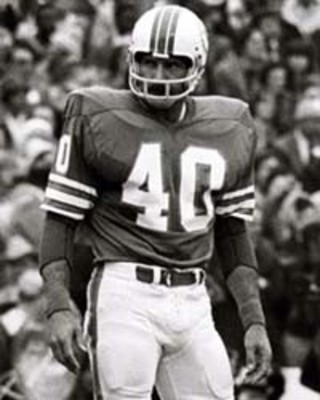

Anderson was the Dolphins third round draft pick in 1968. He was named their starting strong safety right away and responded by leading the league with 230 interception return yards, which came off of eight picks. One interception went 96 yards for a touchdown. It was a team record until 1992.

After getting named AFL Defensive Rookie of the Year that season, he followed that up with 106 yards off three swipes the next year, Anderson led the NFL with 191 interception return yards. He had eight interceptions, returning one for a league leading 86 yards.

Despite all of that excellence, he did not go to the Pro Bowl until the 1972 season after leading the NFL with five fumble recoveries. He returned one for a score. Teaming with Jake Scott as one of the greatest safety duos ever, the Miami "No Name" defense dominated the league in helping the team have a perfect season.

The Dolphins went to the Super Bowl three straight years between 1971 and 1973, winning the last two games. The 1973 season was probably the best in Anderson's career. He led the NFL with eight interceptions and two touchdowns off of those interceptions. He was named to his second straight Pro Bowl and First Team All-Pro honors.

Anderson was named NFL Defensive Player of the Year in a year he picked off four passes for 121 yards for two touchdowns in a key late season game against the Pittsburgh Steelers.

He stayed with Miami until 1977, making the Pro Bowl for the final time in 1974. After missing five games due to injury in 1976, Anderson failed to record any statistics the next year as a reserve. He then retired.

Though he ranks second in Dolphins history with 34 career interceptions, one less than Scott, Anderson was used several different ways by Miami. He played both safety slots, punted the ball nine times, caught a pass, and returned both punts and kickoffs.

The 792 interception return yards in his career is a Dolphins record. His 230 interception yards in one season is still a team record, as is his eight interceptions as a rookie.

Anderson is the only Dolphin with three seasons of at least eight interceptions. His four interceptions in one game in 1973 is a team record, and the 121 yards he got that day stood as a team record until 1992.

His three career touchdowns off interceptions is the second most in team history and the most by a Miami defensive back. The two he had in one game and season is tied as a team record.

He is a member of the Dolphins Honor Roll as both an individual and member of the 1972 team. He is also a member of the NFL's 1970's All-Decade Team. There is no question that Anderson is the greatest strong safety in Dolphins history.

Glenn Blackwood, Jarvis Williams, and Tim Foley deserve mention.


Free Safety : Jake Scott


When the Dolphins grabbed Scott in the seventh round of the draft, Miami general manager Joe Thomas proclaimed the team had gotten first-round talent for seventh-round cash. Scott had been an All-American player who is now on the 50th Anniversary All-Time SEC Team.

Scott was coming in from one season with the BC Lions of the Canadian Football League after having left the University of Georgia as a junior because Vince Dooley had brokered a deal for his team to play in the Sugar Bowl, a lesser game at the time, despite the Bulldog players having voted to play in the Orange Bowl.

Dooley had long called Scott the greatest athlete he ever coached, which includes men like Hershel Walker, but their disagreement in has led Scott to declining induction into the College Football Hall of Fame because Dooley was involved.

Scott joined the Dolphins despite making $10,000 less than he had made in the CFL. He was starting right away at free safety and returning punts full time with the team. He picked off five balls for a career long 112 yards while returning 27 punts. He took one ball 77 yards for a touchdown

The Dolphins safety tandem of Scott and Dick Anderson was quickly becoming the best in the NFL. Both were supremely intelligent and athletic, capable of playing either safety slot at a Pro Bowl level. This versatility gave Miami an advantage few teams have ever enjoyed in NFL history.

The 1971 season saw Scott lead the NFL in punt return yards, getting 318 on 33 returns. He also intercepted seven balls, which led the team and helped Scott earn his first of five consecutive Pro Bowl nods. The Dolphins would get all the way to the Super Bowl that year before losing to the Dallas Cowboys.

He severely broke his left hand on the helmet of Kansas City Chiefs fullback Jim Otis in the 1971 AFC Championship Game, then he would break his right wrist early in Super Bowl VI. This led to both hands in heavy casts and the famous Scott quip, "Now I find out who my real friends are when I go to the bathroom."

The Dolphins 1972 season was one that all teams head into striving for, but only this team actually accomplished. They led the NFL in both offense and defense while going undefeated the entire year. Scott returned less punts that year because Charlie Leigh took most of the attempts.

Miami also had Scott playing strong safety often, and it led to five interceptions. He hurt his shoulder so bad that, heading into Super Bowl VII, prognosticators favored the Washington Redskins because the word was that Scott would be unable to play.

Not only was he able to play, but Scott became the first defensive back, and just second defensive player, to ever be named Super Bowl MVP. In a defensive battle where ball possession reigned supreme, the Dolphins outlasted Washington 14-7 in the lowest scoring game in Super Bowl history.

Scott intercepted a pass on the Redskins first possession, then picked off a second in a crucial moment in the fourth quarter. On a Billy Kilmer pass intended for Hall of Fame wide receiver Charley Taylor, Scott picked off the ball in the end zone and took it 55 yards.That would set up the famous "Garo's Gaffe", when Dolphins kicker Garo Yepremian would throw an interception that resulted in the Redskins only points.

Miami would reach their third consecutive Super Bowl in 1973, a year that saw Scott get named First Team All-Pro on a defense that gave up only 10.7 points per game all season. Scott handled the return duties in Super Bowl VIII and recovered two fumbles in the Dolphins 24-7 win over the Minnesota Vikings.

When Dolphin legends Larry Csonka, Jim Kiick, and Paul Warfield bolted for the fledgling World Football League in 1974, Scott bluffed Miami by saying he also had an offer. The Dolphins quickly signed him to a five-year contract for $600,000, making him the first defensive back in NFL history to make at least $100,000 per season.

He rewarded Miami by intercepting a career best eight passes, which had him earn his second First Team All-Pro honor while playing most of the year at free safety. He also returned 31 punts for 346 yards. He was named NFL Defensive Back of the Year by Football Digest.

Scott and Dolphins head coach Don Shula were close to the point the Shula's son wore Scott's jersey number when playing football because Scott was his hero. When the Dolphins brilliant defensive coordinator, Bill Arnsparger, left Miami after the 1973 season to become head coach of the New York Giants, several Dolphins defenders, including Scott, were unhappy that Vince Costello was chosen as the replacement.

Costello was replaced by Don Doll after one year. Playing under Doll, he enjoyed his final Pro Bowl seasons in 1975 after six interceptions. Rookie wide receiver Freddie Soloman handled the punt return duties instead of Scott that season.

One practice in 1974 had Scott telling Costello he didn't know what he was talking about. When Shula interjected, the pair had words. This carried over into 1976, when Shula wanted Scott to play a preseason game even though the safety said his shoulder was hurting too much.

When Scott refused to shoot pain killing medicine into his shoulder, the coach and safety argued so much that Scott was quickly traded to the Washington Redskins for safety Bryan Salter. Salter lasted six games with Miami before calling it a career after one more game as a Baltimore Colt that season.

Scott lasted three years with the Redskins, starting in every game that he played and missing only two games. Though Washington had him return three punts in 1976, those duties were primarily given to Pro Bowler Eddie Brown.

In his three years with Washington, Scott picked off 14 passes. He had a career best five fumble recoveries in his first year, then picked off seven and retired at the end on the 1978 season.

He is the Dolphins all-time leader in interceptions, punt returns, and punt return yards. Scott is a member of the Dolphins Honor Roll as both an individual and member of the 1972 team. He is definitely the greatest free safety in team history.

He might not yet be inducted into Canton, but his 49 interceptions, punt return prowess, and overall excellence say he surely belongs.

Brock Marion, Lyle Blackwood, Willie West, and Louis Oliver deserve mention.


Cornerback : Sam Madison


Madison was the Dolphins second round draft pick in 1997. He was mostly used as an extra defensive back as a rookie, but would earn a starting job from his second season on.

He intercepted eight balls in 1998, then led the league with seven the next season. He was named to the Pro Bowl and First Team All-Pro after scoring a touchdown off a pick and recording a safety that year.

He made the Pro Bowl, as well as again being named First Team All-Pro, in 2000 after swiping five balls and taking one for a score. He and fellow Dolphins cornerback Patrick Surtain represented Miami in the Pro Bowl that year and again in 2002.

Madison and Surtain were perhaps the best cornerback duo in the NFL and Dolphins history over this time. Teams rarely tested Madison, who was know for his toughness and willing run support.

He became a free agent after the 2005 season, so he signed a contract with the New York Giants. He led the Giants with four interceptions in 2007, helping them reach Super Bowl VLII.

New York defeated a New England Patriots team trying to become the first perfect team since the 1972 Dolphins. He broke his ankle seven games into the 2008 season, causing him to retire at the end of the year.

His 31 interceptions with Miami is the third most in team history and the most ever by a Dolphins cornerback. His four Pro Bowls are the most ever by a Dolphins cornerback, as is his two First Team All-Pro nods.

Some longtime Miami fans will tell you that Sam Madison is the best cornerback in team history. He one day should find himself in the Dolphins Ring of Honor, hopefully joined by Surtain.


Cornerback : Patrick Surtain


Surtain was the Dolphins second round draft pick in 1998. He was used as a nickel back as a rookie and swiped a few balls. Taking over a starting job towards the end of the 1999 season, Surtain picked off two passes and had a career best two sacks.

Now firmly entrenched as a starter, Surtain became a top-flight AFC cornerback. After scoring a touchdown off a pick in 2001, he began a run of three consecutive Pro Bowl appearances in 2002 after scoring once again. The 2002 season saw him named First Team All-Pro as well.

He and Sam Madison were perhaps the best cornerback duo in the NFL from 1999 to 2003, where at least one of them represented Miami in the Pro Bowl each season over that time. The pair would go to the Pro Bowl together twice.

After a career high seven interceptions in 2003, Surtain became a Pro Bowler for the final time in his career the next year. He was due a raise in salary, but Miami chose to dealt the 29-year old to the Kansas City Chiefs for a second round draft pick.

Kansas City had him paired with Ty Law starting in 2006, and the Chiefs had one of the NFL's best pass defenses in 2007. He got hurt in 2008, missing half of the season. The Chiefs then released him, so Surtain retired.

In his seven season with the Dolphins, Surtain intercepted 29 passes. It is the second most ever by a Dolphins cornerback, and tied with Glenn Blackwood as the fourth most in team history by any player. His three Pro Bowls are the second most ever by a Dolphins cornerback.

Miami has had several great cornerbacks wear their jersey over the years, and Patrick Surtain was one of their very best.

William Judson, J.B. Brown, Troy Vincent, Paul Lankford, Dick Westmoreland, Curtis Johnson, Lloyd Mumphord, Don McNeal, Tim Foley, Gerald Small, and Terrell Buckley deserve mention.


Kicker : Garo Yepremian


The journey of Yepremian to NFL stardom is a better story than any Hollywood writer could concoct. He had emigrated to the United States from the island of Cyprus in the 1960's looking for work. He inadvertently watched a few minutes of an NFL game on television and decided he could make money kicking a ball.

After tryouts with several teams, he made the Detroit Lions roster in 1966. He knew so little about the game that he decided not to wear a facemask at first. When Green Bay Packers Hall of Fame linebacker Ray Nitschke hurt him in the fourth game of the season, Yepremian decided to wear one.

A famous story of his football innocence was in a story Lions Pro Bowl defensive tackle Alex Karras liked to tell. Detroit scored a touchdown late in a game that they were losing heavily in. Yepremian celebrated after converting an extra point, prompting Karras to ask Yepremian what he what happy about.

"I keek a touchdown". was Yepremian's reply.

He set an NFL record as a rookie by kicking six field goals on eight attempts in a single game. Jim Bakken, of the Saint Louis Cardinals, broke that record the next season by making seven of nine attempts. Yepremian still holds the rookie record.

He also set an NFL record by making four field goals in one quarter. This has been tied since, but he owns the record for a rookie. Though he made six field goals that day, Yepremian made just seven of 14 attempts in the other eight games he appeared in.

Detroit had him suit up for eight games the next year, where he attempted just six field goals and made two. They preferred having Pro Bowl linebacker Wayne Walker kicking field goals.

He joined the Army for a short stint in 1968, then kicked for the Michigan Arrows of the Continental Football League. The team folded after the season, so Yepremian was out of the game in 1969.

The Miami Dolphins gave him a tryout in 1970, and Yepremian made the team. He had worked hard on his game during his year off, and this was shown by his leading the NFL in field goal percentage that year.

He was named First Team All-Pro in 1971 after making 28 field goals on a career best 40 attempts and leading the league a career best 117 points. His highlight that year was kicking a game-winning field goal during double-overtime against the Kansas City Chiefs in the longest game ever played in NFL history. Miami would go on to reach Super Bowl VI before losing.

Yepremian led the NFL in extra point attempts the next year, as well as the making the first three field goals of his career of 50 yards or longer. He would only make two kicks of 50 yards or longer the rest of his career.

The highlight for Yepremian was not just the fact the Dolphins had a perfect season, but his famous moment in Super Bowl VII will have him forever a part of the games historical lore.

The Dolphins were winning 14-0 when they decided to have Yepremian try a field goal against the Washington Redskins. The kick was blocked right back into Yepremian's hands, where he inexplicably tried to pass the ball.

The ball started to slip from his hands, causing Yepremian to bat it straight in the air. Washington's Mike Bass caught it and ran for a score. Though a play considered a comedy of errors, Miami prevailed with a 14-7 victory.

Yepremian made his first Pro Bowl, as well as earning his second First Team All-Pro honor in 1973, as the Dolphins repeated as champions. He was now a celebrity in Miami, rubbing elbows with their most famous residents.

In the 1973 Pro Bowl, he became the second kicker to ever win the MVP Award after making a Pro Bowl record five field goals. Though Jan Stenerud won it two years earlier, he shared the award with teammate, and fellow Hall of Famer, Willie Lanier. Yepremian is the first kicker to win the award by himself.

Staying with the Dolphins until 1978, he made his last Pro Bowl that year after making 20 consecutive field goals and leading the NFL in field goal percentage. Miami still allowed him to join the New Orleans Saints in 1979, where he played one season.

Yepremian joined the Tampa Bay Buccaneers in 1980, then retired after playing in three games the following season. Of the 1,074 career points Yepremian had, 830 came with the Dolphins and is the second most in team history.

His 117 points in a season was a team record until 1991. No other Dolphin has attempted nor made as many extra points as Yepremian. He has the second most field goal attempts and third most made field goals in team history.

He is an inductee of the Dolphins Honor Roll as a member of the 1972 team and the first Dolphins kicker to ever go to the Pro Bowl or be named First Team All-Pro.

Yepremian is a member of the NFL's 1970s All-Decade Team. He was named Kicker of the Decade for the 1970's, beating out Hall of Famer Stenerud. He was also named one of the Dolphins "Greatest Players" on their 40th Anniversary celebration.

Miami has employed several excellent kickers in their franchise history, yet there have been none better than Garo Yepremian.

Pete Stoyanovich, Uwe von Schamann, and Olindo Mare deserve mention.


Punter : Reggie Roby


Roby was drafted by the Miami Dolphins in the sixth round of the 1983 draft, and was the 167th player chosen overall. He produced immediately, averaging 43.1 yards on 74 punts. He also had the first of just five career punts blocked. Roby went to his first Pro Bowl the next year, when he averaged 44.7 yards on 51 punts.

He would be named an All-Pro that season. Known for his strong leg and incredible hang time, Roby led the NFL in 1986 and 1987 with the longest punts of the year of 73 and 77 yards. He led the NFL with a net average of 38.7 yards per punt in 1986.

Roby returned to the Pro Bowl in 1989 after 42.4 yards on 58 attempts. He then led the NFL with a 45.7 yards average in 1991, on 54 attempts. He is the only Dolphins punter ever to go to a Pro Bowl.

He then joined the Washington Redskins in 1993, and went to his final Pro Bowl the next year. He averaged 44.4 yards on a career high 82 punts. It was also the final time he would be named an All-Pro.

Roby then joined the Tampa Bay Buccaneers for 1995, and averaged 42.8 yards on 77 attempts. He also attempted his only career pass that year, which went for 48 yards. The 1996 season saw Roby in a Houston Oilers uniform, and he had a career best 38 yards net that year.

He stayed with the team as they moved to Tennessee the next year, and then joined the San Francisco 49ers for 14 games in 1998, and averaged 41.9 yards on 60 punts. He then retired from the game with a career average of 43.3 yards per punt on 992 attempts.

Roby was one of a kind. He was known for his quick two step delivery, which many have tried to emulate since. He also wore a watch many games so he could time his punts in the air. The NFL only started recording net punting average in 1991, as well as virtually every other type of punting statistic.

Roby's career net average is probably better than the recorded one of just over 36 yards. He was a great directional punter and put an incredible amount of air under his punts. Twice he had opponents fair catch his punts 23 times over the 8 years that stat was kept.

He still holds several NFL and team records. His 77-yard punt in the longest in Miami Dolphin history, as is his 58.5 yards per punt single game average.

His ten punts in the 1985 Pro Bowl is a record, and he ranks second in Dolphins history in punt attempts and yardage. Reggie Roby is a member of the NFL 1980's All-Decade Team, and should never be forgotten.

Larry Seiple and Matt Turk deserve mention.


Kick Returner : Mercury Morris


Morris was the Dolphins primary kick returner during hid 1969 rookie year. He led the AFL with 43 returns for 1,136 yards and a 105-yard touchdown return that is still the sixth longest in pro football history. He also returned 25 punts.

Averaging an impressive 29 yards on 28 returns the next season, Morris also started to become a bigger part of the Miami offense. He made his first Pro Bowl in 1971 after averaging 28.2 yards on 15 returns.

He began to share kick return duties the next two years as his responsibilities on offense increased. The 1973 Super Bowl-winning season was his last as a return specialist. He returned three kickoffs for touchdowns in his career, a Dolphins record.

The 26.5 yards per kick return average is the 16th best in NFL history and is the best in Dolphins history by anyone with 13 or more returns. His 29 yards per return average is a team record for anyone with 18 or more attempts. He still ranks third in team history in career yards on returns.

While other players have had more attempts and yards as a kick returner for the Dolphins, Morris was the most explosive and effective in franchise history. He is on the Dolphins Honor Roll as a member of the 1972 team.

Wes Welker, Fulton Walker, Brock Marion, and Tedd Ginn Jr. deserve mention.


Punt Returner : Tommy Vigorito
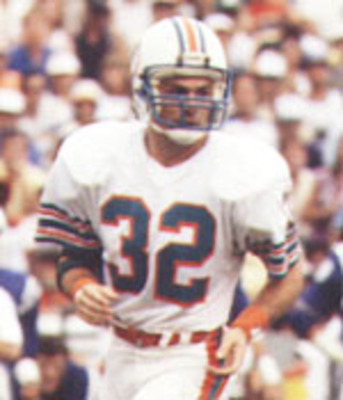

Vigorito was a fifth round draft pick of the Dolphins in 1981. He was the Dolphins primary punt returner, but he also returned the only four kickoffs of his career as well. He had a career high 36 punt returns for 379 yards while scoring on a team record 87-yard return.

He returned 20 punts in the strike-shortened 1982 season and scored again. He got hurt in the first game of 1983 after returning one punt for 62 yards, forcing him to miss the rest of the year and the entire 1984 season. He came back to return 22 punts in 1985, then retired.

Miami liked to throw the ball to Vigorito on third down in his first two seasons, but they ran him occasionally as well. He ran the ball 54 times and caught 57 passes his first two years, then caught just two balls the rest of his career.

His two touchdowns on punt returns is a Dolphins record and he still ranks fourth in team history in punt return yards. Vigorito was a passionate overachiever who finished his brief career as one of the best punt return specialists in Dolphins history.

Jake Scott, Wes Welker, Scott Schwedes, Freddie Soloman, and O.J. McDuffie deserve mention.

Friday, March 11, 2011

NFL 2011 Draft : 10 Quarterbacks Not Named Cam Newton


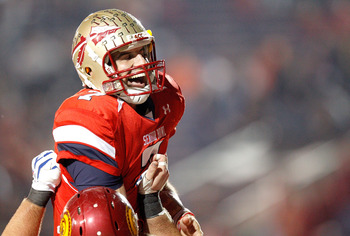
Christian Ponder


He has been schooled well, but is not as athletic as some were once led to believe.

Though he throws a decent short ball, going deep is an issue. He has a tendency to force passes and gets flustered easily.

He works hard and has leadership abilities, but Ponder has durability concerns. Gets compared often to Chad Pennington, so he could be a starter somewhere in his career.

While some see him an early selection in the second round, he could last into the third.


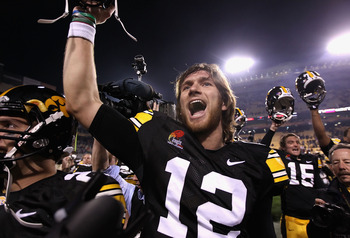
Ricky Stanzi


Scouts like Stanzi's experience, size, athleticism, toughness and maturity.

He also has an acceptable arm for the game today. What scares some is his decision making and deep ball.

Stanzi has the makings of a long-time backup in this league. He has leadership qualities and is a hard worker, so it isn't smart to count him out as a starter.

He could go as early as the second round, even ahead of Ryan Mallett, but it seems he is bound for the third round.


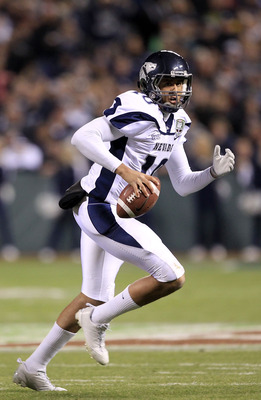
Colin Kaepernick


He is big, athletic and has a gun for an arm.

He has been shooting up some draft boards, passing Ryan Mallett on a few.

While experienced, he might have to learn another position because he has no history in a pro-set offense and is a project. Besides footwork, his long delivery will need work. This issues could drop him to the fourth round.

His size could make for an intriguing wide receiver prospect, but the team that does draft him will need to be patient no matter what position they put him at.


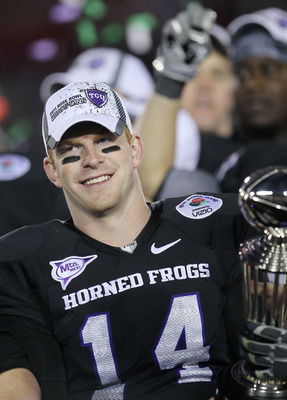
Andy Dalton


Dalton is very smart, a hard worker and has adequate bulk, arm strength and experience. He is a tough guy capable of placing the ball in the right spots.

He isn't very tall or terribly athletic, and he needs work on his mechanics as well. Some wonder how he will do in a pro-style set.

He has the makings of a solid backup, because he understands game management. He would work best in a West Coast system where the dink/dunk pass is king. A probable third or fourth round selection.


Pat Devlin


Devlin is trying to go the Joe Flacco route. Flacco, the Baltimore Ravens starting quarterback, earned his job as soon as he was drafted in the first round of the 2008 draft.

Devlin might go in the third round, but some think he is a fifth-rounder. He has the arm, but needs work on his accuracy, foot placement and is inexperienced. He needs a lot of work in the film room, and has a tendency to gamble.

Though it is possible he can start one day, he looks like an NFL backup right now.


Scott Tolzien


His strength is his accuracy and sound decision making. Tolzien does not have a big arm, but it is passable by the NFL standards of today.

Though he has decent mobility, Tolzien is not a great athlete. One thing he did often in college was win, losing just five times in 26 contests.

At 24 years old, he's older than most rookies. He needs to hit the weight room as well.

There is a chance he gets drafted as high as the sixth round, but it appears he will be, at best, a backup if he makes a team.


Taylor Potts


Destined to be drafted late, Potts has a strong arm and above average accuracy. He needs work on learning the pro-set, and his footwork needs refinement. Potts needs to get stronger.

He will get looked at late in the draft and is a project worth developing for a few years. It is possible he finds himself starting one day in the league, but he can be a serviceable reserve at the least.


Greg McElroy


He will not blow you away in physical measurables, but he balances his short comings there with supreme intellect and a winner's touch. He waited his turn in college, but started winning right away when called on.

He does not have a big arm, but he has great touch and accuracy. He will work as hard as he can to max out his potential, but there is a chance he goes undrafted.

His dad works for the Dallas Cowboys, ask the Garretts how that works, who are in the market for a youngster to eventually replace primary backup Jon Kitna. He might remind Jason Garrett of himself as a player.

Yet do not bet against this kid. He could make a roster and have an impact one day.


T.J. Yates


He is a good leader who had the benefit of being coached by men with NFL experience while in college. He makes good decisions and has good size.

Yates does not have a very strong arm, but he is accurate. Though he has durability concerns, he earned a starting job as a sophomore and has experience. His team's blocking wasn't always stout, so Yates learned early how to stand tall in a crumbling pocket with defenders in his face.

While he isn't a great athlete, he can be a sound backup for years and could get drafted as early as the fifth round.


Josh Portis


Portis has been in the college football system since 2005, went to Maryland University after transferring from Florida University.

After rarely throwing the ball for the Terps, used for his running ability, he left for California of Pennsylvania in 2009 and performed well.

He is the cousin of NFL running back Clinton Portis. He runs well, but is bereft with character issues.

A project who most likely will not get drafted and may have to make a team playing another position.


Others To Consider


Tyrod Taylor
He works very hard at his game and is a terrific leader with an excellent throwing arm.

Taylor is also mobile, able to make plays with both his arm and legs. Yet he is just 6'1", considered too short to play NFL quarterback. He needs major work on fundamentals and tends to lock onto his primary receiver, leaving Taylor often prone to mental errors.

He may get drafted in the last round, but a position switch appears likely.


Mitch Mustain
Mustain might get drafted late, despite sitting on the bench most of his collegiate career.

After going to Arkansas University as a highly touted player, he got off to a good start before clashing with the coaches and heading to USC.

He is not big, but his arm strength is above average and he showed promising skills as a freshman. Some scouts think he is the next Matt Cassell.


Chris Dieker
Missed five games in his senior year due to a broken collarbone. Three-year starter who showed improvement before his injury. He has good size, arm strength and experience, starting three years.

He tends to force passes, which led to him being benched at times. His footwork and release needs work and he is considered a project. Though it is doubtful that Dieker gets drafted, his combination of size and arm strength will warrant a tryout.


Jeff Van Camp
He is a good athlete but needs a ton of work on all of his mechanics. Most likely goes undrafted and gets invited to a training camp somewhere.


Nate Enderle
He started as a freshman and some scouts like his size as well.

He needs work on mechanics, but has shown the ability to stand tall in a collapsing pocket. He performed poorly at the combine, but was good at the East-West Shrine Game.

He was a victim of a ton of dropped passes in college so his numbers aren't a true indication. Enderle looks like he could be a solid reserve, yet perhaps more in the right system.


Jerrod Johnson
He has the size and is mobile. Needs work on his release and footwork, and appears to have a fragile ego. Will quit fast on a play and himself. Lost his starting job in his senior year.

Johnson will get a roster camp invite if undrafted. A project.


Ryan Colburn
Learned under guru Pat Hill. He has good leadership qualities but has been erratic with his accuracy. Didn't throw a lot of interceptions in college, but has questionable arm strength.

Would probably work best in a West Coast system. Probably will go undrafted and get invited to a camp.

Thursday, March 10, 2011

Kevin Love Is Special in Knowing He Is No Dipper, Big E, or Moses


He can sink a shot from far away, well past the three-point line. He can drive past many of the power forwards of today for easy scores. He can post in the blocks and score on anyone in the game.

All those parts of his young game are still developing, but Kevin Love has always been able to gobble up rebounds by the bushel since he got on either an NBA, collegiate, or high school hardwood. On both ends of the floor with a steady consistency not seen for years.

After averaging over 15 rebounds in high school, Love stopped by UCLA for just one season. The 6'10" power forward was an All-American who was named Pac-10 Player of the Year after averaging over 17 points and 10 rebounds in 2007. He also had 23 double-doubles as the Bruins reached the Final Four before losing.

He seemed on his way to finding his name next to Kareem Abdul-Jabbar, Bill Walton, and Gail Goodrich on the long list of Bruin legends who are long considered amongst the best basketball players in NCAA history. Yet Love was looking ahead, so he eschewed his last three years of college in favor of the NBA.

Four NBA teams decided not to draft him in 2008. Derrick Rose, Michael Beasley, O.J. Mayo, and UCLA teammate Russell Westbrook were chosen before him. While Rose is having an MVP caliber season right now, and Westbrook is an All-Star, both Beasley and Mayo have been traded and Mayo was almost traded again recently.

The Memphis Grizzlies selected Love, but wanted Mayo. They traded Love to the Minnesota Timberwolves for Mayo. While Mayo scores 16 points a game for his career, the Grizzlies were recently trying to trade the shooting guard, now coming off the bench, after he fought with teammates and was suspended for steroid use.

Beasley is now Love's teammate, having been a salary cap casualty of the Miami Heat's signings of LeBron James and Chris Bosh. With Love handling the post, the athletic Beasley is currently averaging a career high 19.2 points per game.

Beasley still gets his average of just over five rebounds per game, but the Timberwolves do not ask him to circumcise his game by staying in the blocks the way Miami did. On a roster were just two players are older than 25-years old, most are trying to find their niche under the guidance of head coach Kurt Rambis.

Love just broke a doubles-double record set by the incomparable Moses Malone, who set the record in his 1979 MVP season. Malone, who led the NBA in rebounds five times in his career, was coming off a 1978 season where he had an amazing career high of 1,444 rebounds. He was credited with 51 straight double-double games in 1979, the most since the ABA and NBA merged in 1976.

One of the 50 Greatest Players of All-Time, Malone was a 13-time All-Star who never fouled out of a game in his career despite being an upper echelon defender and unstoppable force on the offense end and all over the boards.

Love says his new record should be respected as far as the post-merger modern game, but he certainly understands the history of the game extends well beyond 1976. He understands his place as well.

Now Love has his eyes set on yet another member of the NBA's 50 Greatest Players of All-Time. Elvin Hayes, considered by most the greatest power forward in the history of the NBA, had 55 straight games of double-doubles on 1973.

Hayes was a 12-time All-Star who led the league in rebounding twice and scoring once in his superb career. Though most might recall how no one could prevent the "Big E" from scoring his patented turn-around jumper that had him score 47 or more points five times in his career, Hayes was a great defender with seven games of 10 or more blocked shots as well.

The 1973 season where Hayes had his 55 games, he averaged over 18 rebounds a game. It is the third best average ever by anyone since Wilt Chamberlain retired. Hayes would take his teams to the finals three times in his career, winning once.

“Whether you put it as a modern-day or an ABA-NBA merger, I would say yes (his new record should be respected),” Love said. “But if you’re looking at the grand scheme of things, you’ve got to look at that 227. The Big Dipper. Wilt the Stilt. He’s something special. You’ve got to look at that. Why not go for Elvin then?”

When one tries to describe the greatest player in NBA history, words are not enough to encompass Wilt Chamberlain. Those 227 straight double-double games are a minimum mark that could be doubled, but there are some scorecard issues stretching back that far.

While fans quickly recall the "Stilt" scoring 100 points in a single game in 1962, some forget he averaged an astronomical 50.4 points and 25.7 rebounds per game the season before. It wasn't an anomaly, because Chamberlain averaged 44.8 points and 24.3 rebounds per game in 1962.

The "Big Dipper" led the league in rebounding 11 times in his 15 seasons, including his last year. Chamberlain also led the league in points scored seven times. When people tried to say all he did was score, the legendary "Stilt" quieted critics by leading the NBA in assists in the 1967 season.

What set Chamberlain far and apart from any other fans choice for "Greatest Player Ever" is the fact the NBA desperately tried to stop him with a mountain of rules changes that were directly aimed at him in hopes of slowing Chamberlain down.

Love knows it is highly unlikely he will come anywhere near Chamberlain's 227 games, but passing Hayes on the double-double list would be amazing in itself. Unlike Hayes, Malone, or Chamberlain, Love is accomplishing his feat on a team with 16 wins in 66 games on a team that gets very little media coverage.

He is just 22-years old and in his third season. Love is on pace to get over 1,200 rebounds this year after averaging over nine and 11 rebounds per game in his first two seasons. He is the leader of a young team filled with talent that will only get better with experience.

Love has been playing on a sore knee, but it has not stopped him from trying to do his best. Love said,"Nothing’s really changed about how I feel about the double-double streak or the situation. I just go out there and play hard.”

Maybe when his career ends, fans will still be speaking of him in the same breath as Moses Malone and Elvin Hayes as they are now. Yet Malone and Hayes certainly have to proud of this youngster continuing the legacy of hard work that isn't seen much in the game anymore.

What Love has accomplished is historic, but the most impressive part is seeing a young man grounded in knowing his place and the trail-blazing players before him while not running around with the bloated ego of a pampered prima donna thinking his feces doesn't stink like so many have before him.

A young star who isn't a head case thinking he is the team. These are the players the NBA needs to promote. Especially one who understands, respects, and revels in the history of the game.

Tuesday, March 8, 2011

Heatles No More : Hey, Hey, They're the Heatees


Here They Come

Crying Down The Street

Shooting Plenty Of Commercials

While They Steadily Get Beat


The only surprise going on in the city of Miami is finding those sheep who actually once believed the team Pat Riley bought could win. As these fair weathered fans hide for cover, it is apparent Heat owner Micky Arison allowed Riley to purchase the "Marx Brothers of Basketball".

Desperation is flying over the franchise like a vulture who thrives off the scraps of hot air and pop references. Ready to swoop when the inevitable conclusion appears much faster than expected.

This vulture has been around since day one, knowing a steady meal will always be readily available unless the team wakes up and humanely kills this Frankenstein they created.

While at Riley has enjoyed success as a coach, his general manager skills need to be questioned. Putting three ball hogs who abhor defense and rebounding on one team is recipe for disaster. Never before in the history of the NBA has this formula worked.

Some teams have tried. The Philadelphia 76ers found this out in the 1970's when George McGinnis and World B. Free fought for shots, while Julius Erving was doing what Dwayne Wade is doing now in trying to make it work by sacrificing parts of his own game for the sake of teamwork.

Instead of whining for help last year, perhaps Wade should have packed up his talents and gone home. Though Chicago has less women in bikinis running around their streets than Miami, the duo of Wade and Derrick Rose probably would have worked much better than things are now with Wade and LeBron James.

Arison and Riley wanted Wade happy for good reason. He is the leader of the team who pours his heart and soul into the game. He has been beat up throwing his body in the paint, but it did help the Heat win a title in 2006.

Some critics think those aches and pains have caught up to the 29-year old, but Wade has adjusted his game to appease two newcomers who were missing the key phrase "winner" on their resumes. This strategy may pay off down the road, but the holes the team has widens each time Wade takes a back seat.

When James pompously stated he was "taking his talents to Miami" in an overblown production number thrown by paparazzi instead of journalists, this group of media immediately anointed the Heat champions and went as far to predict the team would set records yearly for wins in a season.

This noise increased because Chris Bosh had gotten on board the day before James right as Wade committed to staying in Miami. Yet through all the blustering hype, no one chose to look at the obvious weaknesses.

Not the weaknesses of the rest of the roster, though some paparazzi liked to say it didn't matter who filled those roles for the new unstoppable force in the NBA, but the deficiencies on their three highly paid players. Especially meshed together.

The problem with the signings is that Miami basically hired three shooting guards. Though Wade and James, who love to caress the ball for long periods of time, can do an average job in short spurts at the point, both are at their best crashing the paint off the wing.

Bosh might be near seven foot tall, but his game is far away from the rim to avoid contact to his slight frame. He can help rebound on defenses in inconsistent stretches, but he is not the guy a team wants posting up in the blocks.

While Bosh probably has the best jump shot, none of the three are exactly good shooters. James and Wade thought they would spend this year crashing into the rim, but the good teams just pack the defense in and wait.

The desperation mode in Miami has gotten so bad that Mike Bibby was recently brought in. He can join Juwan Howard, Erick Dampier, Eddie House, Zydrunas Ilgaukas, Jamaal Magloire, and Mike Miller on the long list of Heat players who best days were long, long ago. If this was 2001, instead of 2011, the Heat would have quite a team.

While the fair weathered fans point the blame at the helpless Erik Spoelstra, no head coach could get these three to mesh without at least a season under their belts together. Though a strong return by injured power forward Udonis Haslem would be a big help for Heat rebounds, it may not be enough.

Yet Haslem may end up being the real leader of the Heat. He was a free agent before this season, being offered upwards to $10 million more by other teams, yet he decided to remain in Miami in hopes of winning a championship.

Meanwhile the media will keep calling them the "Heatles", an obvious reference to the legendary musical band The Beatles. But the Beatles were fresh, creative, flexible, and ever changing. They always sought new avenues despite reaching a level of stardom never seen before or since.

Miami has the "Heatees", which is in reference to Beatles rip off band The Monkees. A quartet that late comedian Sam Kinison liked to say,"wasn't even a real group!"

The Heatees aren't even a real team. They are swimming in fluff and unearned hype concocted by a few greedy P.R. men. While not everyone was buying into the image day one, more jump off the rickety band wagon by the day.

The best thing for the Heatees is for their season soon so the superstars can go look in the mirror and decide to dedicate themselves to winning a title by working on their weaknesses in the offseason so they can be at their best and fulfill all expectations next year, including their own.

NFL 2011 Mock Draft 1.0


As the NFL combine prepares to wrap up, nothing much more has been answered for the teams heading into the 2011 draft. Most teams needs are pretty clear cut, with only few teams that could start out in any direction.

Trades may be as big a part of the draft day as the players themselves, but trying to speculate who wants to move up or down is pointless at this early stage.

Here is an early peek at how the draft could go down in just over a month from now :


1. Carolina Panthers : Da’Quan Bowers, Defensive End

Ron Rivera, the Panthers new head coach, is a former linebacker who appreciates athleticism and versatility. Bowers has both. Going defensive tackle here is possible, but it was apparent Carolina really missed the freshly departed Julius Peppers off the edge last year.

Some critics fear Bowers is a one-year wonder, while others think the light finally turned on. If this light is indeed on, the Pro Bowl will be a recurring event in his future.


2. Denver Broncos : Marcell Dareus, Defensive Tackle

Here is where the trading could start, yet no one really knows the direction John Elway is headed. John Fox, the Broncos new head coach, is a defensive expert. The current group of defensive tackles Denver has signed is pretty crummy, so Darius fills a big need.

Though Elway just signed Champ Bailey to remain the top cornerback, his being 33-years old is an obvious sign to look into the future. Patrick Peterson could go here, becoming the highest drafted cornerback in NFL history.


3. Buffalo Bills : Nick Fairley, Defensive Tackle

Buffalo just released Marcus Stroud, clearing the way for Fairley. He showed excellent speed at the combine, so he could fit in the Bills 3-4 scheme, looking real good next to nose tackle Kyle Williams.

Wide receiver A.J. Green could get a good look because Lee Evans is 30-years old. If Patrick Peterson is there, he could go despite the Bills already having a deep group at this position.


4, Cincinnati Bengals : Cam Newton, Quarterback

Even if malcontent Carson Palmer stays another year, he is on his way out and has no pop left in his throwing arm. His leadership is obviously questionable, so the Bengals need to look in the future and not let the ghosts of Akili Smith and David Klingler haunt them.

Newton is worth the risk here, but the Bengals may go the safer route. They don’t need Peterson or Green, but could grab Fairley or Darius if they are sitting there.


5. Arizona Cardinals : Patrick Peterson, Cornerback

The Big Red gets a gift here, finding a lock-down defender to bookend Dominique Rogers-Cromartie. While Arizona needs a quarterback and pass rusher, they can fill those slots in the free agent pool. Donovan McNabb, who lives in Arizona, could be available since the Washington Redskins seem intent to keep him on the bench.

Some think Von Miller could go here, but critics think he may be another Aaron Maybin or Vern Gholston as that workout warrior whose measurables never add up on the gridiron.


6. Cleveland Browns : A.J. Green, Wide Receiver

Cleveland gets their man. Green will instantly be the top receiver on a group desperately needing an upgrade for quarterback Colt McCoy, or whoever they plug in.

Cleveland could look to bolster the defensive line with a Cam Jordan or J.J. Watt, but Green should be too tempting to not pass on.


7. San Francisco 49ers : Von Miller, Defensive End

The Niners need a force off the edge and Miller’s strength is rushing the passer. He had 26.5 sacks in his last two years in college, proving he can go get the ball.

Some think new head coach Jim Harbaugh, a former NFL quarterback, will look for a signal-caller here, but I could only see them grabbing Newton at this spot. They might grab Jordan here because he is a defensive end and Miller is more a combo DE/ OLB type.


8. Tennessee Titans : Blaine Gabbart, Quarterback

With Vince Young gone, the Titans need someone at quarterback besides Rusty Smith and the ancient Kerry Collins. This team could try to trade up for Newton as well.

Tennessee also needs help on defense, mainly at linebacker. But there are no linebackers worth grabbing this high.


9. Dallas Cowboys : Adrian Clayborn, Defensive End

Dallas needs help everywhere on defense. J.J. Watt is as solid defensive end who could start right away for them, Rahim Moore would be a big upgrade at free safety, and they desperately need inside linebackers.

Clayborn had 11 sacks as a junior, then spent his senior year being double-teamed. He is also solid against the run and has a frame that additional bulk is possible, He fills a huge need for Dallas.


10. Washington Redskins : Ryan Mallett, Quarterback

The Redskins are probably the only team that could threaten Miami in looking at halfback Mark Ingram. They’d love to get Newton to fall into their laps as well. A cornerback like Prince Amukamara or offensive tackle like Nate Soldier or Anthony Castonzo also would help immensely.

Getting Mallet gives the team the quarterback they need since it was already announced that Donovan McNabb’s days as a starting in D.C. are done. But who knows with head coach Mike Shanahan because Vince Young is out there available.


11. Houston Texans : Prince Amukamara, Cornerback

Houston needs the secondary upgraded immediately, and Amukamara would start as as soon as he was signed. The Texans should concentrate on defense this draft, and try to sign free agent cornerback Nnamdi Asomugha at any price he demands.

A guy like linebacker Robert Quinn could get looked at here, but the issues at the Texans secondary is too great to overlook.


12. Minnesota Vikings : Cameron Jordan, Defensive End

He is the son of Vikings great Steve Jordan and will provide a good pass rushing bookend to Jared Allen. He had a great Senior Bowl and has OLB abilities as well.

Now that wide receiver Sydney Rice has announced his Vikings days are over, Julio Jones could get a look. Minnesota needs a quarterback, but it is doubtful they’d prefer the erratic Jake Locker over an available veteran. Minnesota also needs help on the offensive line, so they might choose to address this issue first.


13. Detroit Lions : Ryan Kerrigan, Linebacker

The 2010 Big-Ten Defensive Player of the Year is the kind of guy you want in a locker room of a team looking to change their losing culture. He is relentless and would fill in the spot emptied by the recently released Julian Peterson. Kerrigan is a good pass rusher who can play defensive end if needed.

Akeem Ayers could get a look here, as well as some blockers to try to get quarterback Matt Stafford to finally play an entire season. A cornerback like Brandon Harris would help too, since Lions general manager Martin Mayhew is a former NFL cornerback himself.


14. Saint Louis Rams : Julio Jones, Wide Receiver

Jones showed better speed than expected at the combine, yet has a history of injury problems. If healthy, he gives the Rams a much needed weapon in their passing attack.

The Rams need help at the defensive line as well. A guy like J.J. Watt might be intriguing to them, or a cornerback like Brandon Harris provides an upgrade. Yet getting their young quarterback more options might be the top priority in the first round.


15. Miami Dolphins : Mark Ingram Jr., Halfback

Ricky Williams, nearing 34-years old, once said that 2010 would be his last year in the NFL, and the oft-injured Ronnie Brown is not an every down type of back. Miami needs to look into the future considering the run game is their bread and butter on offense. Ingram is not a big back, but he could be the type of back to share carries with Brown.

Quarterback is a position some think needs an upgrade, and the Dolphins do need more blockers. Mike Pouncey would help them if he is tabbed here.


16. Jacksonville Jaguars : Rahim Moore, Free Safety

The Jaguars need help in their secondary, especially at safety since Reggie Nelson flamed out and ended up a bust. Linebacker could use more bodies, but the safety situation in Jacksonville is pretty ugly.

If they choose to look in other areas, linebacker and even defensive end could get looked at. Derrick Harvey and Aaron Kampman were terrible last year. Jack Del Rio saved his job as head coach last year, but he needs to upgrade the defense.


17. New England Patriots : Mike Pouncey, Guard

The Pats, who love to wheel and deal on draft day, have two first round draft picks that they might end up trading to move up…or even down. They also own the 33rd pick of the draft, so expect the unexpected with them.

New England is rumored to get ready to release veteran Nick Kazur and Logan Mankins is unhappy with his contract situation. Pouncey, who has center ability, can add depth and last a decade in the league with his abilities. If he plays half as well as his twin brother did with the Steelers last year, the Patriots win here.


18. San Diego Chargers : Akeem Ayers, Linebacker

A defensive end at nearby UCLA, Ayers will give the Bolts another pass rusher off the edge. When you are coming off a season with the top offense and defense, you are playing with house money in the draft.

Losing defensive coordinator Ron Rivera to Carolina will be a task for San Diego to overcome. Too bad they can’t draft a head coach, as the horrid Norv Turner somehow holds onto his job for another season.


19. New York Giants : Nate Solder, Offensive Tackle

A few years ago, I mocked James Laurinaitis to the Jints. They passed on him for Hakeem Nicks and are still searching for a middle linebacker. There are none here worth a first round pick, so adding depth to the offensive line is the next best move.

Soldier is huge. At 6’8″ 320, he can learn from Dave Diehl this year and end up protecting Eli Manning down to road. If they blow off the offensive line, the G-Men could look at outside linebackers like Robert Quinn, Aldon Smith, and Justin Houston. They could even think running back depth with Mikel LeShoure since Brandon Jacobs days appear numbered.


20. Tampa Bay Buccaneers : Aldon Smith, Defensive End

Last year saw the Bucs begin to build a special defensive line. Roy Miller, Gerald McCoy, and Brian Price all have bright futures, but a fourth piece here completes the task. Stylez G. White led the team with 4.5 sacks last year, so an improved pass rush is a must.

Smith is very raw, having just two years of college ball under his belt because of injuries. He is an athletic freak with long arms and a non-stop motor. The Bucs just hired NFL great Keith Millard to teach their kids how to get to the quarterback, so Smith has a chance to be part of something very special.


21. Kansas City Chiefs : Anthony Castonzo, Offensive Tackle

Part of the reason for the Chiefs surprise dominance of the AFC West last year was the top rushing attack in the NFL. Journeyman Ryan O’Callaghan performed admirably at right tackle, but an upgrade is needed. Castonzo started 53 games in college and is 6’7″ 310. He could start right away and bookend Branden Albert for many seasons.

Kansas City might opt to look for a guy to learn from the ancient Mike Vrabel in 2011 at OLB. Guys like Robert Quinn and Justin Houston might get considered. Yet keeping the ground game strong gives the young Chiefs a better chance to duplicate last years success.


22. Indianapolis Colts : Gabe Carimi, Offensive Tackle

The Colts really need help in the trenches on both sides of the ball, so drafting any big body is the right move here. Carimi is 6’8″ 320 as well as very smart and tenacious. He could allow right tackle Ryan Diem to move back to guard and upgrade the line for their aging superstar quarterback Peyton Manning.

Indianapolis might look at the secondary too. Jimmy Smith and Brandon Harris are physical cornerbacks. Since the Colts run defense stinks, defensive tackles like Corey Liuget and Muhammed Wilkerson could help.


23. Philadelphia Eagles : Jimmy Smith, Cornerback

Smith is a big cornerback who plays a physical game. At 6’2″ 205, he is very strong and is excellent at jamming receivers. He is very smart and a hard worker willing to help in run support. Opponents were scared to throw his way in college.

The Eagles seem to yearly be looking for defensive tackle help for their smallish defensive line. Muhammed Wilkerson, who can play defensive end as well, is a local kid from Temple University shooting up draft boards with his 6’5″ 305 frame and upside. Corey Liuget will also get considered.


24. New Orleans Saints : Robert Quinn, Outside Linebacker

Quinn drops due to his 2010 suspension, which brings character issues into question, and a benign brain tumor in his past. He is explosive off the edge, but raw. If the Saints put him on the line, he will need bulk. He also needs to upgrade his pass coverage abilities.

Yet Saints defensive coordinator Greg Williams loves to blitz and New Orleans needs to get much better off the edge. Quinn would give them the needed boost they desire and has the makings of a Pro Bowler written all over him.


25. Seattle Seahawks : Jake Locker, Quarterback

Locker has looked terrible since he left school to do skills events. His arm strength and accuracy have been putrid, to say the least. Yet there are those who love his drive and dedication. Seattle needs their quarterback of the future and head coach Pete Carroll knows Locker well.

Seattle might continue to upgrade the secondary or offensive line insteads. Versatile offensive tackle Derek Sherrod, who can play guard too, or cornerback Brandon Harris might get considered.


26. Baltimore Ravens : Brandon Harris, Cornerback

Harris loves to play and is willing to stick his nose in a pile. The Ravens need cornerback help, and he has the ability to win a starting job day one. He also gets to learn under former Miami Hurricanes and future Hall of Famers Ray Lewis and Ed Reed.

The Ravens could look at Derek Sherrod. His versatility is intriguing and he has the ability to challenge Marshall Yanda for the starting job at right tackle. The Ravens may prefer Jimmy Smith over Harris. Aaron Williams should get consideration as well.


27. Atlanta Falcons : Aaron Williams, Cornerback

Atlanta found out in the playoffs last year that they did not have enough cornerbacks. Williams, coming out after his junior year, started for two years in college. His is a big kid who likes to hit and has good speed. He is good enough to help Brent Grimes and Dunta Robinson right away.

The Falcons could consider adding offensive line depth here as well. Sherrod and the raw Tyron Smith might be considered. Luiget and Wilkerson could help the defensive trenches as well.


28. New England Patriots : J.J. Watt, Defensive End

Remember, we are pretending the Pats stand pat and just draft in order. Watt would be a good get for a team that could surely use an upgrade the defensive end. Watt is a big man with all five tools and propensity to hit opponents hard. He would provide a better option that Brandon Deadrick against the run.

New England could always look at wide receiver too. Torrey Smith is a home run hitter who also excels at returning kicks. Jonathan Baldwin, Reggie Cobb, Jerrel Jernigan, and Titus Young are all wide receivers with good upsides who shouldn’t last on the draft board too much longer.


29. New York Jets : Corey Liuget, Defensive Tackle

The Jets need help in the trenches on defense, so Liuget can help. He is big and strong, but could still use work on conditioning. Liuget has nose tackle ability and reminds many of Saints defensive tackle Sedrick Ellis, the seventh overall pick in the 2007 draft. The Jets could select the massive Phil Taylor instead.

The Jets could look at linebacker here too. Justin Houston would provide youthful depth for the Jets old outside linebackers. Especially since Vern Gholston has been a complete bust. If free safety Raheem Moore is on the board, he would help the Jets.


30. Chicago Bears : Derek Sherrod, Offensive Tackle

Now that the Bears have parted ways with Tommie Harris, getting another body would help. Liuget went to college at Illinois University, but he is off the board here. They may grab him if he is available. The versatile Wilkerson is also one to consider.

Yet Chicago also needs blockers. Tyron Smith will be considered. Smith is raw, but athletic. Sherrod is experienced and able to play all over the offensive line. He should help protect quarterback Jay Cutler’s knee.


31. Pittsburgh Steelers : Phil Taylor, Nose Tackle

At 6’4″ 340, Taylor is a huge man. He dropped 40 lbs last year and was excellent. He is violent and incredibly strong with surprising agility. He still needs work, but will serve as an apprentice to the aging Casey Hampton as a rookie.

Pittsburgh has major issues at offensive tackle, so they might take the very raw Smith to develop down the road. Hampton will soon be 34-years old and coming off the worst season of his career, as well as his most unproductive. Help is desperately needed.


32. Green Bay Packers : Tyron Smith, Offensive Tackle

Green Bay needs to look ahead at offensive tackle. Veterans Chad Clifton and Mark Tauscher will be 35 and 34-years old respectively next year. Smith needs to bulk up and get stronger, as well as work on his hands technique, but spending a season on the bench learning from the pair of veterans will go a long way.

Smith’s future is at left tackle, which works out well for the Packers. Brian Balaga, the Packers first draft choice last year, was excellent for 12 games for the injured Tauscher, but some think right tackle is his best position down the road.

Friday, March 4, 2011

NFL All-Decade All-Time Canton Snubs : Defense

Defensive Tackle : Houston Antwine


6' 270
Defensive Tackle
New England Patriots
1961 - 1972
12 Seasons
156 Games Played
6 Pro Bowls
AFL All-Time Team


Antwine was a third round draft choice by the Detroit Lions in the 1961 NFL Draft, the 38th player picked overall, and an eight round draft pick of the Houston Oilers in the AFL Draft.

When the Oilers traded his rights to the Boston Patriots, Antwine joined the the team.
Though Antwine was still recovering from an injury he suffered at the College All-Star Game, the Patriots first put him at offensive guard. They eventually switched him to defensive tackle during his rookie season. It turned out to be a smart move.

Antwine would be named to an AFL All-Star from 1963 to 1968. He garnered these honors despite having to face multiple blockers on virtually every play. His force enabled fellow Patriot defensive linemen Larry Eisenhauer, Bob Dee, and Jim Hunt become Pro Bowlers multiple times themselves.

He was named to The Sporting News All-AFL First Team in 1969, as well as the Associated Press All-AFL Second Team. Despite having probably the best defensive line in Patriots history, the team became a perennial loser after 1964.

They made the playoffs just one in Antwine's career. The 1963 season saw them reach the AFL Championship Game before losing to the San Diego Chargers. They has the second best defense in the AFL that year, and shut down the Buffalo Bills to reach the title game. Buffalo would go on to win the next two titles.

After his six-year steak of Pro Bowls ended after 1968, Antwine continued to be a powerhouse in the middle of the Patriots defense despite the fact the team could never quite find a home, ending up having to play on four different fields in the Boston area during their AFL days.

Antwine had an injury plagued 1971 season, and was only able to play three games.
He joined the Philadelphia Eagles the next year, then retired at the conclusion of the season. His 39 career sacks are tied with Richard Seymour as the most ever in franchise history.

Antwine was a wrestling champion in college, and his expertise on leverage and technique made him a dominating force. He was also a team leader, and was the Patriots captain and player representative throughout most of his career.

He is a member of the All-Time All-AFL First Team, but is somehow not in Canton. This is confusing, since Buck Buchanan of the Kansas City Chiefs is and Buchanan is on the second team.

Another confusing factor is how the Patriots have yet to retire his jersey, and especially the fact he has not been inducted into the Patriots Hall of Fame thus far.

His six Pro Bowls is tied with Hall of Fame cornerback Mike Haynes as the most ever by a Patriot defender, and it is the third most behind Hall of Fame guard John Hannah and center Jon Morris.

Houston Antwine is easily the best defensive tackle in Patriots history. He would have made an equally dominating nose tackle if the 3-4 defense had been invented in his era. His knowledge of wrestling and leverage, as well as having a squatty body that was impossible to move, is reminiscent of Curley Culp, the greatest nose tackle in NFL history.

Despite being ahead of Buchanan on the All-Time AFL Team, is seems unlikely Canton will give "Twine" his respect. Not only because the Patriots did not win very often in the AFL, but also it appears the voters have mostly turned up their noses at the great players from the league.

Billy Shaw played guard for the Bills and is the only AFL player inducted with no NFL experience. He often pointed out Antwine's exceptional abilities and athleticism. An ability echoed by other AFL greats.

Though lesser defensive tackles have been enshrined into Canton since his retirement, it is a position often overlooked by the voters. It took until 1990 for Buchanan to get in, and he is the only AFL defensive lineman inducted. Antwine is amongst several AFL greats certainly worthy of having a place in Canton.


Defensive Tackle : Keith Millard


6'6 260
Defensive Tackle
Minnesota Vikings
1985 - 1993
8 Seasons
93 Games Played
2 Pro Bowls
1989 Defensive Player of the Year
NFL 1980's All-Decade Team
All-Time USFL Team


Millard was a first round draft pick of the Vikings in 1984, but he decided to sign with the Arizona Wranglers of the United States Football League instead. The Wranglers traded him to the Jacksonville Bulls. The USFL folded in 1985, so he joined the Vikings.

Minnesota had the 6'6" Millard play backup nose tackle as a rookie, which is extremely rare for a player of that height. The rookie started five games and led Minnesota with 11 sacks, which plated in the top-ten in the league. Counting the USFL, Millard had 23 sacks in 1985.

The Vikings switched to a 4-3 defense in 1986, moving Millard to defensive tackle on the right side. After getting 22 sacks over three years, including the strike-shortened 1987 season, Millard was set to have one of the greatest seasons ever by a defensive tackle.

The 1989 season saw him get 18 sacks, the most ever by a defensive tackle in the NFL and only 15 players have ever gotten more. His teammate, Chris Doleman, led the league with 21 that season thanks to lining up next to Millard. Even Al Noga and Henry Thomas were extremely effective. Noga had a career best 11.5 sacks, while the nine Thomas had was the second best total of his career.

Millard also picked off a pass, rumbling for 47 yards, and took a fumble 31 yards for a touchdown. He was given his second and last Pro Bowl and First Team All-Pro honors, while becoming the second, and so far last, Viking named NFL Defensive Player of the Year. Hall of Famer Alan Page was the first NFL player to ever win it in 1971 while with the Vikings.

He was also named the UPI NFC Defensive Player of the Year, an award only Page and Doleman also won while with Minnesota. Page was the first defensive player ever to have won that award, which went defunct after the 1996 season.

Suffering a major knee injury in the fourth game on the 1990 season, he did not suit up again until 1992 as a member of the Seattle Seahawks. Despite a sack in two games played, Seattle released him and the Green Bay Packers had him on their roster for two games.

Millard joined the Philadelphia Eagles in 1993, appearing in 14 games and starting five. He had four sacks, then retired. His 53 sacks with the Vikings still ranks fourth best on the NFL list for the franchise, but Hall of Famers Page and Carl Eller had 108.5 and 130.5 "unofficially with Minnesota, and Jim Marshall, who should be in Canton, had 127 himself.

Though injuries shortened a career that appeared destined for Canton, Millard was ranked 21st of the 50 Greatest Vikings Team put together in 2010. Minnesota has two defensive tackles enshrined in Canton with Page and John Randle, but Keith Millard was surely on their level for a short time before his injury.

Cortez Kennedy, Tom Sestak, Alex Karras, and Tom Keating deserve mention.


Defensive End : Harvey Martin


6'5" 260
Defensive End
Dallas Cowboys
1973 - 1983
11 Seasons
158 Games Played
114 Sacks
4 Pro Bowls
Super Bowl XII MVP
1977 NFL Defensive Player of the Year
NFL 1970's All-Decade Team


Martin was drafted by the Cowboys in the third round of the 1973 draft by the Cowboys, and was the 53rd player chosen overall. He was a reserve his first two seasons, yet it did not stop him from setting a still-standing franchise record of eight sacks for a Cowboys rookie.

Martin continued to be a pass rushing extraordinaire, helping the Cowboys form one of the better defenses in the NFL. He was named a starter in 1975, opposite of long time bookend "Too Tall" Jones, who was entering his first season as a starter. Dallas would reach the Super Bowl that year.

The 1976 season was the first of four consecutive years Martin would be named to the Pro Bowl, and he also had his first career interception. He had a Dallas record 20 sacks in 1977, and was named NFL Defensive Player of the Year.

His 1977 season helped the Cowboys go on to win Super Bowl XII. In that game, Martin and Randy White shared the Super Bowl MVP honors. They are the only defensive linemen to have ever done this.

Martin then had 14 sacks in 1978, along with the last interception of his career. He had nine sacks the next year, and recorded a safety, followed by 12 sacks in 1980. He retired after the 1983 season with an total of 114 sacks. It is unofficially the most in Cowboys history. His two career safeties is tied as the most in Cowboys history.

Dallas had a defensive line that was dominating in the 1970's. Led by Hall of Fame defensive tackle "Manster" White, Martin, Jones, and Jethro Pugh often took over games. White had 111 sacks and Jones had 106. Teammates called Martin "The Beautiful" or "Too Mean" to bookend "Too Tall".

He is also a member of the NFL 1970s All-Decade Team. Though his entry into Canton seems unlikely, given all of the great defensive ends still waiting on induction, I expect Harvey Martin to one day find his rightful place in the Cowboy's Ring Of Honor. It is absolutely stunning that the Cowboys, a team who claims to honor their history, has neglected to do so yet.


Defensive End : Rich "Tombstone" Jackson


6'3" 255
Defensive End
Denver Broncos
1966 - 1972
Seven Seasons
82 Games Played
3 Pro Bowls
AFL All-Time Team


Jackson was signed by the Oakland Raiders as a free agent in 1966. His athleticism was so astounding that Oakland had him wearing the number 32 on his jersey and taking reps as a running back, tight end, and defensive end. He played in 5 games as a rookie before joining the Broncos the following year.

"Tombstone" played as a reserve that year at defensive end, and recorded a safety, Jackson earned the starting job in 1968. He would be named an AFL All-Star that year, then the next two seasons.

Jackson suffered a knee injury in the seventh game of 1970, and was out the rest of the year. After playing in 4 games in 1971, the Broncos traded him to the Cleveland Browns. He retired at the end of that year because of his knee woes.

"Tombstone" was a fierce pass rusher with a wide variety of moves. His favorites were the "head slap" and the "halo spinner". He once broke an opponents helmet with a head slap.

He was also ferocious and strong. Notorious tough guy Lyle Alzado, a Raiders and Broncos legendary defensive end, said that Jackson was the toughest man that he had ever met. Though he left the Broncos over 40 years ago, Jackson is still a respected legend to this day.

He is a member of the Broncos Ring of Honor and their 50th Anniversary Team. Jackson is in the Colorado Sports Hall Of Fame. He is also on the AFL's All Time Team.

Some think Rich Jackson was the best defensive end to have ever played the game. Paul Zimmerman, a long-time writer for Sports Illustrated, has often called "Tombstone" the best pass rusher he has ever seen play.

Many people missed his exploits because the Broncos were a small-market team that no one paid much attention to due to the fact they lost so much in the AFL. Yet Jackson did rack up 31 of his 43 career sacks over three seasons and he is probably the best the Broncos have ever had.

He certainly was headed for induction into the Pro Football Hall of Fame until his injury, but it appears unlikely he will ever get in now. Yet the legend on "Tombstone" still looms large in the Rockies.

L.C. Greenwood, Chris Doleman, Neil Smith, Jerry Mays, Gerry Philbin, Ron McDole, and Ed Sprinkle deserve mention.


Outside Linebacker : Robert Brazile


6'4" 244
Linebacker
Houston Oilers
1975 - 1984
10 Seasons
147 Games Played
13 Interceptions
7 Pro Bowls
NFL 1970's All-Decade Team


Brazile was a first round pick by the Houston Oilers in 1975. He was the sixth player picked overall. Brazile was part a deal former Oilers coach Sid Gillman had made at the end of 1973.

The Oilers acquired Kansas City's 1975 first round selection, along with nose tackle Curley Culp, for defensive end John Matuszak. New head coach/general manager Bum Phillips switched Houston's base defense from the from a 4-3 to a 3-4.

Brazile is credited by many to be most important in making the 3-4 popular by his ability to rush the quarterback from his outside linebacking position. Brazile was the NFL's Defensive Rookie of the Year award in 1975. He was named to the Pro Bowl in each of his first seven seasons.

He was a key member of Oilers teams that went to back-to-back AFC Championship games in 1978 and 1979. In 1984, Brazile's wife died in a car wreck. He retired immediately from the NFL.

Brazil was chosen on the 1970's NFL All-Decade Team. He is the only linebacker from that team not in Canton. Many may remember his moniker in the NFL. Brazile was nicknamed "Dr. Doom" by his team mates after being tossed out of a game in his rookie year for hitting Washington Redskin quarterback Billy Kilmer in the head.

Some may recall the time he bulldogged Dallas Cowboys Hall of Fame running back Tony Dorsett by the face mask. Brazile was a vicious hitter. He was equally excellent is pass coverage and run support as he was rushing the passer.

He didn't always play on good teams, so he wasn't given the nation wide notice, during that era, he deserved. Since the NFL did not record sacks as a statistic until 1982, his impact on the game may not be fully realized by newer fans.

Those who saw Brazile play knew he was always one of the better defensive players in the NFL in his era year in and year out. Robert Brazile deserves to be inducted into the Pro Football Hall of Fame. Ask his peers.


Middle Linebacker : Tommy Nobis


6'2" 240
Linebacker
Atlanta Falcons
1966 - 1976
11 Seasons
133 Games Played
5 Pro Bowls
1966 NFL Rookie of the Year
NFL 1960's All-Decade Team


Nobis was the first draft pick ever by the expansion Atlanta Falcons in the 1966 NFL draft. He was also the first player chosen overall. Nobis started right away for the Falcons, and was very busy on a new team that struggled to a 3-11 record.

He set a Falcons record, that still stands today, when he amassed 294 tackles. It may be an NFL record, but that stat is unofficial and kept by individual teams. He was named to his first Pro Bowl, and was the 1966 NFL Rookie of the Year. He intercepted the first three passes of his career the next season, and returned one for a touchdown. He was also selected to his second Pro Bowl and only First Team All-Pro honor.

In 1968, he was named to his third Pro Bowl, as the struggling Falcons went through a coaching change by hiring Hall of Famer Norm Van Brocklin after the third week of the season. Nobis was injured in the fifth game of the following year, and missed the rest of the season.

Nobis came back in 1970 and was named to the Pro Bowl. He then was injured in the fourth game of the following season, and missed the rest of the year. Nobis would only miss two games for the rest of his career.

He made his last Pro Bowl in 1972, and also scored the last touchdown of his career. The
1973 season would be the best record the Falcons had during Nobis' career. They went 9-5. Atlanta won 50 games in his eleven seasons.

His number 60 the first number retired by the team, and he is a member of the Falcons' Ring of Honor, Georgia Sports Hall of Fame, and the Atlanta Sports Hall of Fame.

He has also been named the NFL Man of the Year (Dodge and Vitalis), and Joseph P. Kennedy, Jr. award, due to his work with the Special Olympics as a member of the Falcons front office, and in his own foundation. Nobis is on the NFL's All-1960s team, which is quite an accomplishment if you consider he didn't even play half of the decade.

It is TRULY astounding that 'Mr. Falcon' still has yet to be inducted into Canton. Sure, he played on many lousy Falcons teams, but he was outstanding. The team got little publicity during his time, but the voters CANNOT use this as an excuse.

These voters are supposed to represent the whole NFL, not just the media driven franchises. They are supposed to be experts, or at least this is what their positions as voters implies. The exclusion of Nobis for all of these years belies that thought.

Tommy Nobis epitomizes what a Hall of Fame football player is supposed to symbolize. Both on and off the field. It is truly disgraceful, and disrespectful, that Nobis is not in Canton.

Levon Kirkland, Hardy Nickerson, and Dan Conners deserve mention.


Outside Linebacker : Kevin Greene


6'3 247
Linebacker
Los Angeles Rams
1985 - 1999
15 Seasons
228 Games Played
160 Sacks
3 Safeties
5 Pro Bowls
1996 NEA Defensive Player of the Year
NFL 1990's All-Decade Team


Greene was a fifth round draft pick of the Los Angeles Rams in 1985. After spending his rookie year as a special teams player, the Rams used him as a pass rush specialist the next two years.

Besides scoring a touchdown off an interception, he compiled 13.5 sacks over that time. Fritz Shurmur, the Rams legendary defensive coordinator and innovator of the nickel defense, then decided to get Greene out of a three-point stance and start him at outside linebacker.

Greene got 16.5 sacks in each of the next two year, the second bringing him a Pro Bowl berth. After 13 sacks and a career best four forced fumbles in 1990, the Rams hired Jeff Fisher as defensive coordinator. Fisher switched the Rams to a 3-4 defense, having Greene line up often at defensive end.

After getting a safety and just three sacks in 1991, Fisher was fired and Greene went back to linebacker. He responded by piling up a career best 87 tackles along with 10 sacks and the third and final safety of his career.

Now a free agent, the usually frugal Pittsburgh Steelers signed him to a big contact. He lasted three years with them, getting named First Team All-Pro in 1994 after leading the league in sacks. Despite going to the Pro Bowl twice in his three seasons, and helping them reach Super Bowl XXX, Pittsburgh allowed him to sign with the Carolina Panthers in 1996.

He made the Pro Bowl in his one year with Carolina, as well as his final First Team All-Pro honor. The Touchdown Club named him NFC Player of the Year, and the Associated Press and NFL Alumni both named him NFL Linebacker of the Year. He also won the very last UPI NFC Defensive Player of the Year Award as well as the NEA Defensive Player of the Year Award after the Panthers reached the NFC Championship Game.

After having maybe his best season, Greene decided to try his hand in professional wrestling. The Panthers were unhappy, so they released him. The San Francisco 49ers quickly signed Greene, using him strictly as a pass rush specialist on third down. His 10.5 sacks that year allowed him to break Hall of Famer Lawrence Taylor's sacks record for a linebacker.

The 49ers released him after the 1997 season, so Greene went back to the Panthers and was named NFC Linebacker of the Year by the NFLPA after getting15 sacks and making the final Pro Bowl of his career. At 37-years old, and in his 15th season, Greene got 12 sacks in 1999 then retired.

His 160 career sacks still rank as the third most by any player in NFL history since the league began recording the statistic in 1982. His three safeties is tied with several other players as the second most in NFL history.

The 72.5 sacks he had with the Rams still ranks second best all-time on the official list, even if Hall of Famers Deacon Jones and Merlin Olsen had more "unofficial" sacks that are not recognized by the NFL. Greene's three safeties with the Rams is a team record.

Greene also ranks third on the Panthers sack list and eighth on the Steelers sacks list despite playing only three years with both clubs. While Greene was obviously a great pass rusher, his pass coverage skills were underrated. His hard work to becoming a well rounded player under Shurmer and Dom Capers was a big reason he lasted 15 seasons in the NFL.

Capers employed Greene while coaching the Steelers and Panthers. When Capers became defensive coordinator of the Green Bay Packers in 2009, he made Greene his outside linebackers coach. Greene's work with Clay Matthews III helped the Packers win Super Bowl XLV.

He has been a semi-finalist for induction into the Pro Football Hall of Fame three times already, a good sign considering so many fantastic outside linebackers have been awaiting induction for decades. Men like Maxie Baughan, Chuck Howley, Robert Brazile, to name just a few. It seems inevitable that Kevin Greene will one day find himself an inductee.

Cornelius Bennett, Carl Banks, John Anderson, Larry Morris, Dave Robinson, George Webster, Larry Grantham, Mike Stratton, and Joe Fortunato deserve mention.


Strong Safety : Johnny Robinson


6'1" 205 Strong Safety/ Running Back
Kansas City Chiefs
1960 - 1971
12 Seasons
164 Games Played
57 Interceptions
77 Receptions
1, 886 Total Yards Offense
18 Total Touchdowns
8 Pro Bowls
AFL All-Time Team


Robinson was a first round pick of the Detroit Lions in 1960. He was the third player picked overall. He opted to go to the fledgling American Football League, where he was a territorial pick of the Dallas Texans.


Under Hall of Fame coach Hank Stram, Robinson started his pro football career as a running back. He rushed for 458 yards in his rookie year at an average of 4.7 yards per carry. He also caught 41 passes for 611 yards, accruing an impressive 14.9 yards per catch average.

Robinson also returned 14 punts for 207 yards at an outstanding 14.8 yards per return average, and returned three kickoffs for 54 yards. He scored four touchdowns rushing, four touchdowns receiving, and returned a punt for a score. He threw the only pass of his pro career that year too, but it was intercepted.

Robinson rushed the ball less in 1961. He had 52 carries for 200 yards and scored twice via the run. He did catch 35 passes for 601 yards, which is an exceptional yards per catch average of 17.2. He caught five touchdowns that year as well. He only returned two punts that year, and would only be asked to return four more his entire career.


In 1962, Robinson was moved to strong safety on defense by Stram. It turned out to be a great move for the Texans. Though he did catch the last pass of his career on offense for 16 yards, he also picked off four passes.

The Texans moved to Kansas City after that season and were renamed the Chiefs. In 1965, Robinson picked off five passes and returned them for 99 yards. The 1966 season was one of Robinson's best years.

He set a career high in interceptions with 10, and returned them for 136 yards, while scoring the only defensive touchdown of his career via an interception. He helped lead the Chiefs to the first Super Bowl ever against the Green Bay Packers. Robinson followed that with five interceptions in 1967. In 1968, he picked off six passes.

In 1969, Robinson set a career high with 158 yards off of eight interceptions. The Chiefs would go on to beat the Minnesota Vikings in Super Bowl IV. Robinson would intercept a pass and recover a fumble that game while playing with broken ribs, which helped keep the Vikings from scoring more than seven points.

He then had a great year in 1970, when the AFL merged with the NFL. He tied his career high with 10 interceptions. He also had 155 interception return yards. He took a fumble 46 yards for the last touchdown of his professional career.

In 1971, Robinson had four interceptions. His last game came on Christmas Day, when the Chiefs and Miami Dolphins played the the longest game in NFL history. It was also the Chiefs' last game in Municipal Stadium. Robinson retired during the off season.

Robinson hold the Chiefs franchise record for a safety with 57 interceptions for his career. He ranks second overall in interceptions behind Hall of Fame cornerback Emmitt Thomas in Chiefs history.

He is still ranked 11th all-time in NFL history in career interceptions, tied with four other players. His 43 interceptions in the AFL ranks third all-time in the leagues history. He led his team in interceptions five times in his career.

No other strong safety in pro football history has more interceptions than him, and only three safeties have had more. His six First Team All-Pro honors is tied with Jim Tyrer and Bobby Bell as the most in team history, and his seven Pro Bowls are the most by a defensive back in Chiefs history.

Robinson is a member of the AFL All-Time Team and one of only twenty players who were in the AFL for its entire ten-year existence. Robinson was a six-time All-American Football League selection and is credited by many to have redefined the role of the strong safety in professional football.

His career was more than spectacular. He was the consummate team player who did whatever it took to help his team win, whether it was on offense, defense, or special teams. His stats do not lie, and his impact on the game is immeasurable.

Maybe the voters have yet to induct him due to the inductions of Buck Buchanan, Emmitt Thomas, Willie Lanier, and Bobby Bell? It certainly took the voters way too long to induct Thomas. Much as they are taking much too long in Robinson's case.

Many fans today don't know much about the AFL. Some may think I am referring to Arena football? It is up to the NFL Seniors Committee to call this to mind while they still can, and while the players are still alive. The Seniors Committee must be woken up and nudged.

Carnell Lake, LeRoy Butler, Joey Browner, Ken Easley, Kenny Graham, and Dick Anderson deserve mention.
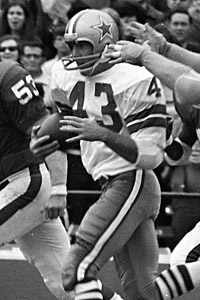


Free Safety : Cliff Harris


6' 188
Free Safety
Dallas Cowboys
1970 - 1979
10 Seasons
141 Games
29 Interceptions
18 Fumbles Recovered
1 Touchdown
6 Pro Bowls
NFL 1970's All-Decade Team


Harris was not chosen in the 1970 NFL Draft. He started immediately at free safety in his rookie year. He intercepted two passes, returning one for 60 yards, and also recovered three fumbles.

Although military obligations caused him to miss the second half of the season, he returned in time for the Cowboys' Super Bowl VI win. Harris also returned punts and kickoffs for the Cowboys from his second season until his fifth season. His best season returning kickoffs was in his second year.

Harris returned 29 kicks for 823 yards at an excellent 28.3 average. All of these stats are his career highs. He took one kick 77 yards for the longest return of his career. He also averaged a career best 7.6 yards per punt return on 17 punts. Harris picked off two passes that year and recovered three fumbles as well.

He ended up with 63 kick returns at a very impressive 25.7 average for his career. He also returned 66 punts in his career. Harris was steady. He intercepted two or more passes every year of his entire career. His career high was five in 1977, when the Cowboys won Super Bowl XII.

In 1975, Harris took an interception 27 yards for the only touchdown of his NFL career. Harris was named to his first Pro Bowl in 1974, and would be named to the Pro Bowl each year for the rest of his career.

Harris earned the nickname "Captain Crash" during his career. He was a starter his entire NFL career, and was fearless versus the run. Harris was a notoriously hard hitter who would make opposing wide receivers get alligator arms when coming across the middle.

He was on five Dallas Super Bowl teams during his career. Harris wore the pads of place kickers in order to keep his speed and quickness up throughout his career, making his hitting prowess even more impressive.

Harris announced his retirement following the 1979 to concentrate on his business ventures, where he runs a company with former Cowboys strong safety Charlie Waters. They also wrote a memoirs about their time together with the Cowboys. Sports Illustrated named him to their Dream Team at free safety. "Captain Crash" was named to the Dallas Cowboys Ring of Honor in 2004.

Harris changed the way the free safety position was played. His run support is legendary in Texas, and his intelligence was a big part of his game. Harris teamed with his best friend, Waters, to form one of the better safety duos in the NFL throughout the 70's.

Waters made three Pro Bowls from 1976 to 1978, the same stretch of time Harris was named First Team All-Pro. Harris was noted for always being around the ball. He got the ball back for the Cowboys 47 times in his 10 year career. He has been a finalist for the Pro Football Hall of Fame.

I don't know what the voters are waiting for. He should have been in already. With his being so close in 2004, there is little doubt in my mind that Cliff Harris will one day be in Canton. Hopefully sooner than later.

Steve Atwater, Nolan Cromwell, Deron Cherry, Eddie Meador, George Saimes, and Goose Gonsoulin deserve mention.


Cornerback : Louis Wright


6'2" 200
Cornerback
Denver Broncos
1975 - 1986
12 Seasons
166 Games Played
26 Interceptions
11 Fumble Recoveries
512 Return Yards
4 Touchdowns
5 Pro Bowls
NFL 1970's All-Decade Team


Wright was drafted in the first round of the 1975 draft by the Denver Broncos. He was the 17th player picked overall. He started all 11 games that he played in his rookie year. He intercepted two passes and recovered one fumble.

In 1977, he had three interceptions for 128 yards. He also scored the first touchdown of his career. Wright was a key member of the "Orange Crush" defense that went to Super Bowl XII. Wright would garner his first Pro Bowl nod that year as well.

Wright would make the Pro Bowl in each of the next two seasons as well. In 1979, he took a fumble 82 yards for a touchdown. He ended up missing half on 1981 due to an injury, but still was named to the UPI All-Conference Second Team.

Wright came back at full health for 1982 with two interceptions. He snared a career high six interceptions in 1983, and was named to the Pro Bowl team.

In 1984, Wright would return a fumble for a touchdown and was named to The Sporting News All-NFL First Team, Pro Football Weekly All-NFL First Team, Pro Football Weekly All-Conference First Team, UPI All-Conference Second Team, and Newspaper Ent. Association All-Conference Second Team.

The 1985 season saw him intercept five passes, and score the last touchdown of his career. Wright also made his last Pro Bowl team that year as well.

Wright played his last season in 1986. He picked off three balls, and helped lead the Broncos to Super Bowl XXI. Wright is a member of the Denver Broncos Ring of Fame. His five Pro Bowls and two First Team All-Pro nods were the most ever by a Broncos cornerback ever until Champ Bailey passed him by one each recently.


Wright was a shutdown cornerback the day he walked onto an NFL field. Teams would hardly throw the ball to his side of the field. He was also a hard hitter, and was one of best run supporting cornerbacks of his era.

He was vital to the "Orange Crush" defense. Hall of Famer Stan Jones coached a line that featured Lyle Alzado and Rubin Carter. Tom Jackson and Randy Gradishar were top notch linebackers. Strong safety Billy Thompson was also great. The Broncos were first in the NFL against the run in 1977.

Wright was consistently excellent. His 163 starts rank seventh all-time in Broncos history. Opponents feared him. He is the greatest defensive back in the history of the Denver Broncos. Many of his contemporaries feel he was the best cornerback in the AFC, if not the entire NFL, during his career. He was big, and fast.

He wasn't one to blow his own horn, and has flown under the radar of the Hall of Fame voters since he has retired. Recreational football fans may look at his stats and not be impressed, but tackles were not a recorded statistic throughout much of Wrights career.

He was always amongst the teams leaders in tackles, which is impressive when you consider how much teams tried to avoid him. If you were blessed enough to have seen Louis Wright play, then you would agree he deserves induction into Canton.


Cornerback : Jack Butler


6'1" 200
Cornerback
Pittsburgh Steelers
1951 - 1959
9 Seasons
103 Games Played
52 Interceptions
827 Yards
10 Fumble Recoveries
9 Touchdowns
5 Pro Bowls
NFL 1950's All-Decade Team


Butler was signed as an undrafted free agent by the Steelers in 1951. He started right away and had five interceptions for 142 yards and a touchdown in his rookie year, and followed that up with seven interceptions for a career high 168 yards the next year. He also caught three passes for two touchdowns.

In 1953, he caught two passes for a touchdown and had nine interceptions for 147 yards and another touchdown. He also had a career high three fumble recoveries.

Butler led the NFL in 1954 with two touchdowns off of his four interceptions. Butler was named to his first Pro Bowl in 1955, despite it being the only season of his career where he did not record an interception. He would be named to the Pro Bowl until 1958.

He recorded six interceptions for 113 yards in 1956, and returned a fumble for the last defensive touchdown of his career. He also caught the last pass of his career, a 10-yard touchdown reception. It was also the last touchdown of his career.

Butler led the NFL with 10 interception in 1957. He followed that up with nine picks the next season. Though he only managed to play seven games due to a knee injury in 1959, he still had two interceptions. He was named First Team All-Pro in each of his last three seasons in the NFL.

He retired after that season because of the injury. His 52 interceptions in nine seasons were second most in NFL history when his career abruptly ended in 1959 and still rank second in the Steelers history.

Butler was named to the NFL's Team of the Decade for the 1950s, and was selected as one of the top 300 players to play in the NFL at that time. In October 2008, Butler was named as one of the 33 greatest Pittsburgh Steelers of all time.

The Steelers named those players to this team as part of their 75th anniversary season celebration. He is also a member of the Steelers 50th Anniversary All Time Team. When he retired from playing, Butler became an NFL scout. He was the director of BLESTO for over 40 years until he retired at 80 years old in 2007.

If you know the game, you realize how important BLESTO is to the NFL. Butler has helped start the career of innumerous scouts, player personnel directors, and general managers in the NFL.

There is only two reasons I can see how the voters in Canton have overlooked Butler as a player. Winning and lack of knowledge when it comes to professional football. The Steelers didn't do a whole lot of winning until the 1970's, and I have long said in this series that the majority of voters are incompetent. Many do not know a thing about football, and get their insights from headlines...and maybe even kickbacks.

Butler was one of the hardest hitting cornerbacks to have ever played the game. Yet, he also had shut down ability, which is shown with his 52 thefts. Those 52 interceptions were tied for second All-Time in NFL history when he retired.

Personally, I think Butler's contributions off the field make him worthy two different ways. But, sticking to just his play on the gridiron, there is no question that is is truly a disgrace that Jack Butler has not yet been inducted into the Pro Football Hall Of Fame.

Aeneas Williams, Frank Minnifield, Lester Hayes, Bobby Boyd, Dave Grayson, Butch Beard, and Miller Farr deserve mention.


Punter : Ray Guy


6'3" 195
Punter
Oakland Raiders
1973 - 1986
14 Seasons
207 Games Played
1049 Punts
44,493 Yards
42.4 Yard Average Per Punt
7 Pro Bowls
NFL 75th Anniversary All-Time Team
NFL 1970's All-Decade Team


Guy was a first round draft pick of the Oakland Raiders in the 1973 draft. He was the 23rd player picked overall. He is considered the greatest punter to have ever played college football, and has a trophy named after him. The Ray Guy Award is given annually to the best collegiate punter in the nation.


Guy is the first punter to ever be drafted in the first round by the NFL. His impact was immediate. He was named to the Pro Bowl as a rookie, when he averaged 45.3 yards per punt. Guy would be named the Pro Bowl Punter every year up until 1978.

At the 1976 Pro Bowl, Ray Guy became the first punter to hit the Louisiana Superdome video screen. In 1979, he was named to the UPI All Conference Second Team, and the Newspaper Ent. Association All-NFL Second Team.

He was named to his final Pro Bowl in 1980 after averaging 43.6 yards per punt. He also booted a career long punt of 77 yards that year. For some unknown reason, he was not named to the 1981 Pro Bowl, despite punting a career high 96 times and having a 43.7 average. He was named to the UPI All Conference Second Team.

Guy booted the ball over 70 yards in four of his seasons, and kicked five over 60 yards in one season alone. His shortest season long was 57, in the strike shortened 1982 season. That season also was the only season of his career when he did not average over 40 yards per punt, finishing with a 39.1 average.

He ended the last three years of his career averaging 90 punts per season, when he retired after the 1986 season. Guy did more than just punt for the Raiders. He threw three career passes, completing two for 54 yards. His first career pass was intercepted. Guy also rushed for 43 yards on 11 attempts.

In 1976, Guy was asked to kick an extra point, but missed. He only had three punts blocked in his entire career, and never had a punt returned for a touchdown. He led the NFL in punting three times also. He also kicked off for aging kicker George Blanda, a Hall of Famer, for several years.


Guy was an integral part of the Raiders. He also was on three Super Bowl winning teams in Oakland during his career. The highlight of his Super Bowls was in 1983. His punt in Super Bowl XVIII pinned the Washington Redskins inside their 12-yard line, which led to a Raiders touchdown via a turnover the next play.

He was also named the punter on the National Football League's 75th Anniversary Team, the Super Bowl Silver Anniversary Team and as a member of the NFL 1970's All-Century team. He was recently inducted into the Bay Area Sports Hall of Fame.

If you saw Guy play, you must be scratching your head right now as to why he isn't yet in Canton. His punts were legendary. Other teams would test the balls that he punted for helium, due to the heights his punts attained.

I had thought, after seeing kicker Jan Stenerud inducted in 1991, that the voters were FINALLY recognizing the importance of special teams. In 1994, Guy was the first punter to be nominated, but he still has not been elected.

I find myself often questioning the football knowledge of the voters. Some claim to be "purists", saying that specialist do not belong because they only get on the field for a few plays each game. Still, isn't Cantons reason for existence based upon what players do once on the field?

There is NO DOUBT that Guy helped the Raiders win many games. Even if you disregard his statistics, you cannot look past his impact on football at all levels. Wake up the voter in the media that represents your area. Ray Guy deserves his place in the Pro Football Hall of Fame right now!

Jerrell Wilson, Darren Bennett, Reggie Roby, Don Chandler, and Bob Scarpitto deserve mention.