As the Washington Redskins finish a third straight season at the bottom of the NFC East, an era where they have 15 total victories, there has been scattered areas of improvement. This is a positive sign for a franchise trying to rebuild a disheveled roster that suffered through years of poor decisions made in the front office.
Though the Redskins new general manager and head coach have yet to make a huge impact to verify a statement of improvement, it appears owner Dan Snyder has enough reason to be patient and stay the course that has been laid before the team.
Struggling often comes with rebuilding, so the roster has players who did not perform well enough to warrant a return in 2012. Yet there are hidden gems in a disastrous season where Washington failed to realize the Super Bowl hopes every team begins a season with.
Quarterback Rex Grossman
 - He is, at times, a poor man's Brett Favre. At other times, he is the equivalent of a junior high school sandlot quarterback.
Like Favre, he turns the ball over in bunches with throws no professional quarterback should make. He also has a habit of taking delay of game penalties in bunches and takes tons of ill-advised sacks that result in huge losses of yards.
Grossman was brought back in 2011 because of his familiarity of Kyle Shanahan's offensive system. This has helped him make plays that show off a skill set that has intrigued many ever since he joined the NFL in 2003.
He is, at most, a system quarterback who needs an exceptional defense to carry him and cover Grossman's innumerable mistakes. But he is no more than a backup because of his constant mental errors. He is certainly on the lower tier of starting quarterbacks in the NFL, as shown currently by his eight fumbles and league leading 19 interceptions.
Washington will most likely upgrade the quarterback position in the draft, thus ending Grossman's days as a starter. He made $810,000 this year, but is is just slightly more than backup John Beck. It is doubtful both will be back in 2012, but Grossman may leave on his own thinking he can start for another team elsewhere.
Grade : D +John Beck - Redskins brass spun stories that Beck could lead the team before the season began, but he was beat out for the starting job in training camp. He did get three starts this year, but lost each of them. Beck has now lost all seven of his career starts, but four did occur with the 1-15 Miami Dolphins in 2007.
He took 16 sacks and threw four interceptions in his four games. While the blocking was not good in stretches, it was expected that his mobility would help prevent so many sacks in a short time.
It won't be shocking to see him return in 2012, but as a reserve since most of the football world expects the Redskins to draft a quarterback to start.
Grade : DRunning Back Roy Helu
 - When Redskins general manager Bruce Allen grabbed Helu in the fourth round of the 2011 NFL Draft, he had an idea Washington had a steal on their hands. Those ideas were put into reality after the rookie was forced into action much earlier and much more often than they expected.
Helu became the main ball carrier after injuries disheveled the backfield. He has responded even better than expected, showing excellent receiving abilities as well. Not only does Helu lead the team with 635 yards rushing, at a respectable 4.3 yards per carry, he has 47 receptions.
The best part of his success may be his ball security. Helu has fumbled twice, but recovered one. He also became the first Washington rookie to for 100 yards in three consecutive games. The Redskins can only hope for similar results in the future.
Grade : A +Tim Hightower - Getting Hightower in a trade this year excited the halfback and Washington fans, because most knew the abilities of the hometown hero from his previous three seasons with the Arizona Cardinals. The only question was if he could last all year as the primary ball carrier.
His season ended after getting hurt in the fifth game, but he was averaging more touches per game than he had before. The reviews of his time were mixed because he was scoring less touchdowns and catching less passes, but Hightower's injury put a damper on getting a real review of his abilities.
His injury allowed Washington to discover rookie Roy Helu, so it seems likely he will go back to a familiar role to sharing the football in 2012.
Grade : CRyan Torain - Injuries basically ended his Redskins career, as Washington cut him a few days after Christmas in 2011. Torain has had injuries plague him ever since college, but his interesting skill set should get him a training camp invitation somewhere in 2012.
Drafted in the fifth round of the 2008 draft by Mike Shanahan and the Denver Broncos, he was lost for the year after getting hurt in his first NFL start. After sitting out the 2009 season, he rejoined Shanahan in Washington last year.
Many got somewhat excited about Torain after seeing him run for 742 yards in eight starts, but injuries soon hit him again. After sitting out preseason and the first three games of the year with a hand injury, Torain led the Redskins to a victory by running for 135 yards on 19 carries.
Since then, he had gained just 65 yards on 40 carries and fell on the depth chart so far that the team decided to part ways with him.
Grade : DEvan Royster - Royster spent most of the year on the practice squad, but was promoted in week 10. Since then, he has run for an impressive six yards per carry on 36 attempts as a reserve.
While pounding the ball between the tackles is more his game, the rookie has had a few impressive moments. He won't outrun opponents, but Royster gets by with intellect and enough elusiveness to show why the Redskins used a sixth round draft pick on him this year.
He will return next year hoping to back up Roy Helu and Tim Hightower, but he has shown some abilities when called on.
Grade : BDarrell Young - A college linebacker, he was converted to fullback as a undrafted free agent rookie last year. While he did play quite often as a rookie, Young has shown a lot of improvement this year.
His job is to block, but the fullback has touched the ball 16 times and scored once. He should return next year and continue to get better.
Grade : AMike Sellers - His has been quite a successful career after the Redskins signed him from the Canadian Football League in 1998. Sellers has played both fullback and tight end in his 12 NFL seasons.
He did leave the team after 2000 to join the Cleveland Browns for a season and the CFL for two years. Sellers returned to Washington in 2004 and made the Pro Bowl in 2008 for his exceptional blocking ability.
Sellers is 36 years old and this is probably his last season. He has spent most of the year on the bench and has one reception. But he was a team player that Redskins fans rooted for because of his toughness and leadership as well.
Grade : C -Wide Receiver Jabar Gaffney
 - Washington is the fourth team Gaffney has played for in his 10 NFL seasons. He has had his best season in the pros with them, as he is on the verge of setting career high marks in receptions and touchdowns scored. He has already set a career best mark of 919 yards receiving.
He has been Washington's only consistent force in the passing game. A big reason is his reunion with quarterback Rex Grossman, who also threw him a ton of passes while both were members of the Florida Gators in college.
Gaffney has one more year left on his contract, so that should guarantee a return to Washington in 2012.
Grade : A -Santana Moss - It has been a forgettable season for the 11-year pro. A injury to his hand slowed him down, and the 43 receptions he has had this year is the fewest he has had since 2004. He signed a three-year contract worth $15 million before the season started, so it appears likely Moss will be with the Redskins in 2012.
Grade : CAnthony Armstrong - It was been a horrific season for Armstrong in 2011. He came out of nowhere as an undrafted free agent rookie in 2010 to catch 44 balls at 20 yards per catch. He has just seven receptions this season.
A big part of the reason could be Washington's struggles at quarterback, but Armstrong has battled a hamstring issue this year and lost his starting job. He might be able to rebound in 2012, after the Redskins get a better quarterback, but Armstrong was a feel-good story of 2010 now trying to prove his success wasn't a flash in the pan.
Grade : DDonte` Stallworth - Stallworth has been in the NFL nine seasons and has played with six teams. He has a good skill set, but has never consistently put it together. He sat out in 2010 after pleading guilty to DUI manslaughter.
Washington cut him briefly this year, but brought him back after injuries depleted their receivers corps. Stallworth has caught 21 passes for two scores in the 10 games he has played. The former first-round pick of the New Orleans Saints appears to be running out of chances, but it would be no surprise to see him in the NFL next year.
Grade : CLeonard Hankerson - The rookie had a case of the drops in preseason, but he made the team because the coaches were impressed with his size and skill set. The team had also used a third-round draft pick to acquire him.
Hankerson was beginning to show productive signs when he got hurt and was lost for the season. He played just four games, catching 13 passes, but he had his first 100-yard receiving game in the NFL at the time of his injury. Expect him back in 2012, assuming he is healthy.
Grade : C +Terence Austin - Austin is a second-year pro who has played and contributed more this season. He has 11 catches, showing decent ability in getting open. He has had to fight through the depth chart since arriving in Washington, an issue he will once again face in next year's training camp.
Grade : CNiles Paul - Paul is another Nebraska Cornhusker that Washington drafted this season. He has primarily been used on special teams, but the speedy wide receiver has caught two passes and run the ball once.
One of Paul's strengths is blocking downfield, a skill he showed often in preseason. He has a very good chance of returning next year, but is buried right now on a depth chart full of good receivers.
Grade : CDavid Anderson - He will played just five games, but the possession-type receiver has caught six balls and scored once. It will be a longshot for his return in 2012, but Mike Shanahan does like a receiver with his skill set. Brandon Stokley is a prime example.
Grade : C +Tight End Chris Cooley
 - You could say it was a wasted season for Cooley, who played just five games because of a knee and hand injury. But he did catch eight balls and surpass Washington legend Jerry Smith for having the most receptions in a career by a Redskins tight end.
Cooley wants to return in 2012, but that was beginning to look suspect when Fred Davis started to excel in his place. Davis then got suspended for illegal drug use, so Washington should think about bringing back a player who wants to finish his career with them.
Grade : C -Fred Davis - Davis was starting to look like one of the few good draft picks Vinny Cerrato had before he was finally fired as the Redskins Vice President for Football Operations in 2009. Then the tight end was suspended for the final four games of the 2011 season for illegal drug use.
The criticism of Davis, when Washington used a second round pick on him in 2008, was that he wasn't really interested in football. He developed slowly behind Chris Cooley on the depth chart, but showed flashes of the ability most felt he possessed.
Davis was having a career year this season, catching 59 passes in 12 games, before he was shelved. His contract expires at the end of the year, so there are no guarantees he will return in 2012.
If Washington loses him, there will be a big hole to fill at tight end. It will be even bigger than the one he created himself by poor decisions.
Grade : BLogan Paulson - A blocking tight end forced into more involvement in the offense due to injuries and suspension, Paulson made the team last year as an undrafted free agent rookie. He has caught a career best nine passes this season, as opposed to the two he had last year.
He makes his bones by blocking, something Paulson does a good job at. This should get him serious consideration at a 2012 return to Washington.
Grade : CRichard Quinn - Quinn went into the 2009 draft as the top blocking tight end in the draft. The Denver Broncos used a second round selection on him, but cut him the following year. He has appeared in one game, so his chance will come in training camp as he vies with Paulson for the job of blocking tight end.
Grade : IncompleteRob Meyers - After spending most of the 2011 on the practice squad, Meyers joined the active roster for the final two weeks of the season. He gets compared a lot to Chris Cooley, most likely because both attended Utah State University.
Meyers has been on six different teams practice squads since joining the NFL in 2009, so it is doubtful he will be back in 2012.
Grade : IncompleteDominique Byrd - Byrd appeared in two games before being waived. The four-year pro has played for both the Saint Louis Rams, who drafted him in the third round of the 2006 draft, and the Seattle Seahawks as well.
Grade : IncompleteOffensive Line Trent Williams
 - It has certainly been mixed reviews since the Redskins used the fourth pick pf the 2010 draft on Williams. Many thought he was suited to play right tackle, but the Redskins believe he can play the demanding left tackle spot.
More criticism of this pick comes from the fact the final four games of this season saw him suspended for using illegal drugs. The fact he continues to miss games due to injuries is also becoming a trend Williams needs to halt next year.
Williams struggled last year by giving up 11.5 sacks, but he showed some improvement this season by giving up just three in his 10 games. He did draw more penalties this year, but the youngster is still a work in progress.
I expect Williams to remain at left tackle in 2012, but his drug suspension has to be cause for some concern. He was lauded for having high character when drafted, so letting his team down belies that thought. But the team needs to hope this is a temporary setback for a man who is the beginning stages of an excellent career.
Grade : B -Jamaal Brown - Washington felt good about trading for Brown's services before 2010, because they knew they were getting a two-time Pro Bowler and Super Bowl champion who was the first round draft pick of the New Orleans Saints in 2005.
He had spent his best years at left tackle, but the Redskins have had him at right tackle since they acquired him. While he has played decently, the injury bug has plagued Brown's career and prevented him from ever playing 16 games in a season.
While the Redskins offensive line showed improvement this season, they are still ranked ninth with 40 sacks allowed. Brown has unofficially been credited with a career high nine sacks allowed, but he has had just four penalties called on him as well.
The Redskins will face some tough decisions once this season ends. Brown will be just 31 years old next year and his 2011 salary was just $685,000, but the team might make some changes to a unit where injuries prevented them from truly gelling this season.
Grade : C -Sean Locklear - His previous seven years had been spent with the Seattle Seahawks, where the veteran started the last year at both tackle spots. Washington signed him as a free agent this year, where he has started in four of the eight games he appeared in.
Health is a concern, mainly because he missed 17 games with Seattle. Even though he was replaced on the starting lineup recently, after giving up four sacks, having a veteran on a roster is a positive. Especially one with the experience of starting 82 games. This factor could bring him back to training camp next year.
Grade : DWill Montgomery - He had quite a journey in becoming the Redskins starting center this year. Drafted in the seventh round of the 2006 draft, he had six starts in 13 games in his first two seasons with the Carolina Panthers and New York Jets. Washington signed him in 2009, where Montgomery had nine starts at guard before this year.
Replacing Casey Rabach, who missed just one contest in six seasons, placed Montgomery in the spotlight somewhat. He has had a few moments where he has been overmatched, but Montgomery has kept his job on a team that has a lot of offensive linemen who are able to play his position.
He will be just 29 years old in 2012, and his body still does not have a ton of wear and tear on it. Montgomery should go into training camp expecting to start next season.
Grade : B -Willie Smith - The undrafted rookie has appeared in just three games this year, but started at left tackle in two. The Redskins could have a legitimate steal here.
Many scouts thought not only that Smith would be drafted this year, a few thought he could start in a year or two into his career. While raw, mainly because the former defensive lineman has less than four years experience as a blocker, he is athletic and blessed with long arms that help him do well in both the run and pass game.
While Trent Williams had had a few decent moments at left tackle, many believe right tackle is his best position. Aging veteran Jamaal Brown may not return next year, so it is a possibility that Smith starts at left tackle while Williams moves to the right side of the offensive line.
Grade : B -Tyler Polumbus - After going undrafted in 2008, Polumbus was signed by Mike Shanahan and the Denver Broncos. He spent the next two seasons starting 15 games at both tackle spots for the Broncos and Seattle Seahawks.
Seattle waived him after five games this year, so the Redskins signed him a few weeks later. Polumbus has a start at right tackle and has also played guard. His familiarity with Shanahan should give him a decent chance at being invited to training camp next year.
Grade : CMaurice Hurt - He began this year on the practice squad, but has started the last eight weeks because of injuries. Drafted in the seventh round of the 2011 NFL Draft., Hurt is one of the gems Redskins general manager Bruce Allen unearthed.
While he has had moments where Hurt had typical rookie struggles, giving up two sacks and drawing a pair of penalties, he has earned a chance to try to make the team again in 2012. His will be an interesting story in training camp, as he battles Kory Lichtensteiger for the job at starting left guard.
Grade : BChris Chester - The Redskins happily signed him as a free agent before this year, because he was a big upgrade over Artis Hicks. Hicks, who was a mistake free agent signing in 2010, was let go by the team. Chester has no sacks or penalties credited against him this year.
Chester was drafted in the second round of the 2006 draft by the Baltimore Ravens. After nine starts in his first two years, Chester has started at right guard since. Washington gave him a five-year contract, so expect him back in 2012.
Grade : AEric Cook - At 6'6", Cook is tall for a center. Washington drafted him in the seventh round of the 2010 draft, but cut him and placed him on the practice squad. He has started in two of the seven games that he played in this season, but as a guard.
Washington might bring him back next year, but it will be interesting to see which position Cook will try to make his mark at.
Grade : C Kory Lichtensteiger - Drafted by Mike Shanahan and the Denver Broncos in the fourth round of the 2008 draft, he spent that year as a reserve before being cut after Shanahan was fired. The Minnesota Vikings signed Lichtensteiger, but cut him a few weeks later.
After sitting out of the league in 2009, he rejoined Shanahan with the Redskins last season and started 14 games at guard. Lichtensteiger, who can play both guard and center, began 2011 starting at guard and tore his knee up in the fifth game of the season.
He should be back, if healthy, next season because Washington needs all the help they can get on the offensive line. Lichtensteiger's best position was once thought to be center, but he has forged a decent career so far at left guard. He was playing at a decent level when his year was halted by injury, giving up no sacks or penalties at the time.
Grade : B Defensive Line Barry Cofield
 - Coming over a free agent this year from the division rival New York Giants, Cofield had adjusted nicely to the nose tackle position after having spent his previous five years as a defensive tackle.
Cofield will end up with the lowest tackle total of his career this season, expected because few nose tackles pile up huge tackle numbers, but he has a career high eight passes defended. A key note is that Cofield has missed just one game in his career, so he will be penned in for 2012.
Grade : B +Stephen Bowen - After five years with the hated Dallas Cowboys, the undrafted Bowen came to Washington as a free agent this season. Not only has become a full-time starter the first time in his career, Bowen has responded with the finest season of his career.
He leads all Redskin defensive linemen in tackles and sacks. Bowen has proven to be a service player that Washington can plan to start again in 2012.
Grade : B +Adam Carriker - Carriker has revitalized his career since washing out as a 2007 first round pick of the Saint Louis Rams in 2007. Unlike his time with the Rams, Carriker has not battled injuries in Washington.
Able to play nose tackle as well, the defensive end has been more productive this year compared to last season in quarterback sacks. He is getting less tackles per game, but the rate isn't a huge drop off.
The five sacks he has right now is second amongst Redskins linemen and fourth overall on the team. Since the team has so many other holes to fill, Washington could ride Carriker another season with confidence.
Grade : B -Chris Nield - The rookie was a hero in his first game, collecting two key sacks and forcing a fumble. He hasn't been heard from since, as his 10 total tackles show. It seems he has a chance to return as a reserve next year, because nose tackle may be the most physically demanding position in all of football.
Grade : C -Darrion Scott - After spending two years in the UFL with Haslett, after having spent four previous years with the Minnesota Vikings, Scott is in his second season with the Redskins. He has played seven games and wore three jersey numbers for Washington since then.
His Haslett connection might get him back in camp, but four total tackles says the Redskins could do better here.
Grade : D -Kedric Gholston - A serviceable lineman since being drafted by Washington in the sixth round of the 2006 draft, Gholston got hurt in the ninth game of this season and was shelved the rest of the year.
He has a good chance of returning because he does fit the 3-4 scheme defensive coordinator Jim Haslett is running, but his output pretty much says that serving as a reserve in the rotation would be his best fit.
Grade : C -Kentwan Balmer - The Redskins could be the last NFL team for Balmer, who has become a journeyman after flopping as the San Francisco 49er's first round pick in 2008. He has given nothing in his three games with Washington, a fact that probably doom his chances for a return next season.
Grade : FChris Baker - Baker came from a very defensive line at Hampton University that featured Miami Dolphins defensive end Kendall Langford and New York Jets defensive end Marcus Dixon. Detroit Lions linebacker Justin Durant got to play behind them.
While those three have become starters in the NFL, Baker had had the least success. He has logged just two games, recording no statistics, since 2009 with two teams.
After spending three months on the practice squad, he joined the team and got hurt in his first practice. Now on the injured reserve, it is doubtful Baker will be back in 2012.
Grade : IncompleteJarvis Jenkins - Getting injured during a promising preseason during your rookie year can only get an incomplete grade. Washington will hope his knee injury does not inhibit him any further.
Grade : IncompleteDoug Worthington - He joined the team for the last two games of 2011 after having spent the season on the practice squad. The combination defensive tackle/ end spent 2010 on the Pittsburgh Steelers and Tampa Bay Buccaneers practice squads after being drafted in the seventh round. He will hope for a chance to make any NFL tea, next year.
Grade : IncompleteLinebacker London Fletcher
 - The unquestioned leader of the defense, Fletcher is a 14 year veteran who contract expires at the end of the season. While 36 years old, he has never missed a game in his career and continues to be one of the top tacklers in the NFL.
He leads the NFL with 163 tackles, which is actually more than he had in his previous two years where he garnered Pro Bowl honors. There is no doubt the man still produces better than most middle linebackers in the NFL, yet the only question will be if he wants to return in 2012.
His return is probably the most critical of all of the Redskins impending free agents. Even if his production is curtailed, Fletcher's leadership is irreplaceable.
Grade : A +Ryan Kerrigan - Drafted in the first round of the 2011 draft, the former collegiate defensive end has made a nice transition to outside linebacker. He leads the team with 7.5 sacks, has 62 tackles, four defended passes and has a touchdown off a interception.
He is a serious candidate for for Defensive Rookie of the Year and appears to have a big future ahead that will probably includes Pro Bowls.
Grade : ABrian Orakpo - Orakpo made the Pro Bowl in his first two seasons after the Redskins drafted him in 2009. He is still learning how to be more than just a pass rusher, yet he has a career high in both tackles and passes defended this season. If he doesn't get 1.5 sacks in his final game, he will have a career low seven this year.
He is a work in progress, but a successful one who has teams up rather nicely opposite Kerrigan at outside linebacker. They are learning from a defensive coordinator who was also once a Pro Bowl linebacker, so there is a very good chance Orakpo's game continues to evolve and improve annually.
Grade : B +Perry Riley - Drafted in the fourth round of the 2010 draft, Riley has steadily improved at middle linebacker. After playing eight games as a rookie, Riley has now become a starter at inside linebacker and has 64 tackles so far.
He has benefited from learning from Fletcher, which only bodes well for his future in Washington. Expect him to be starting in 2012.
Grade : BRocky McIntosh - There is no question that McIntosh hasn't been nearly as productive as he was in 2010. Not only has he lost his starting job, but he has his least amount of starts since the 2006 draft when Washington acquired him in the second round.
His 62 tackles this year are the fewest since that rookie year, and it appears McIntosh is better suited as an outside linebacker in a 4-3 scheme. His contract expires at the end of the season, so there is a decent chance he will be with another team in 2012.
Grade : DLorenzo Alexander - Though listed as a linebacker, his position may be better termed as just "Football Player". Alexander made the Redskins as an undrafted rookie in 2007 and has played all along the front seven of the defense and is the captain of the special teams.
Head coach Mike Shanahan once called him Alexander the best special teams
player he had been around. So it is a pretty safe bet the relentless Alexander returns in 2012.
Grade : CKeyaron Fox - Fox makes his money on special teams. The eight-year veteran has earned a Super Bowl ring with the Pittsburgh Steelers in the past, where he was the captain of their special teams. There is a good chance Washington brings him back in 2012.
Grade : C +Markus White - Drafted in the seventh round of the 2011 draft, White is a former collegiate defensive end converted to outside linebacker. He has appeared in one game this season.
Grade : IncompleteRob Jackson - Another outside linebacker converted from defensive end, Jackson makes his main contributions via special teams. He has been in Washington since 2008 since being drafted in the seventh round, but has appeared in just 24 games. Jackson will have to fight for a roster spot in 2012.
Grade : C -Defensive Back LaRon Landry
 - After starting out the first nine weeks of the 2010 as the best safety in football, Landry has been battling injuries to his Achilles tendon. He has played in just eight games since then.
After sitting out the preseason, Landry struggled with his health before shutting it down. He was still effective, making 48 tackles. But the question with him looms larger with each day.
Landry is going to be a free agent in 2012, one highly sought by teams who want to believe his injuries are behind him. Washington surely doesn't want to let him go without a fight, but owner Dan Snyder has taken similar gambles in the past and gotten burned.
Landry has all the tools desired to play strong safety, and his level of intensity makes him a favorite amongst the Redskin fans. No one would blame him for joining a team offering a bigger salary or a winning record, but this team needs him to return next season and beyond in full health so he can continue to be the best strong safety Washington has had since the immortal Hall of Famer Ken Houston.
Grade : CDeAngelo Hall - Maybe the biggest headlines Hall has made this year was telling reporters he did not deserve his annual $4.5 million salary. Yet he leads the team with 15 passes defended and three interceptions. He is also second on the team in tackles.
Hall plays a soft corner and often gives up plays. There have been lapses in effort and attention, something not to be expected from a player raking in the salary he does.
He should be back starting in 2012, mainly because effective starting cornerbacks are hard to find. He revitalized his career with Washington in 2009 and went to the Pro Bowl last year. He is a key figure in the Redskins dreams to returning to glory.
Grade : B +Josh Wilson - There have been several moments in the 2011 season where Wilson was the best defensive back on the team. A local hero who is also the son of a Maryland University legend, Wilson and Kevin Barnes both played on the same Terrapins team in college.
Washington signed him as a free agent this year and have been rewarded. Besides picking off two passes, Wilson is tied with the most passes defended on the team and has started and played in every game.
Not only should he be back in 2012, but it is likely the Redskins start him as well.
Grade : B +Oshiomogho Atogwe - Washington was hoping for a bigger season from Atogwe in 2011, but he got hurt in preseason and has been inconsistent much of the year. Not only is he about to finish with his lowest tackle total since his rookie year, but the seven-year veteran missed three games and eight starts
Washington invested five years and $26 million into the free safety, so they are hoping for better in 2012. Atogwe can make plays, but he may not be on the team long if injuries continue to hamper him.
Grade : C -Kevin Barnes - Barnes has had his best season as a Redskin since being drafted by them in the third round of the 2009 draft. He has set career high marks of two interceptions and 26 tackles thus far.
He gets picked on at times, but the improvement over his career is evident. Barnes has one more year left on his contract, so there is a good chance the homegrown hero returns to the Redskins in 2012.
Grade : C +Dejon Gomes - Drafted in the fifth round of the 2011 draft., Gomes has started four games at free safety. He is aggressive and shows good range, but his rookie season might be most noted for his tackle ending the year of Minnesota Vikings Pro Bowl halfback Adrian Peterson. Peterson, the highest paid running back in the NFL, had a consecutive streak of 1,000 yard rushing seasons halted at four years.
Gomes will be back next year to back up Atogwe, but the future of the youngster is very promising.
Grade : BReed Doughty - He may not be the most athletic player, but Doughty is third on the team in tackles. Drafted in the sixth round of the 2006 draft by Washington, he has played both safety positions and started 35 of his 74 career games.
Doughty won't wow many and creates even fewer turnovers, but he is an intelligent player who gets the most out of his abilities. Yet there is no guarantee he returns in 2012 for seventh season with the Redskins. Doughty has fended off challenges from players like Chris Horton and Kareem Moore thus far, so don't count him out just yet.
Grade : CByron Westbrook - Born and raised in Washington D.C., Westbrook is about to complete his third season with the Redskins. It is his most productive yet, as he has a career highs with three passes defended, 10 tackles and a forced fumble.
Special teams is his main area of contribution, but it is very foreseeable that the cornerback stays on the team next year.
Grade : CBrandyn Thompson - Drafted in the seventh round of the years draft, the bulk of his work has come via special teams. He has a pair of tackles in the five games he appeared in. He will spend nest season's training camp trying to make the team again.
Grade : DPhillip Buchanon - Drafted in the first round of the 2002 draft, the Redskins represent his fifth team so far. Buchanon started out 2011 suspended for using performance-enhancing substances, then promptly went on inured reserve after playing in two games.
It is hard to imagine he will be back, but Redskins general manager Bruce Allen has worked with him in Oakland and Tampa Bay as well. It could be time for Buchanon to call it a career, but perhaps he tries again in 2012.
Grade : IncompleteSpecialists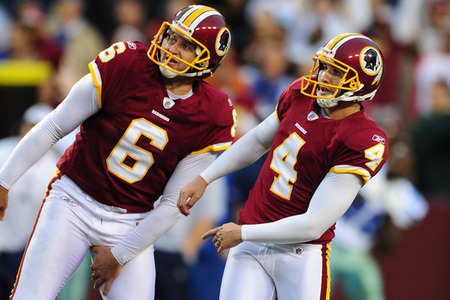 Graham Gano
 - In 35 games over three years with the Redskins, Gano has been up and down. He has missed 20 field goals the last two years, in 74 attempts, but did make a career best four field goals of over 50 yards.
His nine misses of 39 yards or closer is a frustrating career statistic, but there are no guarantees Washington will find a better placekicker in 2012. It is possible Washington may be forced to spend a draft pick on a kicker, since Gano's inconsistencies are not conducive to winning football.
Grade : CSav Rocca - Rocca has been one of the Redskins best free agent signings of 2011. Despite the fact he will attempt the fewest punts of his career this year, his 43.6 yards per attempt average is the close to his career best mark. His 39.7 net yard average is the best of his career.
Though having just five NFL seasons under his belt, Rocca is 38 years old. He has spent 15 years playing Australian Rules Football. Washington needs him back in 2012, and can only hope he wants to return.
Grade : A +Brandon Banks - The Redskins kick return specialist, the second-year pro has been used even less on offense this season. He did throw a 49-yard touchdown pass on a wide receiver option.
The diminutive Banks isn't returning balls as effectively as he did in his 2010 rookie year, but the difference isn't great and he does lead the league in kickoffs and kickoff return yardage. It seems very likely he will return to that role in 2012.
Grade : BNick Sundberg - After spending his 2009 rookie season on the practice squads of the Carolina Panthers and Baltimore Ravens, Sundberg replaced aging Pro Bowler Ethan Albright at long snapper on special teams in 2010. He has done a good enough job to warrant a return next season.
Grade : ACoaches Mike Shanahan
 - Shanahan came to Washington in 2010 with a career record of 138-86 with two Super Bowl titles as a head coach. He also won another Super Bowl as an offensive coordinator.
He has gone 11-19 with the Redskins so far, which has caused some to speculate if his job was in jeopardy. Shanahan admits his rebuilding plan hasn't gone as quickly as expected, but he is basically trying to turn over a roster that suffered years of incompetence under Vinny Cerrato's leadership.
While Shanahan will need all five years of his contract to show if he was a success, there is areas he has earned criticism. The main one is him allowing his son to be the offensive coordinator, a job the younger Shanahan has looked overmatched at often.
Patience will be needed in the Redskins overhaul. He and general manager Brice Allen saw all of their 2011 draft picks make the team, but there are plenty of other holes to fill. Yet there is the worry that Shanahan is running a system that can't win it all in the NFC East.
Grade : C -Kyle Shanahan - Getting a job because your dad is the boss doesn't exactly breed confidence amongst the ranks. He first got a NFL job working with Jon Gruden, then four seasons under Gary Kubiak. Kubiak played two years under the eldest Shanahan, then spent 12 years coaching with him.
Washington finished 25th in scoring last year, averaging 18.9 points per game. They finished 18th in yards gained and 30th in rushing yards accrued. improvement was needed by the younger Shanahan's offense, but it actually regressed in certain areas.
The Redskins are ranked 26th in scoring this year and are averaging about a half a point less per game than 2010. They have improved to 16th and 26th in total yards and rushing yards gained, but regressed in passing yards gained and interceptions thrown despite throwing the ball at about the same rate as last season.
Most of the criticism of Shanahan's strategy comes from the fact it appears he often abandons the run in favor of the pass. It has surprised some because his father had most of his NFL successes via strong rushing attacks.
He appears destined to return to the Redskins in 2012 because of his dad being the head coach. Shanahan will most likely have a rookie quarterback in charge of his offensive schemes, so there is a chance Washington continues to falter with the ball as a young quarterback matures.
Washington fans might be stuck with both Shanahan's all five years, but a lot of critics could be suppressed if the young coordinator shows his theories to be correct.
Grade : DJim Haslett - Haslett has been involved with NFL defenses since 1979, save five years where he coached in college or other professional leagues. First he was a Pro Bowl linebacker, then he eventually became a head coach and respected defensive coordinator.
He is still in the throes of converting the Redskins defense into a 3-4 scheme, acquiring the personnel he feels best fits his system. The Redskins struggled last year, finishing 31st in both total yards and passing yards allowed. They were 26th in rushing yards allowed and 21st in points allowed, getting 29 sacks, 19 forced fumbles and 14 interceptions.
There was improvement this year, as Washington finished 16th in total yards allowed, 11th in passing yards allowed, and 19th in rushing yards allowed. While they have 38 sacks, the Redskins slightly improved to 19th in total points allowed.
Yet the defense is still not creating the turnovers needed to be considered respectable. They have created five less fumbles and interceptions so far, an area the team must improve on in 2012.
Haslett now has some interesting talent to work with, but depth must still be built and the run defense must get stouter. Injuries certainly hindered the unit, but that is a factor most NFL teams deal with annually.
The Redskins defense often found itself on the gridiron too long, causing fatigue, due to an inept offensive attack. If Haslett and Washington can convince aging middle linebacker London Fletcher to return next year, they will be much better off. If he doesn't, a huge hole will be there in the middle of the defense. This hole could get gigantic if strong safety LaRon Landry leaves as well.
But Haslett has led to defense to improve somewhat. He still has a ways to go, but there is more hope that pessimism involved.
Grade : BDanny Smith - Smith has been here since 2004, but it seems he has dealt with a new kicker and punter most years. Washington finally got an excellent punter, even if he is 38 years old. But it seems their placekicker is inconsistent like most have been under Smith.
His coverage teams are generally good, but Smith must get the team a reliable kicker to procure more victories. While widely respected in the NFL, he won't reach the heights of an upper echelon special teams coach until he fixes this critical area.
Grade : B -Yoooooooo! Dis iz Third's cuzin 7thStoneFromaTheSun makin his final procrastinashuns for da 2011 yeer. I did OK so far. I went
11-4 las week, and iz
143-88 overall.
Letz finish strong, capeesh?
Green Bay Packers @ Detroit LionsI do belieef me and Third BOTH said da Lions wuz playoff bound dis yeer. Yo, da Pack don't knead dis, as both teems try to stay healthy. But Detroit wants homefield advantage in dere next game.
Lions 34 Packers 24
Tennessee Titans @ Houston TexansNeither teem needs dis, but I tink da Texans finish strong.
Texans 27 Titans 17
Indianapolis Colts @ Jacksonville JaguarsA battle of bottom feeders.
Jaguars 17 Colts 14
New York Jets @ Miami DolphinsToo teems goin nowhere after dis.
Jets 17 Dolphins 16
Washington Redskins @ Philadelphia EaglesDa disappointing Eagles strong finish mite save Andy Reid's job.
Eagles 31 Redskins 16
Carolina Panthers @ New Orleans SaintsDa Saints go marching into da playoffs wif dere heads held up high.
Saints 34 Panthers 24
San Francisco 49ers @ Saint Louis RamsMany tought, befour da seesun began, dat da Niners would be in last and da Rams in furst. Whops!
49ers 23 Rams 9
Buffalo Bills @ New England PatriotsDa Pats want momentum headin into da playoffs.
Patriots 37 Bills 31
Chicago Bears @ Minnesota VikingsWho cares?
Bears 13 Vikings 10
Kansas City Chiefs @ Denver BroncosDenver needs dis, but Kyle Orton makes dem regret choosing a weak-armed fullback over him.
Chiefs 27 Broncos 13
San Diego Chargers @ Oakland RaidersDa AFC West has always been wacky. Three teems go 8-8 dis yeer.
Chargers 28 Raiders 20
Seattle Seahawks @ Arizona CardinalsZZZzzzzz
Cardinals 24 Seahawks 21
Tampa Bay Buccaneers @ Atlanta FalconsDa erratic Falcons knead dis.
Falcons 34 Buccaneers 13
Pittsburgh Steelers @ Cleveland BrownsAs David Byrne chirped,"Same as it ever was."
Steelers 23 Browns 14
Baltimore Ravens @ Cincinnati BengalsYou like defense? Watch dis game! Call me crazy, but I'm goin wif da Bengals. Dey knead it two klinch a playoff berth.
Bengals 20 Ravens 17
Dallas Cowboys @ New York Giants
Game of the WeekPersonally, I tink dat Ravens/ Bengals game is better den dese too mediovre squads. BUT all da media will bee dere and da winner gets da NFC East title while da loser goes home until 2012.
Neither teem can run da ball, both quarterbacks iz overrated, and da defenses ain't nothin to write home about. I just gunna say Tony Romo ends dat "choke artist" label dis yeer.
Cowboys 30 Giants 24
Power Rankings1. Packers
2. 49ers
3. Saints
4. Ravens
5. Steelers
6. Patriots
7. Texans
8. Lions
9. Bengals
10. Falcons
11. Cowboys
12. Giants
13. Raiders
14. Broncos
15. Chargers
16. Jets
17. Titans
18. Eagles
19. Chiefs
20. Bills
21. Dolphins
22. Cardinals
23. Bears
24. Panthers
25. Seahawks
26. Redskins
27. Buccaneers
28. Browns
29. Jaguars
30. Colts
31. Vikings
32. Rams
OK, datt iz it folks. Yo? I hope I seas yous alls in 2012, but dat iz cuntingint on if dat certain family lookin four me finds me or not.
You all have a Happy New Year and every day beyond.
As dey say in Ol' Mexico= A.M.F.