







NEW ENGLAND PATRIOTS
One thing you can say about the Patriots is that they are stockpiling talents on their roster unlike any other team in the league right now. The term of the rich getting richer certainly applies to them.
Tom Brady returns after a major knee injury early in 2008. It is an injury that usually takes 18 months to get close to all the way back from, but New England is gambling Brady will continue to exceed all others and their expectations. In fact, they are so confidant in Brady, they traded Matt Cassel away. Cassel started for the injured Brady last year, and performed better than expected. New England has Kevin O'Connell returning for his second season, and also picked up Andrew Walter. Walter was a former starter in Oakland who was desired by many teams the last few years.
The running game is a group of backs who figure to share the ball over the course of the year. Fred Taylor, Sammy Morris, Laurence Maloney, BenJarvus Green-Ellis, and Kevin Faulk all do different things when they have the ball, and New England will try to use this to their advantage. This versatility and depth should keep all of the running backs fresh, since none are expected to carry the load primarily.
Randy Moss and Wes Welker are the primary receivers of the Patriots. Moss is the guy who can hit the home run at any time, while Welker works the underneath routes. New England recently picked up veterans Joey Galloway and Greg Lewis to add much needed depth. One player to watch is rookie Julian Edelman, a quarterback in college. Edelman is very athletic, albeit injury prone. The possibility of using him in the single wing is plausible if he makes the team.
The tight end position received an offseason upgrade in preparations for the possibility of Ben Watson's departure at the end of the year. They picked up veterans Chris Baker and Alex Smith, both who have experience as starters.
The offensive line is deep and sound. New England went out and drafted a few more players to learn from their veterans. Led by veteran Matt Light, the group is equally good in the running or passing game. Factor in the young players learning, and the future appears as bright as the present.
Defense is where head coach Bill Belichick excels, and he has built up an impressive group of defenders. The defensive line is maybe one of the deepest in the AFC. Led by Vince Woolfork, Ty Warren, and Richard Seymour, the Patriots added pass rushing defensive end Derrick Burgess and drafted defensive tackle Ron Brace to help Jarvis Green add impressive depth. This is the unit that makes the linebackers look good.
Tedy Bruschi is the leader of a linebacking unit that is very, very deep. Adalius Thomas, Pierre Woods, Vinny Ciuciu, and Eric Alexander are all veterans looking to help the team. Jarod Mayo is coming off of an impressive 2008 rookie season, while Shawn Crable's rookie year was washed away by injury. Tully Banta-Cain excels on special teams, while second year player Gary Guyton hopes to stick as well. Paris Lenon was an excellent pick up in the offseason, and Tyrone McKenzie is a fluid tackling machine that was drafted in the third round this year. There will be a real battle in training camp for jobs amongst this deep group.
The secondary is an interesting group. Veterans Shawn Springs and Leigh Bodden are slated to start at cornerback, with youngsters Terrance Wheatley, Darius Butler, and Jonathan Wilhite providing depth. Brandon Merriweather is penned in as the starting strong safety, but he has the ability to play free safety. James Sanders is the starting free safety, but rookie strong safety Patrick Chung could soon push Merriweather over into that spot. If Springs can stay healthy, it gives guys like Wheatley and Butler another year to mature and learn. Chung's development could provide a real boost to this unit, because of his play making abilities.
New England is a team full of specialists, and this fits in perfectly with today's NFL. It is becoming more of a rare occurrence to see a player on the field for every down these days. With the Patriots loaded with veterans, this could be important as far as keeping players fresh and healthy deep into the year. This edge is what the Patriots are hoping is what pushes them back on top of the league when the 2009 season concludes.
BUFFALO BILLS
Buffalo took a step backwards in 2008, after showing promise the season before. This is the year the Bills must progress, or Dick Jauron could very well lose his head coaching job.
The offense has a chance to be very effective, even with their starting running back Marshawn Lynch suspended for the first three games of the season. The depth behind Lynch consists of Fred Jackson, Xavier Omon, and Dominic Rhodes.
Quarterback Trent Edwards had an injury filled 2008 season, and was not consistent. He has shown glimpses of being very good, and this might be the season that will be most telling in the direction he is headed. He will have plenty of weapons at his disposal.
One of those weapons is the enigmatic wide receiver Terrell Owens. Owens was signed by the Bills after he was released by the Dallas Cowboys. He has athletic talent, but his main issue has been his propensity to draw negative attention to himself gleefully. Owens has divided locker rooms, and caused his teams victories with his destructive behavior. Now nearing the end of his career, the hope is that Owens keeps quiet and just plays football in hopes of finishing his career strong.
Across from him at WR is the underrated Lee Evans, a receiver who has the ability to stretch the seam. Evans might be the most important Bill on offense, because none of the other players have his home run capability.
The other receivers are a mix of slot guys and youngsters. Josh Reed is a consistent possession type who works the slot real well. Roscoe Parrish is a top flight punt returner, and has had moments working the slot for Buffalo. James Hardy was the Bills second round draft choice last season, but has been buried deep on the depth chart. Steve Johnson was drafted in the seventh round last year, but appears to have passed Hardy on the depth chart.
The tight end position is rather intriguing. Derek Shouman is the blocker of the group, but they have two young guys who excel at catching the ball. Derek Fine was drafted in the fourth round last year, and started in five of the ten games he played. Shawn Nelson is a rookie just drafted in the fourth round this year. He is very athletic, and has the ability to get deep. This trio gives Buffalo the ability to be flexible in many offensive sets.
The Bills offensive line has been very good the past few seasons, and many hope for them to continue to be even after trading All-Pro Jason Peters. Langston Walker moves into Peters slot, and has shown the ability to play the position in the past. Buffalo also lost starting guard Derrick Dockery and starting center Duke Preston after 2008.
Buffalo attacked the 2009 draft with the want to fill slots. They used their second pick in the first round on center Eric Wood. They then drafted Andy Levitre in the second round, the first guard drafted. Both are expected to start alongside Walker and Brad Butler. It will be interesting to see if Wood plays center or guard, because the Bills signed the versatile Geoff Hangartner to a big free agent contract after 2008. Hangartner can play center or guard, as can veteran Seth McKinney. The Bills offensive line coaches, Sean Kugler and Ray Brown, will have quite a task sifting this out to a cohesive unit.
If the offense didn't have enough exciting possibilities, the defense has created a unit that has Bills fans excited. They feature a defensive line that is full of possibilities. It is a veteran group that has had troubles staying healthy. If they can be that, it will help the back seven.
The secondary features quite a few exciting players. Terrence McGee and Leodis McKelvin are very athletic cornerbacks who also excel at returning kickoffs. They are backed up by veterans Drayton Florence and Ashton Youboty, who are solid players in their own right. Donte Whitner is the starting free safety who has assumed the leadership role of the group, and relishes supporting the run defense. This is the group that could carry Buffalo into the playoffs.
The linebackers need to improve. Veterans Keith Ellison and Kawika Mitchell start on the outside. Both are decent all around types, but neither are considered game changers. Aaron Maybin was the Bills first draft choice in 2009, and is very raw. He is also supremely athletic, and could see time as an OLB and DE in certain situations. Paul Posluszny is the starting MLB looking to improve upon his 110 tackle total in 2008. If this unit does not step up, it will be a problem coming down the stretch run of the season.
One thing that Buffalo does really well is play special teams. Bobby April is the coach, and his unit has won several games for Buffalo over the past many years. Parrish, McKelvin, and McGee are explosive returners. Rian Lindell is a solid kicker who has sealed many victories for the Bills late in games. Expect more of the same in 2009.
You can call them the Buffalo Bills, the Toronto Bills, or the Buffronto Bills, but you very well could be calling them a playoff team this year. Dick Jauron, his family, and coaching staff is praying this is so.
NEW YORK JETS
If your a fan of the Jets, you have to be pleased with the pedal to the metal approach the team has taken lately. They went out and hired a head coach who embodies this philosophy in Rex Ryan. Rex, much like his legendary father Buddy, is a defensive oriented coach who preaches constant pressure in all directions.
One of the Jets first moves to kick off the Ryan era was to be aggressive in the 2009 NFL Draft. They traded up to get quarterback Mark Sanchez, giving up three players and two draft choices. The Jets are hoping Sanchez can be the quarterback the team has sought since the days of Ken O'Brien at the least. He is expected to battle Kellen Clemens for the starting job.
One offensive strength the Jets have is their running attack. Thomas Jones is in his last year with the team, and should be playing hard for a contract next year. Leon Washington is a tiny back who excels on special teams. He is also in his contract year. Both will be pushed by rookie Shonn Greene, a compact runner who is best between the tackles. This is a three headed monster that could wear teams down late in the game.
The starters on the offensive line are sound, but there is not much depth behind them. A few injuries to this unit could spell doom for the Jets 2009 hopes. They are especially good in the running game, and are helped by fullback Tony Richardson. Richardson has long been one of the better blocking backs in the NFL.
The receiving game may have as many questions as the quarterback situation. Jerricho Cotchery is the most proven receiver, and he has had moments of inconsistency. Chansi Stuckey is expected to start at the other spot, and it remains to be seen how he handles the duties full time. Neither are speed merchants, so the Jets are hoping David Clowney will be the home run threat. Clowney is raw and inexperienced, but might be the fastest receiver on the team. Other guys to look at in camp are veteran Aundrae Allison, Marcus Henry, Paul Raymond, and the versatile Brad Smith.
Tight End Dustin Keller could be the Jets best threat in the passing game. Keller is fast and athletic. His health is paramount, now that Alex Smith has left for Tampa Bay. All that remains on the roster behind Keller is three unproven rookies.
Defense is where the Jets season will be made or lost. Ryan has a lot of tools to work with, and the possibilities are endless. The biggest strength of the defense might be in the secondary.
The Jets starting tandem at cornerback might be the best in the league. Darrelle Revis and Lito Sheppard are both excellent players. Their backups are Dwight Lowery and Donald Strickland, both very good players in their own right. The Jets appear set when opponents go to multiple WR sets.
Kerry Rhodes and Jim Leonhard are the starting safeties, but there is a chance rookie Emanuel Cook could push for playing time.
Linebacker has some depth behind a starting unit that could create havoc on the NFL in 2009. Led by David Harris and Bart Scott in the middle, the Jets are hoping the trio of Calvin Pace, Vernon Gholston, and Bryan Thomas crash teams off the edges with abandon and success.
The defensive line is a group of run stuffers, so it is vital that the linebackers are able to penetrate and create the pressure. With the solid group of cornerbacks, Ryan can afford to gamble often.
The New York media will hype the quarterback, no matter how little of importance the position is to the teams game plan and success. Look at the team they share their stadium with as an example.
The real key to the Jets hopes in 2009 will be their ability to control the clock, and dominate on defense. A formula Rex saw work in Chicago when his dad won a Super Bowl, and when Rex won a Super Bowl when he was the defensive line coach in Baltimore. He now hopes his Jets defense can get him another ring.
MIAMI DOLPHINS
Bill Parcells continues to build something in Miami, but there is a question if they can succeed with mirrors again. The single wing offense, now re-dubbed "Wildcat", gave Miami a nice return from the NFL cellar last year. The offense, though easy to defender if if opponents stay within their containment responsibilities, takes advantage of defenses with poor fundamentals.
Expect more of the same as Miami continues to gain experience in 2009. The offense is still led by quarterback Chad Pennington, though second year quarterback Chad Henne might not be far away from replacing him. Rookie Pat White is very athletic, and might be seen running the "Wildcat" several times this year. White also might be used as a receiver.
Miami's main offensive attack comes from the running game. Led by Ronnie Brown, it had proven to be effective. Ricky Williams provided a nice change of pace last year, and the effectiveness of this duo is critical to the Dolphins success.
The offensive line is young and promising. Offensive tackle Jake Long showed why the Dolphins selected him as the first player in the draft in 2008. His bookend is Vernon Carey, who is a seasoned veteran. Jake Groves was brought in via free agency to start at center, and is considered one of the better centers in the AFC. The guard situation is intriguing. Veteran Justin Smiley mans one starting spot, while second year players Shawn Murphy and Donald Thomas will battle Andy Alleman, a third year player, for the other starting job. This group will decide the fate of the team.
The receivers are a young group still learning the game. Led by tight end Anthony Fasano and wide receiver Davone Bess, Miami is still looking for more pass catchers. Ted Ginn, Brian Hartline, Patrick Turner, and Greg Camarillo will all battle for playing time. Ginn also serves as the Dolphins kickoff return specialist, while Bess returns punts.
The defense carried Miami to a surprising 2008 season, and this young group expects to be even better in 2009. Linebacker Joey Porter got most of the press, but that mainly came from his propensity of running his mouth without thought. Porter did have a nice season rushing the passer, but his success was because of the improved play of the defensive line.
Parcells has built a deep unit for the defensive line. Led by young and promising defensive ends Kendall Langford and Phillip Merling, the unit rotates six deep every Sunday. Several of the players are versatile enough to line up all over the line of scrimmage as well.
The linebackers are led by Porter, and it is a deep unit. One of the most interesting moves the Dolphins made recently was re-acquiring Jason Taylor. Taylor is one of the best defensive ends in Dolphins history, but he is now slated to play SLB.
The secondary might end up being the story of the Dolphins defense in 2009. They drafted cornerback Vontae Davis in the first round, and cornerback Sean Smith in the second round of the 2009 draft. Both will battle incumbents Eric Green and Will Allen for playing time. Miami also picked up free safety Gibril Wilson, after he had a disastrous season in Oakland last season. If this unit falters, Miami could be in for a long season ahead.
The special teams found a nice surprise in kicker Dan Carpenter in his rookie 2008 campaign. Brandon Fields was also excellent as their punter. Both kickers were solid last year, but Miami could improve on their return game.
The Dolphins aren't going to sneak up on anyone this year, so it will be interesting to see how they handle the new founded attention their opponents will give them. Even if Miami doesn't repeat last seasons success, it is clear Bill Parcells has them on the right path.
Friday, August 21, 2009

Tuesday, August 18, 2009
The ALMOST All-Time San Francisco 49ers Defense
Defensive Tackle : Cleveland Elam
Cleveland was drafted in the fourth round by the Niners in 1975, the 85th player chosen overall.
Elam soon found himself starting in his rookie season, and quickly established himself as one of the best in the league.
He was honored with his first Pro Bowl appearance in 1976, as he scooped up a fumble and went 69 yards for the only touchdown of his career.
The 1977 season was his best. He went back to the Pro Bowl, and was named First Team All-Pro.
Elam had his knee severely injured in his fourth season, and was only able to start in four of the twelve games he played in.
He joined the Detroit Lions for the 1978 season, but retired after playing eight games. His knee was giving him too much trouble.
Ed White, the legendary offensive guard, said Hall of Fame defensive tackle Bob Lilly was the best player he ever faced, but also said Elam was just as good when healthy.
Remember, White faced Hall of Famers Alan Page, Carl Eller, and Fred Dean, as well as Jim Marshall, Gary Johnson and Louie Kelcher, in practice every day for years.
This is high praise for a man who knows greatness first hand.

Defensive Tackle : Bryant Young
Bryant was the 49ers first round draft choice in 1994, the seventh player chosen overall.
He was named a starter immediately, and started in every game he played during his 14-year career with San Francisco.
His rookie season saw him get six sacks, as the 49ers went on to win Super Bowl XXIX.
Young missed four games the next season, but had another six sacks.
The 1996 season was the best of his career. He had 61 tackles, 11.5 sacks, and two safeties. All are career high marks.
He was named First Team All-Pro, and to his first Pro Bowl.
The next two seasons saw him miss four games each year, and get 13.5 sacks.
The Associated Press named him the 1999 Comeback Player Of The Year, when he had 11 sacks and a safety. He earned his second Pro Bowl trip as well.
After nine-and-a-half sacks the next season, Young went to the Pro Bowl in both 2001 and 2002. He had five-and-a-half sacks over that time.
Young got six-and-a-half sacks the next two seasons, then was moved to defensive end in 2005. He played there until 2007, and had 20 sacks. He then retired.
His three safeties tie him with Charlie Krueger for the most in franchise history, and his 89.5 sacks are officially recognized as the most in team history.
Bryant Young was an excellent pass rusher, and is one of the best defensive tackles in 49ers history.

Defensive End : Charlie Krueger
Charlie was the Niners' first draft pick in 1958, the ninth player chosen overall that season.
Though Krueger played over 12 seasons at DT, he played his first three years at DE.
In his first three years, he recorded a safety each season.
He made his first Pro Bowl in his second season in 1960, and was moved to defensive tackle permanently in 1962.
Krueger returned to the Pro Bowl in 1964, a year after he missed half the season due to an injury.
He would only miss one game the rest of his career after that.
Krueger was named an All-Pro twice more in 1965 and 1970.
The 1965 season saw him score the only touchdown of his career, when he returned a fumble recovery for six yards.
He also intercepted the only pass of his career in 1969.
His younger brother, Rolf, was a defensive tackle who joined the 49ers in 1972 after having played three years for the Saint Louis Cardinals.
Rolf wore number 70 in Saint Louis, but switched to number 78 because his older brother had that jersey number already.
The brothers both played the same position, so Rolf backed up Charlie until 1973.
Charlie retired after that season, and is easily the greatest defensive linemen in 49ers history.
His three safeties tie him with Bryant Young for the most in franchise history.
Charlie Krueger's number 70 has been retired by the Niners.

Defensive End : Cedric Hardman
Cedric was the Niners' first round draft pick in 1970, the ninth player chosen overall.
He soon earned a starting job, and earned a Pro Bowl nod in his second season.
In 1973, he recorded a safety.
Hardman was one of the better defensive ends of his era, and he would go back to the Pro Bowl for the final time in his career after the 1975 season.
After the 1979 season, he joined the Oakland Raiders.
Used as a pass rush specialist, he had 24 sacks in the two years he played with them.
The Raiders would win Super Bowl XV in the 1980 season.
In 1981, he snatched up a fumble and scooted 52 yards for the only touchdown of his career. He also recorded the last safety of his career.
He then retired.
The United States Football League was formed in 1982, and their Oakland Invaders franchise made Hardman the first player they ever signed.
He played with them in their inaugural 1983 season as a player/coach, then retired for good.
Hardman is also a noted actor who has appeared in such movies like Stir Crazy and House Party.
In Cedric Hardman's 10 seasons with the 49ers, he recorded 106.5 sacks. It is the most in franchise history, though the NFL did not officially recognize sacks as a statistic during Hardman's playing career.
He might be the greatest defensive end in franchise history.
Tommy Hart deserves mentioning.

Outside Linebacker : Charles Haley
Charles was drafted in the fourth round of the 1986 draft by San Francisco, the 96th player chosen overall.
He only started in three games in his first two seasons with the 49ers, primarily used as a pass rusher. He did swipe the first of his two career interceptions as a rookie, along with 12 sacks. He had six-and-a-half sacks the next year.
Haley was named a starter in 1988, and responded with his first Pro Bowl season. He had 11.5 sacks, and recorded the only safety of his career. The 49ers would go on to win Super Bowl XXIII that year.
San Francisco repeated as champions the next year. Haley had 10.5 sacks and scored the only touchdown of his career off of a fumble recovery.
He had the best year of his career in 1990, after getting a career best 16 sacks. He was named to the First Team All-NFL Team, as well as the Pro Bowl.
Haley made the Pro Bowl again the next year, after having seven sacks. He had confrontations with head coach George Seifert and quarterback Steve Young that season, so San Francisco traded Haley to the Dallas Cowboys after the season.
Dallas moved him to defensive end, and he had 10 sacks over the next two years. The Cowboys would win the Super Bowl each season.
The 1994 season was the best year Haley ever had in Dallas. He had 12.5 sacks and the last interception of his career. Haley made the Pro Bowl and was named First Team All-Pro.
Haley made his last Pro Bowl the next year, after getting 10.5 sacks in the 13 games he played. The Cowboys would go on to win Super Bowl XXX.
He got injured in the fifth game on 1996, getting a career low one sack. He then retired from the game.
San Francisco lured him out of retirement in 1998 to help them in the playoffs. Haley decided to play the 1999 season, and had three sacks as a reserve player. He then retired.
Haley is the only player in NFL history to be a member of five Super Bowl winning teams.
His three Pro Bowl appearances are the second most by any linebacker in franchise history, and his 66.5 quarterback sacks are the second most in team history.
Charles Haley was a excellent pass rushing linebacker, and his place in Niners history is one to recognize.
Skip Vanderbundt, Keena Turner, and Lee Woodall deserve mention.

Middle Linebacker : Hardy Brown
This is a personal choice.
Hardy came up the hard way. He grew up in an orphanage after witnessing his father murdered when he was four.
After attending college at both Southern Methodist University and Tulsa University, the New York Giants drafted him in the 12th round of the 1947 NFL Draft. He was the 104th player chosen overall.
Brown opted to join the Army instead, and stayed in the service until 1948.
He then decided to join the Brooklyn Dodgers of the All American Football Conference that season.
This was the only year he was used as the primary kicker on a team. He made 25 of 29 extra point attempts, and missed the only field goal attempt of his career.
Brown also scored the only two offensive touchdowns of his career. He ran for one off of six attempts, and caught one off of three receptions.
He intercepted the first pass of his career that season as well.
Brown then joined the Chicago Hornets of the AAFC the next season.
He did catch one 10-yard pass, as well as punt 10 times for 397 yards. Brown also had a career high three interceptions.
Brown then went to the NFL in 1950, when he signed with the Washington Redskins. He lasted eight games with the team, before joining the Baltimore Colts for four games.
While with the Colts, he missed the last extra point attempt of his career and picked off a pass.
The Colts went defunct at the end of the year, so Brown joined the 49ers and was put in at MLB for the 1951 season.
Brown knocked out 21 players from games in 1951 alone. One game, he knocked the opponents entire backfield out of action.
He stayed with the team until 1955, and gained a reputation for being one of the hardest hitters in the league. He was nicknamed "Thumper" and "The Hatchet" by all.
The 49ers coach, Buck Shaw, banned Hardy from team practices, fearing he would lose players. Hardy Brown is the only man in NFL history to be banned from his own team practices without committing a transgression.
Brown had a technique where he would wind up his shoulder, and had sent players flying backwards as much as 10 yards from his impact.
He also almost took the eye out of Joe Geri, a Pittsburgh Steelers running back, in 1951. He fractured the face of one player, and crushed the vertebrae of another.
He was named to his lone Pro Bowl Team in 1952 as the MLB position. He then would play both of the other linebacker positions his last two years with the team.
Brown did punt the ball for the last 10 times of his career in 1954, totaling 384 yards. He also matched his career best of three interceptions.
He took one of the interceptions for a 41 yard score, the last touchdown of his career.
During that season, the Detroit Lions Gil "Wild Horse" Mains, a future professional wrestler, jumped into Brown's leg feet first. Brown needed 20 stitches, but refused to leave the game. He soon returned and broke the nose of running back Bill Bowman.
Brown moved on to the Chicago Cardinals for the 1956 season, and played eight games before retiring.
He was lulled out of retirement in 1960 to join the Denver Broncos in the newly formed American Football League, thus becoming one of just two men to have played football in the AAFC, NFL, and AFL.
Hardy Brown retired after that year, and is remembered as one of the most vicious defenders of his day. He destroyed numerous careers.
It is often said that he left a trail of broken bones in his wake. His exploits are documented in NFL Films in both their "Greatest Hits" film and their "San Francisco 49ers - The Complete History" film.
His childhood story is set to be told in the upcoming movie "Twelve Mighty Orphans".
Ken Norton deserves mention.
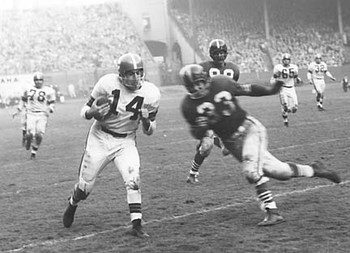
Hardy Getting Ready To Lay Out Otto Graham

Otto After The Game
Outside Linebacker : Matt Hazeltine
Matt was drafted in the fourth round of the 1955 NFL Draft by San Francisco, the 45th player chosen overall.
He soon found his way into the starting lineup, and intercepted the first pass of his career in 1956. He had a career best three interceptions that season as well.
Hazeltine scored the first touchdown of his career in 1958, after taking an interception in for a score.
He scored another touchdown the next year, after taking a fumble recovery for 42 yards.
The 1962 season was his first Pro Bowl year, an honor he would garner again in 1964.
After missing six games in 1965 because of injury, Hazeltine scored the last touchdown of his career off a fumble recovery in 1966.
He retired from the game in 1968, but decided to come back to the NFL in 1970 at 37 years old.
He joined the New York Giants for that season, and played every game. He also intercepted a pass.
He then retired from the game permanently.
His two touchdowns off fumble recoveries is tied with three others as the most in team history.
Hazeltine died of ALS in 1987, and is one of three 49ers from the 1964 squad to have lost their life to a disease most commonly known as Lou Gehrig's Disease.
Matt Hazeltine played 14 solid seasons in San Francisco, and is one of the best linebackers the team has ever had.
The 49ers have an award named after him. It is handed out annually to the 49er who demonstrates the most courage, and is the most inspirational player on defense.

Strong Safety : Tim McDonald
Tim was the second round draft choice of the Saint Louis Cardinals in 1987, the 34th player chosen overall.
McDonald played in just three games in his rookie season, the only year of his career where he did not create a turnover.
The Cardinals moved to Phoenix, Arizona, the next season, and McDonald had two interceptions and sacks in the 15 games he started.
He had a career high seven interceptions for 170 yards in 1989, and scored a touchdown. He also had a career high 155 tackles. McDonald went to the Pro Bowl.
After four interceptions the next season, McDonald returned to the Pro Bowl in 1991 and 1992 with the Cardinals. He had seven interceptions in those two years.
The 49ers then signed McDonald as a free agent for the 1993 season. He was a Pro Bowler his first three seasons with them.
The 1994 season saw San Francisco win Super Bowl XXIX, and McDonald scored two touchdowns that year. One was a career best 73-yard return off of one of his two interceptions, and the other was a 49-yard run on a fumble recovery.
McDonald scored a league leading two touchdowns off of four interceptions the next year.
He remained a consistent force and leader for the team from 1996 to 1999. He had 11 interceptions and seven sacks over that time. He retired after the 1999 season.
Tim McDonald only missed one game for the team in his seven years with them.
His three touchdowns off of interceptions is tied with three others as the most in franchise history.
Carlton Williamson and Tony Parrish deserve mention.

Free Safety : Dwight Hicks
Dwight was drafted by the Detroit Lions in the sixth round of the 1978 draft, and was the 150th player chosen overall.
He did not make the Lions squad, so he played that year with the Toronto Agronauts of the Canadian Football League.
Hicks signed with the 49ers for the 1979 season, and started in four of the seven games he played in.
He intercepted five passes, which led the team.
Now the starter, Hicks picked off four balls, which tied with Ricky Churchman for the team lead.
Hicks had his best season in 1981. He led the NFL with 239 return yards, which was on nine interceptions. He also scored a touchdown on a career long 72 yard return, and another on a 80 yard run off of a fumble recovery.
He went to the Pro Bowl, an honor he would achieve the next three seasons as well.
San Francisco went to Super Bowl XVI at the conclusion of the 1981 season, and Hicks was a big reason why they won over the Cincinnati Bengals 26-21.
The 49ers had just fumbled the opening kickoff, and the Bengals found themselves on San Francisco's five yard line. Hicks intercepted a pass and returned it 27 yards, which eventually led to a 49ers touchdown.
Hicks then had three interceptions in the strike shortened 1982 season.
He scored the last two touchdowns of his career, which led the NFL, on two interceptions the following year.
San Francisco would win Super Bowl XIX in 1984, as Hicks had three interceptions that season.
His last season with the 49ers would be 1985, and he even saw time at cornerback when injuries hit the secondary. He recorded his only official sack of his career, and swiped four balls.
Hicks joined the Indianapolis Colts for the 1986 season, and had two interceptions in the nine games he played. He then retired.
Dwight Hicks' four Pro Bowl games are tied with Merton Hanks as the most by any free safety in team history.
His three touchdowns off of interceptions is tied with three others as the most in franchise history.
Merton Hanks, Lowell Wagner, Dickie Moegul, Rex Barry, Dave Baker, Zack Bronson and Jim Cason all deserve mention.

Cornerback : Kermit Alexander
Kermit was the 49ers first round draft pick in 1963, the eighth player chosen overall.
He started right away at cornerback that year, and had five interceptions. He also returned 24 kickoffs at a career high 26.6 yards per return average.
San Francisco moved him to safety the next year, and he intercepted five more balls. He also led the league with five fumble recoveries, while returning 20 kickoffs. He also returned 21 punts, and took one a career long 70 yards for a touchdown.
The 1965 season saw Alexander lead the NFL with a career best eight fumble recoveries, 32 kickoff returns and 741 kickoff return yards. He also intercepted three passes and returned a career high 35 punts.
The 49ers moved him back to cornerback in 1966, and he responded with four interceptions and a touchdown off of one of his four fumble recoveries. Alexander also scored his last touchdown off a punt return, on 30 attempts, and returned a career best 37 kickoff returns.
He led the NFL with 1,182 kickoff and punt return yards, and matched his career best average of 26.6 yards per kickoff return. He also was second in the league with kickoff returns and kickoff return yardage.
Alexander only returned six punts and one kickoff in 1967, but he did manage to intercept five passes.
The best year of his career may have been 1968, the only season he would earn a Pro Bowl honor. He had a career best nine interceptions and 165 interception return yards. Alexander took one interception 66 yards for a touchdown as well.
It was also his last season used as the 49ers primary return specialist, with 24 punt returns and 20 kickoff returns. Some also may remember Alexander hit Gale Sayers that year, tearing Sayer's knee ligaments.
After intercepting five balls the next year, Alexander found himself on the Los Angeles Rams for the 1970 season. He would score a touchdown off of four interceptions.
The Rams then moved Alexander to strong safety the next season, and responded with three interceptions. He also scored the last touchdown of his career off of a career long 82 yards interception return.
He then joined the Philadelphia Eagles for the 1972 season, but was injured after seven games. It was the first year of his career he failed to create a turnover of any kind. After returning five punts and nine kickoffs the next year, he retired.
Alexander recovered 23 fumbles in his seven years with the Niners, the most in team history.
His 36 interceptions are the second most by any 49ers CB in franchise history, nine less than Hall of Famer Jimmie Johnson, and the third most interceptions overall by any 49er ever.
He is still fifth in team history in kickoff return yards, kickoff returns, and punt returns. His two punt return touchdowns is tied with five others as the most in team history.
Kermit Alexander is one of the most underrated defensive backs in NFL history, and he is certainly one of the best in San Francisco 49ers history.

Cornerback : Eric Wright
Eric was drafted in the second round by the Niners in 1981, the 40th player chosen overall.
He started right away, and intercepted three passes in his rookie year.
The 49ers won Super Bowl XVI that year, and Wright took a ball 25 yards off of an interception in the game.
After getting one pick in the strike shortened 1982 season, Wright had the best season of his career in 1983.
He had seven interceptions for 164 yards and two touchdowns. All were career high totals.
Wright was named to the UPI's All-Conference First Team.
He made his first Pro Bowl in 1984, after getting two interceptions.
The 49ers wound up winning Super Bowl XIX that season, and Wright had an interception in the game.
Wright's last Pro Bowl season was in 1985, when he had one interception. He was also named First Team All-Pro.
His next two years were injury plagued. He was able to suit up for just four games total, starting in three.
The 1988 season saw him bounce back. He started 10 of the 15 games he played, and had two interceptions.
He was used as a reserve the final two seasons of his career, starting one of the 20 games he appeared in. He intercepted two passes in 1989, and retired after the 1990 season.
For the first five years of his career, Eric Wright was a lockdown defender who was one of the best at his position in the NFC.
Don Griffin and Bruce Taylor deserve mention.

Kicker : Tommy Davis
Tommy was drafted by San Francisco in the 11th round of the 1957 NFL Draft. He was the 128th player chosen overall.
The 49ers used Davis as both their kicker and punter for the first eight years of his career.
He led the NFL with a 71 yard punt in his rookie season, and averaged 45.7 yards per punt on 59 attempts.
Davis had an NFL long punt of 74 yards the next season, and led the NFL in field goal attempts and field goals made.
He made his first Pro Bowl in 1963, after he led the NFL with a 45.6 yards per punt average, and a career best 82 yard punt.
Davis returned to the Pro Bowl the next year, his last, despite having the only two punts of his career blocked.
The 1965 season may have been his best. He had a career high 103 points, and a career best 45.8 yards per punt. He also led the NFL in extra points attempted and made.
After giving up his punting duties after 1966, Davis remained the 49ers kicker until he retired after the 1969 season. He also punted the ball 23 times in that final year.
His 350 extra point attempts and 348 conversions are the second most in team history, and his 99.4 percent success rate is the best by anyone with at least 105 attempts.
The 276 field goals he attempted in his career are the most ever in team history, and his 130 field goals made are the second most ever.
His 511 punts for 22,833 yards are the most in team history, though Andy Lee could pass those numbers in 2009.
His career average of 44.7 yards per punt is the best in team history by anyone with at least 20 attempts.
Davis' 82 yard punt is tied with Lee as the second longest in team history.
His two Pro Bowls are the most by any 49ers kicker, though he was named for both his kicking and punting prowess. Back then, only one kicking specialist made the Pro Bowl.
Tommy Davis is easily the greatest kicker and punter in 49ers history.
Ray Wersching, Mike Cofer, Joe Nedney, and Gordie Soltau deserve mention.

Punter : Tom Wittum
Tom was drafted by the Niners in the eighth round in 1972, the 200th player chosen overall.
His rookie season was his best. He averaged a career best 43.7 yards per punt on 77 attempts. He also ran one ball for a career long 63 yards.
He was named to the Pro Bowl that year, and would achieve that honor again the next season.
Wittum averaged 41.2 yards per punt that season. He also ran a ball 13 yards.
He caught the only two passes of his career in 1975, gaining 29 yards.
In 1976, Wittum attempted a career high 89 punts.
In 1977, he attempted three passes, and completed one for 15 yards. He also attempted two field goals, making one, and four extra points, making two.
He then retired from the NFL.
Wittum's 380 punts for 15,494 yards are the third most in team history. His nine kicks blocked are the most.
His two Pro Bowls are the most by any Niners punter.
He once punted a ball 64 yards in a Pro Bowl game, and it is tied as the longest ever. His nine punts in one Pro Bowl game is the second most ever.
Frankie Albert deserves mention.

Punt Returner : Dana McLemore
Dana was drafted in the 10th round of the 1982 draft by San Francisco, and was the 269th player chosen overall.
He rarely played in his rookie season, but he did take one of his seven punt returns for a career long 93 yard touchdown. He also returned 16 kickoffs.
McLemore returned 31 punts the next year, and returned one 56 yards for a score. He also returned a career high 30 kickoff returns.
He would return just 10 kickoffs for the rest of his career.
The 1984 season saw him return a 79 yard return for a touchdown off of a career high 45 attempts.
He also intercepted the first two passes of his career, returning one 54 yards for a score.
San Francisco would win Super Bowl XIX that season.
McLemore's 28 yard punt return in the second quarter set the table for the 49ers third touchdown of the game.
After returning 38 punts and intercepting a pass the next season, McLemore joined the New Orleans Saints for three games in 1986.
He returned 10 punts and two kickoffs before rejoining San Francisco for three games. He did not record a statistic with them.
The 1987 season would be his last in the NFL. He returned 21 punts, including one going for a 83 yard touchdown, and intercepted the last two passes of his career.
He then retired.
Dana McLemore's four punt return touchdowns are the most in team history.
John Taylor, Abe Woodson, Dexter Carter, Kermit Alexander, Hugh McElhenny, Bruce Taylor, and Freddie Soloman all deserve mention.

Cleveland was drafted in the fourth round by the Niners in 1975, the 85th player chosen overall.
Elam soon found himself starting in his rookie season, and quickly established himself as one of the best in the league.
He was honored with his first Pro Bowl appearance in 1976, as he scooped up a fumble and went 69 yards for the only touchdown of his career.
The 1977 season was his best. He went back to the Pro Bowl, and was named First Team All-Pro.
Elam had his knee severely injured in his fourth season, and was only able to start in four of the twelve games he played in.
He joined the Detroit Lions for the 1978 season, but retired after playing eight games. His knee was giving him too much trouble.
Ed White, the legendary offensive guard, said Hall of Fame defensive tackle Bob Lilly was the best player he ever faced, but also said Elam was just as good when healthy.
Remember, White faced Hall of Famers Alan Page, Carl Eller, and Fred Dean, as well as Jim Marshall, Gary Johnson and Louie Kelcher, in practice every day for years.
This is high praise for a man who knows greatness first hand.
Defensive Tackle : Bryant Young
Bryant was the 49ers first round draft choice in 1994, the seventh player chosen overall.
He was named a starter immediately, and started in every game he played during his 14-year career with San Francisco.
His rookie season saw him get six sacks, as the 49ers went on to win Super Bowl XXIX.
Young missed four games the next season, but had another six sacks.
The 1996 season was the best of his career. He had 61 tackles, 11.5 sacks, and two safeties. All are career high marks.
He was named First Team All-Pro, and to his first Pro Bowl.
The next two seasons saw him miss four games each year, and get 13.5 sacks.
The Associated Press named him the 1999 Comeback Player Of The Year, when he had 11 sacks and a safety. He earned his second Pro Bowl trip as well.
After nine-and-a-half sacks the next season, Young went to the Pro Bowl in both 2001 and 2002. He had five-and-a-half sacks over that time.
Young got six-and-a-half sacks the next two seasons, then was moved to defensive end in 2005. He played there until 2007, and had 20 sacks. He then retired.
His three safeties tie him with Charlie Krueger for the most in franchise history, and his 89.5 sacks are officially recognized as the most in team history.
Bryant Young was an excellent pass rusher, and is one of the best defensive tackles in 49ers history.
Defensive End : Charlie Krueger
Charlie was the Niners' first draft pick in 1958, the ninth player chosen overall that season.
Though Krueger played over 12 seasons at DT, he played his first three years at DE.
In his first three years, he recorded a safety each season.
He made his first Pro Bowl in his second season in 1960, and was moved to defensive tackle permanently in 1962.
Krueger returned to the Pro Bowl in 1964, a year after he missed half the season due to an injury.
He would only miss one game the rest of his career after that.
Krueger was named an All-Pro twice more in 1965 and 1970.
The 1965 season saw him score the only touchdown of his career, when he returned a fumble recovery for six yards.
He also intercepted the only pass of his career in 1969.
His younger brother, Rolf, was a defensive tackle who joined the 49ers in 1972 after having played three years for the Saint Louis Cardinals.
Rolf wore number 70 in Saint Louis, but switched to number 78 because his older brother had that jersey number already.
The brothers both played the same position, so Rolf backed up Charlie until 1973.
Charlie retired after that season, and is easily the greatest defensive linemen in 49ers history.
His three safeties tie him with Bryant Young for the most in franchise history.
Charlie Krueger's number 70 has been retired by the Niners.
Defensive End : Cedric Hardman
Cedric was the Niners' first round draft pick in 1970, the ninth player chosen overall.
He soon earned a starting job, and earned a Pro Bowl nod in his second season.
In 1973, he recorded a safety.
Hardman was one of the better defensive ends of his era, and he would go back to the Pro Bowl for the final time in his career after the 1975 season.
After the 1979 season, he joined the Oakland Raiders.
Used as a pass rush specialist, he had 24 sacks in the two years he played with them.
The Raiders would win Super Bowl XV in the 1980 season.
In 1981, he snatched up a fumble and scooted 52 yards for the only touchdown of his career. He also recorded the last safety of his career.
He then retired.
The United States Football League was formed in 1982, and their Oakland Invaders franchise made Hardman the first player they ever signed.
He played with them in their inaugural 1983 season as a player/coach, then retired for good.
Hardman is also a noted actor who has appeared in such movies like Stir Crazy and House Party.
In Cedric Hardman's 10 seasons with the 49ers, he recorded 106.5 sacks. It is the most in franchise history, though the NFL did not officially recognize sacks as a statistic during Hardman's playing career.
He might be the greatest defensive end in franchise history.
Tommy Hart deserves mentioning.
Outside Linebacker : Charles Haley
Charles was drafted in the fourth round of the 1986 draft by San Francisco, the 96th player chosen overall.
He only started in three games in his first two seasons with the 49ers, primarily used as a pass rusher. He did swipe the first of his two career interceptions as a rookie, along with 12 sacks. He had six-and-a-half sacks the next year.
Haley was named a starter in 1988, and responded with his first Pro Bowl season. He had 11.5 sacks, and recorded the only safety of his career. The 49ers would go on to win Super Bowl XXIII that year.
San Francisco repeated as champions the next year. Haley had 10.5 sacks and scored the only touchdown of his career off of a fumble recovery.
He had the best year of his career in 1990, after getting a career best 16 sacks. He was named to the First Team All-NFL Team, as well as the Pro Bowl.
Haley made the Pro Bowl again the next year, after having seven sacks. He had confrontations with head coach George Seifert and quarterback Steve Young that season, so San Francisco traded Haley to the Dallas Cowboys after the season.
Dallas moved him to defensive end, and he had 10 sacks over the next two years. The Cowboys would win the Super Bowl each season.
The 1994 season was the best year Haley ever had in Dallas. He had 12.5 sacks and the last interception of his career. Haley made the Pro Bowl and was named First Team All-Pro.
Haley made his last Pro Bowl the next year, after getting 10.5 sacks in the 13 games he played. The Cowboys would go on to win Super Bowl XXX.
He got injured in the fifth game on 1996, getting a career low one sack. He then retired from the game.
San Francisco lured him out of retirement in 1998 to help them in the playoffs. Haley decided to play the 1999 season, and had three sacks as a reserve player. He then retired.
Haley is the only player in NFL history to be a member of five Super Bowl winning teams.
His three Pro Bowl appearances are the second most by any linebacker in franchise history, and his 66.5 quarterback sacks are the second most in team history.
Charles Haley was a excellent pass rushing linebacker, and his place in Niners history is one to recognize.
Skip Vanderbundt, Keena Turner, and Lee Woodall deserve mention.
Middle Linebacker : Hardy Brown
This is a personal choice.
Hardy came up the hard way. He grew up in an orphanage after witnessing his father murdered when he was four.
After attending college at both Southern Methodist University and Tulsa University, the New York Giants drafted him in the 12th round of the 1947 NFL Draft. He was the 104th player chosen overall.
Brown opted to join the Army instead, and stayed in the service until 1948.
He then decided to join the Brooklyn Dodgers of the All American Football Conference that season.
This was the only year he was used as the primary kicker on a team. He made 25 of 29 extra point attempts, and missed the only field goal attempt of his career.
Brown also scored the only two offensive touchdowns of his career. He ran for one off of six attempts, and caught one off of three receptions.
He intercepted the first pass of his career that season as well.
Brown then joined the Chicago Hornets of the AAFC the next season.
He did catch one 10-yard pass, as well as punt 10 times for 397 yards. Brown also had a career high three interceptions.
Brown then went to the NFL in 1950, when he signed with the Washington Redskins. He lasted eight games with the team, before joining the Baltimore Colts for four games.
While with the Colts, he missed the last extra point attempt of his career and picked off a pass.
The Colts went defunct at the end of the year, so Brown joined the 49ers and was put in at MLB for the 1951 season.
Brown knocked out 21 players from games in 1951 alone. One game, he knocked the opponents entire backfield out of action.
He stayed with the team until 1955, and gained a reputation for being one of the hardest hitters in the league. He was nicknamed "Thumper" and "The Hatchet" by all.
The 49ers coach, Buck Shaw, banned Hardy from team practices, fearing he would lose players. Hardy Brown is the only man in NFL history to be banned from his own team practices without committing a transgression.
Brown had a technique where he would wind up his shoulder, and had sent players flying backwards as much as 10 yards from his impact.
He also almost took the eye out of Joe Geri, a Pittsburgh Steelers running back, in 1951. He fractured the face of one player, and crushed the vertebrae of another.
He was named to his lone Pro Bowl Team in 1952 as the MLB position. He then would play both of the other linebacker positions his last two years with the team.
Brown did punt the ball for the last 10 times of his career in 1954, totaling 384 yards. He also matched his career best of three interceptions.
He took one of the interceptions for a 41 yard score, the last touchdown of his career.
During that season, the Detroit Lions Gil "Wild Horse" Mains, a future professional wrestler, jumped into Brown's leg feet first. Brown needed 20 stitches, but refused to leave the game. He soon returned and broke the nose of running back Bill Bowman.
Brown moved on to the Chicago Cardinals for the 1956 season, and played eight games before retiring.
He was lulled out of retirement in 1960 to join the Denver Broncos in the newly formed American Football League, thus becoming one of just two men to have played football in the AAFC, NFL, and AFL.
Hardy Brown retired after that year, and is remembered as one of the most vicious defenders of his day. He destroyed numerous careers.
It is often said that he left a trail of broken bones in his wake. His exploits are documented in NFL Films in both their "Greatest Hits" film and their "San Francisco 49ers - The Complete History" film.
His childhood story is set to be told in the upcoming movie "Twelve Mighty Orphans".
Ken Norton deserves mention.
Hardy Getting Ready To Lay Out Otto Graham
Otto After The Game
Outside Linebacker : Matt Hazeltine
Matt was drafted in the fourth round of the 1955 NFL Draft by San Francisco, the 45th player chosen overall.
He soon found his way into the starting lineup, and intercepted the first pass of his career in 1956. He had a career best three interceptions that season as well.
Hazeltine scored the first touchdown of his career in 1958, after taking an interception in for a score.
He scored another touchdown the next year, after taking a fumble recovery for 42 yards.
The 1962 season was his first Pro Bowl year, an honor he would garner again in 1964.
After missing six games in 1965 because of injury, Hazeltine scored the last touchdown of his career off a fumble recovery in 1966.
He retired from the game in 1968, but decided to come back to the NFL in 1970 at 37 years old.
He joined the New York Giants for that season, and played every game. He also intercepted a pass.
He then retired from the game permanently.
His two touchdowns off fumble recoveries is tied with three others as the most in team history.
Hazeltine died of ALS in 1987, and is one of three 49ers from the 1964 squad to have lost their life to a disease most commonly known as Lou Gehrig's Disease.
Matt Hazeltine played 14 solid seasons in San Francisco, and is one of the best linebackers the team has ever had.
The 49ers have an award named after him. It is handed out annually to the 49er who demonstrates the most courage, and is the most inspirational player on defense.
Strong Safety : Tim McDonald
Tim was the second round draft choice of the Saint Louis Cardinals in 1987, the 34th player chosen overall.
McDonald played in just three games in his rookie season, the only year of his career where he did not create a turnover.
The Cardinals moved to Phoenix, Arizona, the next season, and McDonald had two interceptions and sacks in the 15 games he started.
He had a career high seven interceptions for 170 yards in 1989, and scored a touchdown. He also had a career high 155 tackles. McDonald went to the Pro Bowl.
After four interceptions the next season, McDonald returned to the Pro Bowl in 1991 and 1992 with the Cardinals. He had seven interceptions in those two years.
The 49ers then signed McDonald as a free agent for the 1993 season. He was a Pro Bowler his first three seasons with them.
The 1994 season saw San Francisco win Super Bowl XXIX, and McDonald scored two touchdowns that year. One was a career best 73-yard return off of one of his two interceptions, and the other was a 49-yard run on a fumble recovery.
McDonald scored a league leading two touchdowns off of four interceptions the next year.
He remained a consistent force and leader for the team from 1996 to 1999. He had 11 interceptions and seven sacks over that time. He retired after the 1999 season.
Tim McDonald only missed one game for the team in his seven years with them.
His three touchdowns off of interceptions is tied with three others as the most in franchise history.
Carlton Williamson and Tony Parrish deserve mention.
Free Safety : Dwight Hicks
Dwight was drafted by the Detroit Lions in the sixth round of the 1978 draft, and was the 150th player chosen overall.
He did not make the Lions squad, so he played that year with the Toronto Agronauts of the Canadian Football League.
Hicks signed with the 49ers for the 1979 season, and started in four of the seven games he played in.
He intercepted five passes, which led the team.
Now the starter, Hicks picked off four balls, which tied with Ricky Churchman for the team lead.
Hicks had his best season in 1981. He led the NFL with 239 return yards, which was on nine interceptions. He also scored a touchdown on a career long 72 yard return, and another on a 80 yard run off of a fumble recovery.
He went to the Pro Bowl, an honor he would achieve the next three seasons as well.
San Francisco went to Super Bowl XVI at the conclusion of the 1981 season, and Hicks was a big reason why they won over the Cincinnati Bengals 26-21.
The 49ers had just fumbled the opening kickoff, and the Bengals found themselves on San Francisco's five yard line. Hicks intercepted a pass and returned it 27 yards, which eventually led to a 49ers touchdown.
Hicks then had three interceptions in the strike shortened 1982 season.
He scored the last two touchdowns of his career, which led the NFL, on two interceptions the following year.
San Francisco would win Super Bowl XIX in 1984, as Hicks had three interceptions that season.
His last season with the 49ers would be 1985, and he even saw time at cornerback when injuries hit the secondary. He recorded his only official sack of his career, and swiped four balls.
Hicks joined the Indianapolis Colts for the 1986 season, and had two interceptions in the nine games he played. He then retired.
Dwight Hicks' four Pro Bowl games are tied with Merton Hanks as the most by any free safety in team history.
His three touchdowns off of interceptions is tied with three others as the most in franchise history.
Merton Hanks, Lowell Wagner, Dickie Moegul, Rex Barry, Dave Baker, Zack Bronson and Jim Cason all deserve mention.
Cornerback : Kermit Alexander
Kermit was the 49ers first round draft pick in 1963, the eighth player chosen overall.
He started right away at cornerback that year, and had five interceptions. He also returned 24 kickoffs at a career high 26.6 yards per return average.
San Francisco moved him to safety the next year, and he intercepted five more balls. He also led the league with five fumble recoveries, while returning 20 kickoffs. He also returned 21 punts, and took one a career long 70 yards for a touchdown.
The 1965 season saw Alexander lead the NFL with a career best eight fumble recoveries, 32 kickoff returns and 741 kickoff return yards. He also intercepted three passes and returned a career high 35 punts.
The 49ers moved him back to cornerback in 1966, and he responded with four interceptions and a touchdown off of one of his four fumble recoveries. Alexander also scored his last touchdown off a punt return, on 30 attempts, and returned a career best 37 kickoff returns.
He led the NFL with 1,182 kickoff and punt return yards, and matched his career best average of 26.6 yards per kickoff return. He also was second in the league with kickoff returns and kickoff return yardage.
Alexander only returned six punts and one kickoff in 1967, but he did manage to intercept five passes.
The best year of his career may have been 1968, the only season he would earn a Pro Bowl honor. He had a career best nine interceptions and 165 interception return yards. Alexander took one interception 66 yards for a touchdown as well.
It was also his last season used as the 49ers primary return specialist, with 24 punt returns and 20 kickoff returns. Some also may remember Alexander hit Gale Sayers that year, tearing Sayer's knee ligaments.
After intercepting five balls the next year, Alexander found himself on the Los Angeles Rams for the 1970 season. He would score a touchdown off of four interceptions.
The Rams then moved Alexander to strong safety the next season, and responded with three interceptions. He also scored the last touchdown of his career off of a career long 82 yards interception return.
He then joined the Philadelphia Eagles for the 1972 season, but was injured after seven games. It was the first year of his career he failed to create a turnover of any kind. After returning five punts and nine kickoffs the next year, he retired.
Alexander recovered 23 fumbles in his seven years with the Niners, the most in team history.
His 36 interceptions are the second most by any 49ers CB in franchise history, nine less than Hall of Famer Jimmie Johnson, and the third most interceptions overall by any 49er ever.
He is still fifth in team history in kickoff return yards, kickoff returns, and punt returns. His two punt return touchdowns is tied with five others as the most in team history.
Kermit Alexander is one of the most underrated defensive backs in NFL history, and he is certainly one of the best in San Francisco 49ers history.
Cornerback : Eric Wright
Eric was drafted in the second round by the Niners in 1981, the 40th player chosen overall.
He started right away, and intercepted three passes in his rookie year.
The 49ers won Super Bowl XVI that year, and Wright took a ball 25 yards off of an interception in the game.
After getting one pick in the strike shortened 1982 season, Wright had the best season of his career in 1983.
He had seven interceptions for 164 yards and two touchdowns. All were career high totals.
Wright was named to the UPI's All-Conference First Team.
He made his first Pro Bowl in 1984, after getting two interceptions.
The 49ers wound up winning Super Bowl XIX that season, and Wright had an interception in the game.
Wright's last Pro Bowl season was in 1985, when he had one interception. He was also named First Team All-Pro.
His next two years were injury plagued. He was able to suit up for just four games total, starting in three.
The 1988 season saw him bounce back. He started 10 of the 15 games he played, and had two interceptions.
He was used as a reserve the final two seasons of his career, starting one of the 20 games he appeared in. He intercepted two passes in 1989, and retired after the 1990 season.
For the first five years of his career, Eric Wright was a lockdown defender who was one of the best at his position in the NFC.
Don Griffin and Bruce Taylor deserve mention.
Kicker : Tommy Davis
Tommy was drafted by San Francisco in the 11th round of the 1957 NFL Draft. He was the 128th player chosen overall.
The 49ers used Davis as both their kicker and punter for the first eight years of his career.
He led the NFL with a 71 yard punt in his rookie season, and averaged 45.7 yards per punt on 59 attempts.
Davis had an NFL long punt of 74 yards the next season, and led the NFL in field goal attempts and field goals made.
He made his first Pro Bowl in 1963, after he led the NFL with a 45.6 yards per punt average, and a career best 82 yard punt.
Davis returned to the Pro Bowl the next year, his last, despite having the only two punts of his career blocked.
The 1965 season may have been his best. He had a career high 103 points, and a career best 45.8 yards per punt. He also led the NFL in extra points attempted and made.
After giving up his punting duties after 1966, Davis remained the 49ers kicker until he retired after the 1969 season. He also punted the ball 23 times in that final year.
His 350 extra point attempts and 348 conversions are the second most in team history, and his 99.4 percent success rate is the best by anyone with at least 105 attempts.
The 276 field goals he attempted in his career are the most ever in team history, and his 130 field goals made are the second most ever.
His 511 punts for 22,833 yards are the most in team history, though Andy Lee could pass those numbers in 2009.
His career average of 44.7 yards per punt is the best in team history by anyone with at least 20 attempts.
Davis' 82 yard punt is tied with Lee as the second longest in team history.
His two Pro Bowls are the most by any 49ers kicker, though he was named for both his kicking and punting prowess. Back then, only one kicking specialist made the Pro Bowl.
Tommy Davis is easily the greatest kicker and punter in 49ers history.
Ray Wersching, Mike Cofer, Joe Nedney, and Gordie Soltau deserve mention.
Punter : Tom Wittum
Tom was drafted by the Niners in the eighth round in 1972, the 200th player chosen overall.
His rookie season was his best. He averaged a career best 43.7 yards per punt on 77 attempts. He also ran one ball for a career long 63 yards.
He was named to the Pro Bowl that year, and would achieve that honor again the next season.
Wittum averaged 41.2 yards per punt that season. He also ran a ball 13 yards.
He caught the only two passes of his career in 1975, gaining 29 yards.
In 1976, Wittum attempted a career high 89 punts.
In 1977, he attempted three passes, and completed one for 15 yards. He also attempted two field goals, making one, and four extra points, making two.
He then retired from the NFL.
Wittum's 380 punts for 15,494 yards are the third most in team history. His nine kicks blocked are the most.
His two Pro Bowls are the most by any Niners punter.
He once punted a ball 64 yards in a Pro Bowl game, and it is tied as the longest ever. His nine punts in one Pro Bowl game is the second most ever.
Frankie Albert deserves mention.
Punt Returner : Dana McLemore
Dana was drafted in the 10th round of the 1982 draft by San Francisco, and was the 269th player chosen overall.
He rarely played in his rookie season, but he did take one of his seven punt returns for a career long 93 yard touchdown. He also returned 16 kickoffs.
McLemore returned 31 punts the next year, and returned one 56 yards for a score. He also returned a career high 30 kickoff returns.
He would return just 10 kickoffs for the rest of his career.
The 1984 season saw him return a 79 yard return for a touchdown off of a career high 45 attempts.
He also intercepted the first two passes of his career, returning one 54 yards for a score.
San Francisco would win Super Bowl XIX that season.
McLemore's 28 yard punt return in the second quarter set the table for the 49ers third touchdown of the game.
After returning 38 punts and intercepting a pass the next season, McLemore joined the New Orleans Saints for three games in 1986.
He returned 10 punts and two kickoffs before rejoining San Francisco for three games. He did not record a statistic with them.
The 1987 season would be his last in the NFL. He returned 21 punts, including one going for a 83 yard touchdown, and intercepted the last two passes of his career.
He then retired.
Dana McLemore's four punt return touchdowns are the most in team history.
John Taylor, Abe Woodson, Dexter Carter, Kermit Alexander, Hugh McElhenny, Bruce Taylor, and Freddie Soloman all deserve mention.
Friday, August 14, 2009
The ALMOST All-Time San Francisco 49ers Offense
Quarterback: John Brodie
The term "hometown hero" surely applies to John Brodie.
He was born in San Francisco, and was raised in the Bay area. He attended nearby Stanford University, where he was an All-American who led the nation in passing in 1956.
He is a member of the College Football Hall of Fame.
The 49ers drafted him in the first round of the 1957 draft, the third player chosen overall.
San Francisco already had a Hall of Fame player named Y.A. Tittle playing quarterback, so they brought Brodie along slowly.
He started in one of the five games he played during his rookie year, and won.
Brodie led the NFL in completion percentage in his second season, when he started six times in the twelve games he played.
After not playing much in his third year, Brodie started eight games in 1960. He showed the 49ers brass he was ready to assume the starting job full time, so Y.A. Tittle was traded to the New York Giants in the offseason.
His 1961 season was solid. He led the NFL with career-high marks of 9.1 yards gained per attempt, and 16.7 yards gained per completion.
After a good 1962 season, Brodie was hurt during the third game of 1963. He would miss the rest of the year.
San Francisco, and Brodie, struggled the next season, but he rebounded with perhaps the best year of his career in the 1965 season despite missing one game.
He led the NFL with 3,112 passing yards, 30 touchdowns, 242 completions, and 239.4 yards per game. All were career best marks. He also led the NFL with a 61.9 percent completion rate, and 349 passing attempts.
Brodie was named to his first Pro Bowl for his efforts.
The 49ers were mediocre the next few years, but Brodie had an excellent 1968 season.
He led the NFL with a career high 404 passing attempts, as well as 234 completions, 3,020 passing yards, a 57.9 completion percentage, and 215.7 yards gained per game. His 21 interceptions also led the league.
The 1970 season is considered by many the best John Brodie ever had. He led the NFL with 2,931 passing yards, 223 attempts, 24 touchdown passes, 210.1 yards gained per game, a 93.8 quarterback rating, a 7.4 net yards gained per attempt, an a 2.6 interception percentage.
He was named to his last Pro Bowl, as well as First Team All-Pro.
The 49ers won the NFC West, and would reach the NFC Championship Game.
Brodie was named NFL MVP by the both the Associated Press and Newspaper Enterprise Association, and was the first ever NFC MVP by United Press International.
The 49ers won the NFC West and went back to the NFC Championship Game again the next year with Brodie at the helm.
San Francisco wanted to Steve Spurrier to succeed the 37 year old Brodie in 1972. Spurrier was the 49ers first pick in 1967, and was the third player chosen. He had been a flop so far, as he would be all of his NFL career.
Spurrier's best year was in 1972, where he started nine games and won six. He was hurt towards the end of the year, and Brodie was called upon again.
He secured the NFC West title by throwing two touchdowns in a comeback victory on the last game of the season.
The 49ers would be eliminated by the Dallas Cowboys for the third year in a row, this time in the first round.
After starting six games the next year, he retired. His 31,548 passing yards were the third most in NFL history at that time.
Brodie was the leader of an exciting offense that led the NFL in points scored in 1965 and 1970, as well as the NFC in 1972.
The 49ers led the NFL in total yards gained in 1965 and the NFC in 1970.
Brodie oversaw an offense that was first in the NFL in yards passing in 1965 and 1969 and the NFC in 1970 and 1972.
His No. 12 jersey has been retired by the team, though he allowed long time friend Trent Dilfer wear it for two seasons as a tribute.
He was an smart and athletic player who had a quick release. Four times in his career, he was the least sacked quarterback in the NFL. His career average of 3.21 is the third best in NFL history.
His 6.59 career average of net yards per passing attempt is still the twelfth best in NFL history
John Brodie is a member of the Bay Area Sports Hall of Fame.
Jeff Garcia deserves mention. His three Pro Bowls are the most by any non-HOF QB in team history.

Fullback: Ken Willard
Ken was the Niners' first pick in the 1965 draft, and the second player chosen overall. He was put into the starting lineup immediately, an honor he would keep up until he left the team nine years later.
Teaming up with John David Crow in the San Francisco backfield, behind John Brodie at quarterback, Willard led the team with 778 yards rushing on 189 carries. He tied Crow for second in touchdowns scored on the team with nine.
Willard also caught 32 passes, and had the only passing attempt of his career intercepted and returned 45 yards.
Both Willard and Crow made the Pro Bowl that year, a season most noted by Hall of Fame running back Gale Sayers scoring six touchdowns in a game against the 49ers.
San Francisco led the NFL in total yards gained, points scored, and passing yards gained that year.
The 1966 season saw Willard return to the Pro Bowl after catching a career best 42 passes, running for 763 yards, and scoring seven times.
He missed a game the next year, and would not miss another for the next six seasons. He rumbled for 510 yards, caught 23 balls, and scored six times.
Willard's best year may have been in 1968. He went back to the Pro Bowl after gaining a career best 967 yards, catching 36 passes, and scoring seven times.
His next season saw him go to his last Pro Bowl after scoring a career best 10 touchdowns. He also snagged 36 receptions, and ran for 557 yards.
San Francisco won the NFC West Division in 1970, and Willard was a big reason. He matched his career high total of 10 scores while gaining 789 yards and catching 31 passes.
The Niners led the NFL in total yards gained and points scored that season.
The 49ers made it to the NFC Championship Game, but lost to the Dallas Cowboys 17-10. Dallas controlled the clock by churning out 221 rushing yards, which was 168 more yards than San Francisco on 31 more attempts.
The Niners would repeat as NFC West champs the next year, as Willard gained 855 rushing yards. He also caught 27 passes and scored five times.
They went back to the NFC Championship, and lost to Dallas again. The Cowboys won the same way, by gaining 111 more rushing yards on 30 extra attempts. Dallas also intercepted three passes, and the game's final score was 14-3.
Willard injured his knee in 1972, and had to be a reserve for three of the 14 games. He rushed for 345 yards on 100 attempts, had 24 receptions, and scored five times.
The 49ers won the NFC West for a third straight year, but lost again to Dallas. This time it was in the divisional playoffs, a game Willard was unable to play. Dallas won 30-28 after scoring 17 unanswered points in the fourth quarter.
Willard's knee was troublesome in the 1973 season. He was a reserve for four games, starting the other 10. He carried the ball 83 times, has 22 receptions, and scored twice.
He joined the Saint Louis Cardinals in 1974, and started in three of the seven games he appeared in. He scored his last career touchdown on four receptions, and gained 175 yards on 40 attempts.
The Cardinals won the NFC East that season, but lost in the first playoff game. Willard retired after that season.
His 1,582 carries for 5,930 yards and 45 rushing touchdowns are the third most in team history behind Roger Craig and Hall of Famer Joe "Jet" Perry.
His 273 receptions are still the thirteenth most in franchise history.
Tom Rathman and Earl Cooper also deserve mention.

Halfback: Roger Craig
Roger was drafted by the Niners in the second round of the 1983 draft, the 49th player chosen overall.
He was named the starting fullback in his rookie year, a position he would have his first four seasons, and showed a nose for the end zone by scoring twelve times. He also led the team with 725 rushing yards.
Craig scored 10 times the next year, and the 49ers would go on to win Super Bowl XIX. Craig scored three times in that game, the first player to have ever accomplished that feat.
He had the best year of his career in 1985, becoming the first player to ever gain a thousand yards in both rushing and receiving. Marshall Faulk is the only other player who has done this since.
Craig also became the first running back in NFL history to lead the league in receiving, when he caught 92 balls. He also scored a career-high 15 touchdowns, and averaged a career best 4.9 yards per carry.
He was named to his first Pro Bowl that season.
After catching 81 passes, running for 830 yards, and scoring seven times the next year, the 49ers moved Craig to halfback in 1987.
He responded by being named to the Pro Bowl. This is a feat he would attain the next two years as well, becoming the first player to ever go to a Pro Bowl as a fullback and halfback. Only Stephen Davis has duplicated by this since.
His 1988 season saw him rush for a career-high 1,502 yards, catching 76 passes, and scoring 10 times.
Craig was named the Newspaper Enterprise Association NFL MVP, the Associated Press NFL Offensive Player Of The Year, the UPI NFC Player Of The Year, and First Team All-Pro that year.
San Francisco would end the season by winning Super Bowl XXIII.
Craig ran for over a thousand yards for the final time of his career in 1989, getting 1,054 yards.
The 49ers won the Super Bowl a second straight season, and Craig scored a touchdown in the game.
He was injured in 1990 and missed five games. The 49ers were trying to get back to a third straight Super Bowl, and were beating the New York Giants by a point as time was running out in the fourth quarter. Craig fumbled, and the Giants recovered. New York soon kicked a game winning field goal as time expired.
It was his last play as a 49er, as they would release him. He signed with the Oakland Raiders for the 1991 season.
After starting in thirteen games, and scoring once on 590 rushing yards, the Raiders cut him.
He signed with the Minnesota Vikings and played two years with them as a backup, starting three times total. He scored six touchdowns over that time, and retired at the conclusion of the 1993 season.
Craig's 1,686 carries is the most in team history, nineteen more than Hall Of Famer Joe "Jet" Perry.
His 7,064 rushing yards is the second most, 1,525 yards behind Perry, and his 50 rushing touchdowns are the second most, 18 behind Perry.
His 508 receptions are the most by any RB in Niners history, and the third most overall in team history.
Roger Craig may be a borderline Hall Of Fame candidate to some, but he is one of the finest players to have ever worn a 49ers jersey.
Ricky Watters, JD Smith, Johnny Strzykalski, and Garrison Hearst deserve mention.

Wide Receiver: Gene Washington
Gene was drafted in the first round of the 1969 NFL Draft by San Francisco, the 16th player chosen overall. This was two years after the Minnesota Vikings drafted a wide receiver named Gene Washington with their first round pick.
In fact, both Gene Washingtons played in the Pro Bowl together on the same team two seasons in a row.
The 49ers version got out to a fast start, making the Pro Bowl in each of his first four seasons. He caught 196 passes over that time, while scoring 31 times. His ability to get deep opened up the Niners offense, which allowed the team to win the NFC West from 1970 to 1972.
Washington's best season was his second. He led the NFL with 1,100 receiving yards and an 84.6 receiving yards per game average. Both were career-high marks, as were his 12 touchdowns caught and 53 receptions.
He did lead the NFL with 12 touchdowns caught in 1972, as he made the Pro Bowl for the last time of his career.
The 49ers went then went through a series of quarterbacks like Tom Owen, Steve Spurrier, Jim Plunkett, and Steve DeBerg. The team struggled, but Washington was able to produce the times the ball reached him.
He led the NFL with a 21.2 yards per catch average in 1974, and continued to be the team's best deep threat.
Washington joined the Detroit Lions in 1979. There was yet another wide receiver named Gene Washington in the league that year, this time with the New York Giants.
Reuniting with former Niners head coach Monte Clark, Washington came off the bench to try and help a young and struggling Lions team. He caught the last score of his career on a career-low 14 receptions. He then retired.
After working on television, Washington began to work in the front offices of the NFL. He is currently the director of football operations for the league.
Washington's 371 career receptions are still the fifth most by any WR in team history, and his 59 receiving touchdowns are the third most in team history.
His 6,664 receiving yards are the fourth most in team history, just 86 yards behind Dwight Clark on 135 less catches.
His career average of 18 yards per catch is the best in franchise history by anyone with more than 41 receptions.
Alyn Beals, Gordie Soltau (a member of the Bay Area Sports Hall of Fame), Dave Parks, Terrell Owens, Freddie Soloman, Dwight Clark, John Taylor, Bernie Casey (also a famous actor), and RC "Alley Oop" Owens all deserve mention.
RC Owens was a high leaper who blocked field goal kicks, and invented the "alley-oop" pass with Hall Of Fame Quarterback Y.A. Tittle. The "alley -oop" term was used to describe them first, and later used in basketball.
Beals was one of the Niners' first stars. He led the league in touchdown receptions in each of his first four years, totaling 46 over that time. He was out of football just two years later, but he never fumbled the ball once in his 211 career receptions and his 49 career receiving TD's are still tied with Billy Wilson as the third most in team history.
Gene Washington fumbled just twice in his career, and is very underrated. He was on teams that were good at first, but struggled for the last five years he was with the 49ers.
Washington's ability to be effective and productive is a testimony on what an excellent player he was.

Wide Receiver: Billy Wilson
First of all, let me say Billy is a future CCC profilee. The fact he has yet to be inducted into Canton is truly disgusting, and proves the media who votes for inductions know NOTHING about the game.
He was a 22nd round draft choice of the 49ers in 1950, and was the 283rd player chosen overall. After making the team, he was used sporadically as rookie. Wilson caught 18 balls and scored three times in nine games played.
After matching his touchdown and games played totals on 23 receptions the next season, Wilson exploded on the NFL in 1952.
He led the NFL with a career-high 10 touchdown receptions, and gained 840 yards on 51 receptions.
Wilson made his first Pro Bowl the next year, leading the NFL with 60 receptions. He also gained 830 yards and scored five times.
He would make the Pro Bowl the next five seasons as well.
Wilson gained 831 yards on 53 receptions, scoring seven times in 1954.
He led the NFL with 60 receptions again in 1955, gaining a career best 889 yards and scoring five times. He also took one touchdown a career-long 77 yards.
Wilson led the NFL with 52 catches the next year, as well as leading the league with a 68.8 yards gained receiving per game average. He also gained 757 yards and scored six times. He did the despite missing a game due to injuries.
His injury woes continued in 1957, as he missed three games. He still managed to grab 43 balls and score fives times.
Wilson played 1- games the next year and caught 44 passes. He also scored four times. This would be his last year as a Pro Bowl player.
Injuries caught up to him by 1959. He was able to play just four games, catching three balls and the last touchdown of his career.
Wilson's 407 receptions career receptions are still the fourth most by any WR in team history, and his 5,902 yards are fifth most.
His 49 career receiving TDs are still tied with Alyn Beals as the third most in team history.
Billy Wilson was a special player. Hall of Famer Don Shula was a defensive back who faced him. Shula says Wilson was so good that he could have been great in the modern game as well.
Bill Walsh, another Hall Of Famer, tried to champion Wilson's induction into Canton for years. Walsh is on record saying it was a long overdue honor.
Though I am hopeful this respect will soon be given, I couldn't imagine anyone but Billy in this slot on my team.

Tight End: Brent Jones
Ted Kwalick surely deserves mention, and could easily win this spot. He is the only TE in 49ers history to be named All-NFL in a season.
Brent was a fifth round draft pick by the Pittsburgh Steelers in 1986, the 135th player chosen overall. He did not make the team, and was out of the league that season.
Jones was signed as a free agent in 1987 by the 49ers, and caught two passes in the four games he appeared in.
The 1988 season saw him catch eight balls in the 10 games he played in. Two went for the first touchdowns of his career.
San Francisco went on to win Super Bowl XXIII that season.
Jones became a starter the next year, and player every game. He caught 40 balls and scored four times.
The 49ers repeated as champions by winning Super Bowl XXIV.
Now firmly entrenched as the starter, Jones snagged 56 receptions for a career best 747 yards and five touchdowns the next season.
His first Pro Bowl season was in 1992. He had 45 receptions for 628 yards and four scores.
Jones made the Pro Bowl the next three seasons. He had a career best 68 receptions in 1993, and a career best nine touchdowns in 1994.
San Francisco won Super Bowl XXIX, their fifth title.
In his last Pro Bowl season, after 1995, Jones had 60 receptions.
He caught 62 passes and three touchdowns over the next two seasons, despite missing eight games due to injuries.
He then retired at the conclusion of the 1997 season.
Jones' 417 career receptions for 5,195 yards and 33 touchdowns are the most by any TE in team history.
Monty Stickles and Russ Francis also deserve mention.

Tackle: Harris Barton
Harris was San Francisco's first round draft choice in 1987, the 22nd player chosen overall.
Barton's rookie season saw him start nine of the 12 games he appeared in during his rookie year.
He started in every game but one the next season, and the 49ers would end up winning Super Bowl XXIII.
San Francisco repeated as champions the following year, and Barton played in every game.
In 1990, Barton moved inside to played guard on the right side. He moved back to RT the next year after Bubba Paris was released and Steve Wallace moved over to fill his spot.
In 1992, Barton was injured in the 13th game and missed the rest of the season.
He was named First Team All-Pro, but was unable to play in the Pro Bowl game.
Barton was named First Team All-Pro again the next season, and played in his only Pro Bowl game.
San Francisco won Super Bowl XXIX in 1994, though Barton was only able to play in nine games due to injury.
He missed seven games over the next two years because of injuries, then decided to retire at the conclusion of the 1996 season.
His two First Team All-Pro nods is tied with Forrest Blue as the most by any offensive lineman in franchise history.
Harris Barton is not only one of the finest offensive tackles to have ever suited up for the 49ers, he is the answer to the trivia question of being the only recorded spectator to have witnessed both Hank Aaron and Barry Bonds break the MLB home run record in person.

Tackle: Len Rohde
Len was a fifth round draft choice by San Francisco in 1960, the 59th player chosen overall.
He spent his first three seasons as a reserve, though he did start five games for injured Hall of Famer Bob St. Clair at RT in 1963.
Rohde was named the starting LT the next year, and would hold into that spot until he retired after the 1974 season.
He would never miss a game or a start in that entire time.
Rohde, who was in charge of protecting quarterback John Brodie's blind side, was an important cog in an potent offense.
San Francisco led the NFL in points scored twice during Rohde's tenure, and the NFC once more. They also led the NFL in passing yards twice, and the NFC two additional times.
Rohde also was part of an offense that led the NFL in total yards gained once, as well as the NFC an additional time.
San Francisco won the NFC West three times from 1970 to 1972, losing in the NFC Championship Game twice.
Rohde was recognized for his sound work in 1970, when he was named to his only Pro Bowl.
In 1969, the UPI named him to their All-NFL Second Team..
Len Rohde was a stalwart in an excellent 49ers offense for 11 years. He was sound and dependable.
He is also one of the best offensive tackles in franchise history.
Kevin Gogan, John Thomas, Steve Wallace, and Walt Rock deserve mention.

Guard: Howard Mudd
Howard was the 49ers ninth round draft pick in 1964, the 113th player chosen overall.
He spent his rookie season as a reserve, but earned the starting job the next year.
Mudd was named to the Pro Bowl in 1966, and would repeat this achievement the next two seasons as well.
He was named First Team All-Pro in 1968.
The 49ers traded Mudd to the Chicago Bears after the fifth game in 1969, and he played nine games with the Bears.
Mudd injured his knee in the tenth game of the 1971 season, and retired from the game.
His three Pro Bowls are tied with Randy Cross as the second most by any guard in team history.
Howard Mudd has been an offensive line coach in the NFL for the last 33 years, and with the Indianapolis Colts since 1998.
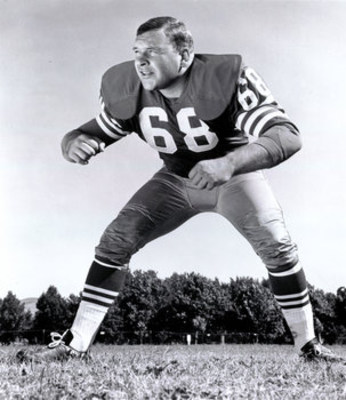
Guard : Guy McIntyre
Guy was drafted in the third round by the 49ers in 1984, the 73rd player chosen overall.
He spent his rookie year as a reserve, and being used as an extra blocker in the backfield on short yardage situations.
The 49ers ended up the season by winning Super Bowl XIX.
In the game, McIntyre attempted to run a kickoff late in the second quarter and fumbled. Miami ended up kicking a field goal, scoring their last points of the game.
McIntyre started two games the next season, and scored a touchdown off of a fumble recovery.
After starting another two games in 1986, McIntyre was named a starter for the next year.
That season ended abruptly, and he played just three games.
The 1988 season saw him start in 12 games, and catch a 17 yard touchdown pass.
San Francisco ended up winning Super Bowl XXIII that year.
They won the Super Bowl again the following season, and McIntyre was named to the Pro Bowl despite starting in just 13 of the 16 games he played.
He would achieve this honor the next four seasons, and not miss a game or start during this span.
After joining the Green Bay Packers in 1994, he started in all 10 games he played.
McIntyre then joined the Philadelphia Eagles in 1995.
After starting all 16 games that season, he started in just two the following year. He also caught a four yard pass.
He then retired from the game.
Guy McIntyre's five Pro Bowls are tied with Hall of Famer Bob St. Clair as the most by any offensive lineman in team history.
Bruno Banducci, Woody Peoples, Kevin Gogan, Randy Cross, and Jesse Sapolu all deserve mention.

Center : Forrest Blue
Forrest was the 49ers' first round draft selection in 1968, and was the 15th player chosen overall.
After spending his rookie year on the bench, he was named a starter the next season.
He started in every game he played until 1974, and missed just two games over that time.
Blue was the centerpiece of an offensive line that led an explosive offense to three straight NFC West titles from 1970 to 1972.
The offense also led the NFL in yards total gained and points scored in 1970.
San Francisco led the NFL in passing yards in 1969, and the NFC in that category in 1970 and 1972.
Blue was named to his first Pro Bowl in 1971, and would continue to attain this honor until 1974.
He was named First Team All-Pro in both 1971and 1972.
During the 1971 season, Blue scooped up a fumble and rambled 25 yards for the only touchdown of his career.
Blue joined the Baltimore Colts in 1975, and backed up Ken Mendenhall until he retired at the conclusion of the 1978 season.
The Colts would win the AFC East from 1975 to 1977 during that time.
Forrest Blue was a unique center for his era, standing at 6'6'' tall. His height would be considered rare even today for his position.
The fact he was named to the Pro Bowl in an era where multiple Pro Bowl centers excelled like Len Hauss, of the Washington Redskins, Mick Tinglehoff, of the Minnesota Vikings, Jeff Van Note, of the Atlanta Falcons, Ed Flanagan, of the Detroit Lions, Rich Saul, of the Los Angeles Rams and Tom Banks, of the Saint Louis Cardinals shows how good of a player he was.
His four Pro Bowls are the most by any center in team history, and his two First Team All-Pro honors are tied with Harris Barton as the most by any lineman in 49ers history.
Bruce Bosley, Bill Johnson, and Fred Quillan all deserve mention.

Kick Returner : Abe Woodson
Abe was drafted by the San Francisco 49ers in the second round of the 1957 draft, the 15th player chosen overall.
Woodson intercepted 19 balls, and recovered 15 fumbles, in his nine year career for the 49ers as a cornerback.
He also brought the bump and run technique to the NFL.
However, he may have made his biggest mark as a return specialist.
Woodson didn't play much in his rookie season, but he was stellar from the next year on.
He would be an All Pro from 1959 to 1963.
In 1959, he led the NFL in kickoff return average with 29.5. He also had a NFL long return of 105 yards, which resulted in his first career touchdown.
He averaged 29.3 yards per kick return the following year, and led the NFL in punt return average with a career best 13.4. He also had the most punt return yards that year, with 174 yards. His 48 yard return via a punt also led the league.
Woodson averaged 10.8 yards per punt return in 1961. He returned one punt 80 yards for a score. Abe also averaged 29 yards per kickoff return, and scored on a 98 yard return.
Woodson then led the NFL with 37 kickoff returns, a career best 1,157 yards returned, and a 31.3 average in 1962.
He also had an NFL long 85 yard punt return, which culminated in his last punt return touchdown of his career.
Woodson also scored the only defensive touchdown of his career that year, when he took a fumble in for a score.
Abe scored an NFL leading three kickoff return touchdowns the next season, and led the NFL with a career best 32.2 average.
Woodson continued to be one of the best kick returners in the league the next two seasons, before giving up the duties for his final season in 1966.
Abe Woodson retired with a defensive TD, two TD's off punt returns, and five more off of kickoff returns.
His career average of 28.69 yards per kickoff return ranks third all time in NFL history.
Abe Woodson led the NFL in kickoff return average three times, which is an NFL record.
Dexter Carter, Dave Williams, Allen Rossum, and James Owens all deserve mention.

The term "hometown hero" surely applies to John Brodie.
He was born in San Francisco, and was raised in the Bay area. He attended nearby Stanford University, where he was an All-American who led the nation in passing in 1956.
He is a member of the College Football Hall of Fame.
The 49ers drafted him in the first round of the 1957 draft, the third player chosen overall.
San Francisco already had a Hall of Fame player named Y.A. Tittle playing quarterback, so they brought Brodie along slowly.
He started in one of the five games he played during his rookie year, and won.
Brodie led the NFL in completion percentage in his second season, when he started six times in the twelve games he played.
After not playing much in his third year, Brodie started eight games in 1960. He showed the 49ers brass he was ready to assume the starting job full time, so Y.A. Tittle was traded to the New York Giants in the offseason.
His 1961 season was solid. He led the NFL with career-high marks of 9.1 yards gained per attempt, and 16.7 yards gained per completion.
After a good 1962 season, Brodie was hurt during the third game of 1963. He would miss the rest of the year.
San Francisco, and Brodie, struggled the next season, but he rebounded with perhaps the best year of his career in the 1965 season despite missing one game.
He led the NFL with 3,112 passing yards, 30 touchdowns, 242 completions, and 239.4 yards per game. All were career best marks. He also led the NFL with a 61.9 percent completion rate, and 349 passing attempts.
Brodie was named to his first Pro Bowl for his efforts.
The 49ers were mediocre the next few years, but Brodie had an excellent 1968 season.
He led the NFL with a career high 404 passing attempts, as well as 234 completions, 3,020 passing yards, a 57.9 completion percentage, and 215.7 yards gained per game. His 21 interceptions also led the league.
The 1970 season is considered by many the best John Brodie ever had. He led the NFL with 2,931 passing yards, 223 attempts, 24 touchdown passes, 210.1 yards gained per game, a 93.8 quarterback rating, a 7.4 net yards gained per attempt, an a 2.6 interception percentage.
He was named to his last Pro Bowl, as well as First Team All-Pro.
The 49ers won the NFC West, and would reach the NFC Championship Game.
Brodie was named NFL MVP by the both the Associated Press and Newspaper Enterprise Association, and was the first ever NFC MVP by United Press International.
The 49ers won the NFC West and went back to the NFC Championship Game again the next year with Brodie at the helm.
San Francisco wanted to Steve Spurrier to succeed the 37 year old Brodie in 1972. Spurrier was the 49ers first pick in 1967, and was the third player chosen. He had been a flop so far, as he would be all of his NFL career.
Spurrier's best year was in 1972, where he started nine games and won six. He was hurt towards the end of the year, and Brodie was called upon again.
He secured the NFC West title by throwing two touchdowns in a comeback victory on the last game of the season.
The 49ers would be eliminated by the Dallas Cowboys for the third year in a row, this time in the first round.
After starting six games the next year, he retired. His 31,548 passing yards were the third most in NFL history at that time.
Brodie was the leader of an exciting offense that led the NFL in points scored in 1965 and 1970, as well as the NFC in 1972.
The 49ers led the NFL in total yards gained in 1965 and the NFC in 1970.
Brodie oversaw an offense that was first in the NFL in yards passing in 1965 and 1969 and the NFC in 1970 and 1972.
His No. 12 jersey has been retired by the team, though he allowed long time friend Trent Dilfer wear it for two seasons as a tribute.
He was an smart and athletic player who had a quick release. Four times in his career, he was the least sacked quarterback in the NFL. His career average of 3.21 is the third best in NFL history.
His 6.59 career average of net yards per passing attempt is still the twelfth best in NFL history
John Brodie is a member of the Bay Area Sports Hall of Fame.
Jeff Garcia deserves mention. His three Pro Bowls are the most by any non-HOF QB in team history.
Fullback: Ken Willard
Ken was the Niners' first pick in the 1965 draft, and the second player chosen overall. He was put into the starting lineup immediately, an honor he would keep up until he left the team nine years later.
Teaming up with John David Crow in the San Francisco backfield, behind John Brodie at quarterback, Willard led the team with 778 yards rushing on 189 carries. He tied Crow for second in touchdowns scored on the team with nine.
Willard also caught 32 passes, and had the only passing attempt of his career intercepted and returned 45 yards.
Both Willard and Crow made the Pro Bowl that year, a season most noted by Hall of Fame running back Gale Sayers scoring six touchdowns in a game against the 49ers.
San Francisco led the NFL in total yards gained, points scored, and passing yards gained that year.
The 1966 season saw Willard return to the Pro Bowl after catching a career best 42 passes, running for 763 yards, and scoring seven times.
He missed a game the next year, and would not miss another for the next six seasons. He rumbled for 510 yards, caught 23 balls, and scored six times.
Willard's best year may have been in 1968. He went back to the Pro Bowl after gaining a career best 967 yards, catching 36 passes, and scoring seven times.
His next season saw him go to his last Pro Bowl after scoring a career best 10 touchdowns. He also snagged 36 receptions, and ran for 557 yards.
San Francisco won the NFC West Division in 1970, and Willard was a big reason. He matched his career high total of 10 scores while gaining 789 yards and catching 31 passes.
The Niners led the NFL in total yards gained and points scored that season.
The 49ers made it to the NFC Championship Game, but lost to the Dallas Cowboys 17-10. Dallas controlled the clock by churning out 221 rushing yards, which was 168 more yards than San Francisco on 31 more attempts.
The Niners would repeat as NFC West champs the next year, as Willard gained 855 rushing yards. He also caught 27 passes and scored five times.
They went back to the NFC Championship, and lost to Dallas again. The Cowboys won the same way, by gaining 111 more rushing yards on 30 extra attempts. Dallas also intercepted three passes, and the game's final score was 14-3.
Willard injured his knee in 1972, and had to be a reserve for three of the 14 games. He rushed for 345 yards on 100 attempts, had 24 receptions, and scored five times.
The 49ers won the NFC West for a third straight year, but lost again to Dallas. This time it was in the divisional playoffs, a game Willard was unable to play. Dallas won 30-28 after scoring 17 unanswered points in the fourth quarter.
Willard's knee was troublesome in the 1973 season. He was a reserve for four games, starting the other 10. He carried the ball 83 times, has 22 receptions, and scored twice.
He joined the Saint Louis Cardinals in 1974, and started in three of the seven games he appeared in. He scored his last career touchdown on four receptions, and gained 175 yards on 40 attempts.
The Cardinals won the NFC East that season, but lost in the first playoff game. Willard retired after that season.
His 1,582 carries for 5,930 yards and 45 rushing touchdowns are the third most in team history behind Roger Craig and Hall of Famer Joe "Jet" Perry.
His 273 receptions are still the thirteenth most in franchise history.
Tom Rathman and Earl Cooper also deserve mention.
Halfback: Roger Craig
Roger was drafted by the Niners in the second round of the 1983 draft, the 49th player chosen overall.
He was named the starting fullback in his rookie year, a position he would have his first four seasons, and showed a nose for the end zone by scoring twelve times. He also led the team with 725 rushing yards.
Craig scored 10 times the next year, and the 49ers would go on to win Super Bowl XIX. Craig scored three times in that game, the first player to have ever accomplished that feat.
He had the best year of his career in 1985, becoming the first player to ever gain a thousand yards in both rushing and receiving. Marshall Faulk is the only other player who has done this since.
Craig also became the first running back in NFL history to lead the league in receiving, when he caught 92 balls. He also scored a career-high 15 touchdowns, and averaged a career best 4.9 yards per carry.
He was named to his first Pro Bowl that season.
After catching 81 passes, running for 830 yards, and scoring seven times the next year, the 49ers moved Craig to halfback in 1987.
He responded by being named to the Pro Bowl. This is a feat he would attain the next two years as well, becoming the first player to ever go to a Pro Bowl as a fullback and halfback. Only Stephen Davis has duplicated by this since.
His 1988 season saw him rush for a career-high 1,502 yards, catching 76 passes, and scoring 10 times.
Craig was named the Newspaper Enterprise Association NFL MVP, the Associated Press NFL Offensive Player Of The Year, the UPI NFC Player Of The Year, and First Team All-Pro that year.
San Francisco would end the season by winning Super Bowl XXIII.
Craig ran for over a thousand yards for the final time of his career in 1989, getting 1,054 yards.
The 49ers won the Super Bowl a second straight season, and Craig scored a touchdown in the game.
He was injured in 1990 and missed five games. The 49ers were trying to get back to a third straight Super Bowl, and were beating the New York Giants by a point as time was running out in the fourth quarter. Craig fumbled, and the Giants recovered. New York soon kicked a game winning field goal as time expired.
It was his last play as a 49er, as they would release him. He signed with the Oakland Raiders for the 1991 season.
After starting in thirteen games, and scoring once on 590 rushing yards, the Raiders cut him.
He signed with the Minnesota Vikings and played two years with them as a backup, starting three times total. He scored six touchdowns over that time, and retired at the conclusion of the 1993 season.
Craig's 1,686 carries is the most in team history, nineteen more than Hall Of Famer Joe "Jet" Perry.
His 7,064 rushing yards is the second most, 1,525 yards behind Perry, and his 50 rushing touchdowns are the second most, 18 behind Perry.
His 508 receptions are the most by any RB in Niners history, and the third most overall in team history.
Roger Craig may be a borderline Hall Of Fame candidate to some, but he is one of the finest players to have ever worn a 49ers jersey.
Ricky Watters, JD Smith, Johnny Strzykalski, and Garrison Hearst deserve mention.
Wide Receiver: Gene Washington
Gene was drafted in the first round of the 1969 NFL Draft by San Francisco, the 16th player chosen overall. This was two years after the Minnesota Vikings drafted a wide receiver named Gene Washington with their first round pick.
In fact, both Gene Washingtons played in the Pro Bowl together on the same team two seasons in a row.
The 49ers version got out to a fast start, making the Pro Bowl in each of his first four seasons. He caught 196 passes over that time, while scoring 31 times. His ability to get deep opened up the Niners offense, which allowed the team to win the NFC West from 1970 to 1972.
Washington's best season was his second. He led the NFL with 1,100 receiving yards and an 84.6 receiving yards per game average. Both were career-high marks, as were his 12 touchdowns caught and 53 receptions.
He did lead the NFL with 12 touchdowns caught in 1972, as he made the Pro Bowl for the last time of his career.
The 49ers went then went through a series of quarterbacks like Tom Owen, Steve Spurrier, Jim Plunkett, and Steve DeBerg. The team struggled, but Washington was able to produce the times the ball reached him.
He led the NFL with a 21.2 yards per catch average in 1974, and continued to be the team's best deep threat.
Washington joined the Detroit Lions in 1979. There was yet another wide receiver named Gene Washington in the league that year, this time with the New York Giants.
Reuniting with former Niners head coach Monte Clark, Washington came off the bench to try and help a young and struggling Lions team. He caught the last score of his career on a career-low 14 receptions. He then retired.
After working on television, Washington began to work in the front offices of the NFL. He is currently the director of football operations for the league.
Washington's 371 career receptions are still the fifth most by any WR in team history, and his 59 receiving touchdowns are the third most in team history.
His 6,664 receiving yards are the fourth most in team history, just 86 yards behind Dwight Clark on 135 less catches.
His career average of 18 yards per catch is the best in franchise history by anyone with more than 41 receptions.
Alyn Beals, Gordie Soltau (a member of the Bay Area Sports Hall of Fame), Dave Parks, Terrell Owens, Freddie Soloman, Dwight Clark, John Taylor, Bernie Casey (also a famous actor), and RC "Alley Oop" Owens all deserve mention.
RC Owens was a high leaper who blocked field goal kicks, and invented the "alley-oop" pass with Hall Of Fame Quarterback Y.A. Tittle. The "alley -oop" term was used to describe them first, and later used in basketball.
Beals was one of the Niners' first stars. He led the league in touchdown receptions in each of his first four years, totaling 46 over that time. He was out of football just two years later, but he never fumbled the ball once in his 211 career receptions and his 49 career receiving TD's are still tied with Billy Wilson as the third most in team history.
Gene Washington fumbled just twice in his career, and is very underrated. He was on teams that were good at first, but struggled for the last five years he was with the 49ers.
Washington's ability to be effective and productive is a testimony on what an excellent player he was.
Wide Receiver: Billy Wilson
First of all, let me say Billy is a future CCC profilee. The fact he has yet to be inducted into Canton is truly disgusting, and proves the media who votes for inductions know NOTHING about the game.
He was a 22nd round draft choice of the 49ers in 1950, and was the 283rd player chosen overall. After making the team, he was used sporadically as rookie. Wilson caught 18 balls and scored three times in nine games played.
After matching his touchdown and games played totals on 23 receptions the next season, Wilson exploded on the NFL in 1952.
He led the NFL with a career-high 10 touchdown receptions, and gained 840 yards on 51 receptions.
Wilson made his first Pro Bowl the next year, leading the NFL with 60 receptions. He also gained 830 yards and scored five times.
He would make the Pro Bowl the next five seasons as well.
Wilson gained 831 yards on 53 receptions, scoring seven times in 1954.
He led the NFL with 60 receptions again in 1955, gaining a career best 889 yards and scoring five times. He also took one touchdown a career-long 77 yards.
Wilson led the NFL with 52 catches the next year, as well as leading the league with a 68.8 yards gained receiving per game average. He also gained 757 yards and scored six times. He did the despite missing a game due to injuries.
His injury woes continued in 1957, as he missed three games. He still managed to grab 43 balls and score fives times.
Wilson played 1- games the next year and caught 44 passes. He also scored four times. This would be his last year as a Pro Bowl player.
Injuries caught up to him by 1959. He was able to play just four games, catching three balls and the last touchdown of his career.
Wilson's 407 receptions career receptions are still the fourth most by any WR in team history, and his 5,902 yards are fifth most.
His 49 career receiving TDs are still tied with Alyn Beals as the third most in team history.
Billy Wilson was a special player. Hall of Famer Don Shula was a defensive back who faced him. Shula says Wilson was so good that he could have been great in the modern game as well.
Bill Walsh, another Hall Of Famer, tried to champion Wilson's induction into Canton for years. Walsh is on record saying it was a long overdue honor.
Though I am hopeful this respect will soon be given, I couldn't imagine anyone but Billy in this slot on my team.
Tight End: Brent Jones
Ted Kwalick surely deserves mention, and could easily win this spot. He is the only TE in 49ers history to be named All-NFL in a season.
Brent was a fifth round draft pick by the Pittsburgh Steelers in 1986, the 135th player chosen overall. He did not make the team, and was out of the league that season.
Jones was signed as a free agent in 1987 by the 49ers, and caught two passes in the four games he appeared in.
The 1988 season saw him catch eight balls in the 10 games he played in. Two went for the first touchdowns of his career.
San Francisco went on to win Super Bowl XXIII that season.
Jones became a starter the next year, and player every game. He caught 40 balls and scored four times.
The 49ers repeated as champions by winning Super Bowl XXIV.
Now firmly entrenched as the starter, Jones snagged 56 receptions for a career best 747 yards and five touchdowns the next season.
His first Pro Bowl season was in 1992. He had 45 receptions for 628 yards and four scores.
Jones made the Pro Bowl the next three seasons. He had a career best 68 receptions in 1993, and a career best nine touchdowns in 1994.
San Francisco won Super Bowl XXIX, their fifth title.
In his last Pro Bowl season, after 1995, Jones had 60 receptions.
He caught 62 passes and three touchdowns over the next two seasons, despite missing eight games due to injuries.
He then retired at the conclusion of the 1997 season.
Jones' 417 career receptions for 5,195 yards and 33 touchdowns are the most by any TE in team history.
Monty Stickles and Russ Francis also deserve mention.
Tackle: Harris Barton
Harris was San Francisco's first round draft choice in 1987, the 22nd player chosen overall.
Barton's rookie season saw him start nine of the 12 games he appeared in during his rookie year.
He started in every game but one the next season, and the 49ers would end up winning Super Bowl XXIII.
San Francisco repeated as champions the following year, and Barton played in every game.
In 1990, Barton moved inside to played guard on the right side. He moved back to RT the next year after Bubba Paris was released and Steve Wallace moved over to fill his spot.
In 1992, Barton was injured in the 13th game and missed the rest of the season.
He was named First Team All-Pro, but was unable to play in the Pro Bowl game.
Barton was named First Team All-Pro again the next season, and played in his only Pro Bowl game.
San Francisco won Super Bowl XXIX in 1994, though Barton was only able to play in nine games due to injury.
He missed seven games over the next two years because of injuries, then decided to retire at the conclusion of the 1996 season.
His two First Team All-Pro nods is tied with Forrest Blue as the most by any offensive lineman in franchise history.
Harris Barton is not only one of the finest offensive tackles to have ever suited up for the 49ers, he is the answer to the trivia question of being the only recorded spectator to have witnessed both Hank Aaron and Barry Bonds break the MLB home run record in person.
Tackle: Len Rohde
Len was a fifth round draft choice by San Francisco in 1960, the 59th player chosen overall.
He spent his first three seasons as a reserve, though he did start five games for injured Hall of Famer Bob St. Clair at RT in 1963.
Rohde was named the starting LT the next year, and would hold into that spot until he retired after the 1974 season.
He would never miss a game or a start in that entire time.
Rohde, who was in charge of protecting quarterback John Brodie's blind side, was an important cog in an potent offense.
San Francisco led the NFL in points scored twice during Rohde's tenure, and the NFC once more. They also led the NFL in passing yards twice, and the NFC two additional times.
Rohde also was part of an offense that led the NFL in total yards gained once, as well as the NFC an additional time.
San Francisco won the NFC West three times from 1970 to 1972, losing in the NFC Championship Game twice.
Rohde was recognized for his sound work in 1970, when he was named to his only Pro Bowl.
In 1969, the UPI named him to their All-NFL Second Team..
Len Rohde was a stalwart in an excellent 49ers offense for 11 years. He was sound and dependable.
He is also one of the best offensive tackles in franchise history.
Kevin Gogan, John Thomas, Steve Wallace, and Walt Rock deserve mention.
Guard: Howard Mudd
Howard was the 49ers ninth round draft pick in 1964, the 113th player chosen overall.
He spent his rookie season as a reserve, but earned the starting job the next year.
Mudd was named to the Pro Bowl in 1966, and would repeat this achievement the next two seasons as well.
He was named First Team All-Pro in 1968.
The 49ers traded Mudd to the Chicago Bears after the fifth game in 1969, and he played nine games with the Bears.
Mudd injured his knee in the tenth game of the 1971 season, and retired from the game.
His three Pro Bowls are tied with Randy Cross as the second most by any guard in team history.
Howard Mudd has been an offensive line coach in the NFL for the last 33 years, and with the Indianapolis Colts since 1998.
Guard : Guy McIntyre
Guy was drafted in the third round by the 49ers in 1984, the 73rd player chosen overall.
He spent his rookie year as a reserve, and being used as an extra blocker in the backfield on short yardage situations.
The 49ers ended up the season by winning Super Bowl XIX.
In the game, McIntyre attempted to run a kickoff late in the second quarter and fumbled. Miami ended up kicking a field goal, scoring their last points of the game.
McIntyre started two games the next season, and scored a touchdown off of a fumble recovery.
After starting another two games in 1986, McIntyre was named a starter for the next year.
That season ended abruptly, and he played just three games.
The 1988 season saw him start in 12 games, and catch a 17 yard touchdown pass.
San Francisco ended up winning Super Bowl XXIII that year.
They won the Super Bowl again the following season, and McIntyre was named to the Pro Bowl despite starting in just 13 of the 16 games he played.
He would achieve this honor the next four seasons, and not miss a game or start during this span.
After joining the Green Bay Packers in 1994, he started in all 10 games he played.
McIntyre then joined the Philadelphia Eagles in 1995.
After starting all 16 games that season, he started in just two the following year. He also caught a four yard pass.
He then retired from the game.
Guy McIntyre's five Pro Bowls are tied with Hall of Famer Bob St. Clair as the most by any offensive lineman in team history.
Bruno Banducci, Woody Peoples, Kevin Gogan, Randy Cross, and Jesse Sapolu all deserve mention.
Center : Forrest Blue
Forrest was the 49ers' first round draft selection in 1968, and was the 15th player chosen overall.
After spending his rookie year on the bench, he was named a starter the next season.
He started in every game he played until 1974, and missed just two games over that time.
Blue was the centerpiece of an offensive line that led an explosive offense to three straight NFC West titles from 1970 to 1972.
The offense also led the NFL in yards total gained and points scored in 1970.
San Francisco led the NFL in passing yards in 1969, and the NFC in that category in 1970 and 1972.
Blue was named to his first Pro Bowl in 1971, and would continue to attain this honor until 1974.
He was named First Team All-Pro in both 1971and 1972.
During the 1971 season, Blue scooped up a fumble and rambled 25 yards for the only touchdown of his career.
Blue joined the Baltimore Colts in 1975, and backed up Ken Mendenhall until he retired at the conclusion of the 1978 season.
The Colts would win the AFC East from 1975 to 1977 during that time.
Forrest Blue was a unique center for his era, standing at 6'6'' tall. His height would be considered rare even today for his position.
The fact he was named to the Pro Bowl in an era where multiple Pro Bowl centers excelled like Len Hauss, of the Washington Redskins, Mick Tinglehoff, of the Minnesota Vikings, Jeff Van Note, of the Atlanta Falcons, Ed Flanagan, of the Detroit Lions, Rich Saul, of the Los Angeles Rams and Tom Banks, of the Saint Louis Cardinals shows how good of a player he was.
His four Pro Bowls are the most by any center in team history, and his two First Team All-Pro honors are tied with Harris Barton as the most by any lineman in 49ers history.
Bruce Bosley, Bill Johnson, and Fred Quillan all deserve mention.
Kick Returner : Abe Woodson
Abe was drafted by the San Francisco 49ers in the second round of the 1957 draft, the 15th player chosen overall.
Woodson intercepted 19 balls, and recovered 15 fumbles, in his nine year career for the 49ers as a cornerback.
He also brought the bump and run technique to the NFL.
However, he may have made his biggest mark as a return specialist.
Woodson didn't play much in his rookie season, but he was stellar from the next year on.
He would be an All Pro from 1959 to 1963.
In 1959, he led the NFL in kickoff return average with 29.5. He also had a NFL long return of 105 yards, which resulted in his first career touchdown.
He averaged 29.3 yards per kick return the following year, and led the NFL in punt return average with a career best 13.4. He also had the most punt return yards that year, with 174 yards. His 48 yard return via a punt also led the league.
Woodson averaged 10.8 yards per punt return in 1961. He returned one punt 80 yards for a score. Abe also averaged 29 yards per kickoff return, and scored on a 98 yard return.
Woodson then led the NFL with 37 kickoff returns, a career best 1,157 yards returned, and a 31.3 average in 1962.
He also had an NFL long 85 yard punt return, which culminated in his last punt return touchdown of his career.
Woodson also scored the only defensive touchdown of his career that year, when he took a fumble in for a score.
Abe scored an NFL leading three kickoff return touchdowns the next season, and led the NFL with a career best 32.2 average.
Woodson continued to be one of the best kick returners in the league the next two seasons, before giving up the duties for his final season in 1966.
Abe Woodson retired with a defensive TD, two TD's off punt returns, and five more off of kickoff returns.
His career average of 28.69 yards per kickoff return ranks third all time in NFL history.
Abe Woodson led the NFL in kickoff return average three times, which is an NFL record.
Dexter Carter, Dave Williams, Allen Rossum, and James Owens all deserve mention.
Wednesday, August 12, 2009
How Will The NFC West Be Won?
ARIZONA CARDINALS
Arizona was minutes away from winning their first Lombardi Trophy last season, and some are expecting them to have a chance again this year.
Last year was a magical run that saw QB Kurt Warner revive his career, while WR Larry Fitzgerald put his in the spotlight. Fitzgerald teams with Anquan Boldin to give the Cardinals the best WR duo in the NFL, and Steve Breaston is a spectacular third receiver who makes them even better.
A big reason for their playoff run in 2008 was the emergence of the offensive line. If they can improve even more, the offense becomes more deadly. They will need to, because an injury to Warner could prove to be catastrophic. His backup, Matt Leinart, has been a huge flop. Warner will hope to remain healthy, while attempting to defy age. He appeared to be nearly out of the league until he resurrected his career last year.
The defense is led by DT Darnell Dockett and an above average secondary. Dockett is one of the more underrated players in the NFL. Arizona's defense won games last season, most notably a victory over the Dallas Cowboys on national television. If they can be as good as last year, the Cardinals will be in good shape.
The big question will be the running game. Tim Hightower was a nice surprise in his 2008 rookie season, and he might have to carry the bulk of the workload this year. Arizona drafted a talented runner in Beanie Wells this year, but Wells has shown to be injury prone in college and even in his first professional training camp.
The pieces are in place for another Super Bowl run on paper. Injuries weren't a big factor last year for the Cardinals. If they can't avoid them again this year, their luck may run out.
SAINT LOUIS RAMS
It wasn't all that long ago the Rams offense was dubbed "The Greatest Show On Turf". They could pile up point in bunches over a short time. The Rams of today are anything but that.
This is a team built on winning in the trenches and controlling the clock. Led by a deep and talented offensive line, Steven Jackson could be primed for a big season rushing the football. The problem is if Jackson misses time, because there is a serious drop off in the depth chart.
The passing game is full of questions. Quarterback Marc Bulger has had injury issues the past few seasons, and TE Randy McMichael is trying to return from an injury that ended his 2008 season early. The wide receivers are very young, and are led by second year pro Donnie Avery.
The defense is led by an up and coming line that features two young and versatile studs in Adam Carriker and Chris Long. The unit, though not very deep, is god against the run and pass. They could allow MLB James Laurinaitis to become a star. Factor in OLB Chris Draft, CB Tye Hill, and FS Oshiomogho Atogwe, and the Rams defense is better than some may expect.
Another big weapon for the Rams is kicker Josh Brown. He is consistent and has a strong leg, the type you want when the game is on the line.
Every year, a team surprises NFL fans. This could be the year of the Rams.
SAN FRANCISCO 49ERS
The Niners have been stuck in muddle the last many years. They are never the worst team, but they often fall short with rosters full of players not fulfilling their potentials.
One player most spotlighted, in this regard, is quarterback Alex Smith. Smith spent last year injured, and might be getting his last shot to prove why he was the first player selected in the 2005 draft. If he can't, Shaun Hill will get the call. One player to watch is talented rookie Nate Davis.
The woes at quarterback also has cost their skilled players from excelling. They rely on RB Frank Gore and his surgically repaired knees to carry the team much too often.The blocking has been so subpar, they have wasted the immense talents of TE Vernon Davis so far. Davis is an amazing athlete who works best in the slot, but he is forced to stay in and help block, squandering his abilities.
Michael Crabtree was drafted this year to provide another weapon, but a wide receiver can only excel if the quarterback can get him the ball. Crabtree's ego, however, may say otherwise.
The defense may be the best in the division, led by tackling machine Patrick Willis. They got even better with the acquisition of Dre Bly. This is the unit that gives the 49ers the best chance at winning.
Mike Singletary was a hard nosed player who achieved his potential, and inspired his teammates to fulfill theirs. It is a lot different trying to convey passion from the sideline rather than the huddle, so it will be interesting to see what Singletary does with his roster.
Getting guys like Smith, Crabtree, and Vern Davis to realize their potentials could get the Niners out of the perpetual muddle, and into the playoffs.
SEATTLE SEAHAWKS
Seattle is trying to remain competitive while turning over their roster. The hardest thing to do is expect to win your division in the process.
With the impending retirements of future Hall Of Fame OT Walter Jones and QB Matt Hasselbeck on the horizon, there appears to be no solid contingency plan in place.
Seattle relies on their passing game. Hasselbeck is dealing with a chronic back problem, so his playing a full season is crucial to their success.
The offense is veteran and savvy. They got better by acquiring TJ Houshmanzadeh, who should team up with TE John Carlson to give Seattle two solid possession type threats. If Nate Burleson or rookie Deon Butler can get deep, it will open many options up. Deion Branch also needs to show why he was given a big contract several seasons ago.
The running game scares no one, and is led by two veterans who haven't excelled in years. Julius Jones and TJ Duckett are the guys Seattle is gambling on, and these are a risk few would take.
The defense is solid, and led by a deep linebacking unit. Julian Peterson was sent packing so first round draft choice Aaron Curry could start. The secondary is veteran, and is boosted by the return of CB Ken Lucas. Lucas had spent the last four years in Carolina. The defensive line rotates players constantly, except for DE Patrick Kerney.
The special teams are a unit worth watching. Seattle needs to decide if they will keep Orlindo Mare or Brandon Coutu at kicker, or carry both on the roster. Also, they have a battle between Josh Wilson, Justin Forsett, and Devin Moore for the return duties.
Seattle should be in a lot of games this year, mainly because of their defense. If they can get some semblance of a running game to balance the offense, then guys like Jones and Hasselbeck can try to get one last NFC West crown.
Arizona was minutes away from winning their first Lombardi Trophy last season, and some are expecting them to have a chance again this year.
Last year was a magical run that saw QB Kurt Warner revive his career, while WR Larry Fitzgerald put his in the spotlight. Fitzgerald teams with Anquan Boldin to give the Cardinals the best WR duo in the NFL, and Steve Breaston is a spectacular third receiver who makes them even better.
A big reason for their playoff run in 2008 was the emergence of the offensive line. If they can improve even more, the offense becomes more deadly. They will need to, because an injury to Warner could prove to be catastrophic. His backup, Matt Leinart, has been a huge flop. Warner will hope to remain healthy, while attempting to defy age. He appeared to be nearly out of the league until he resurrected his career last year.
The defense is led by DT Darnell Dockett and an above average secondary. Dockett is one of the more underrated players in the NFL. Arizona's defense won games last season, most notably a victory over the Dallas Cowboys on national television. If they can be as good as last year, the Cardinals will be in good shape.
The big question will be the running game. Tim Hightower was a nice surprise in his 2008 rookie season, and he might have to carry the bulk of the workload this year. Arizona drafted a talented runner in Beanie Wells this year, but Wells has shown to be injury prone in college and even in his first professional training camp.
The pieces are in place for another Super Bowl run on paper. Injuries weren't a big factor last year for the Cardinals. If they can't avoid them again this year, their luck may run out.
SAINT LOUIS RAMS
It wasn't all that long ago the Rams offense was dubbed "The Greatest Show On Turf". They could pile up point in bunches over a short time. The Rams of today are anything but that.
This is a team built on winning in the trenches and controlling the clock. Led by a deep and talented offensive line, Steven Jackson could be primed for a big season rushing the football. The problem is if Jackson misses time, because there is a serious drop off in the depth chart.
The passing game is full of questions. Quarterback Marc Bulger has had injury issues the past few seasons, and TE Randy McMichael is trying to return from an injury that ended his 2008 season early. The wide receivers are very young, and are led by second year pro Donnie Avery.
The defense is led by an up and coming line that features two young and versatile studs in Adam Carriker and Chris Long. The unit, though not very deep, is god against the run and pass. They could allow MLB James Laurinaitis to become a star. Factor in OLB Chris Draft, CB Tye Hill, and FS Oshiomogho Atogwe, and the Rams defense is better than some may expect.
Another big weapon for the Rams is kicker Josh Brown. He is consistent and has a strong leg, the type you want when the game is on the line.
Every year, a team surprises NFL fans. This could be the year of the Rams.
SAN FRANCISCO 49ERS
The Niners have been stuck in muddle the last many years. They are never the worst team, but they often fall short with rosters full of players not fulfilling their potentials.
One player most spotlighted, in this regard, is quarterback Alex Smith. Smith spent last year injured, and might be getting his last shot to prove why he was the first player selected in the 2005 draft. If he can't, Shaun Hill will get the call. One player to watch is talented rookie Nate Davis.
The woes at quarterback also has cost their skilled players from excelling. They rely on RB Frank Gore and his surgically repaired knees to carry the team much too often.The blocking has been so subpar, they have wasted the immense talents of TE Vernon Davis so far. Davis is an amazing athlete who works best in the slot, but he is forced to stay in and help block, squandering his abilities.
Michael Crabtree was drafted this year to provide another weapon, but a wide receiver can only excel if the quarterback can get him the ball. Crabtree's ego, however, may say otherwise.
The defense may be the best in the division, led by tackling machine Patrick Willis. They got even better with the acquisition of Dre Bly. This is the unit that gives the 49ers the best chance at winning.
Mike Singletary was a hard nosed player who achieved his potential, and inspired his teammates to fulfill theirs. It is a lot different trying to convey passion from the sideline rather than the huddle, so it will be interesting to see what Singletary does with his roster.
Getting guys like Smith, Crabtree, and Vern Davis to realize their potentials could get the Niners out of the perpetual muddle, and into the playoffs.
SEATTLE SEAHAWKS
Seattle is trying to remain competitive while turning over their roster. The hardest thing to do is expect to win your division in the process.
With the impending retirements of future Hall Of Fame OT Walter Jones and QB Matt Hasselbeck on the horizon, there appears to be no solid contingency plan in place.
Seattle relies on their passing game. Hasselbeck is dealing with a chronic back problem, so his playing a full season is crucial to their success.
The offense is veteran and savvy. They got better by acquiring TJ Houshmanzadeh, who should team up with TE John Carlson to give Seattle two solid possession type threats. If Nate Burleson or rookie Deon Butler can get deep, it will open many options up. Deion Branch also needs to show why he was given a big contract several seasons ago.
The running game scares no one, and is led by two veterans who haven't excelled in years. Julius Jones and TJ Duckett are the guys Seattle is gambling on, and these are a risk few would take.
The defense is solid, and led by a deep linebacking unit. Julian Peterson was sent packing so first round draft choice Aaron Curry could start. The secondary is veteran, and is boosted by the return of CB Ken Lucas. Lucas had spent the last four years in Carolina. The defensive line rotates players constantly, except for DE Patrick Kerney.
The special teams are a unit worth watching. Seattle needs to decide if they will keep Orlindo Mare or Brandon Coutu at kicker, or carry both on the roster. Also, they have a battle between Josh Wilson, Justin Forsett, and Devin Moore for the return duties.
Seattle should be in a lot of games this year, mainly because of their defense. If they can get some semblance of a running game to balance the offense, then guys like Jones and Hasselbeck can try to get one last NFC West crown.
Friday, August 7, 2009
Past News, Present Stain, Future Shame
Like a birth certificate's legitimacy being ridiculed by a kid born with the umbilical chord wrapped around its neck, it is time for POINTLESS PONDERING. That dried up dingleberry residing in the stretch marks of journalism's taint.
Though there is some dysphoria after Brett Favre retired again, joviality reigns supreme.
Never again will the Hyckocrite be written in this blog. Let us go over a few myths with the fine comb of reality in honor of his departure.
There are people who say Favre is the greatest quarterback in football history. These are folks who haven't watched much football, or being paid to promote their media darling. I can think of at least 30 other quarterbacks that I feel are better players.
If you examine his character, it reeks of a self serving ego who put himself first at all turns. This was first seen in his rookie season, where Favre clashed with the Atlanta Falcons coaches and spent most of his time partying.
Other lowlights included his throwing a teammate under the bus for holding out for a pay raise. Favre, of course, had nothing to worry about. He had just signed a lifetime contract a few years earlier, and became the first NFL player to get 100 million dollars. The multiple retirements also showed his true persona.
If you want to talk about on the field, you first must understand how much easier it is to play his position compared to the years before him. He never had to call his own plays in an era where blockers could hold and receivers could only be chucked in the first five yards.
In these times where the quarterback could practically wear a dress as defenders feared the leagues wrath for tackling them too hard, Favre was considered an iron man.
He played 273 games in his 18 seasons, and has the NFL record for the most turnovers in league history with 427. This includes league records of 310 interceptions thrown and 117 fumbles lost. That is an average of 1.56 turnovers in every game he played.
Brett Favre was a player who you knew what you got with him. A egomaniac who loved the thrill of taking risks, even if he cost the team a victory. He infuriated and clashed with his teammates and coaches. He played to the media, who gave him an image that has endeared him to the millions of people who had forgotten or never paid attention to his antics.
Favre is a first ballot Hall Of Fame player who won a championship in a record setting career. He won't be soon lost from memory, but he is absolutely not even close to being one of the greatest ever at his position.
His ego has many saying good riddance to him now, while his fans will probably never let go of his image nor the hope of his return.
Is anyone really that shocked about the Redsox Roids scandal that Major League Baseball is currently trying to suffocate?
If you are, you really haven't paid any attention to the game the past twenty years.
The bogus Mitchell Report, in case you weren't aware, was written by part BoSox owner George Mitchell. Notice only one scrub middle reliever from his team made that list then?
If you think Roger Clemens didn't start using junk until after he left Beantown, I would like to sell you the Longfellow Bridge for a nice price.
Now we hear David Ortiz and Manny Ramirez are on it. My response is,"DUH!". Ortiz was a scrub on the bench in Minnesota before he hit Boston. ManRam's erratic behavior screams of a steroid user called "Roid Rage". Who else in their right mind would go urinate in the left field wall during a game other than a junkie?
Then there is the story where former player Jerry Remy's kid was recently fired for being on the stuff. Of course they don't know of any players who are on the stuff. Sounds like the ol' good soldier being a scapegoat. Taking one for the team, for his dad, and the faux legacy of the organization.
Now, I certainly am not saying just Boston was shooting up. It seems quite clear everyone was, and the list of non-users is going to be much shorter than the users.
Baseball was coming off a strike in 1994, and attendance was suffering in 1995. Owners had to do something, they thought, and this included George W. Bush. Bush owned the Texas Rangers at the time, and would become the President of the United States of America just five years later.
Baseball had already lowered the pitching mound and lowered and brought the outfield walls in closer to home plate. In order to bring in the fair weathered fan to fill seats, they decided to try other options to increase offense.
The first step was to wind the balls tighter, which is called "juicing" them. It makes the ball travel further, and this theory was proved by testing. Seemingly no one cared, because the media and MLB soon stifled this story.
Another way was to water down the talent pool through expansion. The Milwaukee Brewers moved to the National League in 1998. The Arizona Diamondbacks and Tampa Bay Devil Rays joined the league also that year in what is called "a magical season" by some. These teams, along with the defending champion Florida Marlins and Colorado Rockies franchise entering just their fifth years of existence, set the stage for a big public relations push.
Watering down the talent, shrinking the stadiums, and juicing the balls wasn't enough. For several years, many players already had begun to take steroids. The MLB owners chose to look the other way, especially in a lucrative 1998 season. Two of the poster children for steroids, Mark McGwire and Sammy Sosa, began a binge on both drugs and home runs. The gloss of the home run shined over the steroids then, because the game and media were getting fat on these times.
Times were good to baseball. So good even guys with salami bats were going on home run tears in the 90's. In 1996, Kevin Elster hit 24 homers. He had 88 total in his 13 year career. Brady Anderson had ten career home runs in four years before 1992. He hit 50 in 1996 alone. Steroids were as common as a fastball down the heart of the plate from then on.
Now there seems some phony repent from the game. Long after they stole money from the fans. A repent that has been so untrue, we are seeing names casually trickle and fade quickly now. Players the game pushes into their spotlight like Ortiz, Ramirez, Alex Rodriguez, and others.
Can the players be blamed alone? The media slants it that way.
Imagine a teenager next door who is doing drugs and robbing your house daily. Does his parents deserve some of the blame? What if the parents supplied the drugs and served as a lookout as the kid did his dirt?
It is a sad time for the game, yet people seem to still attend as much as ever. Still, you cannot help but wonder if the Red Sox are a team that has not legitimately won a World Series since 1918.
Perhaps the "Curse of The Bambino" still exists?
Roger Goodell seemingly has the NFL off course, but there still may be a method to the madness by the owners puppet.
With the Pro Bowl being moved to the week before the Super Bowl, and is a moronic idea! All this proves is that Goodell is bad as hell for the NFL.
Let us imagine your favorite player on your favorite team having a spectacular year and leading the way to a Super Bowl appearance.
Only two scenarios can be played out. Obviously this first one is that the player skips the Pro Bowl entirely, which will be the most prevalent move by any Pro Bowlers on teams that make it to the Super Bowl.
The second option is what I call the "Robert Edwards" result. Edwards was a rookie who blew out his knee in a NFL event during the 1998 Pro Bowl week. He almost had to have his leg amputated, and did not return to the NFL again until 2002. No team in the Super Bowl is willing to risk this happening.
This move by Goodell takes away from the Pro Bowls legitimacy, because lesser players will have to fill in and make it more of an ALMOST Pro Bowl instead.
Why even bother playing this kind of game at all? The game already has been suffering from lackluster play by divas, now less talented and worthy ones will cause a deeper coma for viewers.
The last part is how the NFL is moving the game from Hawaii to Miami.
Cheap greed is the first thought that comes to my head. Miami is a nice city, but it ain't Hawaii. Players loved the trip to Honolulu, and brought family along. You really see this happening in Miami?
Then there is the sad reality the long shot player may be phased out of Goodell's NFL. Many players in the Hall Of Fame were not drafted early or at all.
With the NFL practically phasing out the preseason, you probably will see less of these types of long shots. The whole purpose for training camp and exhibition games is to get the best players possible on your roster. Now it can't happen.
Pretend the Jets try out an undrafted quarterback who easily outplays their first draft pick Mark Sanchez.There is just one roster spot open. With all the money invested into Sanchez, there is no way the undrafted kid beats him for the job nor has enough time to.
The UFL will be starting soon, and it could have the success of the last incarnation of the AFL if managed right. Some ex-NFL players, now coaching in the UFL, think the NFL wants the UFL to succeed. Some theories range from the UFL serving as a minor leagues for all the good players who fail an NFL job. Other think it could help the game eventually branch out to new cities then NFL would envelop the upstart league, much like they did with the AFL.
If this is true, and the NFL is using the UFL to grow, then it could be a win-win. There are many good players unable to make rosters each year. Some need time to develop and learn the game more.
Still, it is a bit sad and melancholy to think of all the possible future legends forced to go this route rather than doing it the way it has been done since the birth of the NFL.
Every few years, we get sports pages telling us about bike riding. Lance Armstrong brought it mainstream with his cancer battle, and his steroids cloud.
ESPN pushes the X Games yearly, and bikes are a big part of it.
The Olympics has bike riding events, though they seemingly get little air time.
One can appreciate the ability of the rider, but it seems amazing how much of a spectator sport it has become.
Not so much in the X Games, because they mix it up with other events like skating and skiing. The real surprise is how many people line up throughout the countryside of France. They line up deep and far to catch glimpses of the riders.
Though there is some history to this tour, as well as the bicycle itself, but is this a sport a great portion of Americans pine away for its arrival on television? Do even the highlights pump you up?
Why does it get so much publicity, yet women's sports get hardly any at all? Are you even aware the WNBA has played twenty games already?
Well, it's that time to make like a baby and head out. As they like to say in Ol' Mexico : AMF.
Though there is some dysphoria after Brett Favre retired again, joviality reigns supreme.
Never again will the Hyckocrite be written in this blog. Let us go over a few myths with the fine comb of reality in honor of his departure.
There are people who say Favre is the greatest quarterback in football history. These are folks who haven't watched much football, or being paid to promote their media darling. I can think of at least 30 other quarterbacks that I feel are better players.
If you examine his character, it reeks of a self serving ego who put himself first at all turns. This was first seen in his rookie season, where Favre clashed with the Atlanta Falcons coaches and spent most of his time partying.
Other lowlights included his throwing a teammate under the bus for holding out for a pay raise. Favre, of course, had nothing to worry about. He had just signed a lifetime contract a few years earlier, and became the first NFL player to get 100 million dollars. The multiple retirements also showed his true persona.
If you want to talk about on the field, you first must understand how much easier it is to play his position compared to the years before him. He never had to call his own plays in an era where blockers could hold and receivers could only be chucked in the first five yards.
In these times where the quarterback could practically wear a dress as defenders feared the leagues wrath for tackling them too hard, Favre was considered an iron man.
He played 273 games in his 18 seasons, and has the NFL record for the most turnovers in league history with 427. This includes league records of 310 interceptions thrown and 117 fumbles lost. That is an average of 1.56 turnovers in every game he played.
Brett Favre was a player who you knew what you got with him. A egomaniac who loved the thrill of taking risks, even if he cost the team a victory. He infuriated and clashed with his teammates and coaches. He played to the media, who gave him an image that has endeared him to the millions of people who had forgotten or never paid attention to his antics.
Favre is a first ballot Hall Of Fame player who won a championship in a record setting career. He won't be soon lost from memory, but he is absolutely not even close to being one of the greatest ever at his position.
His ego has many saying good riddance to him now, while his fans will probably never let go of his image nor the hope of his return.
Is anyone really that shocked about the Redsox Roids scandal that Major League Baseball is currently trying to suffocate?
If you are, you really haven't paid any attention to the game the past twenty years.
The bogus Mitchell Report, in case you weren't aware, was written by part BoSox owner George Mitchell. Notice only one scrub middle reliever from his team made that list then?
If you think Roger Clemens didn't start using junk until after he left Beantown, I would like to sell you the Longfellow Bridge for a nice price.
Now we hear David Ortiz and Manny Ramirez are on it. My response is,"DUH!". Ortiz was a scrub on the bench in Minnesota before he hit Boston. ManRam's erratic behavior screams of a steroid user called "Roid Rage". Who else in their right mind would go urinate in the left field wall during a game other than a junkie?
Then there is the story where former player Jerry Remy's kid was recently fired for being on the stuff. Of course they don't know of any players who are on the stuff. Sounds like the ol' good soldier being a scapegoat. Taking one for the team, for his dad, and the faux legacy of the organization.
Now, I certainly am not saying just Boston was shooting up. It seems quite clear everyone was, and the list of non-users is going to be much shorter than the users.
Baseball was coming off a strike in 1994, and attendance was suffering in 1995. Owners had to do something, they thought, and this included George W. Bush. Bush owned the Texas Rangers at the time, and would become the President of the United States of America just five years later.
Baseball had already lowered the pitching mound and lowered and brought the outfield walls in closer to home plate. In order to bring in the fair weathered fan to fill seats, they decided to try other options to increase offense.
The first step was to wind the balls tighter, which is called "juicing" them. It makes the ball travel further, and this theory was proved by testing. Seemingly no one cared, because the media and MLB soon stifled this story.
Another way was to water down the talent pool through expansion. The Milwaukee Brewers moved to the National League in 1998. The Arizona Diamondbacks and Tampa Bay Devil Rays joined the league also that year in what is called "a magical season" by some. These teams, along with the defending champion Florida Marlins and Colorado Rockies franchise entering just their fifth years of existence, set the stage for a big public relations push.
Watering down the talent, shrinking the stadiums, and juicing the balls wasn't enough. For several years, many players already had begun to take steroids. The MLB owners chose to look the other way, especially in a lucrative 1998 season. Two of the poster children for steroids, Mark McGwire and Sammy Sosa, began a binge on both drugs and home runs. The gloss of the home run shined over the steroids then, because the game and media were getting fat on these times.
Times were good to baseball. So good even guys with salami bats were going on home run tears in the 90's. In 1996, Kevin Elster hit 24 homers. He had 88 total in his 13 year career. Brady Anderson had ten career home runs in four years before 1992. He hit 50 in 1996 alone. Steroids were as common as a fastball down the heart of the plate from then on.
Now there seems some phony repent from the game. Long after they stole money from the fans. A repent that has been so untrue, we are seeing names casually trickle and fade quickly now. Players the game pushes into their spotlight like Ortiz, Ramirez, Alex Rodriguez, and others.
Can the players be blamed alone? The media slants it that way.
Imagine a teenager next door who is doing drugs and robbing your house daily. Does his parents deserve some of the blame? What if the parents supplied the drugs and served as a lookout as the kid did his dirt?
It is a sad time for the game, yet people seem to still attend as much as ever. Still, you cannot help but wonder if the Red Sox are a team that has not legitimately won a World Series since 1918.
Perhaps the "Curse of The Bambino" still exists?
Roger Goodell seemingly has the NFL off course, but there still may be a method to the madness by the owners puppet.
With the Pro Bowl being moved to the week before the Super Bowl, and is a moronic idea! All this proves is that Goodell is bad as hell for the NFL.
Let us imagine your favorite player on your favorite team having a spectacular year and leading the way to a Super Bowl appearance.
Only two scenarios can be played out. Obviously this first one is that the player skips the Pro Bowl entirely, which will be the most prevalent move by any Pro Bowlers on teams that make it to the Super Bowl.
The second option is what I call the "Robert Edwards" result. Edwards was a rookie who blew out his knee in a NFL event during the 1998 Pro Bowl week. He almost had to have his leg amputated, and did not return to the NFL again until 2002. No team in the Super Bowl is willing to risk this happening.
This move by Goodell takes away from the Pro Bowls legitimacy, because lesser players will have to fill in and make it more of an ALMOST Pro Bowl instead.
Why even bother playing this kind of game at all? The game already has been suffering from lackluster play by divas, now less talented and worthy ones will cause a deeper coma for viewers.
The last part is how the NFL is moving the game from Hawaii to Miami.
Cheap greed is the first thought that comes to my head. Miami is a nice city, but it ain't Hawaii. Players loved the trip to Honolulu, and brought family along. You really see this happening in Miami?
Then there is the sad reality the long shot player may be phased out of Goodell's NFL. Many players in the Hall Of Fame were not drafted early or at all.
With the NFL practically phasing out the preseason, you probably will see less of these types of long shots. The whole purpose for training camp and exhibition games is to get the best players possible on your roster. Now it can't happen.
Pretend the Jets try out an undrafted quarterback who easily outplays their first draft pick Mark Sanchez.There is just one roster spot open. With all the money invested into Sanchez, there is no way the undrafted kid beats him for the job nor has enough time to.
The UFL will be starting soon, and it could have the success of the last incarnation of the AFL if managed right. Some ex-NFL players, now coaching in the UFL, think the NFL wants the UFL to succeed. Some theories range from the UFL serving as a minor leagues for all the good players who fail an NFL job. Other think it could help the game eventually branch out to new cities then NFL would envelop the upstart league, much like they did with the AFL.
If this is true, and the NFL is using the UFL to grow, then it could be a win-win. There are many good players unable to make rosters each year. Some need time to develop and learn the game more.
Still, it is a bit sad and melancholy to think of all the possible future legends forced to go this route rather than doing it the way it has been done since the birth of the NFL.
Every few years, we get sports pages telling us about bike riding. Lance Armstrong brought it mainstream with his cancer battle, and his steroids cloud.
ESPN pushes the X Games yearly, and bikes are a big part of it.
The Olympics has bike riding events, though they seemingly get little air time.
One can appreciate the ability of the rider, but it seems amazing how much of a spectator sport it has become.
Not so much in the X Games, because they mix it up with other events like skating and skiing. The real surprise is how many people line up throughout the countryside of France. They line up deep and far to catch glimpses of the riders.
Though there is some history to this tour, as well as the bicycle itself, but is this a sport a great portion of Americans pine away for its arrival on television? Do even the highlights pump you up?
Why does it get so much publicity, yet women's sports get hardly any at all? Are you even aware the WNBA has played twenty games already?
Well, it's that time to make like a baby and head out. As they like to say in Ol' Mexico : AMF.
Wednesday, July 29, 2009
Can The NFC South Rise Again?
New Orleans Saints
The Saints have been a bit of a mystery the last two seasons. They show promise and talent, but have fallen well short of proving their worth in the NFL.
Drew Brees 2008 season was special, and New Orleans will be beyond blessed if the quarterback comes even close to matching it in 2009.
The running game has been what has held the Saints back from going far. The blockers have done well in pass defense, but will need to step it up in the rushing attack.
Reggie Bush has done fairly well receiving the ball, but has shown that he is not the cowbell the team needs so far. He is a back who usually goes down on first contact, and has rarely shown why the Saints drafted him so high in the first place.
The key to the season may rest on the shoulders of Pierre Thomas. Thomas has shown glimpses of being special, but has yet been given the duties to display that promise more than a few times. If he gets the Saints 1,000 yards this season, the team will be hard to defeat in their division.
New Orleans has shown they can toss the ball around the field as good as anyone in the league. They did this in 2008 with their top receiver injured for most of it, and their tight end having his own issues.
With Marques Colston and Jeremy Shockey at full health, it could open up things even more for Robert Meachem, Lance Moore, and Devery Henderson. Rookie Adrian Arrington will also push for a roster spot on a deep group.
The Saints other weakness has been defense. They took one step in the right direction by acquiring Jonathan Vilma, a tackling machine who mans their MLB slot. This year they added veteran SS Darren Sharper and DE Paul Spicer, along with CB Malcolm Jenkins, their 2009 first round draft pick.
The Saints hope Jenkins can team up with Tracy Porter to give them the CB tandem the franchise has sought most of their existence in the league. If the duo is, then veteran Randall Gay's versatility to play FS comes in handy for quality depth.
The kicking game is also something to pay attention to. Garrett Hartley took over the job in the tenth game of 2008, and the rookie was perfect the rest of the way. If he can come close to that again will help, but it remains to be seen if he will. Rookie Thomas Morstead is expected to win the punting job, though Glenn Pakulak is the incumbent who also was a rookie in 2008 and didn't play until the tenth game of the season.
The Saints still have a few "ifs" going into 2009, though perhaps a few less than the 2008 season. Regardless, it is better to have those "ifs" than to be the "Aints".
CAROLINA PANTHERS
Carolina's big off season news has been regarding the future of star DE Julius Peppers. Peppers is a man who grew up and was schooled in North Carolina. Peppers is still on the roster, so the fans can focus on an excellent draft class coming in to 2009.
The Panthers are about winning the battle in the trenches, and they really helped themselves on both sides of the ball. Tony Fiametti is a FB who could supplant long time starter Brad Hoover this year. Whomever gets the call, they will lead block for a potentially explosive threesome at running back.
Carolina already has a dynamic duo in DeAngelo Williams and Jonathan Stewart, but they may have stolen a gem in speedster Mike Goodson from the draft. Goodson can develop into a game changing pass catcher and return specialist, if he realizes his potential.
The passing game revolves around WR Steve Smith. If the ultra productive star can get some help, the Panthers get much more dangerous. Dwayne Jarrett has been a huge bust so far, and the team hopes that he or another guy can push 36 year old Muhsin Muhammed for playing time. With the fact they haven't gotten much production from the TE spot, this need intensifies.
The blocking was stout in 2008, and they may have gotten tougher with monstrous G Duke Robinson. He could be the steal of the Panthers draft, and might team up with RT Jeff Otah to give the Panthers a couple of men who make pancakes all day on Sunday.
If Peppers does indeed leave this season, rookie Everette Brown will have to step up faster. Brown is an undersized pass rush specialist who could excel if he has Peppers to bookend him.
The inside defense has been sporadic, but Carolina has Jon Beason at MLB cleaning up the mistakes. The LB unit is not deep, so an injury could be disastrous for the team.
The Panthers did get better at safety in the draft, an area in need, when they selected Sherrod Martin. Martin is a FS type with CB skills, but is very raw. Head Coach John Fox and Defensive Coordinator Ron Meeks will be busy trying to get him, and fellow rookies Brown and DT Corey Irvin ready to contribute right away.
Opponents know Carolina plans to mash the running game down their throats, as well as throw to Steve Smith several times each game. The only shot they have at beating the Panthers is to expose the weaknesses Carolina has on defense and the passing attack. This can be hard to do if Carolina controls the clock, which is their best strategy.
ATLANTA FALCONS
The Falcons shocked the NFL in 2008. Many thought the team would have trouble winning five games, but they ended up winning eleven. It was done with a rookie coach, a rookie quarterback, and a running back being counted on as the primary ball carrier for the first time in his five year career.
The Falcons, liking the potential they saw, then went out and acquired future Hall Of Fame TE Tony Gonzales. Gonzales will not only open up things for WR's like Roddy White, Harry Douglas, and Michael Jenkins, but he will provide QB Matt Ryan with a security blanket better than most young Falcons passers have had in the teams history.
The only offensive questions left are if RB Michael Turner can hold up and come close to last years production, where he virtually carried the team on his back, or if Ryan will succumb to the all too well known sophomore jinx.
Defense was the main concern before 2008, but the Falcons still found a way to win. DE John Abraham had a spectacular season, and Atlanta hopes he and his bookend, Jamaal Anderson, can do even more as a tandem this year. The Falcons DT's scared no one last year, so they went out and drafted two this year. Peria Jerry was the teams first selection, and he will be given every chance to start day one.
Linebacker is a big concern. Keith Brooking has left town, so Atlanta doesn't have much after Curtis Lofton and veteran Mike Peterson. Lofton was solid in his rookie campaign last year, but Peterson is an unknown. He had a falling out in Jacksonville last season, and his production noticeably slipped. He is also moving from MLB to SLB for the 2009 year, a position he hasn't played since 2002 for the Indianapolis Colts. He also hasn't played a full season since 2005.
Perhaps Atlanta will be watching the waiver wire, since they have yet to show interest in free agents like Derrick Brooks. Brooks would be a good fit in Atlanta, and provide leadership, but the team might not be able to afford him after sinking so much cash into Ryan's huge salary.
Another area to watch is the extremely young secondary. Starting FS Erik Coleman is the graybeard of the group at 27 years old, and entering his sixth season. The next oldest player, CB Von Hutchins, is entering his fifth year. Mistakes are a big possibility for the unit.
Most doubt the Falcons will even come close to their 2008 success, but that is the way they want it. Doubt them, overlook them, and disregard them. Just like 2008. It worked fine for them then, so who is to say it wouldn't again?
TAMPA BAY BUCCANEERS
Tampa Bay went 9-7 last year, which would have been good enough to win the NFC West. It was only good enough to finish third in their division, so it cost Jon Gruden his job as coach.
Now Tampa Bay is moving away from all past philosophies. No longer will they employ a West Coast offense, nor the Tampa - 2 defense. They will try to line up man to man and beat down their opponents.
One reason is because the Buccaneers have a young and excellent offensive line. No starter is older than 27, and they also have good depth. There is a question if starting LG Arron Sears is suffering from post-concussion effects, and if he will be ready to play any time soon.
Though the team has yet to decide on whether Brian Leftwich or Luke McCown start at quarterback, or if 2009 first round draft pick Josh Freeman is in the mix yet. Regardless, the QB will have a few weapons to work with.
Tampa picked up TE Kellen Winslow Jr. and RB Derrick Ward, as well as raised the salaries of Winslow and WR Antonio Bryant. This spending spree was big news, because the Buccaneers are dead last in salary spending the past five years. In contrast, the Dallas Cowboys have spent $117.8 million more than them over this time.
Winslow and Jerramy Stevens should give the Bucs a nice duo TE threat, especially in the jumbo packages they plan to run. Winslow's ability to line up in the slot will give other teams issues. That, with a running game led by Earnest Graham and Ward, spells all the makings for a good ball control offense.
The defense is the question. They will be moving 2008 starting SS Jermaine Phillips into the WLB slot, as well as hoping 34 year old CB Ronde Barber can cover man to man. There isn't much depth in the secondary, and the pair of safeties lined up to start are guys who take bad angles and get burned often. If Barber struggles, and the safeties don't get over in time, the possibility of big pass plays by opponents are even more likely.
The defensive line is in transition as well. They did draft two big men in DT Roy Miller and DE Kyle Moore this year, but they will need an improved pass rush from Gaines Adams and Stylez G. White. The pair combined for just 11.5 sacks last year. Now that the team has moved away from ex-defensive coordinator Monte Kiffin's gap penetration schemes to lining up head to head on opponents, this pass rush need becomes even more magnified.
Another battle worth watching is the kicker position. Matt Bryant is coming off a career year, which he dedicated to his three month old son who had passed away a few weeks into the season. He scored a career best 131 points, and kicked three game winning field goals. He will have to battle for his job against Mike Nugent, a four year veteran who was a second round draft pick of the New York Jets in 2005.
The Buccaneers have mostly been decent on defense since they drafted Hall Of Fame DE Lee Roy Selmon in 1976. This will be the first season in a long time the Bucs will come in appearing so possibly shaky.
These issues could be hidden if the offense plays up to their potential and controls the clock. If they underachieve, an issue many of the key players they are counting on have done at one time or another in their career, the defense could be exposed early and often.
Tampa Bay goes into 2009 as a bit of an enigma who is capable of winning their division, or ending up in last place. If they struggle, you may see the rookie QB Freeman playing before the Bucs initially had planned to break him in.
The Saints have been a bit of a mystery the last two seasons. They show promise and talent, but have fallen well short of proving their worth in the NFL.
Drew Brees 2008 season was special, and New Orleans will be beyond blessed if the quarterback comes even close to matching it in 2009.
The running game has been what has held the Saints back from going far. The blockers have done well in pass defense, but will need to step it up in the rushing attack.
Reggie Bush has done fairly well receiving the ball, but has shown that he is not the cowbell the team needs so far. He is a back who usually goes down on first contact, and has rarely shown why the Saints drafted him so high in the first place.
The key to the season may rest on the shoulders of Pierre Thomas. Thomas has shown glimpses of being special, but has yet been given the duties to display that promise more than a few times. If he gets the Saints 1,000 yards this season, the team will be hard to defeat in their division.
New Orleans has shown they can toss the ball around the field as good as anyone in the league. They did this in 2008 with their top receiver injured for most of it, and their tight end having his own issues.
With Marques Colston and Jeremy Shockey at full health, it could open up things even more for Robert Meachem, Lance Moore, and Devery Henderson. Rookie Adrian Arrington will also push for a roster spot on a deep group.
The Saints other weakness has been defense. They took one step in the right direction by acquiring Jonathan Vilma, a tackling machine who mans their MLB slot. This year they added veteran SS Darren Sharper and DE Paul Spicer, along with CB Malcolm Jenkins, their 2009 first round draft pick.
The Saints hope Jenkins can team up with Tracy Porter to give them the CB tandem the franchise has sought most of their existence in the league. If the duo is, then veteran Randall Gay's versatility to play FS comes in handy for quality depth.
The kicking game is also something to pay attention to. Garrett Hartley took over the job in the tenth game of 2008, and the rookie was perfect the rest of the way. If he can come close to that again will help, but it remains to be seen if he will. Rookie Thomas Morstead is expected to win the punting job, though Glenn Pakulak is the incumbent who also was a rookie in 2008 and didn't play until the tenth game of the season.
The Saints still have a few "ifs" going into 2009, though perhaps a few less than the 2008 season. Regardless, it is better to have those "ifs" than to be the "Aints".
CAROLINA PANTHERS
Carolina's big off season news has been regarding the future of star DE Julius Peppers. Peppers is a man who grew up and was schooled in North Carolina. Peppers is still on the roster, so the fans can focus on an excellent draft class coming in to 2009.
The Panthers are about winning the battle in the trenches, and they really helped themselves on both sides of the ball. Tony Fiametti is a FB who could supplant long time starter Brad Hoover this year. Whomever gets the call, they will lead block for a potentially explosive threesome at running back.
Carolina already has a dynamic duo in DeAngelo Williams and Jonathan Stewart, but they may have stolen a gem in speedster Mike Goodson from the draft. Goodson can develop into a game changing pass catcher and return specialist, if he realizes his potential.
The passing game revolves around WR Steve Smith. If the ultra productive star can get some help, the Panthers get much more dangerous. Dwayne Jarrett has been a huge bust so far, and the team hopes that he or another guy can push 36 year old Muhsin Muhammed for playing time. With the fact they haven't gotten much production from the TE spot, this need intensifies.
The blocking was stout in 2008, and they may have gotten tougher with monstrous G Duke Robinson. He could be the steal of the Panthers draft, and might team up with RT Jeff Otah to give the Panthers a couple of men who make pancakes all day on Sunday.
If Peppers does indeed leave this season, rookie Everette Brown will have to step up faster. Brown is an undersized pass rush specialist who could excel if he has Peppers to bookend him.
The inside defense has been sporadic, but Carolina has Jon Beason at MLB cleaning up the mistakes. The LB unit is not deep, so an injury could be disastrous for the team.
The Panthers did get better at safety in the draft, an area in need, when they selected Sherrod Martin. Martin is a FS type with CB skills, but is very raw. Head Coach John Fox and Defensive Coordinator Ron Meeks will be busy trying to get him, and fellow rookies Brown and DT Corey Irvin ready to contribute right away.
Opponents know Carolina plans to mash the running game down their throats, as well as throw to Steve Smith several times each game. The only shot they have at beating the Panthers is to expose the weaknesses Carolina has on defense and the passing attack. This can be hard to do if Carolina controls the clock, which is their best strategy.
ATLANTA FALCONS
The Falcons shocked the NFL in 2008. Many thought the team would have trouble winning five games, but they ended up winning eleven. It was done with a rookie coach, a rookie quarterback, and a running back being counted on as the primary ball carrier for the first time in his five year career.
The Falcons, liking the potential they saw, then went out and acquired future Hall Of Fame TE Tony Gonzales. Gonzales will not only open up things for WR's like Roddy White, Harry Douglas, and Michael Jenkins, but he will provide QB Matt Ryan with a security blanket better than most young Falcons passers have had in the teams history.
The only offensive questions left are if RB Michael Turner can hold up and come close to last years production, where he virtually carried the team on his back, or if Ryan will succumb to the all too well known sophomore jinx.
Defense was the main concern before 2008, but the Falcons still found a way to win. DE John Abraham had a spectacular season, and Atlanta hopes he and his bookend, Jamaal Anderson, can do even more as a tandem this year. The Falcons DT's scared no one last year, so they went out and drafted two this year. Peria Jerry was the teams first selection, and he will be given every chance to start day one.
Linebacker is a big concern. Keith Brooking has left town, so Atlanta doesn't have much after Curtis Lofton and veteran Mike Peterson. Lofton was solid in his rookie campaign last year, but Peterson is an unknown. He had a falling out in Jacksonville last season, and his production noticeably slipped. He is also moving from MLB to SLB for the 2009 year, a position he hasn't played since 2002 for the Indianapolis Colts. He also hasn't played a full season since 2005.
Perhaps Atlanta will be watching the waiver wire, since they have yet to show interest in free agents like Derrick Brooks. Brooks would be a good fit in Atlanta, and provide leadership, but the team might not be able to afford him after sinking so much cash into Ryan's huge salary.
Another area to watch is the extremely young secondary. Starting FS Erik Coleman is the graybeard of the group at 27 years old, and entering his sixth season. The next oldest player, CB Von Hutchins, is entering his fifth year. Mistakes are a big possibility for the unit.
Most doubt the Falcons will even come close to their 2008 success, but that is the way they want it. Doubt them, overlook them, and disregard them. Just like 2008. It worked fine for them then, so who is to say it wouldn't again?
TAMPA BAY BUCCANEERS
Tampa Bay went 9-7 last year, which would have been good enough to win the NFC West. It was only good enough to finish third in their division, so it cost Jon Gruden his job as coach.
Now Tampa Bay is moving away from all past philosophies. No longer will they employ a West Coast offense, nor the Tampa - 2 defense. They will try to line up man to man and beat down their opponents.
One reason is because the Buccaneers have a young and excellent offensive line. No starter is older than 27, and they also have good depth. There is a question if starting LG Arron Sears is suffering from post-concussion effects, and if he will be ready to play any time soon.
Though the team has yet to decide on whether Brian Leftwich or Luke McCown start at quarterback, or if 2009 first round draft pick Josh Freeman is in the mix yet. Regardless, the QB will have a few weapons to work with.
Tampa picked up TE Kellen Winslow Jr. and RB Derrick Ward, as well as raised the salaries of Winslow and WR Antonio Bryant. This spending spree was big news, because the Buccaneers are dead last in salary spending the past five years. In contrast, the Dallas Cowboys have spent $117.8 million more than them over this time.
Winslow and Jerramy Stevens should give the Bucs a nice duo TE threat, especially in the jumbo packages they plan to run. Winslow's ability to line up in the slot will give other teams issues. That, with a running game led by Earnest Graham and Ward, spells all the makings for a good ball control offense.
The defense is the question. They will be moving 2008 starting SS Jermaine Phillips into the WLB slot, as well as hoping 34 year old CB Ronde Barber can cover man to man. There isn't much depth in the secondary, and the pair of safeties lined up to start are guys who take bad angles and get burned often. If Barber struggles, and the safeties don't get over in time, the possibility of big pass plays by opponents are even more likely.
The defensive line is in transition as well. They did draft two big men in DT Roy Miller and DE Kyle Moore this year, but they will need an improved pass rush from Gaines Adams and Stylez G. White. The pair combined for just 11.5 sacks last year. Now that the team has moved away from ex-defensive coordinator Monte Kiffin's gap penetration schemes to lining up head to head on opponents, this pass rush need becomes even more magnified.
Another battle worth watching is the kicker position. Matt Bryant is coming off a career year, which he dedicated to his three month old son who had passed away a few weeks into the season. He scored a career best 131 points, and kicked three game winning field goals. He will have to battle for his job against Mike Nugent, a four year veteran who was a second round draft pick of the New York Jets in 2005.
The Buccaneers have mostly been decent on defense since they drafted Hall Of Fame DE Lee Roy Selmon in 1976. This will be the first season in a long time the Bucs will come in appearing so possibly shaky.
These issues could be hidden if the offense plays up to their potential and controls the clock. If they underachieve, an issue many of the key players they are counting on have done at one time or another in their career, the defense could be exposed early and often.
Tampa Bay goes into 2009 as a bit of an enigma who is capable of winning their division, or ending up in last place. If they struggle, you may see the rookie QB Freeman playing before the Bucs initially had planned to break him in.
Subscribe to:
Posts (Atom)


