Showing posts with label St. Louis Cardinals. Show all posts

Friday, August 27, 2010

The ALMOST All-Time Green Bay Packers


Titletown, USA

Most every football fan knows this refers to the Green Bay Packers. Their 12 championships are more than any other professional football team ever. There have been 21 Packers to be inducted into the Pro Football Hall of Fame, second only to their main rival the Chicago Bears.

They have played the Bears 178 times, winning 82 and tying six. This is one of the oldest and best rivalries going in the game today, and the Packers are the third oldest team in NFL history. There is a difference of just 116 points scored between the two.

The Packers actually trace back to semi-pro teams in 1896. Curley Lambeau is one of the founders of the professional franchise, borrowing money from his employer, Indian Packing Company, to get uniforms and equipment. The Green Bay Packers are the oldest team by use of nickname and origin in the NFL today.

They were fist referred to as the "Indians", but played their first game known as the "Packers". Their first team colors were navy blue and gold, after Lambeau's Alma mater Notre Dame. Lambeau briefly considered changing the team name to the "Blues".

They changed to their current colors of green and gold in 1950, and then started using the "G" emblem on their helmet in 1961. Despite having the smallest television market in a town of barely over 102,000 people, the fans are considered amongst the most loyal and rabid.

The history that emanates from this team, from Lambeau, who the Packers named their stadium after, to "Blood" McNally, to Don Hutson, the man who many say invented the pass pattern, to Vince Lombardi, the man who the NFL named their championship trophy after, to Bart Starr and even Brett Favre, the lineage is unlike any other franchise.

Now with rising star Aaron Rodgers leading a young roster chock full of talent, Packers fans are looking forward to continue filling up the largest trophy case in the NFL.


Quarterback : Cecil Isbell
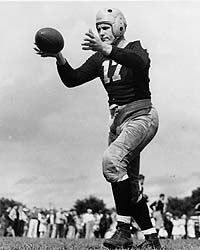

Isbell was the Packers first round draft pick in 1938, the seventh overall selection. He was used as a halfback mostly at first, because Hall of Famer Arnie Hebner was the primary quarterback. Hall of Fame head coach Curly Lambeau alternated them often, as well as played them together.

Leading the NFL with a 5.2 yards per carry average, Isbell was named a Pro Bowler his rookie year. He led the team in rushing and passing, helping them get to the NFL Championship game before losing to the New York Giants.

He led the team in rushing again the next year, making the Pro Bowl again. Green Bay faced the Giants again in the championship game and won 27-0. He split time at quarterback with Herber until the end of the 1940 season, when Herber retired.

Now the primary quarterback in 1941, Isbell led the NFL in attempts, completions, completion percentage, passing yards and touchdowns,, touchdowns and interception percentage, yards gained per pass attempt, completion, and per game played, as well as quarterback rating. He was named to the Pro Bowl and First Team All-Pro. His 1,479 passing yards was an NFL record at the time.

He broke that record with another Pro Bowl season the next year by tossing for an NFL leading 2,021 yards. He also led the NFL in touchdown passes, completions, touchdown percentage, yards gained per attempt, passing yards per game, quarterback rating, and a career long 73 yard pass.

Hall of Fame receiver Don Hutson was his primary target, grabbing 17 scores, a record that stood 42 years, out of his 24 touchdowns total. Hutson also caught 74 of Isbell's 146 completions, and 1,211 of Cecil's passing yards.

Isbell then suddenly retired from the game, stating he wanted to leave at the top of his game.He went on to become a head coach at the college and professional ranks. His four Pro Bowls is tied with Hall of Famer Bart Starr as the second most by a Packers quarterback, and his 61 touchdown passes still rank sixth best in team history.

He is a member of both the Packers and College Football Hall of Fames, as well as the NFL 1930's All-Decade Team alongside Herber. Cecil Isbell is the only quarterback on that team not yet inducted into Canton, but four Pro Bowls in his five year career shows he was great.

Lynn Dickey, Don Majkowski, and Tobin Rote deserve mention.


Fullback : John Brockington


Brockington was the Packers first round draft pick in 1971, the ninth player chosen overall. He quickly became the main staple of Green Bay's offensive attack, running for 1,105 yards at a career best 5.1 yards per carry.

He was named NFL Offensive Rookie of the Year by the Associated Press, the only Packer to ever acquire this honor. He won the NFC Rookie of the Year Award by the UPI, and was also named to the Pro Bowl and First Team All-Pro that year. He gained over 1,000 yards the next year on a career best 274 carries and nine total touchdowns, getting to his second Pro Bowl.

The 1973 season was his last as both a Pro Bowler and 1,000 yard rusher. He set career highs with 1,144 yards and 81.7 yards rushing per game. Though he churned out 833 yards the next year, it became apparent the amount of carries has piled up on him.

After running for 840 yards the next two years, he was cut after the first game of the 1977 season. The Kansas City Chiefs picked him up for ten games as a reserve, and he retired at the end of the year.

John Brockington is a member of the Packers Hall of Fame, and his 5,024 career yards rushing with the Packers still ranks third best in team history. He three Pro Bowls is tied with Hall of Famer Clarke Hinkle as the second most by any Packers fullback.

Though Hinkle and Jim Taylor are Hall of Famers who are thought to be the best fullbacks in Green Bay history, Brockington was a special player in his own right.

William Henderson, Howie Ferguson, Ted Fritsch, Edgar Bennett, Frank Balasz, Gerry Ellis, and Ed Jankowski deserve mention.


Halfback : Ahman Green


Green was a third round draft pick of the Seattle Seahawks in 1998. He spent two years there mostly riding the bench, carrying the ball 61 times total before being traded to the Packers.

Green Bay put him to work immediately as their featured back, and he churned out five consecutive seasons where he gained over 1,000 yards on the ground. He also went to the Pro Bowl four straight years. He also caught 267 passes over those five years, displaying what a complete weapon he was for the team.

No other player gained as many yards in those five seasons than he did. He also was explosive, running for touchdowns from 98 and 90 yards out. He is one of just two players in NFL history to have touchdown runs of 90 yards or more.

After an injury plagued 2006 season that saw him play just five games, Green rebounded the next year with his sixth 1,000 yard season in seven years. He then joined the Houston Texans for two injury riddled years before rejoining he Packers in 2009 to add depth to a depleted backfield.

Though he played just eight games as a reserve, he gained enough yards to become the Packers all-time leader in rushing yards and carries. No Packers halfback has appeared in more Pro Bowls that his four. His 350 receptions are the most by any running back, and ranks seventh on the teams list.

A lot was made of the fact Green fumbled 34 times as a Packer, but he only fumbled one more time with 40 more carries than Hall of Famer Jim Taylor, who is considered the greatest fullback in team history. Ahman Green may very well be the best halfback the team ever had. He recently joined the Omaha Nighthawks in the United Football League.


Billy Grimes, Vern Lewellen, Joe Laws, Tom Moore, Larry Buhler, Dick Weisgerber, Hank Bruder, Donny Anderson, Dorsey Levins, Terdell Middleton, Andy Uram, Travis Jervey, Brent Fullwood, and Jimmy Lawrence all deserve mention.


Wide Receiver : Billy Howton


Howton was the Packers second round draft pick in 1952. He became a star right away, leading the league with career best marks of 1,231 receiving yards and total yards from scrimmage, 102.6 receiving yards per game, and a 90 yard reception. He also averaged a career high 23. 2 yards on 52 catches, scoring 13 times, and making the Pro Bowl squad.

Despite playing just eight games because of injuries the next year, he went back to the Pro Bowl in 1955. He led the NFL with 1,188 receiving yards, 12 touchdowns, and 99 yards receiving per game in 1956, as well as averaging 21.6 yards per catch on a career best 55 receptions. He was named to the Pro Bowl and garnered a First Team All-Pro nod.

He replicated the Pro Bowl and First Team All-Pro honors the next season, and made his final Pro Bowl squad in 1957. He joined the Cleveland Browns for the 1959 season before joining the fledgling Dallas Cowboys in their expansion year in 1960.

He stayed with the Cowboys for four years, catching 161 passes over that time. He retired with 503 career receptions for 8,459 yards after 1963, and both were NFL records at the time.

Though he was the very first NFLPA president, and a member of the Packers Hall of Fame, Howton has yet to be close to induction into Canton though it appears very evident he is worthy.


Wide Receiver : Sterling Sharpe


Sharpe was the Packers first round draft pick in 1988, the seventh pick overall. He started immediately and grabbed 55 balls. He led the NFL with 90 catches the next season, attaining his first Pro Bowl and First Team All-Pro nods. He made the Pro Bowl again the next year.

The 1992 season may have been his best. He led the league with 108 catches for a career best 1,461 yards and 13 scores. He also averaged an NFL best 91.3 yards receiving per game. His 108 catches were an NFL record at the time.

He won the Triple Crown for receivers by leading the league in catches, yards, scores, becoming just the 6th player to ever accomplish this. All previous players to have done this are members of the Pro Football Hall of Fame, and only Steve Smith of the Carolina Panthers has done this since. He was also named to the Pro Bowl as well as First Team All-Pro.

He broke that record with 112 the next year, becoming the first player to have consecutive seasons of over 100 receptions. He was named to the Pro Bowl and got his third nod as First Team All-Pro.

His last year as a Pro Bowler was in 1994, which happened to also be his last as a player. He led the league with 18 touchdown catches on 94 receptions. He injured his neck so severely that year that he was forced to retire.

Not only is Sharpe a member of the Packers Hall of Fame, his 595 receptions for 8.134 yards were team records until Donald Driver surpassed those marks in 2009. The Packers have had a ton of legendary wide receivers, and Sterling Sharpe certainly ranks near the top.

Lavvie Dilweg, Boyd Dowler, Carroll Dale, John Jefferson, Tom Nash, Tillie Voss, Milt Gantenbein, Harry Jacunski, Carl Mulleneaux, Javon Walker, Roell Preston, Steve Odom, Max McGee, Robert Brooks, and Antonio Freeman all deserve mention.


Tight End : Paul Coffman


Coffman made the Packers squad as a free agent rookie in 1978, but did not accumulate any statistics in the 16 games he played that year. He earned the starting job the next year and snagged a career high 56 passes.

He made the first of his three consecutive Pro Bowls after the strike shortened season of 1982. His best season may have been in 1983, when he set career high marks of 814 receiving yards, eleven touchdowns, and a 15.1 yards per catch average.

He left the Packers after 1985 to join the Kansas City Chiefs. After 17 catches over two years, he joined the Minnesota Vikings and suited up for eight games before retiring at the end of the 1988 season.

His 322 catches for 4,223 yards and 39 scores are far and away the most ever by any Packers tight end in the franchises history. His three Pro Bowls is tied as the most by a tight end in Green Bay history. It is safe to say Paul Coffman is the best to have ever played the position for them.

Mark Chmura, Bubba Franks, Ron Kramer, Rich McGeorge, and Keith Jackson deserve mention.


Center : Charley Brock

Charley with Curley Lambeau

Brock was drafted by the Packers in the third round of the 1939 draft, the 24th player chosen overall. He was named to the Pro Bowl and scored off of an interception in his rookie year as Green Bay won the championship.

He made the Pro Bowl again the next season, then saw time at halfback and fullback over the next two years. He intercepted a career best 6 balls in 1942, and also scored off of a fumble recovery while making his last Pro Bowl.

After Green Bay won the 1944 NFL Championship, he was named First Team All-Pro in 1945 after leading the NFL with 122 yards off interceptions and two returns for score. He also led the league with 52 yards off of 5 fumble recoveries.

Brock retired after the 1947 season with 20 interceptions and 13 fumble recoveries in his career. His three Pro Bowls is the second most by a center in Packers franchise history behind Hall of Famer Jim Ringo.

Not only is Brock a member of both the Packers and Nebraska University Football Hall of Fames, he is on the NFL 1940's All-Decade Team. He is one of the best all around players in team history.

Larry McCarren, Frank Winters, Bo Svendsen, Tom Greenfield, Ken Bowman, Nate Barragar, and Mike Flanagan all are worthy of mention.


Guard : Gale Gillingham


Gillingham was drafted by the Packers in the first round of the 1966 NFL Draft, the 13th player chosen overall. He earned the starting job at left guard late in the year, unseating Pro Bowler and Packers Hall of Famer Fuzzy Thurston.

After helping Green Bay win the famous "Ice Bowl" game against the Dallas Cowboys, he helped the Packers defeat the Kansas City Chiefs in the first championship game between the NFL and American Football League. It is now commonly known as Super Bowl I.

The Packers repeated as champions the next year as well, as Gillingham started in every game. He would start in every game the team played until 1976, except for 12 games due to injury in 1972.

He made his first Pro Bowl in 1969, as well as garnering First Team All-Pro honors. After repeating that feat the next season, he made the Pro Bowl in 1971 before being injured in the second game of 1972 and missing the rest of the season.

Gillingham returned to the Pro Bowl in 1973 and the following year before deciding to retire at the end of 1976. He is a member of the teams Hall of Fame, and his five Pro Bowls are the most by any Packers guard in franchise history.

Though Packers historians clamor for the induction of ex-guard Jerry Kramer's induction into Canton, Gale Gillingham certainly should be considered as well.


Guard : Jerry Kramer


Kramer was drafted in the fourth round of the 1958 draft by the Packers. He spent his rookie year as a reserve, mostly playing special teams. He earned the starting job the next year, which was also this first of Hall of Famer Vince Lombardi as a head coach. Kramer held onto his starters job until he retired.

He was named First Team All-Pro for the first time in 1960, and was an integral part of Packers teams that won NFL Championships 1961, 1962, and 1965. He made the Pro Bowl and was honored as First Team All-Pro in 1962 and 1963.

What made those two years particularly special was the fact Kramer served as the primary placekicker as well. He led the NFL in field goal percentage in 1962, made 16 out of 34 field goal attempts the next year, and made 81 out of 85 extra point attempts over that time. He would not kick again until his final season.

He played just two games in 1964 because of injury, but rebounded to be named First Team All-Pro in both 1966 and 1967, as well as make the 1966 Pro Bowl squad. He retired after the 1968 season, where he went four for nine on field goals and nine out of ten on extra points.

Jerry Kramer is a member of the Packers Hall of Fame, the NFL 50th Anniversary Team, the NFL 1960's All-Decade Team, the Senior Bowl Hall of Fame, and the Senior Bowl 50th All-Time Anniversary Team. He has been a finalist for induction into the Pro Football Hall of Fame a whopping ten times. He is the only member of the NFL's 50th Anniversary All-Time team not yet inducted into Canton.

He awaits his induction still, one that should have happened several decades ago, because he is one of the greatest guards in Packers history.

Buckets Goldenberg, Fuzzy Thurston, Gust Zarnas, Bill Lueck, Paul Tinsley, Marco Rivera, Lon Evans, and Ross Letlow deserve mention.


Tackle : Dick Wildung


Wildung was the Green Bays first round draft pick in 1943, the eighth overall selection, but he served in the military until 1946 before joining the Packers.

After playing guard his first two seasons, getting a safety playing defensive tackle as well, Green Bay moved him to left tackle in 1948. He stayed there the rest of his career, but missed the 1952 season because of injury.

He made his lone Pro Bowl in 1951, then retired after 1953. He was inducted into both the Packers and College Football Hall of Fame. Though he was a Packer for just seven years, his impact lasted much longer.


Tackle : Bob Skoronski
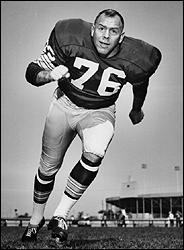

Skoronski was drafted in the fifth round of the 1956 draft by the Packers. He won the staring job at left tackle right away that season. He had to leave the team until 1959 because he served in the military during the Korean Conflict. It was also the first season Hall of Famer Vince Lombardi was head coach.

After playing as a reserve that year, he earned back his starting job in 1960 and would hold onto it until he retired after the 1968 season. Skoronski was so reliable that he missed just two games in his whole career.

He was an integral part of a offensive line blocking for Hall of Fame quarterback Bart Starr. Green Bay won championships five times between 1961 to 1967. Skoronski was named to his lone Pro Bowl in 1966.

Not only is he a member of the Packers Hall of Fame, but Bob Skoronski is one of the best left tackles the franchise has ever had.

Baby Ray, Ernie Smith, Bill Lee, Paul Kell, Howard "Cub" Buck, Charles Schultz, Greg Koch, and Ade Schwammel deserve mention.


Defensive Tackle : Dave Hanner


Hanner was a fifth round draft pick by the Packers in 1952. He was a Pro Bowler by 1953, again getting the honor for the last time in 1953.

He was steady and versatile in his 13 seasons with Green Bay, playing both tackle positions. He was also extremely athletic, getting four career interceptions and a safety. He missed just four games in his entire career.

Not only was he reliable, but Hanner was a winner. He played on two Packers teams that won league championships. When he retired at the end of the 1964 season, he became an assistant coach immediately and was part of two Super Bowl winning teams. He stayed with the team until 1996, filling roles like defensive coordinator and scout.

Dave "Hawg" Hanner is a member of both the Packers and Arkansas Sports Hall of Fames. He is also remembered for sacking Chicago quarterback Ed Brown for a safety, helping secure Hall of Famer Vince Lombardi's first career victory with a 9-6 decision over the Bears.


Defensive Tackle : Bob Brown


Brown was drafted in the first round of the 1964 AFL Draft by the Denver Broncos, and in the 13th round of the NFL Draft by the San Francisco 49ers.

He did not play until 1966, joining the Packers as a reserve. Green Bay won the Super Bowl that season, and repeated the next year. After playing in just six games because of injury in 1968, he earned a starting job the next year and held onto it until he left the team after 1973.

The best year of his career was in 1972, when he sacked Houston Oilers quarterback Dan Pastorini for a safety and was later was named to his only Pro Bowl. He was traded to the San Diego Chargers in 1974, then joined the Cincinnati Bengals the next year. He stayed with them for two years before retiring.

Brown was a consistent force, only missing the eight games in 1968. He is one of just three Packer defensive tackles to go to the Pro Bowl. Hall of Famer Henry Jordan and "Hawg" Hanner are the others. It is safe to say Bob Brown is one of the best defensive tackles in team history.

Mike McCoy and Ron Kostelnik deserve mention.


Defensive End : John Martinkovic


Martinkovic was drafted in the sixth round of the 1951 draft by the Washington Redskins. He soon joined the Packers and earned a starting job as a rookie. He scored two touchdowns in 1952.

He made the first of his three consecutive Pro Bowls in 1953 and was considered one of the top defensive ends of the 1950's. He was traded to the New York Giants in 1957 and retired at the end of the season.

Not only is he a member of the Packers Hall of Fame, but he is one of the best defensive ends in franchise history.


Defensive End : Kabeer Gbaja-Biamila


Gbaja-Biamila was drafted in the fifth round of the 2000 draft by the Packers. He appeared in seven games, during his rookie season, getting 1.5 sacks.

He was named a starter the next year and got 13.5 sacks. He has 12 in 2002, and took an interception 72 yards for a touchdown. The 2003 season saw him go to his only Pro Bowl after getting 10 sacks. He followed that up by matching his career high total of 13.5 sacks the next year.

Not only is Gbaja-Biamila recognized as the first to have three straight seasons double digit sack totals, but also the first to do it four consecutive seasons.

In 2007, the Packers used him as a pass rush specialist and he added 9.5 sacks. After being able to suit up for just seven games the next year because of injury, the Packers released him.

Gbaja-Biamila is the Packers all-time leader in sacks with 74.5 total. He has yet to officially retire, but he was one of the finest defensive ends in Green Bay history.

Ab Wimberly, Ezra Johnson, Allen Moore Robert Brown, and Lionel Aldridge deserve mention.


Outside Linebacker : Dave Robinson
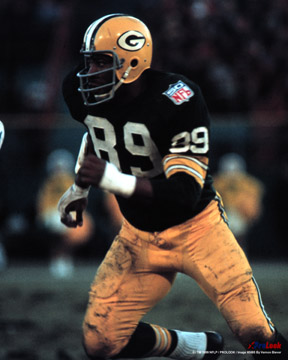

Robinson was drafted in the first round of the 1963 NFL Draft by the Packers, and in the third round of the AFL Draft by the San Diego Chargers. He opted to play in Green Bay.

He spent his rookie year as a reserve, but earned a starting job the following season. After helping the Packers win the 1965 season, the 1966 season was his first as a Pro Bowler as the Packers won the first Super Bowl. He earned his second Pro Bowl the next year, as Green Bay won their third straight championship.

After making his last Pro Bowl in 1969, he stayed on with the Packers until 1973 when he was traded to the Washington Redskins. He played two years with them before retiring. He is a member of the Packers Hall of Fame, the College Football Hall of Fame, and Gator Bowl Hall of Fame.

Dave Robinson is a member of the NFL's 1960's All-Decade Team, and he has been seriously considered for induction into the Pro Football Hall of Fame several times. He may be the best outside linebacker the team has ever had.


Middle Linebacker : Bill Forester


Forester was drafted in the third round of the 1953 draft by the Pack, the 31st player chosen overall. He started at middle guard in his rookie year, a position later turned into middle linebacker by Hall of Famer Bill George.

After playing left outside linebacker in 1954, he played the following two years at middle guard and picked off four balls each season. Green Bay then permanently moved him to the right outside linebacker spot in 1957 and matched his career high mark of four interceptions.

He made the Pro Bowl for four straight years from 1959 to 1962, earning First Team All-Pro honors the last three years. He also tallied his only points in 1959, off of a safety.

When Forester retired after 1962, he had 21 interceptions and 15 fumble recoveries in his 11 seasons. It was the most ever by a Packers linebacker at the time, and still ranks third best. His four Pro Bowls are the most ever by any linebacker in franchise history.

He is a member of the teams Hall of Fame and the Texas High School Football Hall of Fame. Forester was also nominated for induction into the Pro Football Hall of Fame a few times, but has failed to get in as of yet.

When Vince Lombardi became head coach of Green Bay, part of the Hall of Famers winning formula was built around Forester on defense. The Packers went to three straight NFL Championship games in Forester's last three seasons as a player, winning in his last two years.

He is one of the best linebackers the team ever had.

Ed Neal, Clayton Tonnemaker, and Jim Carter also deserve mention.


Outside Linebacker : Fred Carr


Carr was drafted in the first round of the 1968 NFL Draft by Green Bay, the fifth player chosen overall. He spent his first two seasons as a back up to Pro Bowler and Packers Hall of Famer Lee Roy Caffey before earning the starters job in 1970.

He would start in every Packers game from then until he retired after 1977. Carr made his first Pro Bowl in 1970, then went back in 1972 and 1975. He was named MVP of the 1970 Pro Bowl, becoming the first to win it in the modern day AFC-NFC Pro Bowl and just the third Packer ever to win the award.

Not only is Fred Carr a member of the Packers Hall of Fame, his three Pro Bowls are tied with Dave Robinson and Roger Zatkoff as the most ever by a Green Bay outside linebacker. He might be the best one the team ever had.

Lee Roy Caffey, John Anderson, Bryce Paup, Tim Harris, Dan Currie, Deral Teteak, George Koonce, Bob Forte, Mike Douglass, and Roger Zatkoff also deserve mention.


Strong Safety : LeRoy Butler


Butler was drafted in the second round of the 1990 draft and spent his rookie season as a reserve. He still picked off three passes and was starting at cornerback the next year.

The Packers moved him to strong safety in 1992, where he would stay the rest of his career. Butler picked off a career best six passes in 1993, 90 tackles, and took a fumble recovery 25 yards for a score. He was named First Team All-Pro and to the Pro Bowl that year.

He attained those honors again in 1996, where Green Bay won Super Bowl XXXI. He swiped 5 balls, taking one 90 yards for a score, and had a career high 6.5 sacks. He was also named First Team All-Pro and to the Pro Bowl in each of the following two years.

When Butler played nine games because of injury in 2001, he retired. He is a member of the Packers Hall of Fame and the NFL 1990's All-Decade Team. He is the only Packers strong safety to be named to four First Team All-Pro honors, and his 38 interceptions rank fourth best in franchise history.

Hank Gremminger and Mark Murphy deserve mention.


Free Safety : Bobby Dillon
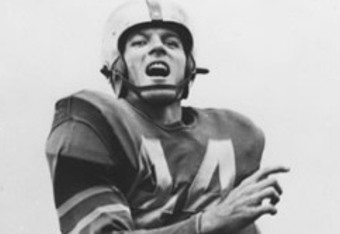

Dillon was drafted in the 3rd round of the 1952 draft by the Green Bay Packers. He was the 28th player chosen overall. He attended college at Texas University, and is inducted into the Longhorn Hall of Honor and to the Texas Sports Hall of Fame.

He earned a starting job immediately for the Packers, picking off four passes in his rookie year. Then he became even more of a nightmare to opposing teams in 1953, grabbing nine interceptions for 112 yards. He also scored the first touchdown of his career off of a 49 yard return of an interception. Dillon accomplished this despite playing in just 10 of the 12 games that year.

The 1954 season saw him swipe seven more balls, scoring another touchdown as well. He was named to his first First Team All-Pro honor that season. He was named to the first of his four consecutive Pro Bowls and another First Team All-Pro nod the next season after getting nine interceptions for 153 yards.

Dillon gained an NFL-leading and career best 244 yards off of seven interceptions in 1956, scoring another touchdown and was named to First Team All-Pro again.

He tied his career best mark of nine interceptions in 1957, scoring a touchdown off of a 55 yard return in his 180 total yards. He was named to his last Pro Bowl and First Team All-Pro honors in 1958, after picking off 6 balls for 134 yards and scoring his fifth and final career touchdown.

Dillon retired at the end of the 1959 season year and still holds the Packers franchise record for career interceptions and interception return yardage. He is a member of the Green Bay Packers Hall Of Fame.

Bobby got a lot of early notoriety early in his career because he was blind in one eye. Since it is more than obvious this did not detract from his play, Dillon's exploits on the field are his real mark on the game.

He averaged over six interceptions a year for his career. There are a few factors that may have kept Bobby from inducted into the Pro Football Hall Of Fame thus far. One is that he played on some bad Packers teams. The only season that he played on a winning team was his last, which also happened to be Vince Lombardi's first year in Green Bay.

Another reason may be that he played just 8 seasons. Those detractors would get some argument from me on these facts. There is the obvious fact of the impact Bobby had on the gridiron. His amazing nose for the ball is not matched by many to have ever played the game.

When he retired, he ranked second all time in NFL history with his 52 career interceptions That mark was tied by Jack Butler of the Pittsburgh Steelers, who also retired in 1959. Both are now presently tied for 23rd all time.

There are only four safeties in NFL history with more interceptions than Bobby Dillon (Ronnie Lott's first five seasons were spent at cornerback). If you add these facts up, it eradicates the arguments of his teams won-loss record or his amount of seasons played. Bobby Dillon deserves his inductions into Canton.

Darren Sharper, Chuck Cecil, Irv Comp, and Johnnie Gray are worthy of mention.


Cornerback : Bob Jeter


Jeter was the Packers second round draft pick in 1960, the 17th player overall, after a stellar career at Iowa University. He ran for 194 yards on nine carries in their 1959 Rose Bowl win over California University to procure a National Championship title.

He joined Green Bay in 1963 after military service. Though he spent his first two years as a reserve, he did catch two balls He earned the starting job in 1965 and helped the Packers win the NFL Championship.

After leading the NFL with two touchdowns off of a team leading five interceptions for 142 yards in 1966 that helped Green Bay win the first Super Bowl ever, the Packers repeated as champions the following year with Jeter's eight interceptions leading the team in that category.

He was named to the Pro Bowl and garnered First Team All-Pro honors that season. After a strong 1968 season, he went to his last Pro Bowl the next year.

Green Bay traded him to the Chicago Bears just before the 1971 season, and he played three more years and then retired. His 23 interceptions still rank as the fourth most ever by a Packers cornerback and he is a member of the teams Hall of Fame.


Cornerback : Willie Buchanon


Buchanon was drafted in the first round of the 1972 draft, the seventh player chosen overall, and he stood out immediately. He picked off four passes and was named NFL Defensive Rookie of the Year, the only Packer to have won this award.

Despite playing just six games the next year because of injury, he was named to his first Pro Bowl. He repeated that honor the next season in 1974. He played in two games the following season due to injury but would not miss another game in the subsequent six years.

Perhaps his best year was in 1978, where he had a career best nine interceptions. Four came in one game against the San Diego Chargers, which tied a still standing NFL record. He was named to his final Pro Bowl and his only First Team All-Pro honor.

The Chargers were coached by Don Coryell, who was Buchanon's coach in college. Coryell traded for him, where Buchanon started in three of the four years he was with the team. He recovered three fumbles in one game, which tied a still standing NFL record.

After starting in just one of the nine games played in the strike shortened season of 1982, he retired. He is a member of the Packers Hall of Fame, the Packers All-Time team, the California State Junior College Hall of Fame, the Oceanside High School Hall of Fame, and the San Diego Hall of Champions.

Jesse Whittenton, Ken Ellis, and Mark Lee deserve mention.


Kicker : Chester Marcol


Marcol was drafted in the second round of the 1972 draft by the Packers. He exploded in his rookie year, attempting 48 field goals and making 33. Both led the NFL and are team records, and he was named NFC Rookie of the Year by the UPI. His 48 attempts are still the second most in NFL history, and the 128 points he had that year led the league and was the only time he eclipsed the century mark.

He was named to the Pro Bowl and First Team All-Pro that year, an honor he duplicated two years later when he led the NFL with 94 points as well as 39 field goal attempts and 25 makes. He is the only Packers kicker to be named to the Pro Bowl.

His last year in the NFL was an interesting one. In the 1980 season opener against the Chicago Bears, he had made two field goals as the game went to overtime tied 6-6. As he attempted a game-winner from 42 yards out, it was blocked. The ball went right back to Marcol, who scooted 25 yards for the winning points.

He was released after five games, but the Houston Oilers signed him for one game. It was against the Packers in Green Bay. Marcol chipped in four points for the Oilers victory. He retired after the game.

The 521 points he scored for Green Bay is still the third most by a kicker, and sixth overall. His 128 point season still ranks seventh best in team history, and he is a member of the Packers Hall of Fame.

Don Chandler, Chris Jacke, Ryan Longwell, and Tiny Engebretson deserve mention.


Punter : Donny Anderson


Anderson was drafted in the first round of the 1965 NFL Draft, the seventh player chosen overall. Not only was he a punter, but Anderson was a halfback. He did little of both in his rookie year, as Green Bay won Super Bowl I. He did chip in with a touchdown off a 77 yard punt return.

Gone was the Hall of Fame tandem of Jim Taylor and Paul Hornung in 1967. Elijah Pitts, their other star running back, was in the twilight of his career. Anderson was third on the team in rushing yards and receptions as the Packers repeated as champions. He also punted 65 times, having one blocked for the only time in his career.

The 1968 season was his only Pro Bowl year. He punted the ball 59 times, and had 1,095 all-purpose yards. Perhaps his best season was in 1970, when he ran for a career best 853 yards, caught 36 balls, and punted a career high 81 times.

He was traded to the Saint Louis Cardinals in 1972 and had one of his better years the next season. He ran in a career best ten touchdowns and caught a career high 41 balls and three more scores. He retired after the 1974 season.

Donny Anderson is a member of the Packers Hall of Fame, the College Football Hall of Fame, and the Texas Tech Hall of Fame. He still ranks third best in punt attempts, and fourth in punt yardage.

What makes his feats as punter even better was the fact he was the Packers main running back for years, which shows tremendous grit, athleticism, and durability to still be able to end up with a career average of 39.6 yards per punt.

David Beverly, Don Bracken, Max McGee, Josh Bidwell, Craig Hentrich, Max McGee, Jug Girald, and Don Chandler deserve mention.


Kick Return Specialist : Travis Williams


Travis was a fourth round draft pick by the Green Bay Packers in the 1967 draft. He played just five seasons in the NFL, but his impact has him on top of the leagues record books to this very day.

He returned four kickoffs for a touchdown as a rookie, which is the most by a rookie in NFL history. It is also tied with Cecil Turner as the most ever by any player in one season. He averaged an amazing 41.1 yards per kickoff return, which led the NFL., and is the highest average ever by anyone for one year. As a running back, he scored twice more, while helping the Packers win Super Bowl II.

In 1969, Williams scored on a 96 yard kickoff return, while leading the NFL with 1,517 all purpose yards. He also returned the first eight punt returns of his career, and scored on a 83 yard return while averaging a career best 23.6 yards per return. He also led the Packers with 536 rushing yards, and ran for four more touchdowns. He also led the Packers with 27 receptions, while scoring three times.

Williams got hurt in the seventh game of the 1970 season, and missed the rest of the year. He joined the Los Angeles Rams the next year, and led the NFL with a 29.7 kickoff return average on 25 attempts. He also scored on a 105 yard return, which is tied for 3rd longest All-Time in NFL history. He then retired after that season.

His 6 kickoff returns are the most in NFL history, tied with 4 others. He also has the longest kickoff return in Rams history. He averaged 27.5 yards on 102 kickoff returns in his career.

Steve Odom, Dave Hampton, Al Carmichael, Robert Brooks, and Roell Preston deserve mention.


Punt Return Specialist : Desmond Howard
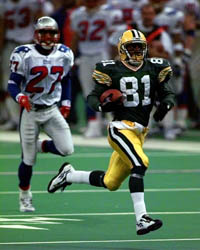

Desmond was a first round draft pick of the Washington Redskins in 1992. He was used primarily as a kickoff returner as a rookie, but did manage to score a touchdown off of one of his six punt returns.

In 1994, Howard had his best year as a wide receiver. He established career bests with 40 catches for 727 yards at an 18.2 average for five touchdowns. He ended up with the Jacksonville Jaguars the next year, and returned 24 punts at a 10.3 average, then went to Green Bay the following season.

Though he only played one season for the Packers, it was a memorable season. He led the NFL with 58 punt returns for 875 yards, 3 touchdowns, and a 92 yard return. His 875 yards are an NFL single season record, and he even helped propel the Packers into Super Bowl XXXI with a punt return touchdown in the playoffs.

He ended up being the Super Bowl MVP, when he took a kickoff return 99 yards for a score to help Green Bay win. His 90 punt return yards are a Super Bowl record, and his 244 all purpose yards tied a Super Bowl record. He is the only special teams player to ever be named Super Bowl MVP.

Howard then went to the Oakland Raiders. He led the NFL in 1997 with 61 kickoff returns. He led the NFL in punt return touchdowns in 1998, when he took two in. He split the 1999 season between Green Bay and Detroit, but did score on a 68 yard punt return for the Lions in five attempts.

He made his lone Pro Bowl team the next year with Detroit, as he averaged 14.7 yards on 31 punt returns and had 1,401 yards on 57 kickoff returns. He scored his last special teams touchdown that year with a league leading 95 yard punt return. In 2001, Howard set career highs with 1,446 yards on 57 kickoff returns, to go with a 25.4 average. After an injury plagued 2002, he retired.

Desmond Howard was labeled another Heisman Trophy winning flop in the NFL after his first four years, but he shed that label when it was all said and done. He is the only special teams player in NFL history to win a Super Bowl MVP Award.

He had eight career touchdowns on punt returns, which is tied for the third most in NFL history. He once returned 10 kickoffs in a game, which is tied for the most in NFL history.


Billy Grimes, Antonio Chatman, Phil Epps, Will Blackmon, Walter Stanley, Al Carmichael, Johnnie Gray, Ken Ellis, Jon Staggers, and Steve Odom deserve mention.

Friday, March 20, 2009

I Must Be In The Front Row

The Genius Of Bob Uecker

Bob Uecker makes me wish I had been able to listen to Brewers games since 1971 from the same booth in which he broadcast from.

Milwaukee fans know what I mean.

The rest of us are lucky just to catch snippets of him.

From his TV shows, movies, and commercials, the man has entertained Americans for decades.

And say what you want to about his playing career, the man owns a World Series ring. He may try to say he didn't earn it, but it is obvious he did.


Bob is 74 years young these days, and is as sharp as he has always been.


Here is a montage of some of his quips and clips :


Anybody with ability can play in the big leagues. But to be able to trick people year in and year out the way I did, I think that was a much greater feat.


Baseball hasn't forgotten me. I go to a lot of old-timers games and I haven't lost a thing. I sit in the bullpen and let people throw things at me. Just like old times.


Career highlights? I had two. I got an intentional walk from Sandy Koufax and I got out of a rundown against the Mets.


I didn't get a lot of awards as a player. But they did have a Bob Uecker Day Off for me once in Philly.


I had slumps that lasted into the winter.


I hit a grand slam off Ron Herbel and when his manager Herman Franks came out to get him, he was bringing Herbel's suitcase.


I knew when my career was over. In 1965 my baseball card came out with no picture.


I led the league in "Go get 'em next time."


I set records that will never be equaled. In fact, I hope 90% of them don't even get printed.


I signed with the Milwaukee Braves for three-thousand dollars. That bothered my dad at the time because he didn't have that kind of dough. But he eventually scraped it up.


If a guy hits .300 every year, what does he have to look forward to? I always tried to stay around .190, with three or four RBI. And I tried to get them all in September. That way I always had something to talk about during the winter.


In 1962 I was named Minor League Player of the Year. It was my second season in the bigs.


Let's face it. Umpiring is not an easy or happy way to make a living. In the abuse they suffer, and the pay they get for it, you see an imbalance that can only be explained by their need to stay close to a game they can't resist.


One time, I got pulled over at four a.m. I was fined seventy-five dollars for being intoxicated and four-hundred for being with the Phillies.


People don't know this but I helped the Cardinals win the pennant. I came down with hepatitis. The trainer injected me with it.


Sporting goods companies pay me not to endorse their products.


Sure, women sportswriters look when they're in the clubhouse. Read their stories. How else do you explain a capital letter in the middle of a word?


The highlight of my career? In '67 with St. Louis, I walked with the bases loaded to drive in the winning run in an intersquad game in spring training.


The way to catch a knuckleball is to wait until it stops rolling and then pick it up.


When I came up to bat with three men on and two outs in the ninth, I looked in the other team's dugout and they were already in street clothes.


When I looked at the third base coach, he turned his back on me.


I was born and raised in Milwaukee, Wisconsin. Actually, I was born in Illinois. My mother and father were on an oleo margarine run to Chicago back in 1934, because we couldn't get colored margarine in Wisconsin. On the way home, my mother was with child. Me. And the pains started, and my dad pulled off into an exit area, and that's where the event took place. I remember it was a Nativity type setting. An exit light shining down. There were three truck drivers there. One guy was carrying butter, one guy had frankfurters, and the other guy was a retired baseball scout who told my folks that I probably had a chance to play somewhere down the line.

Well, a couple of grand slammers and the Brewers are right back in this one (Uecker during the 8th inning of a game the Brewers were losing 8–0.)

The biggest thrill a ballplayer can have is when your son takes after you. That happened when my Bobby was in his championship Little League game. He really showed me something. Struck out three times. Made an error that lost the game. Parents were throwing things at our car and swearing at us as we drove off. Gosh, I was proud.


I had slumps that lasted into the winter.

A doctor told me to drink lemon juice after a hot bath. But I have never finished the bath.


I won the Comeback of the Year Award five years in a row!

I'm scared of the Reds.

I had been playing for a while, and I asked Louisville Slugger to send me a dozen flame treated bats. But when I got it, I realized they had sent me a box of ashes.


A Story Told About Uecker By Artie Lange To David Letterman


Uecker As A WWE Announcer


A Few Of His Famous Lite Beer Commercials


Uecker On Johnny Carson's Tonight Show


The Famous Bob Uecker Seats in Milwaukee that cost one dollar to sit in


Thank You for letting us have front row seats to your brilliance Ueck

Monday, February 23, 2009

The ALMOST All Time Dallas Cowboys = Offense

REMEMBER = This list, as the title implies, pays tribute to greats NOT in Canton


Quarterback : Don Meredith

Don was already a legend in Dallas before he turned pro. He went to SMU, which some called "Southern Meredith University" during his time there, and is a member of the College Football Hall Of Fame. The Chicago Bears drafted Meredith in the 3rd round of the 1960 draft, the 32nd player picked overall, but traded him to the expansion Cowboys for a few draft picks. After starting five of the fourteen games he played in his first two season, Don replaced incumbent starter Eddie LeBaron during the 1962 season. Though the Cowboys would not have a winning season until 1966, Meredith became a fan favorite who was known for his toughness and determination. He led the NFL in yards gained per completion in 1965, as the Cowboys had their first non losing season by going 7 - 7. The 1966 season saw Don win the Bert Bell Awards for NFL Player Of The Year, as well as earn his first Pro Bowl nod, when he led the NFL in yards gained per pass completion again. Dallas had now joined the top tier of the NFL ranks, and would go on to play in the 1967 NFL Championship. Though they lost in the famous "Ice Bowl" to the Green Bay Packers, his leadership skills were now in the national spotlight. "Dandy Don" would make the Pro Bowl Team in each of the following two seasons, but missed several games due to various injuries. After the 1969 season, he suddenly retired from the game at 30 years old. Every home football game he played from high school to the pros was in North Texas. He then went on to enjoy a career as an NFL broadcaster for 15 years. Don Meredith is a member of the Cowboys Ring Of Honor. Though the Cowboys have had a few Hall Of Famers play quarterback during the teams 48 years of existence, "Dandy Don" was one of a kind.


Fullback : Don Perkins

Don was a ninth round draft pick of the Baltimore Colts in the 1960 draft, the 106th player chosen overall. Don never played with the Colts because he had signed a contract already with the expansion Cowboys. After the Colts were compensated, Perkins suited up for Dallas in the 1961 season. Don's rookie year saw him play Halfback and gain 815 yards on 200 carries, while catching a career high 32 passes. He was named to his first All Pro Team for that season, an honor he would be given in each of the following two seasons. Perkins had a career bests with 945 rushing yards on 222 carries in 1962. He also ran for 7 touchdowns. The next season Don moved to Fullback, where he scored 7 times on 149 carries for 614 yards over 11 games. After scoring 6 touchdowns on 174 carries for 768 yards, Don did not score in 1965 after gaining 690 yards on 177 carries. It was the only year of his career where he failed to reach the end zone. Perkins rebounded with an All Pro season in 1966 after gaining 726 yards on 186 carries with a career best 8 rushing touchdowns. He returned to the Pro Bowl the nest year after gaining 823 yards on 201 carries and 6 scores. After a Pro Bowl season in 1968, where Perkins gained 836 yards on 191 carries and 6 total touchdowns, he retired from the NFL. He retired as the Cowboys all time leader in rushing yards with 6,217 yards, and still ranks third in franchise history. Don wasn't a big Fullback, standing 5'10" and weighing 204 lbs, but he was a hard nosed runner and an exceptional blocking back. Don Perkins is a member of the Cowboys Ring Of Honor, and the greatest Fullback in Dallas Cowboys history. Robert Newhouse and Daryl Johnston deserve mention.


Halfback : Calvin Hill

Calvin was the Cowboys first round draft choice in the 1969 draft, the 24th player chosen overall. He was put to work right away and gained 942 yards on 204 carries with 8 scores. He ran one ball for a career long 55 yards, and also completed all 3 of his passes with 2 scores. Calvin was named Rookie Of The Year, and was named to the Pro Bowl Team. The next two rears were injury plagued seasons for Hill. He gained 1,045 yards on 259 carries and 15 total touchdowns while starting 14 of the 20 games he played in. The Cowboys would reach the Super Bowl both of those seasons, winning once. He then became the first 1,000 yards rusher in Cowboys history in 1972, after gaining 1,036 yards on 245 carries and 9 total touchdowns. He also snagged a career best 43 pass receptions. Calvin returned to the Pro Bowl, and would do again the following season after gaining career highs with 1,142 yards rushing yards on 273 carries. He also scored 6 times. 1974 was the last year Hill would be an All Pro, and as a member of the Cowboys. He ran for 844 yards on 185 carries for 7 scores. Due to a contract dispute, Calvin joined The Hawaiians of the World Football League for 1975, the only pro football team to emanate out of Hawaii. He joined the Washington Redskins in 1976 and played as a seldom used reserve over the next two seasons, gaining 558 yards on 148 carries and a touchdown. Calvin joined the Cleveland Browns in 1978, and was used primarily 4 seasons. He ran for 516 yards on 138 carries and 2 touchdowns, along with 107 receptions 1,248 yards and 16 more scores. He then retired after the 1981 season. Though Calvin played just 6 seasons with Dallas, he gained 5009 rushing yards and was a 4 time All Pro with them. He certainly was a great player.


Wide Receiver : Drew Pearson

Drew was signed by the Cowboys in 1973 as an undrafted rookie free agent. He broke into the starting unit as a rookie for 6 games and caught 22 passes. Drew had his best season the following year. He caught 62 balls for 1,087 yards, both of which were career bests, and went to his first Pro Bowl game. After catching 46 balls for 822 yards and a career high 8 touchdowns in 1975, Drew returned to the Pro Bowl in 1976 after 58 balls for 806 yards and 6 scores. Pearson then went to his last Pro Bowl the following year after catching 48 passes for a league leading 870 yards to go with 2 scores. His 62.1 receiving yards per game led the NFL also, which would help the Cowboys to go on and win Super Bowl XII. After 44 receptions in 1978, Drew had 1,026 yards on 58 receptions for 8 touchdowns the following season. His 18.7 yards per catch was a career best. Though Drew was still an integral part of the Cowboys offense over the next 3 seasons, his production slightly declined each year with reception totals of 43, 38, and 26 respectively. Despite missing 2 games in 1983, Drew would catch 47 passes and score 5 times. He then retired with 489 career receptions for 7,822 yards and 67 touchdowns. "Mr. Clutch" is a member of the NFL 1970's All Decade Team, and is known for several historical catches like the "Hail Mary against the Minnesota Vikings in a 1975 playoff game, another game winning catch against the Los Angelos Rams in a 1973 playoff game, and the winning catch against the Cowboys arch rival Washington Redskins on Thanksgiving in 1974. All 3 catches were part of the NFL's Top 75 Plays in NFL History by NFL Films in 1994. For some strange reason, Drew Pearson has yet to be put in the Cowboys Ring Of Honor, but he is certainly one of the greatest Wide Receivers the franchise has ever had.


Wide Receiver : Tony Hill

Tony was the Cowboys 3rd round draft pick in 1977, the 62nd player chosen overall. He only caught 2 balls in his rookie year, and returned 10 punts and 3 kickoffs. Dallas would end up winning Super Bowl XII that year. Hill really exploded onto the NFL scene the following year, and earned his first Pro Bowl bid. He snagged 46 balls for 823 yards and 6 scores. He returned to the Pro Bowl the next year, when he scored a career best 10 touchdowns on 60 receptions for 1,062 yards. He took one pass for a career long 75 yards as well. He had virtually identical numbers the following season, when he had 60 receptions for 1,055 yards and 8 touchdowns. Despite starting in 9 of the 16 games he played in 1981, Tony averaged a career high 20.7 yards on 46 catches. After 35 receptions in the strike shortened season of 1982, Hill had 49 catches and 7 touchdowns the next year. Despite missing 5 games in 1984, he managed to snare 58 balls and 5 scores. Tony made his last Pro Bowl Team in 1985, after catching a career best 74 passes for 1,113 yards. He also had 7 touchdowns. His last year in the NFL was in the following 1986 season. Tony had 49 receptions for 770 yards and 3 scores. Tony Hill retired with 479 receptions for 7,988 yards and 51 touchdowns. He and Drew Pearson formed one of the best duo's in the NFL for several years, as you can tell by their similar career statistics.


Tight End : Jay Novacek

Jay was drafted by the Saint Louis Cardinals in the 6th round of the 1985 draft. He was the 158th player chosen overall. Jay was seldom used, and seldom healthy, in his first 3 seasons. He caught a total of 22 passes during that time, but started to blossom with 38 receptions in 1988. After catching 23 passes the next year, Novacek signed with the Cowboys as a free agent before the 1990 season. He immediately contributed as the Cowboys starting Tight End that year, when he had 59 catches. He went to his first Pro Bowl the following year, after catching 59 more passes. Jay returned to the Pro Bowl in 1992 after having career bests with 68 receptions and 6 touchdowns. In his 1993 All Pro season, Jay ran a ball 2 yards for the only rushing touchdown of his career. Novacek would continue to make the Pro Bowl until 1996. That year saw him have a career high 705 yards on 62 receptions, while scoring 5 times. Jay was then hurt during the Cowboys Super Bowl XXX victory,and never played again. Jay Novacek retired with 422 receptions for 4,630 yards and 31 total touchdowns. Doug Cosbie deserves mention, but Jay Novacek may be the best Tight End the Cowboys have ever had thus far.


Center : Mark Stepnoski

Mark was the Cowboys 3rd round draft choice in the 1989 draft. He was the 57th player chosen overall. He eventually took over for long time starter Tom Rafferty, and started 4 games in his rookie year. He would then start in every game he played in the NFL from 1990 until his retirement. Stepnoski made his first Pro Bowl Team in 1992, despite missing 2 games. He would achieve that honor for the next four seasons as well. The Cowboys would go to, and win, back to back Super Bowls between 1992 to 1993. He joined the Houston Oilers in 1995 and stayed with them as they moved to Tennessee in 1997. After the 1998 season, Stepnoski rejoined the Cowboys in 1999. He then started for the team until his retirement in 2001. Mark Stepnoski's 3 Pro Bowl appearances with Dallas are the most by any Center in franchise history, and that mark was recently equaled by Andre Gurode.


Guard : John Niland

Niland was the Cowboys first round draft choice of the 1966 draft, the fifth player chosen overall. He was plugged in as a starter at Left Guard right away, and stayed there for the rest of his time with Dallas. He made his first Pro Bowl Team in 1968, and would garner that nod for six straight seasons. He was an important part of an excellent offensive line that went to 2 Super Bowls, 4 Conference Championships, 6 Division Championships , and 8 seasons of playoff appearances during his time in Dallas. In 1972, Niland scored a touchdown off of a fumble recovery. John made his last Pro Bowl Team in 1973, then played his last year with the Cowboys in 1974. He was then traded to the Philadelphia Eagles before 1975, then retired after playing one season with them. Dallas has had many great Guards in their franchise history, and John Niland certainly ranks near the top.


Guard : Nate Newton

Nate went undrafted by the NFL in 1984, so he joined the Tampa Bay Bandits of the USFL, and played with them until 1985. He then signed with the Cowboys before the 1986 season. He played as a reserve in 11 games during his rookie season, but started in all 11 games he played the next year. Nate would start in every game he played over the next four years, and missed only 3 due to injury. He made his first Pro Bowl Team in 1992, a honor he would achieve for five straight seasons, and helped the Cowboys win Super Bowl XXVII. The Cowboys repeated as champions the next year, then won again in 1995. After Newton missed 3 games in 1997, he made his last All Pro Team the next year. It was also his last with Dallas. He joined the Carolina Panthers, and played in 7 games, in 1999. Nate then retired from the NFL. I left Eric Allen off this list because I am certain he will be inducted into Canton. Herb Scott and Blaine Nye deserve mention as well. Nate Newton was a very big, strong, and agile man who was noted for sound technique and crushing blocks. He is one of the best Guards to have ever played for the Cowboys.


Offensive Tackle : Ralph Neely

Ralph was drafted in the second round by both the NFL Baltimore Colts and the AFL Houston Oilers. Ralph initially agreed to play with the Oilers, who even offered Neely a gas station in his contract, but decided to join the Cowboys after Dallas acquired his rights from the Colts. He started right away at Right Tackle, and remained there for 5 seasons. He made the Pro Bowl three straight seasons from 1967 to 1969. He moved to Left Tackle in 1970, and even saw time at Right Guard. Now the Cowboys starter at Left Tackle, Ralph manned that position until 1977. He was injured halfway into the Cowboys victorious 1971 Super Bowl season, and missed the rest of the year. In 1972, Ralph rushed for 10 yards. After the Cowboys beat the Denver Broncos at Super Bowl XII in 1977, then Neely retired. Though Ralph has yet to join his bookend, Rayfield Wright, in Canton or Cowboys Ring Of Honor, he was an excellent and versatile player. Ralph Neely is a member on the NFL 1960's All Decade Team.


Offensive Tackle : Pat Donovan

Pat was drafted in the 4th round of the 1975 draft by the Cowboys. He was the 90th player chosen overall. Donovan's was part of a Cowboys draft class tabbed "The Dirty Dozen", which helped the team to great successes. After being a reserve for his first three seasons behind Ralph Neely, Pat took over as the full time starter at Left Tackle. He made his first Pro Bowl Team in 1979, and would continue to do so until 1982. After playing out the 1983 season, Donovan retired from the NFL. The Cowboys have had a few great Tackles in their 48 years. Hall Of Famer Rayfield Wright heads the list, and Eric Williams may soon join him in Canton. Pat Donovan was also an excellent player in his own right.


Kicker : Rafael Septien

Rafael wins this spot because of service time. The Cowboys have had several other kickers go to the Pro Bowl just once like Septien did, but none lasted with the team as long. Rafael was a tenth round draft pick of the New Orleans Saints, the 258th player overall, in the 1977 draft. He ended up playing for the Los Angelos Rams that year, and scored 86 points. He then joined the defending champion Cowboys in 1978, and scored 94 points. He made 46 of 47 extra point attempts, both of which led the NFL that season. Septien followed that up with 97 points the next year. He then led the NFL with 59 extra point conversions out of 60 attempts in the 1980 season, while scoring 92 points. Rafael's best season may have been in 1981, his only Pro Bowl year. He scored 121 points, while leading the NFL with 27 field goals made. He then had 58 points in the strike shortened season of 1981, and then had a career best 123 points the following year. Rafael then had 101 points in 1983, and 99 the following year. His last year in the NFL was 1986, where he scored 88 points. Septien is the Cowboys all time leader in field goal and extra point attempts and field goal and extra point conversions. His 874 points are the most ever by any Cowboy. Rafael Septien was named to the Cowboys 40th Anniversary Team in 2000, and he is the greatest kicker the teams has ever had so far.


Return Specialist : Kevin Williams

Williams, born in Dallas, was the 46th player chosen in the second round by the Cowboys in the 1993 draft. He spent his first two seasons as the Cowboys primary return specialist. He returned 2 punts for touchdowns on 36 attempts as a rookie, which was the most in the NFL that year. Kevin also found time to receive 20 balls for two touchdowns, while scoring his only two rushing touchdowns on seven attempts. The Cowboys would go on to win Super Bowl XXVIII. He took another punt 83 yards for a score the next year on 39 returns, while taking a kickoff 87 yards for a touchdown. Kevin averaged a career best 26.7 yards per kick return on 43 attempts that year. 1995 saw the Cowboys win Super Bowl XXX, as Williams saw his punt return duties decrease as his receiving duties increased. He did return 49 kickoffs, the most he had as a Cowboy, as well as catching a career high 38 passes for 613 yards and two scores. He also rushed the ball a career high 10 times for 53 yards. Williams had an injury shortened season in 1996 and caught 27 passes for a score in the 10 games he suited up for. He returned just 21 kickoffs and 2 punts that season as well. He then joined the Arizona Cardinals for the 1997 season and led the NFL with a career best 1,458 kickoff return yards on a career high 59 attempts. Williams also returned a career high 40 punts for 416 yards, and caught 20 passes with one touchdown. He then joined the Buffalo Bills for the following season and returned 47 kickoffs for 1,059 yards, as well as returning 37 punts for 369 yards. Kevin also scored the last touchdown of his career that year on 29 receptions. Williams then caught 31 passes for the Bills in 1999, as well as returning 33 punts for 331 yards and 42 kickoff returns for 8840 yards. He then joined the San Francisco 49ers for the 2000 season. Used only as a return specialist, Kevin had 26 punt returns for 220 yards to go with 30 kickoff returns for 536 yards. He then retired after that year. His 3, 416 kickoff return yards are the most in Cowboys history. Hall Of Famers Bob Hayes and Mel Renfro deserve mention, as does Kelvin Martin. Martin has the most punt return yardage in Cowboys history, and Renfro still has the third most kick return yardage. Hayes, Martin, and Williams all share the Cowboys franchise record for 3 punt returns for touchdowns in a career. Though the Cowboys have had many decent return specialists, and Williams' 98 receptions with the team shows he was a versatile weapon, he is my pick as their best overall return specialist not in Canton.

Tuesday, October 28, 2008

NEVER FORGET! Part 2

WES CHANDLER

Wes was the 3rd pick overall in the 1978 draft by the New Orleans Saints. He was used primarily as a return specialist his rookie year, duties he would rarely be asked to do for the rest of his career. He still managed 35 receptions in limited duty. Wes broke out in his second year, when he had 65 receptions for 1,069 yards and 6 touchdowns. He led the NFL with a career long 85 yard reception. Chandler also made his first All Pro team. He caught 65 balls the following year as well. In 1981, Wes was traded after the 4th game of the season to the San Diego Chargers. He ended up with a career high 69 catches, gaining 1,142 yards and 6 touchdowns. The strike shortened 1982 season was maybe Chandlers best. He snared 49 balls for 1, 032 yards in eight games. He led the NFL with 9 touchdown catches, and 129 receiving yards per game. His 21.1 yards per catch average was the best of his career, and he also made his second All Pro team. Wes caught 58 balls the following year, and was again an All Pro. He followed that up with 52 receptions the next season. 1985 would be Chandler's last as an All Pro, when he caught 67 passes. He set career bests with 1,199 yards and 10 touchdowns as well. Wes caught 56 passes the next year. He was injured in 1987, yet managed to play 12 games and catch 39 passes. Wes then went to the San Francisco 49ers in 1988. He played 4 games for the eventual Super Bowl Champions before retiring. Wes Chandler is know to some as the guy who replaced John Jefferson in Air Coryell during its heights. One of the most famous playoff game in NFL history, The Epic In Miami, saw Chandler catch 6 balls for 106 yards, and score his only punt return touchdown of his career from 56 yards out in the Chargers win. He is a member of the Chargers Hall Of Fame, and was ranked 12th in NFL history in receiving yards and 13th in total receptions in NFL history when he retired. He finished with 559 receptions, 56 touchdowns, and 10,526 all-purpose yards.


MONTE COLEMAN

Monte was drafted in the 11th round of the 1979 draft by the Washington Redskins. He established himself quickly as a special teams star in his rookie year. He also showed great prowess in pass defense, and soon was part of the dime package, and picked off a pass that year. Monte got to start 10 games the next year and swiped 3 passes for 92 yards. He also had a career high 118 tackles. In 1981, Coleman started in 11 of the 12 games he played. He picked off 3 more balls, and returned one 52 yards for the first touchdown of his career. Monte then went back to being spotted on passing downs mostly. In 1984, he had a career high 10.5 quarterback sacks, and returned 1 interception 49 yards for a score. In 1989, he scored a touchdown on a 24 yard interception. Monte scored the last touchdown of his career in 1993, when he scooped up a fumble and returned it 24 yards. Coleman retired after the 1994 season, his 16th. Of the 215 games he played, he started just 62 of them. His impact was made whenever he took the field, and he was a long time special teams star for the Redskins. He ended up with 999 tackles, 43.5 sacks, 17 interceptions, 14 fumble recoveries, 4 touchdowns, and 3 Super Bowl rings in 4 Super Bowl appearances. When he retired, his 215 games as a Redskin were the most ever until Darrell Green passed him. Monte's stats are very impressive, especially if you consider he never played football until college. What separated him from most, and had him a beloved member of the team, was his leadership both on and off the field. Monte Coleman is one of the 70 Greatest Redskins, and deservedly so.


ROY GREEN

Roy is one of the greatest Cardinals of All Time. He was drafted by the Saint Louis Cardinals in the 4th round of the 1979 draft. He was used on both sides of the ball early in his career as a Wide Receiver and Free Safety. He was used as a return specialist his first two seasons as well. He returned 41 kickoffs for an NFL leading 1,005 yards in his rookie year. He took 1 back for Cardinals record 106 yards. He also caught a 15 yard pass. The next year, he returned punts as well, and had a career best 16 returns for 168 yards. He also scored on a 57 yard return. Playing exclusively as a Free Safety, he intercepted his first pass. In 1981, he had a career high 3 interceptions for 44 yards, the last interceptions of his career. Green also caught 33 passes for 708 yards and 4 touchdowns. His 21.5 yards per catch average were a career high. Roy also had 3 rushing attempts for 60 yards, while scoring on a 44 yard jaunt. In the strike shortened 1982 season, Roy had 32 catches. Playing now just at Wide Receiver, Roy broke out in 1983. He had a career best 78 receptions for 1,227 yards. He led the NFL with a career best 14 touchdown receptions, while making his first All Pro team. He matched his reception total the following year, while leading the NFL with career bests of 1,555 yards and 97.2 yards per game. He also had 12 touchdowns, while making his last All Pro team. Roy battled injuries over the next 3 years, missing 12 games total. He had 135 receptions and 15 touchdowns over that span. In 1988, the Cardinals moved to Phoenix and Green had 68 receptions for 1,097 yards and 7 touchdowns. He matched that touchdown total on 44 receptions, despite missing 4 games because of injuries. 1990 was Roy's last healthy season in the NFL. He snagged 53 balls and scored the last 4 touchdowns of his career. Roy was then traded to the Cleveland Browns after the 1990 season, but was released. He was then picked up by the Philadelphia Eagles. He caught 37 balls in 22 games the next 2 years, before retiring after the 1992 season. Roy was a special player. He had 559 career receptions, 69 touchdowns, a 16 yard per catch average, 4 interceptions, 20 fumble recoveries, and 11,391 totals yards. I am surprised the Cardinals have allowed Anquan Boldin, or any Cardinal, to wear his number. It should have been retired. His 522 receptions with the Cardinals ranks second in franchise history, and his 8,497 receiving yards and 66 receiving touchdowns rank first in Cardinals history.


WALLY HILGENBERG

Wally was a 4th round draft pick of the Detroit Lions in the 1964 draft. Playing mostly special teams, Wally started in 9 of the 41 games he suited up for Detroit in his first 3 NFL seasons. He was then traded to the Pittsburgh Steelers before the 1968 season. The Steelers cut him in training camp, and the Minnesota Vikings claimed him off waivers. Hilgenberg ended up starting 7 of 14 games that year for the Vikings, and would remain a starter at Right Outside Linebacker until 1976. He picked off the first two passes of his career in 1970, and scored a touchdown off an interception in 1972. In 1973, Wally scored a touchdown off of a fumble recovery, the last touchdown of his career. By 1977, he was a reserve, and started just one game until he retired after the 1979 season at 37 years old. Wally was an integral member of all four on the Vikings Super Bowl teams, and was considered on of the meanest players in the league on the field. His daughter would be named Miss Minnesota Teen USA in 1998. Wally then became ill with ALS (Lou Gehrig's Disease), and passed away on 9/ 23/ 08. Hilgenberg may not have gotten the headlines that the Purple People Eaters front fours did, but his impact from the strong side OLB slot was vital to the teams extraordinary success. Wally was also known as a practical joker off of the field. Before the Vikings played the Steelers in Super Bowl IX, Howard Cosell was interviewing Hall Of Fame Quarterback Fran Tarkenton at the teams hotel. Wally was on a balcony with teammates a few floors above them, and dumped a bucket of water on Cosell. His passing away has saddened many, but the memories he made will live on.


CHARLIE CONERLY

Charlie was a 13th round draft pick of the Washington Redskins in the 1945 draft. but decided to attend the University of Mississippi. He ended up being the Player of the Year and Back of the Year of the SEC in 1947, when he led Ole Miss to their first SEC title. He was also an All American and the 1947 Player of the Year by the Helms Athletic Foundation. Charlie Conerly is a member of the Ole Miss Athletic Hall of Fame, the Mississippi Sports Hall of Fame, the Ole Miss Team of the Century, and the College Football Hall of Fame. The Conerly Trophy is given annually to the top college player in the State of Mississippi. Charlie, now 27 years old, then joined the New York Giants in 1948, and started immediately. He was the 1948 NFL Rookie of the Year, when he tossed 22 touchdown passes and ran for 5 more. He was named to his first All Pro team in 1950, despite starting in just 8 of the 11 games he played. Conerly led the Giants to 3 NFL Championship games between 1956 to 1959. The Giants won the 1956 NFL Championship by blowing out the Chicago Bears 47-7, as Charlie tossed 2 TD's. He would be named to his last All Pro team that year. Charlie was the NFL MVP in the 1959 season. He led the Giants to the Championship against Johnny Unitas and the Baltimore Colts, in what some termed the "Greatest Game Ever". It was the game that put the NFL on the map, and into the homes of most of America. Charlie led the NFL in passer rating, yards gained per pass attempt, yards gained per pass completion, and the lowest interception rate. Charlie continued to start for the Giants until 1960. That year, he started 8 of 12 games. In 1961, the Giants acquired the services of Hall of Fame Quarterback Y.A. Tittle. Charlie, now 40, ended up starting 4 games, as the Giants would go on to lose to the Green Bay Packers in the NFL Championship game. Conerly retired after that. He retired with 1,418 completions on 2,833 attempts for 19,488 yards. He tossed 173 touchdowns, and had 167 interceptions, and rushed for 10 TD's. Charlie punted the ball 130 times for 5,062 yards, a 38.9 yards per punt average, and even kicked 4 extra points. The Giants have had several Hall of Fame Quarterbacks in their organization. Tarkenton, Tittle, Arnie Herber, and Benny Friedman. Charlie Conerly led the Giants to their last Championship win, until they won Super Bowl XXI in 1986. His place as one of the best in franchise history is secure, and his #42 has been retired by the Giants.

Sunday, October 26, 2008

The ALMOST All Time Philadelphia Eagles = Defense

Defensive Tackle : Charlie Johnson

Charlie was drafted by the Eagles in the 7th round of the 1977 draft. He was the 175th player picked overall. Charlie worked his way into the starting lineup fairly quickly in his rookie season, starting nine of the twelve games he played. Charlie would start in every game he played for the Eagles after that. By 1979, Charlie was honored with his first All Pro team. Johnson was a key member of an excellent Eagles defense that helped lead the franchise to Super Bowl XV in 1980. Charlie intercepted 3 passes that season. He was named to the All Pro team once again that season as well. 1981 was Charlie's last season to earn a Pro Bowl nod, and he intercepted another pass. After that season, he ended up with the Minnesota Vikings, where he recorded the last interception of his career during his first season as a Viking. Charlie recorded 4 sacks in 1984, then retired after the season. Sacks were not recorded until 1982, but Johnson was known for being a good pass rusher. Often he and Claude Humphrey would harass the opposing teams QB all game. Charlie was also important to the Eagles run defense as a Nose Tackle. He occupied several blockers, which helped Eagles linebackers like Bergey, LeMaster, Bunting, and Robinson. Charlie Johnson is one of the very best defensive linemen to have ever been an Eagle.


Defensive Tackle : Floyd Peters

Floyd was drafted by the Baltimore Colts in the 8th round of the 1958 draft. He was the 93rd player chosen overall. Floyd's rookie year took place in 1959 as a member of the Cleveland Browns. He stayed 3 years there, and intercepted a pass. Peters joined the Detroit Lions for one season in 1963, then joined the Eagles the next year. He immediately blossomed into one of the better Defensive Tackles in the NFL with Philadelphia. He earned his first All Pro team nod in that first year with the Eagles in 1964. Floyd missed 5 games because of injury the next season, but rebounded in 1966 with another fine season that saw him earn another Pro Bowl honor. Peter's earned his last Pro Bowl invitation the following year in 1967, and he also intercepted a pass. Floyd picked off the last pass of his career in 1968, then would join the Washington Redskins in 1970. He retired after that season. Floyd would go on to be a noted Defensive Coordinator for the Minnesota Vikings and Tampa Bay Buccaneers in the 1990's. The Eagles have had quite a few excellent Defensive Tackles during their history, and Floyd Peters is one of the very best that they ever had.


Defensive End : Clyde Simmons

Clyde was drafted by the Eagles in the 9th round of the 1986 draft. He was the 233rd player picked overall. Clyde's rookie year saw him slowly work his way into the Eagles rotation on the defensive line, and he accrued 2 sacks. He starter 12 games the next season, and had 6 sacks. Simmons then had 8 more sacks the following year. He also recorded the only safety of his career, and scored a touchdown off of a lateral. Clyde exploded in 1989, when he had 15.5 sacks. He also intercepted a pass and took it 60 yards for a touchdown. Clyde scored another touchdown, via a fumble recovery, in 1990. He also had 7.5 sacks. 1991 saw Simmons earn his first All Pro honors. He had 13 sacks and scored a touchdown off of a fumble recovery. Clyde's best season in the NFL may have taken place in 1992. He led the NFL with 19 sacks, and earned his last All Pro bid. Clyde picked off a pass and had 5 sacks the following season, then joined the Arizona Cardinals in 1994. He had 6 sacks that , year, then 11 the next. He also picked off the last regular season pass of his career, and scored his last touchdown. He also recovered a career high 6 fumbles. Clyde joined the Jacksonville Jaguars in 1996. He had 7.5 sacks that year, and would intercept a pass and score in the playoffs. Simmons then had 8.5 sacks the following year. He joined the Cincinnati Bengals in 1998, and had 5 sacks. He then joined the Chicago Bears. Used primarily as a pass rush specialist, he had 7 sacks in 1999. Clyde only got a half of a sack, a career low, in 2000. He retired after that year with 121.5 career sacks, 25 fumbles recovered, 5 touchdowns, and a safety. 76 of those sacks came in 8 years as an Eagle as an integral member of the famous Gang Green defense. Clyde Simmons is certainly one of the better Defensive Ends to have ever played for Philadelphia.


Defensive End : Norm Willey

Norm was drafted by the Eagles in the 13th round of the 1950 draft. He was the 170th player picked overall. He was nicknamed "Wildman" by his team mates for his reckless abandon on the field. He intercepted a pass, in his rookie year, and took it 41 yards for a touchdown. He also had a career high 4 fumbles recovered that year. Norm picked off the last pass of his career in 1952. In 1954, Norm scored the last touchdown of his career off of a fumble recovery. He also caught 2 passes for 50 yards. He was named to his first All Pro team that year. Willey would then make his final All Pro team in 1955. He returned 2 kickoffs for 32 yards in 1956, then retired after the 1957 season. Willey is one of the best pass rushers in the history of the Eagles. Sacks were not an officially recognized statistic in his era, but he once had 17 sacks in just one game alone. Carl Hairston, Greg Brown, Dennis Harrison, William Fuller and Hugh Douglass deserve mention. Norm "Wildman" Willy should be in the Eagles Ring of Honor.


Linebacker : Bill Bergey

William Earl Bergey was drafted by the Cincinnati Bengals in the second round of the 1969 AFL draft out of Arkansas State and was an AFL All-Star in his first year. Bergey started for the Bengals for 5 years. In 1974 Bergey was traded to the Philadelphia Eagles in exchange for two first-round and one second-round draft picks. With the Eagles, Bergey went to four straight Pro Bowls, and became the highest-paid defensive player in the league. He earned Eagles MVP status three times. Bergey recorded 233 tackles in a single season with the Eagles. After the Eagles lost to Oakland in Super Bowl XV, Bergey retired with a then NFL record for most interceptions by a linebacker in a career. Bergey is a member of the Bengals 40th Anniversary Roster, the Eagles Honor Roll, and the city of Buffalo's Hall of Fame. Though Bill Bergey was excellent in Cincinnati, it was with Philadelphia he enjoyed his best years in the NFL. In his 5 years with the Bengals, Bergey had 9 interceptions and 6 fumble recoveries. He accumulated 18 interceptions and 15 fumble recoveries in 7 seasons as an Eagle. He was a tackling machine that allowed fellow Eagle LB'S John Bunting, Frank LeMaster and Jerry Robinson to excel. When you talk of the rich history of the Eagles, names like Van Buren, Bednarik, McDonald, White, Montgomery, Carmichael, and Bill Bergey roll off the tongues of most die hard Philly fans. He may not get into Canton, but he is a Hall of Fame player in my book.


Linebacker : Jeremiah Trotter

Trotter was drafted in the 3rd round of the 1998 draft by the Eagles. He was the 72nd player picked overall. He mostly played special teams in his rookie year, but earned the starting job in 1999. Trotter piled up 91 solo tackles, 2.5 sacks, and had 2 interceptions. 2000 was his first All Pro season, as he had 100 solo tackles, 3 sacks, and took an interception 27 yards for a touchdown. Jeremiah made the All Pro team the next year, as he scored another touchdown off of an interception. He then joined the Washington Redskins in 2001. In his 2 injury plagued seasons with the Redskins, he had 2 INT's, 150 solo tackles, and 1.5 sacks. He rejoined the Eagles in 2004, and made the Pro Bowl despite only having 59 solo tackles. 2005 was his last All Pro year, as Trotter had a career best 102 solo tackles. He had 88 solo tackles the following season, and had the last interception of his career. Trotter joined the Tampa Bay Buccaneers in 2007, but only played 3 games. He retired after that year. Trotter was known for his fierce leadership, and his ability to run downhill and explode on opponents. His 5 All Pro bids ranks 4th in Eagles history for a linebacker behind Hall of Famer Chuck Bednarik, Bill Bergey, and Maxie Baughan. Maxie Baughan is a future CCC profilee, so I still hope he gets his deserved induction.


Linebacker : Seth Joyner

Seth was drafted in the 8th round of the 1986 draft by the Eagles, the 208th player chosen overall. Seth worked his way into the lineup his rookie year, starting 7 of the 14 games he played. He intercepted a pass, and recorded 2 sacks. He started in all of the 12 games he played the following season, intercepting 2 passes and having 4 sacks. He also scored a touchdown off of a fumble recovery. 1988 saw Seth record a career best 136 tackles. He also had 4 interceptions for 96 yards and 3.5 sacks. Seth recorded 12.5 sacks and 2 interceptions over the next two years. 1991 was one of the better years of his career, as he earned his first All Pro birth. He was also named the Sports Illustrated Defensive Player of the Year. He scored 2 touchdowns off of fumble recoveries, had 6.5 sacks and 3 interceptions. He matched that sack total the next year, to go with 4 interceptions for 88 yards and the last 2 touchdowns of his career. Seth made the Pro Bowl team in 1993, then joined the Arizona Cardinals the next year. He made his final All Pro team in 1994, as he had 6 sacks and 3 interceptions. Seth ended up playing OLB and Strong Safety in 1995 because of injuries to the Cardinals secondary. He picked off 3 balls. He had 6 sacks and the last interception of his career the next year. He joined the Green Bay Packers in 1997, and started in 10 of the 11 games he played. The Packers reached Super Bowl XXXII, but lost to the Denver Broncos. Joyner then Joined the Broncos in 1998. He played mostly on pass coverage, as the Broncos repeated as champions by winning Super Bowl XXXIII. He then retired. Seth Joyner is one of only nine members in the 20/20 Club for interceptions and sacks in NFL history, and he is one of the better Outside Linebackers in Eagles history.


Safety : Bill Bradley

Bill was drafted in the 3rd round by the Eagles in 1969, the 69th played picked overall. The Eagles made use of Bill's versatility right away. He intercepted a pass and took it 56 yards for the only touchdown of his career. He also had a career best 74 punts for a 39.8 average. He also had 28 punt returns and 21 kickoff returns for 653 total yards. In 1971, Bradley led the NFL with 11 and 248 interception return yards. He also punted the ball 61 times, and had 18 punt returns. He was named to his first All Pro team. Bradley once again led the NFL with 9 interceptions in 1972, and was named to the All Pro team. He only punted twice that year, and had 2 kickoff returns, as well as 22 punt returns. Bradley made his final All Pro team in 1973, when he had 4 interceptions, 8 punt returns, and 56 punts at a 40.2 average. Bill played just 3 more years with the Eagles. He had 35 punt returns, 20 punts, and 9 interceptions. He joined the Saint Louis Cardinals in 1977, and returned 11 punts, 4 kickoffs in just 4 games. He retired after that year. Bill Bradley is the first player in NFL history to lead the NFL in interceptions in consecutive seasons, a feat that has been matched by only Everson Walls. He had 34 interceptions in his 8 years with the Eagles, to go with 213 punts and 1,384 yards off of 134 punt and kickoff returns. He also ran for 19 yards on 3 attempts. He is a member of the Eagles Ring of Honor. Bill Bradley is one of the best safeties in Eagles history.


Safety: Tom Brookshier

Tom was drafted by the Eagles in the 10th round of the 1953 draft, the 117th player picked overall. His impact was immediate, as he had a career best 8 interceptions in his rookie season. Due to the Korean War, Tom joined the Air Force after that season, and did not return to the NFL until 1956. He had an interception for 31 yards that year. In 1957, Tom had 4 interceptions for 74 yards. He had another pick the next year. Tom made his first Pro Bowl team in 1959, while having 3 picks. He moved to Cornerback in 1960, and had an interception. He made his last All Pro team, as the Eagles won the NFL Championship. Tom had 2 interceptions going into the 7th game of the 1961. He suffered a compound fracture of his leg in the game, then retired. He is one of just 7 Eagles to have had their number retired, and is a member of the Eagles Ring of Honor. He was known as a ferocious hitter who had a nose for the ball. Tom Brookshier is certainly one of the best defensive backs in Eagles history.


Cornerback : Eric Allen

Eric was the Eagles 2nd round pick in 1988, the 30th overall player chosen overall. The Eagles started him right away, and Allen produced immediately. He had 5 interceptions for 76 yards in his rookie year. He made his first All Pro team the very next year, when he had 8 interceptions. In 1990, he had 3 more picks. He also scored his first touchdown on a 35 yard return. Allen returned to the Pro Bowl the next season, as he had 5 swipes. He had 4 the next season, and was named to the All Pro team again. 1993 was probably his best season. He led the NFL with 4 touchdowns off of interceptions, as well as 201 interception return yards. One touchdown came on a 94 yard interception return. He had 6 total picks, and recorded the first 2 sacks of his career. Allen's last year with the Eagles was 1994. He had 3 interceptions, and made the All Pro team. He joined the New Orleans Saints the next year and made his last All Pro team with 2 interceptions. He snagged 3 more balls over the next two years, then joined the Oakland Raiders in 1998. He had 5 interceptions in 10 games before injuring his knee. He had 3 more interceptions the next year. 000 saw Allen score 3 more touchdowns off of 6 interceptions. He also recorded the last sack of his career. Allen's last year in the NFL was 2001. He had 1 interception, and scored the last touchdown of his career via a fumble recovery. He retired with 54 career interceptions, and had at least 1 in every season he played. He scored 9 total touchdowns, and the only NFL player to run back at least three interceptions for scores in two seasons. 34 interceptions and 5 touchdowns came in his 8 years with the Eagles. Eric Allen may one day get the call into Canton, though there are many, many better defensive backs who still await the call themselves. Still, he is certainly one of the best Cornerbacks in Philadelphia Eagles history.


Cornerback : Troy Vincent

Troy was a first round draft pick of the Miami Dolphins in 1992, the seventh player chosen overall. Troy made abit of history before he even donned an NFL jersey. He was the first player in the history of leagues televised draft, of the first round, whose selection was missed. ESPN was still on commercial break when Troy was selected. He picked off 2 passes in each of his first seasons, as he established himself quickly as a lock down defender. Vincent picked off 5 passes in 1994, scoring a touchdown. He had 5 more interceptions the next year, and scored another touchdown. Troy then joined the Eagles in 1996. He had 3 picks that year, and scored on a 90 yard interception return. He then had 5 swipes over the next 2 seasons. In 1999, Trot led the NFL with 7 interceptions. He was named to his first All Pro team that year, and would again garner that award the next season after having 5 interceptions. Vincent made the Pro Bowl team in 2001, and had 3 interceptions. Troy Vincent won the 2002 Walter Payton Man of the Year Award, and snared 2 balls. He was named to the All Pro team as well. 2003 was Troy's last season to make the All Pro team, as he had 3 picks. Vincent then went to the Buffalo Bills in 2004. He was moved to Free Safety, and had 1 interception in the seven games he played. Troy stayed at FS the next year, and had 3 more picks. After playing one game for Buffalo in 2006, Troy was released. He later signed with the Washington Redskins. Though this was the only season in his 15 NFL seasons that he did not intercept a pass, he still made a big play for the Redskins against Dallas. With the game tied at 19 with the clock at a few seconds remaining, Vincent blocked the Cowboys field goal attempt. The ball was recovered by the late Sean Taylor, who was face masked on his return. That penalty, coupled with the return, put the Redskins in field goal range. The Redskins converted and won 22-19. Troy then retired after that season. In his 8 seasons with the Eagles, Troy made his only 5 All Pro teams. His 5 Pro Bowls are tied with Allen as the most ever by an Eagle. 28 of his 47 career interceptions came as an Eagle. Irv Cross, and Herm Edwards deserves mention, but Troy is one of the best CB's in Eagles history.


Punt Returner: Wally Henry

Brian Mitchell, Boss Pritchard, Timmy Brown, Vai Sikahema, Larry Marshall, Brian Westbrook, and Steve Van Buren all deserve mention. Brian Mitchell's 117 punt returns is tied with John Sciarra as the second most punt returns in Eagles history behind Henry's 148, and his 1,369 punt return yards are the most in Eagles history. Wally's 1,231 are the second most punt return yards in Eagles history. He was signed as an undrafted rookie by the Eagles in 1977. He returned just 2 punts, and caught 2 passes as a rookie. Wally played only 3 games in 1978, but did score on a 57 yard punt return in 11 attempts. He also returned 3 kickoffs. 1979 was Henry's only All Pro season. He returned 28 kickoffs at a 23.9 average, and returned 35 punts at a 9.1 average. In the Eagles Super Bowl year of 1980, Henry had 26 punt returns, and 7 kickoff returns. He also caught 4 passes for 68 yards. In 1981, Henry led the NFL with 54 punt returns. He also returned 25 kickoffs, and caught 9 balls for 145 and the last 2 touchdowns of his career. 1982 was Wally's last year in the NFL. He returned 20 punts and 24 kickoffs. In his 6 seasons in Philadelphia, Henry had 3,406 return yards on 225 returns via punts and kickoffs. Though the Eagles may have had better punt returners in the history of their franchise, Wally Henry is all over the top of the teams record books.