Showing posts with label NFLPA. Show all posts

Thursday, September 29, 2011

NFL Mistakes : 11 Players Who Teams Regret Giving Up On


Dick LeBeau


LeBeau was a fifth round draft pick of the Cleveland Browns in the 1959 draft, the was the 58th player picked overall. LeBeau did not make the Browns team, and was cut in training camp. He would then be picked up by the Detroit Lions.

He played six games in his rookie year, mostly on special teams, did recover the first fumble of his career that season. In 1960, LeBeau earned the starting job at cornerback opposite newly acquired Hall of Famer Dick "Night Train" Lane. The Lions defense also had Hall of Fame middle linebacker Joe Schmidt, Hall of Fame safety Yale Lary. Pro Bowl defensive tackle Alex Karras and Pro Bowl safety Terry Barr.

LeBeau picked off four passes his initial season. The next three seasons, LeBeau and Lane formed the best cornerback tandem in the NFL. LeBeau picked off four balls in 1962. He scored the first two touchdowns of his career that year, by interception and fumble recovery.

In 1963, LeBeau picked off five passes and returned them for 158 yards. He also returned one interception 70 yards for a touchdown. LeBeau would then make his first of 3 consecutive Pro Bowl appearances in 1964. That season also marked Lary's last in the NFL, and Lane played only seven games. LeBeau still managed five interceptions that year.

The 1965 season was the last year for both Lane and Schmidt. LeBeau picked off seven passes and returned one for the last touchdown of his career. LeBeau's last Pro Bowl season was in 1966, when he intercepted four passes.

LeBeau picked off four passes in 1967 by bookending Hall of Fame cornerback Lem Barney. He did this while under new head coach, and former teammate, Joe Schmidt. LeBeau and Barney would then team up for the next three years as one of the best cornerback tandems in the league.

The 1970 season saw LeBeau have a career high nine interceptions. At 34-years old in 1971, LeBeau would intercept six passes. The 1972 season would be the last year as a Detroit Lion for LeBeau and Schmidt. LeBeau was moved to free safety that year, and would not intercept a pass for the first time since his rookie season.

LeBeau only retired from the NFL as a player after 1972. He went into coaching in 1973 for the Philadelphia Eagles as a Secondary Coach. He stayed with the team until 1975. He then held the same duties with the Green Bay Packers from 1976 to 1979.

In 1980, he moved to the Cincinnati Bengals. He served as their secondary coach and a defensive coordinator with the Bengals until 1991. LeBeau then served as the Defensive Coordinator for the Pittsburgh Steelers from 1992 to 1996.

This is when LeBeau would gain notoriety for inventing the now commonly used "Zone Blitz" defense. The Steelers defense featured such greats as Hall of Fame cornerback Rod Woodson, Pro Bowl linebackers Greg Lloyd, Hardy Nickerson, Levon Kirkland, Chad Brown, Kevin Greene, Jason Gildon and strong safety Carnell Lake. They would go to the Super Bowl after the 1995 season.

In 1997, LeBeau returned to the Bengals as a defensive coordinator. He would then be named head coach of the Bengals in 2000, holding that job until 2002. LeBeau then worked for the Buffalo Bills in 2003.

He returned to the Pittsburgh Steelers in 2004, and is still the defensive coordinator of the Steelers today. In 2005, the Steelers won Super Bowl XL. LeBeau is one of the most respected coaches in NFL history and is called "Coach Dad" by his players.

Dick LeBeau's playing career alone may have had him inducted into the Pro Football Hall of Fame in 2010. He is the first player from the 1959 NFL Draft to make it into Canton. He is a member of the Detroit Lions Legends and his 62 interceptions are the most in the history of the Lions.


Dave Butz


Butz was the fifth overall selection of the 1971 draft, chosen by the Saint Louis Cardinals. His career got off to positive beginnings, as he started 10 of the 12 games he played as a rookie.

Then Butz suffered a devastating knee injury of the first game of the 1972 season. The Cardinals believed his playing days were over, so they released him. The Washington Redskins quickly signed the huge defensive tackle.

After being brought along slowly by Hall of Fame head coach George Allen, where Butz started in 16 of the 40 games he appeared in over three seasons, he was elevated to a starters job in 1978. He would remain there the next 11 seasons.

Being 6'7" 291, he was an immovable object in the middle of the defense. While stuffing running backs was his specialty, Butz also batted down a ton of passing attempts. If that wasn't enough of a distraction for opposing quarterbacks, he was also a good pass rusher despite drawing multiple blockers most plays.

The 1983 season is considered his finest year. Butz was named to his only Pro Bowl and First Team All-Pro nod after being named the NFL Defensive Player of the Year by the Kansas City Committee 101, an award chosen by 101 NFL sportswriters and sportscasters. He had a career best 11.5 quarterback sacks that season.

He was the Redskins model of consistency. After becoming a starter, he missed three games in 11 years. Butz missed five total in his 14 years with the Redskins. Besides having 59.5 career sacks, which is most ever by a Washington defensive tackle, his 203 games played is the fourth most in franchise history.

Dave Butz is a member of the NFL's 1980s All-Decade Team. Not only did he constantly make the Cardinals regret giving up on him, Butz made Redskins fans joyful by helping their team win two Super Bowls. He is one of the 70 Greatest Redskins ever.


Lou Creekmur


Creekmur lasted until the 26th round of the 1948 draft when the Philadelphia Eagles used the 243rd pick on him. He did not make the team, so he was out of football until 1950.

The Detroit Lions offered him a tryout that year, which turned out to be a great move. He earned a starting job at left guard that season and went to the first of eight consecutive Pro Bowls. The 1951 season saw him honored as First Team All-Pro, something he would garner in six of the next seven years.

Creekmur moved to left tackle in 1952, where he would stay the rest of his career. While noted as a fierce run blocker, he was equally exceptional pass blocking. He kept Hall of Fame quarterback Bobby Layne upright.

Layne also happened to be a player Detroit got from another team off that 1948 draft. He was selected by the Chicago Bears with the third overall pick that year, who would trade him one year later to the New York Bulldogs. He was traded to the Lions the following season.

Layne was known for taking his linemen out each week for expensive dinners to thank them for keeping him healthy. Creekmur would later note that Layne was his favorite quarterback to protect.

Detroit would go to four title games and win three of them behind Creekmur. He retired after the 1958 season, but was coaxed back in 1959 to play eight straight games despite not having any time to practice and get in shape. He retired permanently after that season.

Not only is Creekmur inducted into the Pro Football Hall of Fame, his six First Team All-Pro nods are the most ever by a Lions offensive lineman. It is also tied with Hall of Famers Barry Sanders and Dutch Clark as the most ever by an offensive player in that franchises long history.

Lou Creekmur is the best blocker in Lions history and his toughness is legendary. Creekmur broke his nose 13 times playing football, but he never missed a game and always was great. Not bad for a guy who nobody wanted on their team for the first few years he was out of college.


George Blanda


Blanda was a 12th round draft pick of the Chicago Bears in the 1949 draft. His final two seasons pf college football was played under legendary coach Bear Bryant. Blanda is a member of the University of Kentucky Hall of Fame.

Blanda then went on to play pro football under NFL founder and Hall of Famer George Halas. The two did not get along.

Blanda was given $600 to sign with the Bears, but Halas took the money back after Blanda made the team.
He kicked, punted, and quarterbacked his rookie year. Blanda started the next season with the Baltimore Colts, but found himself back on the Bears for the final 11 games of that season.

While mainly used as a kicker for three years, he spent the 1951 season also playing linebacker. Blanda intercepted the only pass of his career that season.

Blanda earned the starting job at quarterback in 1953, and led the NFL in attempts and completions. He started seven games the next year, and led the NFL in yards gained-per-games played.

He would accomplish that feat two more times in the AFL. Blanda was then mainly used as a kicker until 1958. He decided to retire because of his difficulties with Halas.

He said that Halas no longer seemed interested in the NFL and the game had passed him by. Blanda was quoted to have said, "Halas was too cheap to even buy me a kicking shoe."

After sitting out of the 1959 season, Blanda decided to play for the expansion Houston Oilers in the fledgling American Football League. The Oilers would go on to win the first AFL Championship with Blanda at the helm.

The Oilers repeated as AFL Champions the next year, as Blanda was named to his first All Pro team while leading the AFL in passing yards, touchdowns, and several other categories. He also set a record for fewest receiving yards in a career, when he caught a pass for negative 16 yards.

He would be named an All-Pro the next two seasons as well. He led the AFL in attempts and completions from 1963 to 1965. Blanda also led the AFL in interceptions thrown from 1962 to 1965.

At 40-years old, Blanda joined the Oakland Raiders in 1967. He was named to his last All Pro team, this time as a kicker, helping the Raiders get to Super Bowl II.

He led the league in extra points attempted and made in four of his first eight seasons with Oakland. He led the NFL in scoring in 1967 with 116 points, and had a career high 117 points the following year.

His biggest year in Oakland was in 1970, when he would be named the Bert Bell Award winner for Player of the Year. Blanda had actually been released for a short time in preseason, but was quickly brought back.

That season, Blanda had to come off the bench four times to replace Darryl Lamonica, the starter, due to injury. Blanda led the Raiders to three comeback wins and a tie.

He then had the come in for an injured Lamonica during the AFC Championship game. He booted a 48-yard field goal, and went 17-32 for 271 yards and two touchdowns, but the Raiders fell to the eventual Super Bowl Champion Baltimore Colts.

In 1973, at 46-years old, Blanda scored 100 points. He then retired after the 1975 season at 48-years old.
Many fans may know that the Hall of Famer Blanda retired with an then-NFL record 2002 points, but he also holds several other records.

He shares the record for seven touchdown passes in a game, owns the record for most seasons played, and most seasons scoring a point (26). He's also the first player in history to score over 2,000 points, the oldest person to ever play in the NFL and in a title game. Blanda has thrown the most interceptions in a season.

He still has attempted and made the most extra points ever. While playing the fourth most games ever, he still has the fifth most points scored ever. His 26 seasons played and most years of scoring a point are also records.

Brett Favre broke his record of 277 interception in 2007, and Drew Bledsoe broke his record of 68 passing attempts in a game during the 1994 season.

George Blanda is truly one of the legends of the game of football, as a kicker and quarterback. Many Raiders will always remember him coming off the bench and leading Oakland to thrilling victories.


Timmy Brown
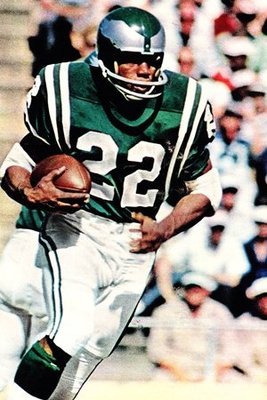

Brown was a 27th round draft pick by the Green Bay Packers in the 1959 draft. He only was on the roster for one game in his rookie year, and did not accumulate any stats.

He then joined the Philadelphia Eagles the next year. He played very sparingly, but did have a 79-yard kick return on 11 attempts.

The 1961 season would be the year Brown got his chance. He led the NFL with 29 kickoff returns and 811 yards. He scored on a 105-yard return, which still stands as an Eagles franchise record and is the seventh longest in NFL history. He also scored the only punt return touchdown of his career on just eight returns.

Brown led the NFL in all-purpose yards in 1962 and 1963. In 1962, Brown caught 50 balls and averaged an impressive 16.3 yards per catch.

He led the NFL in kickoff returns and kickoff return yards in 1963, with 33 attempts for a career high 945 yards. He was also named to the Pro Bowl from 1962 to 1965.

He led the league with a yards per rushing average of 5.4 yards per carry, as he ran for a career high 861 yards in 1965. Brown became the first ever to score on two kickoff returns in one game during the 1966 season, which is still a NFL record that he shares with nine others.

Brown got injured in the seventh game in 1967 and missed the rest of the year. He joined the Baltimore Colts the next year, and helped the Colts win the NFL Championship before they went on to lose in Super Bowl III. He retired after that season and has enjoyed a fine acting career. Brown was in both the movie and TV version of M*A*S*H.

Timmy Brown rushed for 3,862 yards and 31 touchdowns, while catching 235 passes for 3,399 yards and 26 additional scores. His 14.5 yards per catch is very impressive for a running back, and he also averaged 26 yards on 184 kickoff returns. Brown's five career kickoff return touchdowns is tied for the eighth most in NFL history.


Don Maynard


Maynard was drafted in the ninth round of the 1957 draft by the New York Giants. Though he did not make the team that year, he did play the next year for the Giants. He was used as a return specialist mostly, taking 24 punts and 11 kickoffs for 401 yards. Maynard also caught five passes and ran the ball a career best 12 times as a reserve halfback.

He was released after that season, so Maynard joined the Hamilton Tiger-Cats of the Canadian Football League in 1959. The fledgling American Football League was born the next year, so Maynard left the CFL to join the New York Titans.

He was teamed up with felow wide receiver Art Powe. Powe, who is a member of the AFL's All-Time Team, was another receiver rejected by the NFL the year before. Powe had been an 11th-round pick of the Philadelphia Eagles, but was also just used as a return specialist.

The duo lit up the AFL for the three years they teamed up. Powe had 204 catches over that time, leading the league in receiving yards and touchdown catches once, before going to play with the Oakland Raiders.

Maynard was equally as dangerous, grabbing 171 balls for 1,935 yards and 22 scores over that time. The Titans weren't a very good team, so the franchise was often on the verge of bankruptcy trying to compete against the Giants in the same city.

Renamed the Jets in 1963, the franchises fortunes began to change for the better after drafting future Hall of Fame quarterback Joe Namath. He and Maynard soon developed an excellent repertoire and Namath often looked the way of his favorite receiver when the team needed yards most.

Making his first Pro Bowl in 1965, Maynard led the AFL with a career best 14 touchdown receptions. Namath became the first quarterback to throw for over 4,000 yards in 1967, and Maynard's career best 1,434 yards and 102.4 yards receiving yards per game, both of which led the league, was a big reason why. He also averaged 20.2 yards on 71 receptions while scoring 10 times.

This set the stage for the Jets magical 1968 season. Maynard led the AFL with a career best 22.8 yards per catch average, while also leading the league with a 99.8 yards receiving per game average. He piled up 1,297 yards and caught 10 touchdown passes.

In the 1968 AFL Championship, Maynard burned the Oakland Raiders secondary for 118 yards on six receptions. Not only did he score the first touchdown of the contest, he also scored the last. That latter touchdown won the game for the Jets 27-23.

The Jets then faced the NFL's Baltimore Colts in Super Bowl III. Tired of hearing the media constantly tell him the Colts would dominate, Namath made his famous guarantee that his team would win. Baltimore was so intent on stopping Maynard, Namath used him as a decoy and targeted George Sauer instead.

While Maynard did not touch the football, the strategy worked. New York won 16-7, an important moment in AFL history that ultimately forced a merger between the leagues. It is still the only championship season in Jets history.

The 1969 season was not only Maynard's last Pro Bowl year, it was his only First Team All-Pro nod. He averaged 20 yards on 47 receptions. His production began to decline over the next three years, so he joined the Saint Louis Cardinals in 1973.

After one catch in two games, he joined the Houston Texans of the World Football League in 1974. The Texans were later renamed the Shreveport Steamers because the WFL was struggling financially. He retired after that season.

Not only is Maynard inducted into the Pro Football Hall of Fame, he is a member of the AFL's All-Time Team. Maynard is one of 20 players to play the entire 10 seasons the AFL existed, and he is one of seven to have played his entire AFL career for one franchise. He is also one of just a few players to play for the NFL, CFL, AFL and WFL.

Maynard was once just one of only five players to record more than 50 receptions and more than 1,000 receiving yards in five different seasons for many years. He left the game with the most receptions and receiving yards in pro football history at the time. He is the first receiver ever to exceed 10,000 receiving yards.

He still is the Jets all-time leader in receptions, receiving yards and touchdowns caught. His 18.7 career yards per catch average is even more amazing because Maynard dealt with the 10-yard chuck rule and caught balls from over a dozen different quarterbacks.

Known for his sure hands, Maynard also was had great improvisational skills when running routes. He is easily the greatest receiver in Jets history, let alone one of the best in pro football history.


Warren Lahr


In the final round of the 1947 draft, the Pittsburgh Steelers selected Lahr. Just six players were chosen after him. He did not make the team, but he was the last of 16 players from Case Western Reserve University to play in the NFL.

The Cleveland Browns had him try out in 1949 and he made the team. His rookie season found Lahr used in assorted ways, where he caught his only career pass and scored his only offensive touchdown off of nine rushing attempts.

Safety was the position he would make his mark quickly. He had four interceptions his rookie year as the Browns won the All-American Football Conference title for the fourth and final time. The AAFC merged with the NFL the next season.

Cleveland dominated the NFL in 1950 and Lahr was certainly a big reason why. He snagged a career best eight interceptions, two of which he returned for two scores. He led the league in scores off of interceptions that year.

When Cleveland beat the New York Giants in a 8-3 defensive struggle, Lahr picked off a pass that helped preserve the win. It helped substantiate the Browns as a legitimate powerhouse as well as showed the three AAFC teams belonged in the NFL.

He came up big in the Browns first title win. The Los Angeles Rams had two Hall of Fame quarterbacks in Bob Waterfield and Norm Van Brocklin, but Cleveland picked off five of their passes that day. Lahr led the way with two, as the Browns prevailed 30-28.

Lahr led the NFL again with two touchdowns off of interceptions in 1951. Cleveland mowed through the league with one loss behind the top defense. They scored five times off of 58 turnovers that season.

The Browns faced Los Angeles again in the title game, where Lahr had an interception and two fumble recoveries. The Rams won the game 24-17 on a 73-yard bomb from Van Brocklin to Hall of Fame wide receiver Tom Fears late in the fourth quarter.

Despite 22 interceptions in his first four seasons, Lahr did not get to the Pro Bowl until 1953 after gaining a career best 119 yards off of five interceptions, He scored the final touchdown of his career in 1954, as the Browns won another championship.

Cleveland repeated as champions in 1955 as Lahr had another five swipes. In his first seven seasons, he had piled up an impressive 34 picks and never had fewer than four in a season. He stayed with the team until 1959 before retiring.

His 44 career interceptions are still the second most in Browns history, and his five touchdowns off of interceptions is still the most in franchise history. He is a member of the Browns Legends and should soon find himself inducted into the newly created Browns Ring of Honor.


Earl Morrall


Morrall was a first round draft pick of the San Francisco 49ers in the 1956 draft. He was the second player chosen overall that year.

He was mostly used as a punter in his rookie year. He did start four games when the starter, Hall of Famer Y.A. Tittle, was injured. Morrall was traded to the Pittsburgh Steelers after that year, and was named to his first Pro Bowl in 1957.

After starting the first two games of the 1958 season for Pittsburgh, Morrall was traded to the Detroit Lions for Hall of Famer Bobby Layne. There, he backed up Tobin Rote, Jim Ninowski, and Milt Plum until 1964. During the 1963 season, Plum was injured early in the year and Morrall ended up starting 11 games.

Morrall tossed 24 touchdowns on 2,621 yards. Both totals would be the second highest of his career. He was hurt early in the 1964 season, and missed the rest of the year. He was then dealt to the New York Giants during the offseason.

He started the entire 1965 season, and threw the longest pass of that season for 89 yards. Morrall started seven games the next year and threw a pass that is still franchise long of 98 yards to Homer Jones, the man who invented the spiking of the football after a score.

He was replaced by Gary Woods as the Giants went 1-12-1. Morrall soon became a reserve behind Hall of Famer Fran Tarkenton. He then was dealt to the Baltimore Colts in 1968, where his career would be reborn.

Hall of Famer Johnny Unitas was injured in the last preseason game and was out for the year, so Morrall became the starter. He led the Colts to a 13-1 record after throwing for a career high 26 touchdown passes with a career best 2,909 yards.

He led the NFL in touchdown passes, touchdown percentage and yards gained-per-pass attempt. He was selected to his last Pro Bowl and was named the 1968 NFL MVP. The Colts would go on to lose in Super Bowl III. With Unitas healthy again, Morrall started three games over the next two seasons.

In 1970, the Colts would win Super Bowl V when Morrall was called upon again after Unitas was injured early in the game. Morrall helped the Colts beat the Dallas Cowboys 16-13.

Morrall started the first nine games of the 1971 year, leading the Colts to a 7-2 record. He was then injured and replaced by Unitas as the Colts would go on to lose to the Miami Dolphins in the AFC Championship game.

The Colts then cut Morrall, but he was claimed by Miami. Dolphins head coach Hall of Famer Don Shula had coached him on the Colts' 1968 Super Bowl team, so he knew what kind of player he was getting.

The move paid off early into the 1972 season, when Hall of Famer Bob Griese was injured during the fifth game.
Morrall started the next 12 games and helped lead the eventual Super Bowl Champion Dolphins to the only perfect season in modern NFL history. He took them to the AFC Championship game, but was replaced by Griese.

Morrall was named the AFC Player of the Year in 1972, and he also won the first Comeback Player of the Year Award that year. He started one game the next year, as the Dolphins repeated as Super Bowl Champions. Morrall retired after the 1976 season at the age of 42-years old.

Though Earl Morrall started only 102 of the 255 games he played over 21 years, he won 60 and tied three. He also was an important part of four Super Bowl teams and has to be considered one of the best firemen in NFL history.


Otis Taylor
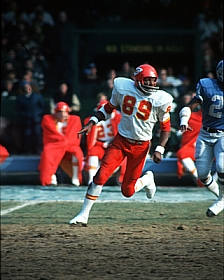

Taylor was drafted in the 15th round of the 1965 NFL Draft by the Philadelphia Eagles. He was also selected in the fifth round of the American Football League's draft by the Kansas City Chiefs.

What happened next is part of both AFL and Chiefs lore. Taylor was brought into the Eagle camp to try out, but legendary Chiefs scout Lloyd Wells had other ideas. Wells had successfully stolen Hall of Fame talents like Buck Buchanan, Emmitt Thomas and Willie Lanier from the NFL.

Taylor was being watched closely by Eagles personnel to prevent him from talking to Wells, but were unsuccessful. In a moment called the "Babysitting Incident", Wells coerced Taylor to sneak out the Eagles facility and sign a contract with the Chiefs.

It turned out to be a great move for Kansas City because Taylor became the big-play receiver the needed. He made his first Pro Bowl in 1966 after having the best year of his career.

Taylor led the league with a 22.4 yards per catch average on 58 receptions for a career best 1,297 yards. He scored eight times, including one on a league leading 89-yards catch.

He led the AFL with a career best 11 touchdown catches the next year, as well as grabbing a career high 59 balls, then spent the next three seasons battling injuries. Yet he was there when Kansas City needed him most, which was seen in the 1969 season.

The Chiefs won the last AFL title that year, which propelled them into Super Bowl V. Taylor led all Chiefs receivers with six catches for 81 yards. He sealed Kansas City's 23-7 victory in the fourth quarter with a catch that covered 46 yards en route to a touchdown.

The 1971 season saw Taylor return to the Pro Bowl and earn his second First Team All-Pro nod after grabbing 57 passes for a league-leading 1,110 yards. He made his final Pro Bowl the next year after getting another 57 receptions.

After a decline in production over the next two seasons, he suited up for one game in 1975 before retiring. He was more than a productive receiver with a propensity of making a big play, Taylor was also a fierce competitor who is one of the best blocking wide receivers to ever play the game.

This fierceness was seen in a game against the Oakland Raiders in 1970. Chiefs Hall of Fame quarterback Len Dawson was speared by mammoth Raiders defensive end Ben Davidson as he laid on the ground. Taylor attacked Davidson, which provoked a bench-clearing brawl.

Not only is he a member of the Chiefs Hall of Fame, Taylor is still all over the teams record books. He ranks second all-time in receiving yards and touchdown catches. His 410 career receptions still ranks third best in Kansas City history.

Wells was a huge reason the Chiefs got their only Super Bowl win. His famous encounter with Taylor helped give the team the best wide receiver that team ever had wear their uniform. Taylor also made the NFL regret not keeping a closer eye on their prospects.


Pete Retzlaff


Retzlaff was drafted in the 22nd round of the 1953 draft by the Detroit Lions, where he was the 265th player chosen overall. The Lions cut Retzlaff in training camp, so he went back to college and worked as an employee of the school for a year. He then enlisted in the United States Army for almost two years before coming back to again try out with the Lions.

Detroit sold his contract to the Philadelphia Eagles in 1956, where he would spend the first two seasons of his career as a reserve fullback. Though he did not have a rushing attempt over that time, the Eagles coaching staff noticed his excellent receiving skills.

Moved to wide receiver in 1958, Retzlaff exploded onto the NFL scene. He went to his first Pro Bowl after leading the team with 56 receptions. After a solid 1959 season, Retzlaff became part of Philadelphia lore.

The 1960 season is the last year the Eagles have won an NFL title. There were eight Pro Bowlers on that squad, which included Retzlaff, and four future Hall of Famers in Norm Van Brocklin, Sonny Jurgensen, Tommy McDonald, and Chuck Bednarik.

While all three Eagles receivers went to the Pro Bowl that year, Retzlaff led the team in receptions and receiving yards. He would catch 80 passes over the next two years, but he got hurt in 1962 and missed six games.

The Eagles asked Retzlaff to move to tight end in 1963, where he excelled immediately. Making the Pro Bowl until the 1965 season, he led the team in receptions and receiving yards each season.

The 1965 is considered by many his finest year in the NFL. Retzlaff set career best marks of 66 receptions for 1,190 yards and 10 touchdowns. Not only was he given his only First Team All-Pro nod, Retzlaff was the recipient of the Bert Bell Award for NFL player of the year.

He was 35-years old in 1966, an advanced age for an NFL tight end. Despite having another productive season, Retzlaff decided to retire at the end of the season after 11 years.

Dubbed "The Baron" and "Pistol Pete" by his teammates, Retzlaff bled the Eagles colors. He loved his peers so much, he was the second ever National Football League Players Association president.

He was also the second general manager in Eagles history. Not only has the franchise retired his jersey number, Retzlaff is a member of the Eagles Honor Roll.

Retzlaff still ranks second in Eagles history with career receptions and receiving yards. He also ranks fifth in touchdown catches. His five Pro Bowls is tied with McDonald and Mike Quick as the second most ever by a Philadelphia receiver.

Philadelphia got real lucky Retzlaff came along when he he did. Pete Pihos, the legendary Hall of Fame end of the Eagles, had just retired in 1955. Buck Shaw and his coaching staff also deserve credit for switching his position.

His experience as a fullback made him an exceptional blocker and a threat once he caught a pass. Retzlaff averaged over 16 yards per catch in his career, never averaging less than 15.4 yards in the last eight years of his career.

While the spectacular and diminutive McDonald got most of the press, which was also shared with Pro Bowl tight end Bobby Walston, Retzlaff was consistent. He led the Eagles receptions six times throughout his career.

Not only could he split the seam of a defense by being a deep threat, Retzlaff went and got the tough pass over the crowded middle of the field. He missed just 12 games in his career, showing the toughness and durability he exemplified.


Brett Favre


The main reason Favre lasted until the second round of the 1991 draft is because teams were concerned about reports of a hip condition he had. The Atlanta Falcons used the 33rd overall selection on him.

He got into two games as a rookie, throwing two interceptions off of four attempts. Green Bay then hired Ron Wolf as their general manager, who then began trying to acquire Favre.

Wolf had been working for the New York Jets before that and had planned on drafting Favre until the Falcons snagged him one pick before the Jets could. New York took Browning Nagle instead, and the quarterback stayed in the NFL until 1996.

Giving up Green Bay's first round pick of 1992, a running back named Tony Smith, the Packers obtained Favre's services. Smith, who was out of the league after 1994, happened to be Favre's teammate at Southern Mississippi University.

What happened next is often compared to Wally Pipp. Pipp was the first baseman of the New York Yankees who sat out a game and never got his job back because Hall of Famer Lou Gehrig would man the position for the next 17 seasons.

Green Bay had a Pro Bowl quarterback named Don Majkowski, but he got hurt in the third game of the season. Favre took over and stood out immediately, making the Pro Bowl. It was the third straight year Majkowski got hurt, so he was released after the season and was out of the league at the end of the 1996 season.

Favre began a career where he went to the Pro Bowl in nine of his 16 seasons with the Packers. He not only had the respect of his peers, the media loved him. He would be named NFL MVP three times.

The 1996 season was his most successful. Favre led the NFL with a career best 39 touchdown passes while tossing just 13 interceptions. Green Bay would go on to win Super Bowl XXXI, where the gunslinger tossed a pair of scores in the 35-21 victory.

He led the NFL a third straight year in touchdown passes in 1997, something he would do one more time in his career. The Packers reached the Super Bowl again, but would lose 31-24 despite Favre's three touchdown passes. This would be the last time in his career that he took a team that far.

After setting a ton of NFL and Packers records, Favre decided to retire after the 2007 season, his last Pro Bowl season with Green Bay. He then decided he wanted to play again, but the Packers opted to go with Aaron Rodgers as their quarterback.

He was traded to the Jets and got off to a good start, tossing a career best six touchdowns in the fourth game of the season. He would make the Pro Bowl that season, then decide to retire again.

The itch to play quickly returned, so Favre decided to suit up for the Minnesota Vikings in 2009. He went to his 11th and final Pro Bowl after having maybe the best season of his career. The 40-year old tossed a career low seven interceptions against 33 touchdowns. His 4,202 yards thrown that year was the third highest total of his career.

After taking the Vikings to the NFC Championship Game that year, he decided to play in 2010. Unfortunately for him and Minnesota, he played like a 41-year old quarterback. He got hurt, which ended his streak of 297 consecutive starts, and missed three games that season. He retired for good soon after.

Favre owns several records, like most consecutive games started, most touchdown passes thrown, most passes attempted and completed. and most wins by a quarterback. He is the only player named NFL MVP by the Associated Press three straight years and he is a member of the NFL's 2000s All-Decade Team.

There is the other side of his gunslinger attitude that most likely prohibited him from winning more than one title. Favre owns the NFL records for most interceptions thrown, most fumbles lost, most turnovers ever by a player, and most times sacked.

Yet he did take his teams to five conference championship games and two Super Bowls in his career. Pretty good for a guy given up on early in his career because people thought the avascular necrosis in his hip would prevent him from attaining the greatness he later achieved.

Saturday, August 20, 2011

Philadelphia Eagles Legend Norm "Wild Man" Willey Passes Away


Norm Willey passed away at the age of 83-years old in Newark, Delaware on August 18, 2011. While many young Philadelphia Eagles fans may know nothing about him, he is one of the greatest defensive players in franchise history.

He was drafted by the Eagles in the 13th round of the 1950 draft. He was the 170th player picked overall. Nicknamed "Wild Man" by his teammates, Willey was known for for his reckless abandon on the field.

After a exceptional career in both football and basketball in college, Willey was later inducted into the Marshall University Athletics Hall of Fame. He quickly earned a starting job for the Eagles and intercepted a pass in his rookie year, taking it 41-yards for a touchdown. He also had a career high four fumbles recovered that year.

Willey picked off the last pass of his career in 1952 and scored the last touchdown of his career off of a fumble recovery in 1954. But Willey did more than tackle opponents. He also caught 2 passes for 50 yards in 1954.

He was named to his first Pro Bowl and lone All-Pro team that year. Willey would then make his final Pro Bowl team in 1955.

He retired after the 1957 season at 30-years old. Though he left the Eagles, he stayed in the area and dedicated his life to teaching kids both on and off the gridiron.

Teaching physical education and football, as well as being a driving instructor, Willy had a tremendous impact on Pennsville, New Jersey. The the Norm Willey Boot trophy is awarded annually to the winner of the Pennsville-Pennsgrove football game.

Willey is one of the best pass rushers in the history of the Eagles, even if the record books cannot give him the respect he deserves. The NFL did not start recording the quarterback sack statistic officially until 1982. Hall of Famer Derrick Thomas had seven sacks in one game during the 1990 season, and this is called the NFL record.

"I guess I came along too soon," Willey once said."I'd get two or three a game, but no one kept count. If I played today, I'd be setting records and getting rich. Back then, no one paid attention to the defense."

Willey sacked New York Giants quarterback Charlie Conerly 17 times in one game during the 1952 season. A game that New York writers in that era said "Willey's the greatest defensive end we have ever seen, and probably the greatest we'll ever see."

Giants Hall of Fame halfback Frank Gifford once wrote that Willey was "very fast and we were very slow." Conerly left the field bleeding and limping, and Eagles coach Jim Trimble argued with the Giants chaplain, because the chaplain felt Conerly was abused too much.

Named the NFL Player of the Week for his monstrous day, Willey said the best moment was collecting $170 in incentive bonuses. Paid just $9,000 yearly, Willey was given $10 each time he hit the opposing quarterback.

It is a shame so many defensive statistics were overlooked for decades by the NFL, and it took until the 1980's for the league to start officially recognizing important ones like sacks and tackles. If Willey's day had been an official stat, it may sit along other notable accomplishments like Joe DiMaggio's 56-game hitting streak.

The "Wild Man" should be in the Eagles Ring of Honor. Not just for his Pro Bowls and incredible amount of sacks, but for what he did for the surrounding community for 60 years of his life.

Rest in Peace Norman Earle Willey.

Monday, July 11, 2011

Pete Duranko Was A Brave Leader And Hero For NFL Players


Pete Duranko (12/15/1943-7/8/2011)

Pete Duranko passed away Friday from Lou Gehrig's Disease at the age of 67. To the casual observer, they will see a fine football player who was a champion on the field. Yet his legacy reached much further.

After having grown up and starred on gridirons and track fields in Johnstown, Pennsylvania, which would have him inducted into the Pennsylvania State Hall of Fame, Duranko would decide to attend Notre Dame University.

He found more success in college, as the Fighting Irish would be named National Champions twice. He lined up with Hall of Famer Alan Page for legendary coach Ara Parseghian and played with such noted players like Bob Kuechenberg, Jim Lynch, Rocky Bleier, George Kunz, Jack Snow, and 1964 Heisman winner John Huarte.

He was a fourth round draft pick of the Cleveland Browns in 1966, but he opted to sign with the Denver Broncos of the American Football League. He soon found himself starting at left defensive end on a good Broncos trenches.

Not only did Denver have Pro Bowl defensive tackle Dave Costa, but Duranko was bookending one of the AFL's most fierce pass rushers in Rich "Tombstone" Jackson. The pair proved to be very effective off the edges for the Broncos.

Jackson, who has been called the best pass rush specialist ever by Sports Illustrated's Hall of Fame voter Paul Zimmerman, and Costa earned Pro Bowls while working with the steady Duranko. Jackson and Duranko were so versatile, they switched positions in 1969 and 1970.

Denver drafted Lyle Alzado in 1971, so Duranko helped shore up the defensive line by moving to defensive tackle and replacing the departed Costa in 1972. When Jackson's career ended from knee injuries, he moved back to defensive end in 1973.

He moved back inside the next year because of injuries, but decided to retire at the end of the 1974 season. Though sacks and tackles were not officially recorded in his era, it is obvious by looking at his career on the gridiron that he was versatile and valuable by having started and played full seasons at each position along the defensive line.

I had the privilege of interviewing Mr. Duranko about a year ago. I was writing about Kansas City Chiefs legend Jim Tyrer in hope of the nine-time Pro Bowler finally getting inducted into Canton.

Tyrer's exclusion is most likely tied to his tragic death, but he did play in an era where things like concussions and depression caused from them were never even thought of, let alone mentioned.

Not only was he a friend Tyrer, having had dinner with him and their wives, but he faced Tyrer several times on the field.

Here is an excerpt from our interview :

"He was the best offensive tackle ever, and one of the best to ever have played football," Duranko said enthusiastically. "He didn't get his full recognition because he was on those excellent Chiefs teams, but he was load to deal with."

The one factor I have found while interviewing NFL Alumni is something that seems to never get written about nor mentioned, because the NFL seemingly desires to sweep ex--players under the rug and forget about them while spouting words like honor and tradition.

ALS is very prevalent amongst former players, as is depression and the aches and pains that came from a rough game.The league's health care plan for these men is miniscule, as I found one player, a former Pro Bowl player in the 1960's, got a monthly increase of just $80 when he was permanently disabled after having both knees and hips replaced while living in virtual poverty.

Duranko spent his post-football career working with players who suffer from depression and also dealt with his own health issues and depression. He was diagnosed with ALS in 2000, but it did not deter him from trying to support his brethren.

Little did I know of his suffering before we spoke, but he took time to speak with me about Tyrer and football. The effects of the game had him in pain, which propelled him to offer anything he could to those going through anything similar.

"It creeps up on you" he said. "People, especially the voters, do not understand mental illness. Jim Tyrer was a strong man who did his best to hide his disease. He didn't want people to know he was depressed and preferred to try to deal with it himself."

"When we were in the game, if you didn't play, you'd go highway. Meaning you got released. This made you play through all sorts of injuries, especially concussions."

While he agreed Tyrer belonged in Canton, I could not help but be impressed with his own career in football. To play seven years in the trenches is extraordinary if you understand the game, let alone the fact of his playing full seasons at each position and excelling well enough to start.

Norm Bulaich, a Pro Bowl running back who played in the 1970's, once told me most folks do not really seem to understand how hard it is just to make an NFL team, let alone get on the field. I am sure some would not truly fathom the plight of Pete Duranko.

This was an educated man who was an executive for a steel company after he retired and decided to return to his hometown to give back to his community. Many a man would have withered into a fetal position after being diagnosed with ALS, but not Duranko.

He decided to fight, much like he did on the football field. He not only made Johnstown, Pennsylvania a better place, but he found time to dedicate himself by helping others who played football like he did.

In our talk, he did not lament his fate of having a terminal disease at all. Duranko only spoke of offering help to others. He helped me in my quest to get Jim Tyrer respect, an act I am sure he tried to do for others until his final breath.

Rest In Peace Peter Nicholas Duranko. Thank you for giving people like me a reason to have hope for the human race.

Monday, April 11, 2011

Dignity After Football


Those who have read this blog know my feelings about the NFLPA, an organization as greedy, underhanded, sleazy, and willingly blind like the NFL itself.

An organization presided for year by former player Gene Upshaw, who screwed over his brethren at every opportunity. Even his own teammates that helped him win championships and other personal glories.

When Upshaw died, few tears were shed by former players.

Now the NFLPA is being run by an ambulance chaser who point blank told a former Redskin, a team he supposedly is a fan of because he grew up in the District of Columbia, that things would be "business as usual".

This means thousands of people who dedicated their lives to the game are basically brushed aside and forgotten. The same people who made professional football a billion dollar empire that has so much power, it had their blackout rule pass through Congress, the House of Representatives, and White House in one day.

You don't even see declarations of war get done that quickly.

Yet there are brave people who have tried to let the public know the sordid side of the NFL, even knowing that the machine would be there to try to block them at every turn.

Men like the Joe DeLamielleure and Mike Ditka are Hall of Famers who have long been vocal about the lack of support their brethren get medically, financially, and spiritually.

Bruce Laird, Jack Kemp, Tom Addison, Ricky Harris, and many more, have also tried to get the NFLPA to at least give respect to those who made the game what it is today.

While there is a lock out, the NFL is giving lip service about player safety for the first time since the league was born in 1920. The countless amount of players who left the game permanently damages and forgotten by the NFL would take more than just a calculator to recall.

When I was calling ex-players to garner support for Chris Hanburger's induction into Canton last year, I was astonished to find many players suffering for Lou Gehrig's Disease.

It seemed the amount of gridiron legends stricken with Amyotrophic lateral sclerosis (ALS) was far more prevalent with NFL players than any other sport or other lines of work.

As we learn more about head injuries with the advances of science, we start to understand better the hell men like Mike Webster, Jim Tyrer, Andre Waters, and others went through just before their deaths.

I also encountered many ex-players with Alzheimer's and Parkinson's disease in my Hanburger quest. While some players were unable to converse, some lit up at the mention of the game they love and held lucid discussions recalling the time they sweat and bled for the NFL.

This is why the work DeLamielleure, Laird, Ditka, and others are so very important and MUST be supported by anyone who claims to be a fan of football.

But I want to tell you about the work of BRENT BOYD.

Boyd is a former offensive lineman with the Minnesota Vikings for seven years. He has testified before the House Judiciary subcommittee on how this former starter is a single father who found himself homeless because he suffers from brain injuries brought on by several concussions.

He still suffers today from depression,headaches, dizziness, and fatigue from his post-concussion disorder. But it has not stopped Boyd in his fight to get the NFL and NFLPA to take care of their own.

http://www.dignityafterfootball.org

He runs Dignity After Football, an organization that tells the stories of players like him still hurting after retiring.

DeLamielleure, Kenny Easley, Wayne Hawkins, Dave Pear, Ed White, Jeff Nixon, Delvin Williams, and Jerry Shirk are just a few ex-players supporting this mission and offer their own stories on this site.

The work Boyd is doing is needed. The NFL pockets every penny possible, which is tax-free. The NFLPA is their puppets who have never shown interest in former players. Boyd terms it "Upshaw Thugocracy", and this mode is still running today.

"The bottom line is I don't work for them. They don't hire me and they can't fire me. They can complain about me all day long. They can have their opinion. But the active players have the vote."

This infamous quote by Upshaw is exactly the mission DeMaurice Smith continues. Smith never played the game and he recently pulled a stunt by decertifying the NFLPA because of the lock out, yet he has shown the Upshaw message remains.

The message of a puppet working for team owners who seemingly treat players like product instead of human beings. Product used to fill their pockets by any means necessary, even if it costs lives.

Please visit Boyd's site and sign his petition. Even if you have no interest in a player once he leaves the game, much like the NFL and NFLPA, then do it because you are a fan of the game.

A game that has cost humanity much more than mortality can acknowledge.


If you want a taste of how the NFLPA works against even their own employees, then read this letter from someone who spent years working for scum like Upshaw.

I am a former employee of the NFLPA (1983-1988 and 1999-2003). I worked in the Special Events/Licensing (1 yr), Research(4 yrs), Legal Departments (4 yrs) and the Financial Advisers Program (detail 6 action. I would not accept intimidation and pursued my rights. 10 years of administrative and legal maneuvers followed. I was reinstated to my job in 1997 - NFLPA refused and in 1999 I returned via court order. I worked on the 7th floor but could only get access up to the 6th floor because the NFLPA refused to give me an elevator key and office keys.

Thus, I was required to walk up the public stairwell without a choice for approx. 20 months. (morning, noon and afternoons) I received an e-mail that the reason for no keys was because of my Title VII litigation and union activity.

I was fired in 2003 after my mother died suddenly and unexpectedly. NFLPA mgt. actually expected me to call or come to work on the day of the funeral.

You will be astonished to hear the details of my plight. They sued my 1st arbitrator and boycott the hearing.

NFLPA mgt. refused to honor the decision and retaliated against me through work conditions, monetary considerations, etc. (judge, jury, prosecutor) The 2nd arbitrator was the former executive secretary and past chairman of the NLRB. The NFLPA has the largest settlement against the NFL in the history of the NLRB. NFLPA mgt. and its representatives distorted the truth during arbitration, to EEOC and the US District Court. NFLPA mgt. denied receiving documents that I had confirmation receipts, denied receiving phone calls that I have phone records ofs.)

I have been involved in 20 years of litigation with the NFLPA regarding Title VII violations and Union activity. In 1988 I was reduced in force and told that I would be fired if I filed grievances or took it, distorted the context of conversations - that I have documentation for, disparaged the reputations of the arbitrator, medical professional, sued and taxed the finances of the union that represented the staff and burdened the attorneys that represented me. Thereby stressing my relationships with my own representatives.

Effectuated unfavorable decisions against me through unfathomable misrepresentations. I was entitled to Family Medical Leave but received no assistance during my family crises. I was fired for excessive and unexcused absences when my job should have been protected like the professional organizations that extended that consideration to my 3 siblings.

It's no wonder that I didn't have permission to deal with my loss and overwhelming grief. I didn't have the NFLPA's permission to return to work in 1999.

In Feb. 2002, until satisfaction thereof, the NFLPA had to pay over $400,000 in Title VII fees to my attorney (not me). My firing in April 2003, and the subsequent fiascos - grievance meetings, arbitration, EEOC and Federal Court - were done in retaliation and were discriminatory.

The actions that I have experienced are unethical and unprofessional at best and at worst - well look at how you all and Congress are being treated. Deja vu.

Litigation is pending - the judge allowed discovery, subpoenas were issued, deposition was held, status - waiting for trial date. The union (Local 2) is not responding.

I am not surprised by their exodus - after all - how could this union have allowed me to walk up a public stairwell for 20 months?


Regretfully submitted, I hope to have a favorable resolve to the moral indignation that I have experienced from this "professional and caring" organization. NFLPA mgt. has spent money in order to destroy my life. It is vindictive and unacceptable.

I returned to work at the NFLPA with the expectations of professionalism. NFLPA mgt. purposely created a hostile environment. My career in sports and union affiliations have been derailed.

I have a Master degree in Urban Planning, Paralegal certificate and years of experience in many areas. I am a wife and mother of two children (11 and 15).

Your support is welcome.

Friday, February 11, 2011

NFL Lout : Why Roger Goodell Is Bad As Hell For The NFL


The muckerism known as the Roger Goodell Era began in the National Football League when he barely won the job as commissioner by two votes in 2006. Though he tried to push this image of being a strict disciplinarian since then, but he has mostly shown to be a watered down version of his mentor and predecessor Paul Tagliabue.

Goodell began working with the NFL as an intern thanks to the fact his dad was a Senator in the same state that NFL Commissioner Pete Rozelle lived in. When Tagliabue replaced a retired Rozelle in 1989, Goodell was taken under the wing of a former college basketball player who knew very little about the game of football.

His role increased as the rules began to heavily favor the offenses and the quarterback position especially. Goodell has even taken this many steps further to sickening proportions since 2006 to the point even touching a quarterback results in a penalty and fine.

The 2011 season has been his worse, yet it may be a blessing for the NFL. It is quite evident Goodell is the wrong man for the job more than ever and replacing him would benefit the league. The league has made mistakes here before, so admitting they made the wrong hire would be nothing new for the NFL.

Jim Thorpe was the first NFL Commissioner ever from 1920 to 1921. He was an obvious figurehead much like Goodell is. Thorpe was a Hall of Fame football player who won two Gold Medals in the 1921 Olympics, played Major League Baseball, and basically excelled in any athletic endeavor.

Carl Stork, a co-founder of the NFL, was commissioner for two years until stepping down due to illness. Austin Gunsel stepped in when Bert Bell died in 1959, but was replaced by Rozelle four months later. Elmer Layden, one of the famous "Four Horsemen" from Notre Dame University, held the job for five year before being replaced by Bell because owners thought him too much a gentleman and not forceful enough for the job.

While Goodell has tried to pretend his was forceful regime, it has been severely tainted with hypocrisy. He reduced a suspension of Pittsburgh Steelers quarterback Ben Roethlisberger by two games this year, but then proceeded to tell people, right before the quarterback was to play Super Bowl XLV, that at least two dozen Steelers did not support Roethlisberger.

The reporter, Peter King, tried to back peddle soon after, but most likely because he was ordered to by Goodell. Still, the damage was done and the timing could not have been more inappropriate. The Super Bowl is the biggest game the league has, one where billions of dollars are involved and where more viewers from other parts of the world tune in.

Not only was the big game marred by Goodell's boorish behavior, but perhaps the worst pre-game and halftime entertainment shows in Super Bowl history followed in a game where hundreds of fans were displaced because Goodell's people did a poor job preparing Cowboys Stadium for the event. These fans are now suing the league.

These debacles took place on the eve of a players strike that is almost certainly going to occur. Players strikes are nothing new in the NFL, having occurred in 1968, 1970, 1982, and 1987. Yet each strike dealt with different issues.

When the players threatened a strike in 1968, the owners countered by declaring a lockout. Since players salaries were low in that era, which caused them to hold second hobs, this strike was brief.

There was another brief strike during training camp in 1970 where the Rozelle Rule evolved. The players union won the right for players to bargain through their own agents with the clubs while allowing any team that lost a free agent to another team to receive something of equal value to his former team


The 1982 season had just nine regular season games played because of the strike. When the 1987 strike went down, players missed a month of the regular season but the games were still played.

Owners hire replacement players, which was largely a group of players who had been cut in training camps. Many players, including Hall of Famers like Joe Montana, Steve Largent, and Randy White, crossed the picket lines to play.

This strike may be different because NFL players see how Major League Baseball players get paid. The NFL is the king of professional sports right now and players want a bigger piece of the pie. Considering an average career lasts less than two years, their request doesn't seem ridiculous.

The players today are afforded luxuries like never before. Though the game still contains hard hitting at times, the rules today make it a much less violent game. Goodell is now saying the league cares about players suffering concussions, an issue they ignored since their beginnings.

Past players suffer today, ignored by their own brethren who are enjoying the path paved for them. Yet the players see how the legends are doing today and are trying to prevent repeating that in their own future. Goodell's recent claims of caring are generally considered just lip service by most so he can resolve the impending strike sooner.

Besides continuing Tagliabue's mission to pamper quarterbacks and offenses while castrating defenses, there are many other things about Goodell that anger players. Many feel he is out of touch, sitting in an ivory tower with a blind eye as his wallet fills up at a rapid pace.

Many players lately have been echoing the same sentiment in regards to their commissioner. They feel he has too much power and control over the game while maintaining a constant predilection of making wrong decisions ultimately. He once was referred to as an obtuse fascist who has ruined the integrity of the game in favor of money.

Though it is unknown if things would be much better or worse now if Goodell did not retain those two votes in 2006, the question if he is the right man for the job gets louder each day. Whether the owners are listening or even caring is the question.

Bell and Rozelle, generally considered the best commissioners in NFL history, never uttered such ramblings like Goodell has while holding the office over 30 years combined. Neither besmirched their players like Goodell has. Though it is doubtful a person as good as Bell or Rozelle is out there right now, it would behoove the NFL to try and find out while firing Goodell.

If the league stays complacent behind his questionable leadership, the United Football League could very well find success the the American Football League did in the 1960's, forcing the NFL to allow all 10 of their teams to merge. Before that, the All-American Football Conference had the NFL take in three teams in 1950.

Though the game of football needs the upstart UFL, now entering their third season, to compete with the NFL to make their product better, the NFL learned 41 years ago from the AFL that it can take a long time to get back on top after being the only game in town several years. A game that has been eroding under the direction of Roger Goodell.

Saturday, July 31, 2010

Roger Goodell's Ideas For Progress May Retard The NFL


When NFL commissioner Roger Goodell announced plans for possibly expanding the regular season to 18 games, several experts said the change was on the horizon years ago. Not only does it increase revenue, but it may draw even more fans in the long run.

Extending the schedule of the regular season is nothing new for the NFL. Since 1922, the regular season went from 11 to 12 games in 1935, then to 14 games in 1961, to the current 16 game schedule in 1978. The 32 year gap now represents the longest time the league has gone without adding more games.

One of many problems in the Goodell plan is his wanting to shorten training camps and exhibition seasons. Though seasons will now run well into February under an 18 game schematic, the loss of training camp time could greatly hinder the league in both fundamentals and character.

The Pro Football Hall of Fame is supposed to represent the greatest player to have ever stepped on the gridiron. Many men in those hallowed walls played for the NFL, and many made the league via their play in a training camp. Coming from virtually nowhere, their names are now as prevalent as the pads, goalposts, and football itself.

In 1955, the Pittsburgh Steelers cut their ninth round draft pick in training camp. The young man hitchhiked home to save the few dollars he had earned for his family. He worked construction and played weekend semi-pro football the rest of the year.

He joined the Baltimore Colts in their 1956 training camp and made the team. Eventually he won three championships and went to the Pro Bowl ten times. Johnny Unitas, a man many consider the greatest quarterback in football history, may not have achieved all of this success without a real training camp to participate in.

Dick "Night Train" Lane is widely considered one of the greatest cornerbacks in NFL history. He made the Lo Angeles Rams in 1952 as a 24-year old man who just left a job at a factory and decided to try football. He hadn't played the sport since he was in junior college for one season over five years earlier.

He wanted to play wide receiver, but the Rams already had future Hall of Famers Elroy "Crazy Legs" Hirsch and Tom Fears there. The Rams moved him to cornerback and he intercepted 14 passes that year. Not only is it a rookie record, but it is the most in the history of professional football for one season.

Though Lane was a notoriously hard hitter, and expert of the horse collar tackle, he finished with 68 interceptions and seven Pro Bowls in his Hall of Fame career. A career that probably would not have been enjoyed by millions if he had to participate in the shortened version of the Goodell training camp.

One lamentation of the NFL historian is the erosion of fundamentals the last decade. More players lead with their heads, going for the kill shot. With defenses castrated by runs heavily favoring the offensive side of the ball, the kill shot has become more part of the game than the zone defense.

Defenses also lean heavily on the zone defense because of the receivers allowed to run virtually unimpeded off the line of scrimmage and few cornerbacks left have solid enough fundamentals to play man to man defense.

Part of the reason is that the NCAA has drastically cut practice time down each week. Players get less time to learn their positions, which is evident in translation on the professional gridiron. Agents cal also keep many players from jumping right in as they negotiate contracts, which also inhibits the learning curve.

Goodell's plan to shorten training camps puts a hindrance on the unknown. Teams will more likely keep the high round draft choice over the undrafted player who outperforms him because of moneys invested. That means there will be several excellent players looking for jobs.

This type of development bodes well for the Canadian Football League, United Football League, and even the upstart All-American Football League that looks to debut in 2011. Though there are no guarantees a Unitas, Lane, or countless other players with similar stories, will come out in the next few years. However, each decade there are players who appear from off the grid to make a significant impact on the game.

You will probably see less of these, the All-American kid from parts unknown walking onto any NFL field and becoming a legendary part of the fabric of a game millions consider a religion. Greed over quality. This what the NFL has been known for the past few decades. It seems is it Goodell's mission to drive that message home into the wallets of the viewers while offering less as a return.

Friday, June 25, 2010

The Scariest Players In Football History

Hardy Brown

Hardy came up the hard way. He grew up in an orphanage after witnessing his father murdered when he was four.

After attending college at both Southern Methodist University and Tulsa University, the New York Giants drafted him in the 12th round of the 1947 NFL Draft. He was the 104th player chosen overall.

Brown opted to join the U.S. Army instead, and stayed in the service until 1948.

He then decided to join the Brooklyn Dodgers of the All American Football Conference that year, then joined the Chicago Hornets of the AAFC the next season. He played placekicker, offensive end, and linebacker.

Brown then went to the NFL in 1950, when he signed with the Washington Redskins. He lasted eight games with the team, before joining the Baltimore Colts for four games.

The Colts went defunct at the end of the year, so Brown joined the 49ers and was put in as their starting middle linebacker for the 1951 season. He knocked out 21 players from games in 1951 alone. In one game, he knocked the opponents entire backfield out of action.

He stayed with the team until 1955, and gained a reputation for being one of the hardest hitters in the league. He was nicknamed "Thumper" and "The Hatchet" by all.

49ers head coach Buck Shaw banned him from team practices, fearing the team would lose players. Hardy Brown is the only man in NFL history to be banned from his own team practices without committing a transgression.

Brown had a technique where he would wind up his shoulder, and had sent players flying backwards as much as ten yards from his impact.

He also almost took the eye out of Joe Geri, a Pittsburgh Steeler running back, in 1951. He fractured the face of one player, and crushed the vertebrae of another.

He was named to his lone Pro Bowl Team in 1952 as the MLB position. He then would play both of the other linebacker positions his last two years with the team.

During the 1954 season, the Detroit Lions Gil "Wild Horse" Mains, a future professional wrestler, jumped into Brown's leg feet first. Brown needed 20 stitches, but refused to leave the game. He soon returned and broke the nose of Lions running back Bill Bowman.

Brown moved on to the Chicago Cardinals for the 1956 season, and played eight games before retiring.

He was lulled out of retirement in 1960 to join the Denver Broncos in the newly formed American Football League, thus becoming one of just two men to have played football in the AAFC, NFL, and AFL.

Hardy Brown retired after that year, and is remembered as one of the most vicious defenders of his day. The number of careers he ended or destroyed is innumerous. It is often said that he left a trail of broken bones in his wake.

His childhood story is set to be told in the upcoming movie "Twelve Mighty Orphans".


Hardy Getting Ready To Hit Otto Graham


Otto After The Game


Ed "The Claw" Sprinkle

Sprinkle was signed as an undrafted free agent by Chicago in 1944 because Hall of Fame Bears center Clyde "Bulldog" Turner recommended him to owner/ coach George Halas. Turner had attended the same college, Hardin-Simmons, as Sprinkle and was familiar with him.

He was brought along slowly initially to gain weight and muscle, but it became quite apparent that Sprinkle excelled on defense. His was called "The Claw" because of his ability to shed blockers with his strong left arm from his right defensive end position.

Bears would end up winning the 1946 NFL championship by defeating the New York Giants 24-14. In 1950, he attained a Pro Bowl nod. He would return to the Pro Bowl in each of the next three years.

By the time he retired after the 1955 season, he had a career where he played with some of the greatest players in NFL history. Men like Turner, Bill George, Sid Luckman, George Connor, Doug Atkins, and George Blanda played defense with him and are all members of the Pro Football Hall of Fame.

Sprinkle was dubbed "The Meanest Man in Pro Football" in his playing days. He used his left arm in ways that opponents accused him of dirty play, especially after the whistle had sounded to halt the action. There are also those who say he used his cleats to stomp on the opposition.

He disputed these claims in an interview, saying that he was about as aggressive as any other player in the league and that he would have faced retribution if he was a dirty player. He was never fined nor suspended for any of his actions on the field.

"A guy wouldn't have lasted long in those days playing dirty.", he said. "The others would take care of him. They would call a play and try to bury him with six or eight guys, or blindside him. There were so many ways to do it."

Halas often said that not only was Sprinkle the greatest pass rusher he ever saw play, but that he was the roughest player the Bears ever had. He probably would have went to more Pro Bowls if defensive ability was more recognized then, but the honor often went to pass catching ends until later in his career.

His owner, teammates, coaches, and Bears fans loved and admired him. Though "The Claw" might be most renowned for his rough and tumble style of play, there are many Bears historians that agree with Halas that Ed Sprinkle was the greatest pass rushing defensive end to ever wear their jersey.


Dick Butkus

The Chicago Bears had the great fortune of drafting two Hall of Famers in the first round of the 1965 draft. They snagged Butkus with the third pick overall, then running back Gale Sayers with the next selection.

Butkus started right away at middle linebacker and instantly became a star. After getting a career best five interceptions, he was named to the first of his eight straight Pro Bowls. He was known for having the brute strength to cause opponents to fumble, and he pounced on a then-NFL record 27 balls over his career.

The NFL also feared his hitting abilities and intelligence. Sports Illustrated dubbed him "The Most Feared Man in the Game" in 1970 after he won his second straight Defensive Player of the Year Award. His desire and athleticism was legendary.

Butkus' knees began to fail him as his career went on, so he retired after 1973. He filed a lawsuit against the team for pushing pain killing pills on him so he would suit up and fill seats for more money. Since then, he has actively campaigned for sports to be played clean without the use of drugs like steroids.

He is a member of the NFL's 1960's and 1970's All-Decade Teams, the 75th Anniversary Team, and both the Pro Football and College Football Halls of Fame. His jersey has been retired by both the Bears and his Alma mater Illinois University.

Few men struck fear in the hearts of opponents like Butkus. The NFL Network named him the most feared player to ever play the game, and it is a justified honor. No linebacker has ever roamed the gridiron like him.


Jack Tatum

Tatum was a first round draft pick of the Oakland Raiders in 1971. He was the 19th player picked overall. He went to college at Ohio State University. Two legends there would help change his path. Woody Hayes was planning to use Tatum as a running back when his assistant coach, Lou Holtz, persuaded Hayes to move Tatum into the defensive safety position.

In his first game as a Buckeye, Tatum knocked the opposing teams starting tight end and running back out of the game. He was All-Big Ten from his sophomore year until his senior year, and was a two-time All-American. He helped Ohio State get to two National Championship games in his collegiate career, winning once. Ohio State lost just two games in his three seasons playing.

His legend at Ohio State is so everlasting that current Ohio State head coach Jim Tressel instituted a "Jack Tatum Hit of the Week Award," given to the player who had the most impressive defensive hit of the game.

Tatum made an immediate impact upon his arrival in the NFL. One game, he knocked out two Baltimore Colts from the game. Hall of Fame Tight End John Mackey was one of the players. He also once sent Hall of Fame wide receiver Lynn Swann to the hospital after a hit.

Tatum was one of the most feared and respected free safeties in the NFL. He was named to his first Pro Bowl squad in 1973, and would go on to be named to the Pro Bowl team each season until 1977. He was a key ingredient to the Raiders team that would go on to win Super Bowl XI.

Tatum would then be traded to the Houston Oilers prior to the 1980 season, and responded by intercepting a career high seven interception for 100 yards despite not starting one game. He helped the Oilers win the AFC Central Division Championship.

Houston, coincidentally, would then lose to the Wild Card Oakland Raiders in the first round of the playoffs. Tatum retired after that game. No matter how one looks at him, Tatum is part of some of some of the most memorable moments in the NFL's history.

The famous "Immaculate Reception", at the end of a playoff game in 1972, started when Tatum laid out Pittsburgh's John Fuqua. Most fans recall Hall of Fame running back Franco Harris gathering the caromed ball and running it in for a game winning touchdown. In Super Bowl XI, Vikings wide receiver Sammy White was leveled by Tatum on a crossing pattern, but the Viking held onto the ball.

During a 1978 preseason game, he hit New England Wide Receiver Darryl Stingley in a play that would paralyze Stingley for life. Tatum happened to play on a team that was called the "Bad Boys" of the 1970's NFL. It was a unique roster full of characters.

Tatum was nicknamed the "Assassin" due to his hard hitting ability. The hit on Stingley, coupled with the Raiders already established reputation, gave Jack an unfair label of being a dirty player. He was vilified by casual observers, and anti-Raider media types after this play.

Tatum once said, “I always wanted to hit someone hard, and if they got hurt, that was just part of the game. But you always wanted them to be okay.” He admitted his hitting prowess "borderlines on felonious assault."

"They said on ESPN that I hit Stingley in the back and that's just a lie," Tatum said. "It's amazing to me that they lie like that when they can just look at the hit. They have it on tape." As you can see in the picture, the hit was clean". Even then-Patriots head coach Chuck Fairbanks said the hit was far from dirty.

The "Assassin" may have hit guys hard, but that is the way the game was played then. Jack Tatum played within the rules. He was not flagged nor fined for his hit on Stingley, though the play was the catalyst for changing the ten yard chuck rule to the current five yard rule.


Jim Brown

When the Cleveland Browns drafted Jim Brown in the first round of the 1957 draft, with the sixth overall selection, they were getting possibly the greatest football and lacrosse player in the history of Syracuse University and collegiate sports.

He was put in as a starter immediately and led the NFL in rushing yards and touchdowns, yards rushing per game, and rushing and receiving touchdowns as a rookie. He was named to the Pro Bowl, an honor he would accrue every year that he played.

In his nine years with the NFL, he led the league in rushing yards eight times. He led the NFL in yards rushing per game eight times, rushing touchdowns five times, carries six times, yards from scrimmage six times, and rushing and receiving touchdowns six times. There has never been a player in the history of any sport who has so thoroughly dominated a professional sport for as long a time.

To intensify the target that was on his back already for being the best player in the NFL, he had to deal with the prevalent bigotry that ran rampant in society at the time. He dealt with anger over the color of his skin, which was intensified due to the fact he was a handsome, educated man who refused to succumb to being bullied.

Always as quick and strong with his mind as he was with his body, one game an opposing player yelled an expletive at him and claimed "You stink Brown!" He walked back to the huddle, asked for the ball, then proceeded to score. Brown then asked "How do I smell from here?"

He retired after nine years as the NFL rushing king in yards for a season and career, rushing and total touchdowns in a career, and still holds the records for having run for four touchdowns in a game six times and leading the league in all-purpose yards five times.

Not only is Brown a member of the NFL's 1960's All-Decade Team and 75th Anniversary Team, but he also a three time NFL MVP, a three time Pro Bowl MVP, and a member of the Pro Football Hall of Fame.

The 1964 season saw Cleveland win the NFL Championship, the last the franchise has seen. Brown helped the team secure the title by running for 114 yards and helping Cleveland control the clock will ball possession.

When he shocked the sports world by retiring at age 29, an age many consider to be the prime years of an athlete, he went into acting and starred in several films. Much as he broke barriers on the gridiron, he did the same in Hollywood. Yet, through all the fame, he always worked to help those less fortunate in society.

Jim Brown was truly scary each time he was handed the ball. He would outrun opponents while carrying a few on his back. A man amongst boys and most likely the greatest human being to ever step foot on an NFL field. He is also an American hero.


Joe Greene

The Pittsburgh Steelers used their first round pick in the 1969 draft, the fourth overall selection, to select the man they would call "Mean" Joe Greene. The reason for his nickname came from the fact he went to college at North Texas State, and their sports teams are called the "Mean Green".

Yet he lived up to the moniker instantly. He went to the Pro Bowl after being named Defensive Rookie of the Year on a Steelers team that won just once. He went to the Pro Bowl in nine of the next 10 years. The lone exception was in 1977, where he was named First Team All-Pro.

Greene did not like to lose, and his fiery disposition exuded this fact. He once spat in the face of Dick Butkus, challenging him to a brawl. He kicked a lineman lying on the ground, and swatted the ball away from the center as the opposition was lining up to run a play. He was frequently triple-teamed as the team struggled, but his desire was rubbing off on the entire Pittsburgh roster.

The Steelers went from perennial losers to the most dominate team in the 1970's, and Greene led the way. On a team stockpiled with stars now, he remained the main face of the franchise. The Steelers would have 12 Hall of Famers in the organization at this time, yet he was generally the first player mentioned above all

Pittsburgh won four Super Bowls under his leadership, as he led a legendary defensive unit simply called the "Steel Curtain". Four Hall of Famers patrolled this defense, though several fans believe there are others who should join them in Canton. It was a defense filled with 10 Pro Bowl players, yet perhaps none was more important than Greene. Pittsburgh's defense fed off of his abilities and leadership.

When he retired after the 1981 season, opposing teams were glad to see him go. He dominated them for 13 years, piling up an unofficial total of 78.5 sacks. He also was stellar versus the run, often swallowing up running backs no matter how many blockers were attempting to pester him.

"Mean" Joe was a total team player bent on winning. He would line up between the center and guard to take them out of the play so his teammates could have an easier time stopping the opponents. Something they did time and time again.

He is a member of the 1980's All-Decade Team and 75th Anniversary Team, as well as being twice named NFL Defensive Player of the Year. He is also a member of both the Pro Football and College Football Halls of Fame.


Randy White

When the Dallas Cowboys drafted White in the first round of the 1975 draft, the second pick overall, they didn't know what to do with him. He played on the defensive line at Maryland University, winning virtually every award possible, but his blend of speed, intelligence, strength, and athleticism had the Cowboys think he would make an excellent middle linebacker who would one day supplant aging great Lee Roy Jordan.

He spent his first two years as a reserve and special teams performer, as Bob Bruenig passed him on the depth chart and became the starter when Jordan retired. Dallas then moved White to defensive tackle, a move that paid off in legendary proportions.

He made the Pro Bowl in his first year at the position as the Cowboys would go on to win in Super Bowl XII. He was dominate in the game, and was named the co-MVP along with his defensive linemate Harvey Martin.

The next eight years saw him return to the Pro Bowl. He was unblockable and even played through injury. He missed two games in his 14 year career. There were Cowboy fans debating if he or Hall of Famer Bob Lilly was the best defensive tackle in team history. Lilly had long been recognized as one of the best the NFL ever saw, so White's abilities were truly recognized and admired.

Though he was officially recognized with 52 career sacks, the Cowboys kept this stat through his career and credit him with 111 total. But he was much more than an amazing pass rusher from inside the pocket, he also was equally adept at stopping the run. He finished his career with an astronomical 1,104 tackles, including an amazing 701 solo tackles.

Not only is White a member of the NFL 1980's All-Decade Team, but he is a member of both the Pro Football and College Football Halls of Fame. He was known as the "Manster" because opponents swore he was half man and half monster. He terrorized and struck fear into other teams hearts each time he took the field.


Reggie White

White was not drafted in 1983 by the NFL despite having been named the SEC Player of the Year and All-American in his senior season at the University of Tennessee. He instead joined the Memphis Showboats of the fledgling United States Football League.

He played 36 games over two years for them, and racked up 23.5 sacks. The USFL folded after 1984, and the Philadelphia Eagles made White their first draft choice in the 1984 Supplemental Draft. He had 13 sacks in 13 games for the Eagles in 1985.

He became a huge star the next year, making the first of 13 consecutive Pro Bowls. He had a whopping 57 sacks between 1986 - 1988, including 21 in just 12 games in 1987. Though Philadelphia had one of the better defenses in the league when White was there, they were unable to reach any Super Bowls.

He became a free agent in 1993, so he joined the Green Bay Packers. His leadership and skills were crucial in helping the Packers reach consecutive Super Bowls, where they won once. He stayed with the Packers until retiring after 1998.

The Carolina Panthers coaxed him out of retirement in 2000, and he had a career low 5.5 sacks. It was the only season of his career he failed to reach the Pro Bowl. He then retired with a then-NFL record 198 sacks in 232 games played.

Not only was he a great pass rusher, but he was equally excellent against the rush. Hew had an amazing 1,048 tackles, including four years of 100 tackles or more. He had a "hump" and "swim" move that blockers could not stop him from using, and he was rarely blocked out of a play.

He is a member of the NFL's 1980's and 1990's All-Decade Teams, as well as the 75th Anniversary Team and USFL All-Time Team. He won the NFL Defensive Player of the Year Award twice and the NFC Defensive Player of the Year Award three times. His jersey has been retired by both the Eagles and Packers, and he is a member of both teams Halls of Fame as well as the Pro Football and College Football Halls of Fame.

White was called the "Minister of Defense" because he was an ordained minister. Though a gentle soul off the field, he was a scary sight on it. Teams weekly concocted game plans to stop him, but failed.


Dick "Night Train" Lane

The story of the Night Train is proof why the NFL should never shorten training camp and preseason. Found as an abandoned infant, he graduated from high school then went to junior college for one year before joining the Army. After his discharge, he got a job as a factory worker and disliked it. He then showed up at the training camp of the Los Angeles Rams asking for a tryout in 1952.

He initially tried out as a wide receiver, but was moved to cornerback because the Rams had two Hall of Famers already there in Tom Fears and Elroy "Crazy Legs" Hirsch. Lane made the team and quickly earned a starting job. He picked off an NFL record 14 passes in just 12 games during his rookie year, returned them for a league leading 298 yards, still the sixth most in NFL history, and scored twice. He even recorded a safety on a tackle, yet somehow was not named a Pro Bowler.

The Rams traded him to the Chicago Cardinals in 1954 and he responded with his first of three consecutive Pro Bowl season by leading the league with 10 interceptions for 181 yards. After two more Pro Bowl years, including one season in 1958 where he caught a 98 yard touchdown pass, he was traded to the Detroit Lions in 1960 and made the Pro Bowl three straight years.

He was part of an elite defense that had three Hall of Famers in the secondary with Lane, Yale Lary, and Dick LeBeau. The defensive line was called the "Fearsome Foursome", led by Roger Brown and Alex Karras and Hall of Fame middle linebacker Joe Schmidt. Though the Lions never won a championship, there were few defenses ever as good.


When he retired after 1965, he had 61 interceptions for 1,207 yards and seven total touchdowns with his safety. His 1,207 interception return yards still ranks as the sixth most ever in NFL history. The NFL named him the top cornerback in their first 50 years of existence, and he is on their 75th Anniversary Team and 1950's All-Decade Team.

What made Lane stand out even more than his propensity to acquire the ball, and go long distances with it, was his hitting ability. He often knocked players out of games, and his favorite move was dubbed the "Night Train Necktie". It was a move where he would lasso a receiver around the head and shoulders, crashing him hard into the turf.

Few cornerbacks have ever hit as hard or covered a receiver as well as "Night Train" Lane. He may not only be the scariest cornerback in the history of football, but also the most complete and best overall.


Deacon Jones

Jones was drafted in the 14th round of the 1961 NFL Draft by the Los Angeles Rams, the 186th player picked overall. Amazingly, the American Football League chose not to take a flier on him.

He earned a starting job right away, was named the teams Rookie of the Year, and made the first of seven consecutive Pro Bowls by 1964. The Rams had stockpiled defenders like Hall of Famer Merlin Olsen along with Pro Bowlers like Rosey Grier, Jack Pardee, Eddie Meador, Lamar Lundy, Maxie Baughan, Irv Cross, Myron Pottios, Coy Bacon, Roger Brown, and Hall of Famer Bill George over this time.

The "Fearsome Foursome" was born in Los Angeles, and the group was very popular with the fans and media. Jones was called the "Secretary of Defense", and was named the "Most Valuable Ram of All Time"by the Los Angeles Times newspaper. Hall of Fame coach George Allen said Jones was the "Greatest Defensive End of Modern Football".

He left the Rams after 1971 and joined the San Diego Chargers. He was named to his final Pro Bowl in 1972, then reunited with Allen as a member of the Washington Redskins in 1974 before retiring. Sacks were not recorded in his era, but several teams recorded the stat anyways for fun. Jones is said to have recorded 50 over two years, including 26 in 1967. Both would be records if recognized. One source claims he had 173.5 over his career, while others claim that number to far exceed 200.

It was Jones himself who coined the phrase "sack" , when it came to tackling the quarterback attempting a pass. His toughness is legendary, having missed just six games in his 14 seasons. He was named NFL Defensive Player of the Year twice. He also is a member of the NFL's 1960's All-Decade Team and 75th Anniversary Team, along with being a member of the Pro Football Hall of Fame.

No other defensive end is said to be more important to the position than Deacon Jones. Blessed with long arms, his favorite pass rush move was the "head slap" technique. Opponents said it felt like Jones was slapping their brains out of their earholes with the move because he was so strong and had pinpoint accuracy.

The Rams have retired his jersey, but not his memories. There may be no tougher or scarier defensive end in the history than David "Deacon" Jones.


Lawrence Taylor

The New York Giants drafted Taylor in the first round of the 1981 draft, where he was the second player chosen overall. The Giants immediately started him at right outside linebacker, a position he would spend most of his career at, and he rewarded them by being named the NFL Defensive Player of the Year and NFL Defensive Rookie of the Year. He is the only player to have accomplished this feat. He also was named to the first of his ten consecutive Pro Bowl nods.

The NFL began to officially record quarterback sacks as a statistic in 1982, and Taylor stood out even more as he won his second straight NFL Defensive Player of the Year Award . He would pile up 142 over his 13 seasons. He led the NFL with 20.5 in 1986, winning the NFL Defensive Player of the Year Award for a record third time as the Giants would go on to win Super Bowl XXI.

The 1990 season was his last as a Pro Bowler, yet he helped the Giants win Super Bowl XXV. He retired after the 1993 season and is a member of the NFL's 1980's All-Decade Team and their 75th Anniversary Team. The Giants also retired his jersey.

While some fans recall how Taylor broke the leg of Washington Redskins quarterback Joe Thiesmann during a nationally televised game in 1985, it is not the play that capsules his career. Teams best remember him for knowing he was coming hard off the edge, but were hardly ever able to stop him. His speed, strength, and athleticism were unusual and unmatched.

His abilities opened things up for the rest of an excellent Giants defense that won two championships and were in serious contention for several others. Many pundits think he is the greatest defensive player to have ever played, and he certainly was one of the most feared.


Ronnie Lott

When the San Francisco 49ers drafted Lott in the first round of the 1981 draft, the eoghth pick overall, they put him at cornerback. He stood out immediately, going to the first of ten straight Pro Bowls after getting seven interceptions and a league leading three touchdowns that helped the 49ers win Super Bowl XVI.

After 17 interceptions and four scores and another Super Bowl win over four years, he shifted to free safety midway in the 1985 season. The move initially didn't go well, because he had to have the tip of his left pinkie finger amputated after a tackle. He stayed at free safety however.

He led the NFL with ten interceptions in 1986 despite missing two games. San Francisco would go on to win both Super Bowl XXIII and XXIV with Lott creating turnovers and crushing opponents with bone jarring hits.

He departed the 49ers to join the Los Angeles Raiders in 1991, and led the NFL with eight interceptions playing the strong safety for the first time. He stayed with them until 1993, then played two seasons at free safety for the New York Jets before retiring after the conclusion of the 1994 season.

He is a member of the NFL's 1980's and 1990's All-Decade Teams, the 75th Anniversary Team, as well as both the Pro Football and College Football Halls of Fame.

When you see how Lott got 1,113 tackles, 61 interceptions, 17 fumble recoveries, and five touchdowns over his 14 seasons, you see a productive player. Yet it does not tell his true worth. His hitting prowess changed games and game plans because he was so feared.


Jack Lambert

Lambert was drafted in the second round of the 1974 draft by the Pittsburgh Steelers, the 46th player chosen overall. He earned the starting job at middle linebacker right away and won the NFL Defensive Rookie of the Year Award as the Steelers won Super Bowl IX..

His second season saw him get the first of nine straight Pro Bowl nods. He recovered a career high eight fumbles in his third year, tied as the second most ever by a defensive player. He was not only an established star in the league, but he was also a well reknowned leader.

His leadership really shone in 1976, when the Steelers started the year at 1-4 after several injuries to key players. Lambert held a players only meeting and put the onus on the defense to lead the team. Pittsburgh's defense responded by sending eight players to the Pro Bowl after pitching five shutouts over the next nine games, and only 28 points over the course of the other four games.

He was named NFL Defensive Player of the Year and was a member of four Super Bowl winning Steelers teams in his career. He is a member of both the NFL's 1970's and 1980's All-Decade Teams as well as the 75th Anniversary Team. He is also a member of the Pro Football Hall of Fame.

Few fans who saw Lambert play will ever forget his determination, leadership, intelligence, and relentless motor. What they also will not forget is his toothless snarl that struck fear in the opposition each play, a look that made "Count Dracula in Cleats" become an indelible image of the league for eternity.


Johnny Sample

Sample was drafted by the Baltimore Colts in the seventh round of the 1958 draft, where he was the 79th player chosen overall. Though he played sparingly as a rookie, he was on the field as the Colts defeated the New York Giants in the 1958 NFL Championship, which is called "The Greatest Game Ever Played".

He then began to start at free safety and return kicks by his second year. Baltimore traded him to the Pittsburgh Steelers in 1961, and he led the NFL in punt returns, punt return yards gained, and had a career best eight interceptions his first year with the Steelers, who had moved him to cornerback.

After an injury plagued 1962, he joined the Washington Redskins the next year for two games. He stayed with the team until 1965, before jumping to the American Football League to play with the New York Jets. The Jets would go on to win the 1968 AFL Championship, then Super Bowl III, where Sample picked off a pass. He retired after the game

Though he is the only person to ever win a Super Bowl as well as an NFL and AFL Championship, people tend to forget he snagged 41 interceptions and scored six times in his 11 seasons because of the style of play he had on the field.

He was known as a hard hitter who was dirty to some. He even wrote a book called "Confessions of a Dirty Ballplayer" in 1970 before becoming a famous professional tennis umpire. Homer Jones, a Pro Bowl receiver for the New York Giants who invented the spike and has the NFL record for career average of yards per catch, said Sample laid out the biggest hit he ever saw at the expense of his teammate Del Shofner.

Shofner was a well respected receiver with five Pro Bowls under his belt when he caught a pass and was headed towards the sidelines. Sample came from out of nowhere and laid a hit so ferocious that it knocked Shofner out and caused both teams benches to empty into a brawl.

The NFL's director of football operations is Gene Washington, a former Pro Bowl receiver. He said, "I played against Sample, and nobody today plays the way he did. Playing on the line or over the line, as it relates to dirty tactics, there is not an equal."

Whether he got into an opponents psyche or body, there where few defensive backs as feared as Johnny Sample.


Larry Csonka

Csonka was drafted by the Miami Dolphins in the first round of the 1968 draft, where he was the eighth player chosen overall. He had attended Syracuse University, where he had broken many school rushing records that were set by such legends like Jim Brown, Ernie Davis, and Floyd Little.

He had almost never became a running back. He was playing defensive end in high school when he filled in on the kickoff team in his sophomore year on the last game of the season. He got his hands on the ball and loved it. After pleading to his coaches to play fullback for a long period of time, he was given an opportunity and immediately stood out from then on.

Miami brought him along slowly his first two seasons, handing the ball off to him just under ten times a game because he suffered two concussions so severe that his career was in jeopardy. They increased his workload his third season and the team improved as Csonka made the first of his five consecutive Pro Bowls.

He never missed a game over a four year span that saw him regularly run over defenders on each play. He was a nightmare trying to tackle, and he would often deliver a more forceful impact than the opposition could deliver. To make matters worse, he rarely fumbled and was an outstanding blocker.

He was called a "movable weight" by one defender, who lamented the strength in Csonka's legs. He also was extremely tough, having played through at least ten broken noses in his gridiron career. Monte Clark, a assistant coach on Miami, once said "When Csonka goes on safari, the lions roll up their windows."

"Zonk" became famous as the offensive leader on Dolphin teams that appeared in three Super Bowls in the first half of the 1970's, winning two. He was named MVP of Super Bowl VIII. His story was on books and magazines constantly, and was named 1973 Super Athlete of the Year by the Professional Football Writers Association.

With all of his successes, he was significantly underpaid. The World Football League was starting up in 1974, so Csonka left the Miami Dolphins for the Memphis Southmen for a more lucrative contract. He stayed there until the WFL folded midway into their second year.

He joined the New York Giants in 1976, and was part of a memorable play two years later most call "The Miracle at the Meadowlands". With the Giants leading the Philadelphia Eagles by five with 31 seconds left on the game clock, the New York offensive coordinator instructed the quarterback to hand off the ball to Csonka instead of kneel down. The rest of the team was expecting the quarterback to kneel, but he attempted to hand it to Csonka while juggling the ball. The ball bounced around until Philadelphia scooped up the ball and ran it in for a winning score.

He returned to Miami in 1978 and scored a career high 13 times and was named the NFL Comeback Player of the Year. He asked for an increase in pay, but was denied so he retired. He is a member of the Pro Football, College Football, and Miami Dolphins Halls of Fame.

The images of a bloodied "Zonk" glaring into a hole just before he ran over three defenders is permanently etched in the memories of every football fan that got to see him play. There were few as tough, sturdy, or strong to ever carry the football.


Conrad Dobler

Dobler was drafted in the fifth round of the 1972 draft by the Saint Louis Cardinals, the 110th player chosen overall. He joined a team filled with great blockers who all would go to the Pro Bowl in their careers. Men like Hall of Famer Dan Dierdorf, Bob Young, Ernie McMillan, Tom Banks and Hall of Fame tight end Jackie Smith played along the line with him.

He started right away at left guard, but was moved to the right side in his second year. A position he would stay at the rest of his career, and he stood out immediately. Known for his surly demeanor on the field, Dobler would do whatever it took to keep the opposition away from his teams high powered offense.

Though he was called "Pro Football's Dirtiest Player", he was also excellent and respected. He was named to the Pro Bowl for three straight years from 1975-1977. Whether he was seen punching Hall of Famer "Mean" Joe Greene, kicking Hall of Famer Merlin Olsen in the head, or spitting on an injured player, Dobler was a character you loved to have on your team or hate the fact that he wasn't.

What made him so scary was his unpredictable nature. He was as apt to punch you or dive into your knees on any play. This style of play was also one with payback, but he was so tough that he played through multiple injuries. The Cardinals traded him to New Orleans in 1978, who then traded him to the Buffalo Bills in 1980 before he retired after 1981.

He now is 90% disabled after several surgeries to try to fix a body that both gave out and was dealt severe punishment. He has had nine knee replacement surgeries alone so far, causing financial hardship seen with many players of his era because of how they are disregarded by the NFL and NFLPA.


Bronko Nagurski

Bronko joined the Chicago Bears after a legendary collegiate career with the University of Minnesota. He once scored a touchdown and intercepted a pass while playing with cracked vertebrae.

At 6'2" 226, he was one of the largest running backs of his era. His strength carrying the ball was legendary. He ran over four players while playing in Wrigley Field, then smashed against the brick wall after scoring. "That last guy hit me awfully hard." was his response.

He got hurt carrying the ball, so the Bears used his blocking prowess by inserting him at offensive tackle. He was a All-Pro player at fullback, defensive tackle, and offensive tackle, making him the only player ever to be named to the All-Pro at three different positions.

Nagurski was also a professional wrestler when he wasn't playing football. He did it to supplement his income, because NFL players were paid little in his era. He won three world championships as a wrestler.

Nagurski is considered one of the greatest defensive tackles in college football history. Not only is there an annual award named after him that goes to the top defender in college football, but he is a member of the College Football Hall of Fame and the starting defensive tackle on Sports Illustrated's NCAA Football All-Century Team. He is also an charter member of the Pro Football Hall of Fame, a member of the 1930's All-Decade Team and NFL 75th Anniversary Team.

As a professional player, he was truly feared on both sides of the ball. Whether he was carrying it, blocking, or tackling, Nagurski made a huge impact. He retired after 1937, but returned in 1943 to help Chicago win a championship by scoring a touchdown in the title game. The Bears retired two of the numbers he wore.

When Hall of Famers like Jim Brown, Marion Motley, John Riggins, Earl Campbell, and Larry Csonka were seen dragging around defenders into the end zone, history must pay tribute to the man who did it first. Bronko Nagurski was a winner who scared opponents each time he stepped on the gridiron.