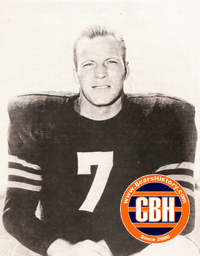
Hardy Brown Hardy came up the hard way. He grew up in an orphanage after witnessing his father murdered when he was four.
After attending college at both Southern Methodist University and Tulsa University, the New York Giants drafted him in the 12th round of the 1947 NFL Draft. He was the 104th player chosen overall.
Brown opted to join the U.S. Army instead, and stayed in the service until 1948.
He then decided to join the Brooklyn Dodgers of the All American Football Conference that year, then joined the Chicago Hornets of the AAFC the next season. He played placekicker, offensive end, and linebacker.
Brown then went to the NFL in 1950, when he signed with the Washington Redskins. He lasted eight games with the team, before joining the Baltimore Colts for four games.
The Colts went defunct at the end of the year, so Brown joined the 49ers and was put in as their starting middle linebacker for the 1951 season. He knocked out 21 players from games in 1951 alone. In one game, he knocked the opponents entire backfield out of action.
He stayed with the team until 1955, and gained a reputation for being one of the hardest hitters in the league. He was nicknamed "Thumper" and "The Hatchet" by all.
49ers head coach Buck Shaw banned him from team practices, fearing the team would lose players. Hardy Brown is the only man in NFL history to be banned from his own team practices without committing a transgression.
Brown had a technique where he would wind up his shoulder, and had sent players flying backwards as much as ten yards from his impact.
He also almost took the eye out of Joe Geri, a Pittsburgh Steeler running back, in 1951. He fractured the face of one player, and crushed the vertebrae of another.
He was named to his lone Pro Bowl Team in 1952 as the MLB position. He then would play both of the other linebacker positions his last two years with the team.
During the 1954 season, the Detroit Lions Gil "Wild Horse" Mains, a future professional wrestler, jumped into Brown's leg feet first. Brown needed 20 stitches, but refused to leave the game. He soon returned and broke the nose of Lions running back Bill Bowman.
Brown moved on to the Chicago Cardinals for the 1956 season, and played eight games before retiring.
He was lulled out of retirement in 1960 to join the Denver Broncos in the newly formed American Football League, thus becoming one of just two men to have played football in the AAFC, NFL, and AFL.
Hardy Brown retired after that year, and is remembered as one of the most vicious defenders of his day. The number of careers he ended or destroyed is innumerous. It is often said that he left a trail of broken bones in his wake.
His childhood story is set to be told in the upcoming movie "Twelve Mighty Orphans".
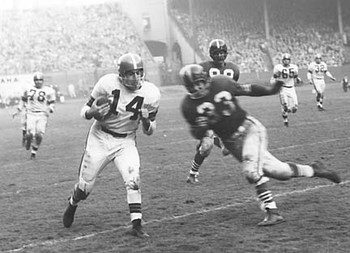
 Hardy Getting Ready To Hit Otto Graham
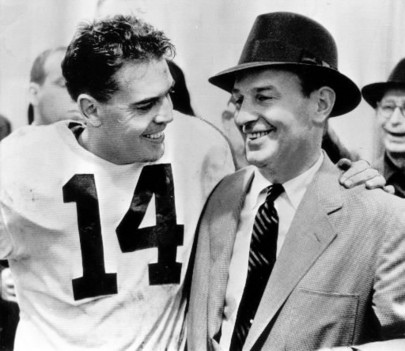
  Otto After The Game Ed "The Claw" Sprinkle
 Sprinkle was signed as an undrafted free agent by Chicago in 1944 because Hall of Fame Bears center Clyde "Bulldog" Turner recommended him to owner/ coach George Halas. Turner had attended the same college, Hardin-Simmons, as Sprinkle and was familiar with him.
He was brought along slowly initially to gain weight and muscle, but it became quite apparent that Sprinkle excelled on defense. His was called "The Claw" because of his ability to shed blockers with his strong left arm from his right defensive end position.
Bears would end up winning the 1946 NFL championship by defeating the New York Giants 24-14. In 1950, he attained a Pro Bowl nod. He would return to the Pro Bowl in each of the next three years.
By the time he retired after the 1955 season, he had a career where he played with some of the greatest players in NFL history. Men like Turner, Bill George, Sid Luckman, George Connor, Doug Atkins, and George Blanda played defense with him and are all members of the Pro Football Hall of Fame.
Sprinkle was dubbed "The Meanest Man in Pro Football" in his playing days. He used his left arm in ways that opponents accused him of dirty play, especially after the whistle had sounded to halt the action. There are also those who say he used his cleats to stomp on the opposition.
He disputed these claims in an interview, saying that he was about as aggressive as any other player in the league and that he would have faced retribution if he was a dirty player. He was never fined nor suspended for any of his actions on the field.
"A guy wouldn't have lasted long in those days playing dirty.", he said. "The others would take care of him. They would call a play and try to bury him with six or eight guys, or blindside him. There were so many ways to do it."
Halas often said that not only was Sprinkle the greatest pass rusher he ever saw play, but that he was the roughest player the Bears ever had. He probably would have went to more Pro Bowls if defensive ability was more recognized then, but the honor often went to pass catching ends until later in his career.
His owner, teammates, coaches, and Bears fans loved and admired him. Though "The Claw" might be most renowned for his rough and tumble style of play, there are many Bears historians that agree with Halas that Ed Sprinkle was the greatest pass rushing defensive end to ever wear their jersey.
 Dick Butkus
 The Chicago Bears had the great fortune of drafting two Hall of Famers in the first round of the 1965 draft. They snagged Butkus with the third pick overall, then running back Gale Sayers with the next selection.
Butkus started right away at middle linebacker and instantly became a star. After getting a career best five interceptions, he was named to the first of his eight straight Pro Bowls. He was known for having the brute strength to cause opponents to fumble, and he pounced on a then-NFL record 27 balls over his career.
The NFL also feared his hitting abilities and intelligence. Sports Illustrated dubbed him "The Most Feared Man in the Game" in 1970 after he won his second straight Defensive Player of the Year Award. His desire and athleticism was legendary.
Butkus' knees began to fail him as his career went on, so he retired after 1973. He filed a lawsuit against the team for pushing pain killing pills on him so he would suit up and fill seats for more money. Since then, he has actively campaigned for sports to be played clean without the use of drugs like steroids.
He is a member of the NFL's 1960's and 1970's All-Decade Teams, the 75th Anniversary Team, and both the Pro Football and College Football Halls of Fame. His jersey has been retired by both the Bears and his Alma mater Illinois University.
Few men struck fear in the hearts of opponents like Butkus. The NFL Network named him the most feared player to ever play the game, and it is a justified honor. No linebacker has ever roamed the gridiron like him.
 Jack Tatum
 Tatum was a first round draft pick of the Oakland Raiders in 1971. He was the 19th player picked overall. He went to college at Ohio State University. Two legends there would help change his path. Woody Hayes was planning to use Tatum as a running back when his assistant coach, Lou Holtz, persuaded Hayes to move Tatum into the defensive safety position.
In his first game as a Buckeye, Tatum knocked the opposing teams starting tight end and running back out of the game. He was All-Big Ten from his sophomore year until his senior year, and was a two-time All-American. He helped Ohio State get to two National Championship games in his collegiate career, winning once. Ohio State lost just two games in his three seasons playing.
His legend at Ohio State is so everlasting that current Ohio State head coach Jim Tressel instituted a "Jack Tatum Hit of the Week Award," given to the player who had the most impressive defensive hit of the game.
Tatum made an immediate impact upon his arrival in the NFL. One game, he knocked out two Baltimore Colts from the game. Hall of Fame Tight End John Mackey was one of the players. He also once sent Hall of Fame wide receiver Lynn Swann to the hospital after a hit.
Tatum was one of the most feared and respected free safeties in the NFL. He was named to his first Pro Bowl squad in 1973, and would go on to be named to the Pro Bowl team each season until 1977. He was a key ingredient to the Raiders team that would go on to win Super Bowl XI.
Tatum would then be traded to the Houston Oilers prior to the 1980 season, and responded by intercepting a career high seven interception for 100 yards despite not starting one game. He helped the Oilers win the AFC Central Division Championship.
Houston, coincidentally, would then lose to the Wild Card Oakland Raiders in the first round of the playoffs. Tatum retired after that game. No matter how one looks at him, Tatum is part of some of some of the most memorable moments in the NFL's history.
The famous "Immaculate Reception", at the end of a playoff game in 1972, started when Tatum laid out Pittsburgh's John Fuqua. Most fans recall Hall of Fame running back Franco Harris gathering the caromed ball and running it in for a game winning touchdown. In Super Bowl XI, Vikings wide receiver Sammy White was leveled by Tatum on a crossing pattern, but the Viking held onto the ball.
During a 1978 preseason game, he hit New England Wide Receiver Darryl Stingley in a play that would paralyze Stingley for life. Tatum happened to play on a team that was called the "Bad Boys" of the 1970's NFL. It was a unique roster full of characters.
Tatum was nicknamed the "Assassin" due to his hard hitting ability. The hit on Stingley, coupled with the Raiders already established reputation, gave Jack an unfair label of being a dirty player. He was vilified by casual observers, and anti-Raider media types after this play.
Tatum once said, “I always wanted to hit someone hard, and if they got hurt, that was just part of the game. But you always wanted them to be okay.” He admitted his hitting prowess "borderlines on felonious assault."
"They said on ESPN that I hit Stingley in the back and that's just a lie," Tatum said. "It's amazing to me that they lie like that when they can just look at the hit. They have it on tape." As you can see in the picture, the hit was clean". Even then-Patriots head coach Chuck Fairbanks said the hit was far from dirty.
The "Assassin" may have hit guys hard, but that is the way the game was played then. Jack Tatum played within the rules. He was not flagged nor fined for his hit on Stingley, though the play was the catalyst for changing the ten yard chuck rule to the current five yard rule.
 Jim Brown
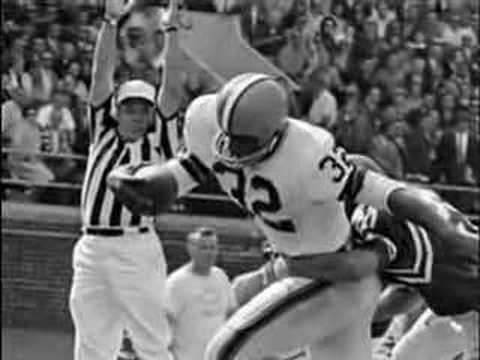
 When the Cleveland Browns drafted Jim Brown in the first round of the 1957 draft, with the sixth overall selection, they were getting possibly the greatest football and lacrosse player in the history of Syracuse University and collegiate sports.
He was put in as a starter immediately and led the NFL in rushing yards and touchdowns, yards rushing per game, and rushing and receiving touchdowns as a rookie. He was named to the Pro Bowl, an honor he would accrue every year that he played.
In his nine years with the NFL, he led the league in rushing yards eight times. He led the NFL in yards rushing per game eight times, rushing touchdowns five times, carries six times, yards from scrimmage six times, and rushing and receiving touchdowns six times. There has never been a player in the history of any sport who has so thoroughly dominated a professional sport for as long a time.
To intensify the target that was on his back already for being the best player in the NFL, he had to deal with the prevalent bigotry that ran rampant in society at the time. He dealt with anger over the color of his skin, which was intensified due to the fact he was a handsome, educated man who refused to succumb to being bullied.
Always as quick and strong with his mind as he was with his body, one game an opposing player yelled an expletive at him and claimed "You stink Brown!" He walked back to the huddle, asked for the ball, then proceeded to score. Brown then asked "How do I smell from here?"
He retired after nine years as the NFL rushing king in yards for a season and career, rushing and total touchdowns in a career, and still holds the records for having run for four touchdowns in a game six times and leading the league in all-purpose yards five times.
Not only is Brown a member of the NFL's 1960's All-Decade Team and 75th Anniversary Team, but he also a three time NFL MVP, a three time Pro Bowl MVP, and a member of the Pro Football Hall of Fame.
The 1964 season saw Cleveland win the NFL Championship, the last the franchise has seen. Brown helped the team secure the title by running for 114 yards and helping Cleveland control the clock will ball possession.
When he shocked the sports world by retiring at age 29, an age many consider to be the prime years of an athlete, he went into acting and starred in several films. Much as he broke barriers on the gridiron, he did the same in Hollywood. Yet, through all the fame, he always worked to help those less fortunate in society.
Jim Brown was truly scary each time he was handed the ball. He would outrun opponents while carrying a few on his back. A man amongst boys and most likely the greatest human being to ever step foot on an NFL field. He is also an American hero.
 Joe Greene
The Pittsburgh Steelers used their first round pick in the 1969 draft, the fourth overall selection, to select the man they would call "Mean" Joe Greene. The reason for his nickname came from the fact he went to college at North Texas State, and their sports teams are called the "Mean Green".
Yet he lived up to the moniker instantly. He went to the Pro Bowl after being named Defensive Rookie of the Year on a Steelers team that won just once. He went to the Pro Bowl in nine of the next 10 years. The lone exception was in 1977, where he was named First Team All-Pro.
Greene did not like to lose, and his fiery disposition exuded this fact. He once spat in the face of Dick Butkus, challenging him to a brawl. He kicked a lineman lying on the ground, and swatted the ball away from the center as the opposition was lining up to run a play. He was frequently triple-teamed as the team struggled, but his desire was rubbing off on the entire Pittsburgh roster.
The Steelers went from perennial losers to the most dominate team in the 1970's, and Greene led the way. On a team stockpiled with stars now, he remained the main face of the franchise. The Steelers would have 12 Hall of Famers in the organization at this time, yet he was generally the first player mentioned above all
Pittsburgh won four Super Bowls under his leadership, as he led a legendary defensive unit simply called the "Steel Curtain". Four Hall of Famers patrolled this defense, though several fans believe there are others who should join them in Canton. It was a defense filled with 10 Pro Bowl players, yet perhaps none was more important than Greene. Pittsburgh's defense fed off of his abilities and leadership.
When he retired after the 1981 season, opposing teams were glad to see him go. He dominated them for 13 years, piling up an unofficial total of 78.5 sacks. He also was stellar versus the run, often swallowing up running backs no matter how many blockers were attempting to pester him.
"Mean" Joe was a total team player bent on winning. He would line up between the center and guard to take them out of the play so his teammates could have an easier time stopping the opponents. Something they did time and time again.
He is a member of the 1980's All-Decade Team and 75th Anniversary Team, as well as being twice named NFL Defensive Player of the Year. He is also a member of both the Pro Football and College Football Halls of Fame.
 Randy White
When the Dallas Cowboys drafted White in the first round of the 1975 draft, the second pick overall, they didn't know what to do with him. He played on the defensive line at Maryland University, winning virtually every award possible, but his blend of speed, intelligence, strength, and athleticism had the Cowboys think he would make an excellent middle linebacker who would one day supplant aging great Lee Roy Jordan.
He spent his first two years as a reserve and special teams performer, as Bob Bruenig passed him on the depth chart and became the starter when Jordan retired. Dallas then moved White to defensive tackle, a move that paid off in legendary proportions.
He made the Pro Bowl in his first year at the position as the Cowboys would go on to win in Super Bowl XII. He was dominate in the game, and was named the co-MVP along with his defensive linemate Harvey Martin.
The next eight years saw him return to the Pro Bowl. He was unblockable and even played through injury. He missed two games in his 14 year career. There were Cowboy fans debating if he or Hall of Famer Bob Lilly was the best defensive tackle in team history. Lilly had long been recognized as one of the best the NFL ever saw, so White's abilities were truly recognized and admired.
Though he was officially recognized with 52 career sacks, the Cowboys kept this stat through his career and credit him with 111 total. But he was much more than an amazing pass rusher from inside the pocket, he also was equally adept at stopping the run. He finished his career with an astronomical 1,104 tackles, including an amazing 701 solo tackles.
Not only is White a member of the NFL 1980's All-Decade Team, but he is a member of both the Pro Football and College Football Halls of Fame. He was known as the "Manster" because opponents swore he was half man and half monster. He terrorized and struck fear into other teams hearts each time he took the field.
 Reggie White
 White was not drafted in 1983 by the NFL despite having been named the SEC Player of the Year and All-American in his senior season at the University of Tennessee. He instead joined the Memphis Showboats of the fledgling United States Football League.
He played 36 games over two years for them, and racked up 23.5 sacks. The USFL folded after 1984, and the Philadelphia Eagles made White their first draft choice in the 1984 Supplemental Draft. He had 13 sacks in 13 games for the Eagles in 1985.
He became a huge star the next year, making the first of 13 consecutive Pro Bowls. He had a whopping 57 sacks between 1986 - 1988, including 21 in just 12 games in 1987. Though Philadelphia had one of the better defenses in the league when White was there, they were unable to reach any Super Bowls.
He became a free agent in 1993, so he joined the Green Bay Packers. His leadership and skills were crucial in helping the Packers reach consecutive Super Bowls, where they won once. He stayed with the Packers until retiring after 1998.
The Carolina Panthers coaxed him out of retirement in 2000, and he had a career low 5.5 sacks. It was the only season of his career he failed to reach the Pro Bowl. He then retired with a then-NFL record 198 sacks in 232 games played.
Not only was he a great pass rusher, but he was equally excellent against the rush. Hew had an amazing 1,048 tackles, including four years of 100 tackles or more. He had a "hump" and "swim" move that blockers could not stop him from using, and he was rarely blocked out of a play.
He is a member of the NFL's 1980's and 1990's All-Decade Teams, as well as the 75th Anniversary Team and USFL All-Time Team. He won the NFL Defensive Player of the Year Award twice and the NFC Defensive Player of the Year Award three times. His jersey has been retired by both the Eagles and Packers, and he is a member of both teams Halls of Fame as well as the Pro Football and College Football Halls of Fame.
White was called the "Minister of Defense" because he was an ordained minister. Though a gentle soul off the field, he was a scary sight on it. Teams weekly concocted game plans to stop him, but failed.
 Dick "Night Train" Lane
 The story of the Night Train is proof why the NFL should never shorten training camp and preseason. Found as an abandoned infant, he graduated from high school then went to junior college for one year before joining the Army. After his discharge, he got a job as a factory worker and disliked it. He then showed up at the training camp of the Los Angeles Rams asking for a tryout in 1952.
He initially tried out as a wide receiver, but was moved to cornerback because the Rams had two Hall of Famers already there in Tom Fears and Elroy "Crazy Legs" Hirsch. Lane made the team and quickly earned a starting job. He picked off an NFL record 14 passes in just 12 games during his rookie year, returned them for a league leading 298 yards, still the sixth most in NFL history, and scored twice. He even recorded a safety on a tackle, yet somehow was not named a Pro Bowler.
The Rams traded him to the Chicago Cardinals in 1954 and he responded with his first of three consecutive Pro Bowl season by leading the league with 10 interceptions for 181 yards. After two more Pro Bowl years, including one season in 1958 where he caught a 98 yard touchdown pass, he was traded to the Detroit Lions in 1960 and made the Pro Bowl three straight years.
He was part of an elite defense that had three Hall of Famers in the secondary with Lane, Yale Lary, and Dick LeBeau. The defensive line was called the "Fearsome Foursome", led by Roger Brown and Alex Karras and Hall of Fame middle linebacker Joe Schmidt. Though the Lions never won a championship, there were few defenses ever as good.
When he retired after 1965, he had 61 interceptions for 1,207 yards and seven total touchdowns with his safety. His 1,207 interception return yards still ranks as the sixth most ever in NFL history. The NFL named him the top cornerback in their first 50 years of existence, and he is on their 75th Anniversary Team and 1950's All-Decade Team.
What made Lane stand out even more than his propensity to acquire the ball, and go long distances with it, was his hitting ability. He often knocked players out of games, and his favorite move was dubbed the "Night Train Necktie". It was a move where he would lasso a receiver around the head and shoulders, crashing him hard into the turf.
Few cornerbacks have ever hit as hard or covered a receiver as well as "Night Train" Lane. He may not only be the scariest cornerback in the history of football, but also the most complete and best overall.
 Deacon Jones
 Jones was drafted in the 14th round of the 1961 NFL Draft by the Los Angeles Rams, the 186th player picked overall. Amazingly, the American Football League chose not to take a flier on him.
He earned a starting job right away, was named the teams Rookie of the Year, and made the first of seven consecutive Pro Bowls by 1964. The Rams had stockpiled defenders like Hall of Famer Merlin Olsen along with Pro Bowlers like Rosey Grier, Jack Pardee, Eddie Meador, Lamar Lundy, Maxie Baughan, Irv Cross, Myron Pottios, Coy Bacon, Roger Brown, and Hall of Famer Bill George over this time.
The "Fearsome Foursome" was born in Los Angeles, and the group was very popular with the fans and media. Jones was called the "Secretary of Defense", and was named the "Most Valuable Ram of All Time"by the Los Angeles Times newspaper. Hall of Fame coach George Allen said Jones was the "Greatest Defensive End of Modern Football".
He left the Rams after 1971 and joined the San Diego Chargers. He was named to his final Pro Bowl in 1972, then reunited with Allen as a member of the Washington Redskins in 1974 before retiring. Sacks were not recorded in his era, but several teams recorded the stat anyways for fun. Jones is said to have recorded 50 over two years, including 26 in 1967. Both would be records if recognized. One source claims he had 173.5 over his career, while others claim that number to far exceed 200.
It was Jones himself who coined the phrase "sack" , when it came to tackling the quarterback attempting a pass. His toughness is legendary, having missed just six games in his 14 seasons. He was named NFL Defensive Player of the Year twice. He also is a member of the NFL's 1960's All-Decade Team and 75th Anniversary Team, along with being a member of the Pro Football Hall of Fame.
No other defensive end is said to be more important to the position than Deacon Jones. Blessed with long arms, his favorite pass rush move was the "head slap" technique. Opponents said it felt like Jones was slapping their brains out of their earholes with the move because he was so strong and had pinpoint accuracy.
The Rams have retired his jersey, but not his memories. There may be no tougher or scarier defensive end in the history than David "Deacon" Jones.
 Lawrence Taylor
 The New York Giants drafted Taylor in the first round of the 1981 draft, where he was the second player chosen overall. The Giants immediately started him at right outside linebacker, a position he would spend most of his career at, and he rewarded them by being named the NFL Defensive Player of the Year and NFL Defensive Rookie of the Year. He is the only player to have accomplished this feat. He also was named to the first of his ten consecutive Pro Bowl nods.
The NFL began to officially record quarterback sacks as a statistic in 1982, and Taylor stood out even more as he won his second straight NFL Defensive Player of the Year Award . He would pile up 142 over his 13 seasons. He led the NFL with 20.5 in 1986, winning the NFL Defensive Player of the Year Award for a record third time as the Giants would go on to win Super Bowl XXI.
The 1990 season was his last as a Pro Bowler, yet he helped the Giants win Super Bowl XXV. He retired after the 1993 season and is a member of the NFL's 1980's All-Decade Team and their 75th Anniversary Team. The Giants also retired his jersey.
While some fans recall how Taylor broke the leg of Washington Redskins quarterback Joe Thiesmann during a nationally televised game in 1985, it is not the play that capsules his career. Teams best remember him for knowing he was coming hard off the edge, but were hardly ever able to stop him. His speed, strength, and athleticism were unusual and unmatched.
His abilities opened things up for the rest of an excellent Giants defense that won two championships and were in serious contention for several others. Many pundits think he is the greatest defensive player to have ever played, and he certainly was one of the most feared.
 Ronnie Lott
 When the San Francisco 49ers drafted Lott in the first round of the 1981 draft, the eoghth pick overall, they put him at cornerback. He stood out immediately, going to the first of ten straight Pro Bowls after getting seven interceptions and a league leading three touchdowns that helped the 49ers win Super Bowl XVI.
After 17 interceptions and four scores and another Super Bowl win over four years, he shifted to free safety midway in the 1985 season. The move initially didn't go well, because he had to have the tip of his left pinkie finger amputated after a tackle. He stayed at free safety however.
He led the NFL with ten interceptions in 1986 despite missing two games. San Francisco would go on to win both Super Bowl XXIII and XXIV with Lott creating turnovers and crushing opponents with bone jarring hits.
He departed the 49ers to join the Los Angeles Raiders in 1991, and led the NFL with eight interceptions playing the strong safety for the first time. He stayed with them until 1993, then played two seasons at free safety for the New York Jets before retiring after the conclusion of the 1994 season.
He is a member of the NFL's 1980's and 1990's All-Decade Teams, the 75th Anniversary Team, as well as both the Pro Football and College Football Halls of Fame.
When you see how Lott got 1,113 tackles, 61 interceptions, 17 fumble recoveries, and five touchdowns over his 14 seasons, you see a productive player. Yet it does not tell his true worth. His hitting prowess changed games and game plans because he was so feared.
 Jack Lambert
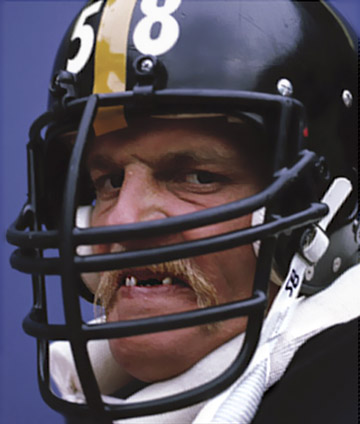
 Lambert was drafted in the second round of the 1974 draft by the Pittsburgh Steelers, the 46th player chosen overall. He earned the starting job at middle linebacker right away and won the NFL Defensive Rookie of the Year Award as the Steelers won Super Bowl IX..
His second season saw him get the first of nine straight Pro Bowl nods. He recovered a career high eight fumbles in his third year, tied as the second most ever by a defensive player. He was not only an established star in the league, but he was also a well reknowned leader.
His leadership really shone in 1976, when the Steelers started the year at 1-4 after several injuries to key players. Lambert held a players only meeting and put the onus on the defense to lead the team. Pittsburgh's defense responded by sending eight players to the Pro Bowl after pitching five shutouts over the next nine games, and only 28 points over the course of the other four games.
He was named NFL Defensive Player of the Year and was a member of four Super Bowl winning Steelers teams in his career. He is a member of both the NFL's 1970's and 1980's All-Decade Teams as well as the 75th Anniversary Team. He is also a member of the Pro Football Hall of Fame.
Few fans who saw Lambert play will ever forget his determination, leadership, intelligence, and relentless motor. What they also will not forget is his toothless snarl that struck fear in the opposition each play, a look that made "Count Dracula in Cleats" become an indelible image of the league for eternity.
 Johnny Sample
 Sample was drafted by the Baltimore Colts in the seventh round of the 1958 draft, where he was the 79th player chosen overall. Though he played sparingly as a rookie, he was on the field as the Colts defeated the New York Giants in the 1958 NFL Championship, which is called "The Greatest Game Ever Played".
He then began to start at free safety and return kicks by his second year. Baltimore traded him to the Pittsburgh Steelers in 1961, and he led the NFL in punt returns, punt return yards gained, and had a career best eight interceptions his first year with the Steelers, who had moved him to cornerback.
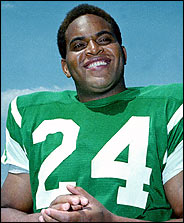
After an injury plagued 1962, he joined the Washington Redskins the next year for two games. He stayed with the team until 1965, before jumping to the American Football League to play with the New York Jets. The Jets would go on to win the 1968 AFL Championship, then Super Bowl III, where Sample picked off a pass. He retired after the game
Though he is the only person to ever win a Super Bowl as well as an NFL and AFL Championship, people tend to forget he snagged 41 interceptions and scored six times in his 11 seasons because of the style of play he had on the field.
He was known as a hard hitter who was dirty to some. He even wrote a book called "Confessions of a Dirty Ballplayer" in 1970 before becoming a famous professional tennis umpire. Homer Jones, a Pro Bowl receiver for the New York Giants who invented the spike and has the NFL record for career average of yards per catch, said Sample laid out the biggest hit he ever saw at the expense of his teammate Del Shofner.
Shofner was a well respected receiver with five Pro Bowls under his belt when he caught a pass and was headed towards the sidelines. Sample came from out of nowhere and laid a hit so ferocious that it knocked Shofner out and caused both teams benches to empty into a brawl.
The NFL's director of football operations is Gene Washington, a former Pro Bowl receiver. He said, "I played against Sample, and nobody today plays the way he did. Playing on the line or over the line, as it relates to dirty tactics, there is not an equal."
Whether he got into an opponents psyche or body, there where few defensive backs as feared as Johnny Sample.
 Larry Csonka
 Csonka was drafted by the Miami Dolphins in the first round of the 1968 draft, where he was the eighth player chosen overall. He had attended Syracuse University, where he had broken many school rushing records that were set by such legends like Jim Brown, Ernie Davis, and Floyd Little.
He had almost never became a running back. He was playing defensive end in high school when he filled in on the kickoff team in his sophomore year on the last game of the season. He got his hands on the ball and loved it. After pleading to his coaches to play fullback for a long period of time, he was given an opportunity and immediately stood out from then on.
Miami brought him along slowly his first two seasons, handing the ball off to him just under ten times a game because he suffered two concussions so severe that his career was in jeopardy. They increased his workload his third season and the team improved as Csonka made the first of his five consecutive Pro Bowls.
He never missed a game over a four year span that saw him regularly run over defenders on each play. He was a nightmare trying to tackle, and he would often deliver a more forceful impact than the opposition could deliver. To make matters worse, he rarely fumbled and was an outstanding blocker.
He was called a "movable weight" by one defender, who lamented the strength in Csonka's legs. He also was extremely tough, having played through at least ten broken noses in his gridiron career. Monte Clark, a assistant coach on Miami, once said "When Csonka goes on safari, the lions roll up their windows."
"Zonk" became famous as the offensive leader on Dolphin teams that appeared in three Super Bowls in the first half of the 1970's, winning two. He was named MVP of Super Bowl VIII. His story was on books and magazines constantly, and was named 1973 Super Athlete of the Year by the Professional Football Writers Association.
With all of his successes, he was significantly underpaid. The World Football League was starting up in 1974, so Csonka left the Miami Dolphins for the Memphis Southmen for a more lucrative contract. He stayed there until the WFL folded midway into their second year.
He joined the New York Giants in 1976, and was part of a memorable play two years later most call "The Miracle at the Meadowlands". With the Giants leading the Philadelphia Eagles by five with 31 seconds left on the game clock, the New York offensive coordinator instructed the quarterback to hand off the ball to Csonka instead of kneel down. The rest of the team was expecting the quarterback to kneel, but he attempted to hand it to Csonka while juggling the ball. The ball bounced around until Philadelphia scooped up the ball and ran it in for a winning score.
He returned to Miami in 1978 and scored a career high 13 times and was named the NFL Comeback Player of the Year. He asked for an increase in pay, but was denied so he retired. He is a member of the Pro Football, College Football, and Miami Dolphins Halls of Fame.
The images of a bloodied "Zonk" glaring into a hole just before he ran over three defenders is permanently etched in the memories of every football fan that got to see him play. There were few as tough, sturdy, or strong to ever carry the football.
 Conrad Dobler
 Dobler was drafted in the fifth round of the 1972 draft by the Saint Louis Cardinals, the 110th player chosen overall. He joined a team filled with great blockers who all would go to the Pro Bowl in their careers. Men like Hall of Famer Dan Dierdorf, Bob Young, Ernie McMillan, Tom Banks and Hall of Fame tight end Jackie Smith played along the line with him.
He started right away at left guard, but was moved to the right side in his second year. A position he would stay at the rest of his career, and he stood out immediately. Known for his surly demeanor on the field, Dobler would do whatever it took to keep the opposition away from his teams high powered offense.
Though he was called "Pro Football's Dirtiest Player", he was also excellent and respected. He was named to the Pro Bowl for three straight years from 1975-1977. Whether he was seen punching Hall of Famer "Mean" Joe Greene, kicking Hall of Famer Merlin Olsen in the head, or spitting on an injured player, Dobler was a character you loved to have on your team or hate the fact that he wasn't.
What made him so scary was his unpredictable nature. He was as apt to punch you or dive into your knees on any play. This style of play was also one with payback, but he was so tough that he played through multiple injuries. The Cardinals traded him to New Orleans in 1978, who then traded him to the Buffalo Bills in 1980 before he retired after 1981.
He now is 90% disabled after several surgeries to try to fix a body that both gave out and was dealt severe punishment. He has had nine knee replacement surgeries alone so far, causing financial hardship seen with many players of his era because of how they are disregarded by the NFL and NFLPA.
 Bronko Nagurski
Bronko joined the Chicago Bears after a legendary collegiate career with the University of Minnesota. He once scored a touchdown and intercepted a pass while playing with cracked vertebrae.
At 6'2" 226, he was one of the largest running backs of his era. His strength carrying the ball was legendary. He ran over four players while playing in Wrigley Field, then smashed against the brick wall after scoring. "That last guy hit me awfully hard." was his response.
He got hurt carrying the ball, so the Bears used his blocking prowess by inserting him at offensive tackle. He was a All-Pro player at fullback, defensive tackle, and offensive tackle, making him the only player ever to be named to the All-Pro at three different positions.
Nagurski was also a professional wrestler when he wasn't playing football. He did it to supplement his income, because NFL players were paid little in his era. He won three world championships as a wrestler.
Nagurski is considered one of the greatest defensive tackles in college football history. Not only is there an annual award named after him that goes to the top defender in college football, but he is a member of the College Football Hall of Fame and the starting defensive tackle on Sports Illustrated's NCAA Football All-Century Team. He is also an charter member of the Pro Football Hall of Fame, a member of the 1930's All-Decade Team and NFL 75th Anniversary Team.
As a professional player, he was truly feared on both sides of the ball. Whether he was carrying it, blocking, or tackling, Nagurski made a huge impact. He retired after 1937, but returned in 1943 to help Chicago win a championship by scoring a touchdown in the title game. The Bears retired two of the numbers he wore.
When Hall of Famers like Jim Brown, Marion Motley, John Riggins, Earl Campbell, and Larry Csonka were seen dragging around defenders into the end zone, history must pay tribute to the man who did it first. Bronko Nagurski was a winner who scared opponents each time he stepped on the gridiron.