Showing posts with label USFL. Show all posts

Saturday, August 13, 2011

Tim Tebow Replaces Brett Favre As Media's NFL Deity


Becoming the poster child for the current version of the "All-American Boy" almost never happened for the big kid with the goofy smile and "Aw shucks" attitude. His mom was ill while pregnant with him and doctors urged her to abort a child that could be stillborn.

Ignoring medical advice, she carried out a pregnancy that gave the media someone to talk about at every turn on the hype highway. Tim Tebow has more reasons for them to like him besides cheating death before even being born.

Home-schooled by a family with Christian beliefs, Tebow soon incurred some controversy as a home-schooled student when he played football for a nearby high school. Though he started out playing linebacker and tight end, he soon became Florida's Player of the Year twice and his legend began to grow by playing a game on a broken leg.

ESPN began following him at this time and even did a show featuring Tebow and labeled him "The Chosen One". A top recruit, he decided to attend the University of Florida.

The media kept following him, this time in greater numbers. Not only did they have Tebow confess he was a virgin, they printed and recorded the question and answer that had nothing to do with football. The purpose of the question was to add to the mystique that was often found on an ESPN broadcast somewhere seemingly daily.

All of this publicity came despite the fact he was a backup, something that would come about again in five years. Tebow played as a freshman, and even played a key role in helping the Gators win the 2006 National Championship.

He started from his sophomore year on and became the first home-schooled athlete to win the Heisman Trophy Award. Tebow was also the first underclassman ever to win the award.

Though he was never able to tie Archie Griffin's record of winning the Heisman twice, he did lead Florida to another championship in 2008 and won the Maxwell Award twice. Many media members would be so bold to call Tebow the greatest college football player ever.

Yet critics would say that he would never have success as a quarterback in the NFL. Tebow ran the position kind of like a mix of a throw-back player and fullback in college, opting to run over defenders and toss jump passes more often than any other contemporary quarterback.

The Denver Broncos did not care to listen to the critics. They traded up in the 2009 Draft to use the 25th overall selection to grab Tebow. While many in the media had been wondering incessantly throughout the draft why Tebow hadn't been drafted yet, critics expected him to keep falling to possibly even the third round.

Now a Bronco, the cameras keep a few feet away constantly recording every Tebow move. The most popular reserve in the NFL, his jersey was a hot-selling item that set records. It had been the top-selling jersey every month since he was drafted for many months.

While spotted in six games in the beginning of his career, the Broncos lost their starting quarterback and were forced to start Tebow for three games. He became the first quarterback in NFL history to run for a touchdown in each of his first three career starts.

While his passing numbers were far from gaudy, they were certainly better than the critics expected. The 82.1 quarterback rating he had as a rookie was impressive for a kid no one thought would ever be an effective professional quarterback.

Now in his second season, the hype highway has intensified with more bodies and pressure in the way. His name is mentioned constantly on television and the Internet is strewn with tons of articles discussing if this is the year Tebow begins his career as a starter.

The problem is that last years starter, Kyle Ortin, has outperformed Tebow in camp by a pretty wide margin. Tebow's fans will say practice is unimportant, that the play on the field during a game matters most.

In the Broncos first 2011 preseason game, Orton was not sharp in his few plays. Tebow was sharp with one incompletion against backup defenders on the Dallas Cowboys. Still, Tebow's head coach John Fox called the youngster a work in progress who made a few bad reads.

With his unconventional release and style of play, Tebow is a unique player. Some think his style best works as a spot player. One reporter compared Tebow to 1984 Heisman winner Doug Flutie.

Flutie, about eight inches shorter than Tebow, lasted 11 rounds before being drafted. After a season in the United States Football League, Flutie joined the NFL as the USFL folded.

He soon found himself on the field playing, but the results were not as hoped. Flutie then bolted for the Canadian Football League and became a star. He played in the CFL for eight years and won three titles. He was also named the CFL's Most Outstanding Player six times.

Flutie then returned to the NFL in 1998 and became a Pro Bowler. He played to the age of 43 and became the first NFL player in 65 years to convert a successful drop kick.

While a trip to the CFL is an unlikely route for Tebow, it may take some time before the Broncos are ready to let him lead the team. But his teammates will tell you Tebow displays a an obvious burning desire to win.

With his religious beliefs, humble attitude, and desire to fulfill his childhood dream to becoming a great NFL quarterback, the media has bought in full force. There have been stories of him quoted as saying his Broncos starting job was “grabbed back away” when Orton was not traded recently.

But the negative press rolls off his back like water on a duck, leaving him unscathed. Well
insulated with a huge fanbase, the loyalty of the press will stay persistent no matter how much of Tebow's 2011 season is spent on the bench.

It appears Tebow can do no wrong to a group of writers, which reminds some of Brett Favre. Favre, who retired last year after 20 years as a player, still gets brought up in stories for a possible return this year.

While Favre won one Super Bowl and set several records as a player, he also left the game with the most fumbles, times sacked, and interceptions thrown in an era of football where the NFL constantly bent the rule in a quarterbacks favor to ensure success.

Tebow hasn't thrown a teammate under the bus yet for holding out while being the highest paid player in team history like Favre did. Nor are there any reports of purported sexual harassment either.

Yet there are similarities that extend beyond the fact both men play quarterback. Favre also lived under the media microscope and was trumpeted as the greatest player ever innumerous times.

Favre could do no wrong himself, even if reports of wrong doing were running rampant. He was given a pass at every turn and ESPN dropped his name seemingly every ten minutes on all broadcasts for many years.

With him now away from the game, the mantle has been filled by the kid who has had a media shadow since he was 17-years old. Tebow handles the things well, but has also lamented the constant process of being interviewed repeatedly and practically daily.

He will be only 24-years old soon, but the target is set firmly on his back. Opponents have stated they will try to hit Tebow with all of their abilities. That pressure alone would buckle most, let alone the constant attention he receives from a large group of reporters following him.

While appearing bashful at being given the throne Favre reigned for so many years, Tebow appears to understand the perks that go with it. Whether all of this hype gets him on the field with a successful career remains to be seen, but the media will make sure we witness every second of it.

Wednesday, April 20, 2011

NFL Free Agency: 10 Best Free Agent Signings Ever


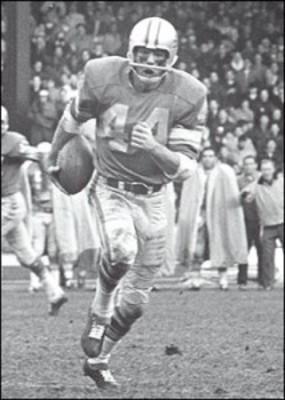
Johnny Unitas

Unitas was drafted by the Pittsburgh Steelers in the ninth round of the 1955 draft. He was cut in camp, as the Steelers decided to go with Jim Finks, Ted Marchibroda and Vic Eaton at quarterback.

Finks would later go on to be a legendary general manager who built the Minnesota Vikings, Chicago Bears and New Orleans Saints into winners. Marchibroda became an offensive guru who coached several teams. Eaton, drafted two rounds after Unitas, was out of football after 1955.

Unitas hitch-hiked back home to save money, then worked construction. He kept in shape by playing semipro football for $6 a game.

Weeb Ewbank, the Hall of Fame head coach, asked Unitas' semipro teammate Jim Deglau to try out for the Baltimore Colts. Hearing the Cleveland Browns were interested in Unitas, he asked Deglau to bring the quarterback with him.

Despite the objections of family members, Unitas went to Baltimore. He made the team, backing up George Shaw and Gary Kerkorian. He soon passed Kerkorian, now in his third year of backing up Shaw, on the depth chart.

During camp, Unitas would stay after practice was over and throw balls all night to a wide receiver, Raymond Berry, who had caught just 13 catches the year before after making the team as a 20th-round draft pick. This bond between Unitas and Berry would soon have a tremendous impact on the NFL.

Shaw, who was the Colts first-round draft pick in 1952, broke his leg in the fourth game of the year. Unitas was plugged in and showed some promise.

His next 10 years saw him go to the Pro Bowl and win the NFL MVP Award three times. Baltimore also won the championship twice with maybe the greatest quarterback to ever play the game.

The 1970 season was his last as a starter, where the 37-year old Unitas led the Colts to a Super Bowl win. He played until the 1973 season before retiring.

Unitas left with a ton of records. Many have been equaled or passed as quarterbacks play longer season with rules that help them succeed, but his 47-games streak of a touchdown pass in each game still survives.

College football hands the top senior quarterback of each year the Johnny Unitas Golden Arm Award. The name of the award is fitting, because Unitas is more than the greatest quarterback in Colts history.

He is the best free agent signing in NFL history.


Dick "Night Train" Lane


A story that the movie "The Natural" may have gotten inspiration from.

Lane was found as an abandoned infant in a dumpster, then raised by a kind-hearted lady. After going to a community college for one year, Lane joined the United States Army for four years and fought in both World War II and the Korean War.

After serving, he got a job at an aircraft factory. He disliked the job, so he walked onto the training camp of the Los Angeles Rams seeking a job.

He wanted to play wide receiver, but the Rams already had a set of Hall of Famers there named Elroy "Crazy Legs" Hirsch and Tom Fears. He was switched to cornerback and found his calling.

Lane was a monstrous hitter who could blanket any receiver in the game. In a matter of months, he came from nowhere and was the top defensive back in all of professional football.

Though just 12 games were played in his rookie year, Lane had 14 interceptions. This is a record that still stands today for the most interceptions in a single season.

Yet Lane was dangerous once he got the ball. He returned the interceptions for 298 yards and two touchdowns, while still finding time to record a safety. Despite such incredible numbers, he was somehow left off the Pro Bowl squad even though he had almost twice as many interceptions combined over the players that were chosen.

He did get to the first of his seven career Pro Bowls in 1954. After having been traded to the Chicago Cardinals that season, Lane had 10 interceptions for 181 yards.

After six years with the Cardinals, he was dealt to the Detroit Lions and took part in some of the greatest secondaries in NFL history. Lane played with Hall of Fame safety Yale Lary and Hall of Fame cornerback Dick LeBeau.

When he hung up his cleats in 1965, Lane had 68 interceptions in 14 seasons. It still ranks the fourth most in NFL history, but it is still the most ever by a cornerback. Rod Woodson, who had 71 career swipes, got 24 as a safety.

Lane had 1,207 yards returned off of interceptions, still the sixth most ever. Deion Sanders is the only cornerback who had more.

He loved to hit receivers and often sought out contact. His favorite way to tackle was a clothesline shot, which was legal in the NFL then. It was dubbed a "Night Train Necktie."

There may be no free agent signing on defense more special or important than the day Lane decided to try and play professional football.


Original Cleveland Browns


When the Browns were formed in 1946, head coach Paul Brown had a plan. The fledgling All-American Football Conference would soon get steamrolled by these plans.

Otto Graham, Marion Motley, Dante Lavelli, Lou Groza and Bill Willis are all Hall of Famers that Brown signed as free agents that year. Along with many other great players like Mac Speedie, Lin Houston, Horace Gillom, Frank Gatski and Lou Rymkus who were just a few others that helped Cleveland dominate.

After winning all of the AAFC titles, they jumped to the NFL in 1950 and promptly won a title. Graham, Groza, Gatski, Gillom and Lavelli were all on the 1954 and 1955 teams that won it all.

Several great coaches came from those Browns rosters. Rymkus and Lou Saban won American Football League titles as head coaches and Ara Parseghian won a title with Notre Dame University.

When it comes to free agent signings, the original Cleveland Browns are on a level all by themselves.


Willie Wood


Wood went undrafted in 1960 after a collegiate career where he was the first African-American quarterback for the University of Southern California and the Pacific-10 Conference. He signed with the Green Bay Packers, who moved him to free safety.

While mainly returning punts, a duty he did much of his career, the rookie was mentored by Hall of Famer Emlen Tunnel. Tunnel retired at the end of the season, so Wood was named starter and held that spot the next 11 years.

He played on teams that went to the championship six times, winning five. Not only was he excellent at returning punts, he became a ball hawk. In 1961, he scored twice off of 14 punt returns.

He led the NFL with a 16.1 yards per return average. Wood led the NFL with nine interceptions in 1962, while becoming one of the best free safeties of his era. Green Bay relied on him as their last line of defense, and he seldom ever let them down.

When he retired after the 1971 season, Wood had intercepted 48 passes, scored four times, and went to eight Pro Bowls. Only Forrest Gregg and Brett Favre have gone more for the Packers.

After having been a finalist nine times, Wood was inducted into the Pro Football Hall of Fame in 1989.

He is easily the best free agent signing Green Bay ever made.


Dick LeBeau


LeBeau was a fifth-round draft pick of the Cleveland Browns in the 1959 draft. He was the 58th player picked overall, but did not make the Browns team and was cut in training camp. He would then be picked up by the Detroit Lions as a free agent and played six games in his rookie year, mostly on special teams.

He did recover the first fumble of his career that season. In 1960, LeBeau earned the starting job at cornerback opposite newly acquired Hall of Famer Dick "Night Train" Lane.

The Lions defense also had Hall of Fame MLB Joe Schmidt, Hall of Fame Safety Yale Lary, Pro Bowl defensive tackle Alex Karras and Pro Bowl safety Terry Barr. LeBeau picked off four passes. The next three seasons, LeBeau and Lane formed the best cornerback tandem in the NFL.

LeBeau picked off three passes in 1961, then four in 1962. He scored the first two touchdowns of his career that year, by interception and fumble recovery. In 1963, LeBeau picked off five passes and returned them for 158 yards. He also returned one interception 70 yards for a touchdown.

LeBeau would then make his first of three consecutive Pro Bowl appearances in 1964. That season also marked Lary's last in the NFL, and Lane played only seven games. LeBeau still managed five interceptions that year. The 1965 season was the last year for both Lane and Schmidt. LeBeau picked off seven passes and returned one for the last touchdown of his career.

The 1966 season would be LeBeau's last Pro Bowl season, when he intercepted four passes. LeBeau stayed steady the next several years. He picked off four passes in 1967, opposite of Hall of Fame cornerback Lem Barney under new coach, and former teammate, Joe Schmidt.

LeBeau and Barney would then team up for the next three years as one of the best CB tandems in the league. LeBeau had 20 picks over that time. At 34-years old in 1971, LeBeau would intercept six passes.

The 1972 season would be the last year as a Detroit Lion for LeBeau and Schmidt. LeBeau was moved to free safety that year, and would not intercept a pass for the first time since his rookie season. He did recover the last fumble of his career that year.

LeBeau only retired from the NFL as a player after 1972. He went into coaching in 1973 for the Philadelphia Eagles as their secondary coach. He stayed with the team until 1975. He then held the same duties with the Green Bay Packers from 1976 to 1979.

In 1980, he moved to the Cincinnati Bengals. He served as a secondary coach, and as defensive coordinator with the Bengals until 1991. LeBeau then served as the defensive coordinator for the Pittsburgh Steelers from 1992 to 1996.

This is when LeBeau would gain notoriety for inventing the now commonly used "Zone Blitz" defense. The Steelers defense featured such greats as Hall of Fame cornerback Rod Woodson, Pro Bowl linebackers Greg Lloyd, Hardy Nickerson, Levon Kirkland, Chad Brown, Kevin Greene, Jason Gildon and strong safety Carnell Lake. They would go to the Super Bowl after the 1995 season.

In 1997, LeBeau returned to the Bengals as a defensive coordinator. He would then be named head coach of the Bengals in 2000 and held that job until 2002.

LeBeau then worked for the Buffalo Bills in 2003. He returned to the Steelers in 2004, and is still the defensive coordinator of the Steelers today. In 2005, the Steelers won Super Bowl XL. Pittsburgh also won Super Bow XLIII in 2008.

Dick LeBeau is one of the most respected coaches in NFL history, obviously, and is called "Coach Dad" by his players. He is a member of the Detroit Lions Legend and his 62 interceptions are the most in the history of the Lions.

He is the first player from the 1959 NFL Draft to be inducted into the Pro Football Hall of Fame. He is the best free agent signing the Lions ever had.


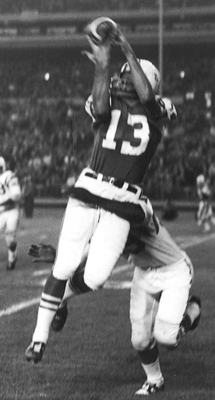
Don Maynard


Maynard was drafted by the New York Giants in the ninth round of the 1957 draft, but did not make the team.

He tried again the next year and made it, mostly being used as a punt returner. The Giants cut him again, so he played in the Canadian Football League in 1959 for the Hamilton Tiger-Cats.

He left the CFL to become the first player signed by the expansion New York Titans of the fledgling American Football League. He caught a career best 72 balls his first year. Yet he also teamed up with Art Powell to be probably the best wide receiver duo in the AFL.

The tandem became the first professional football players to gain over 1,000 yards on receptions in a season. They duplicated that feat again in 1962. Despite this dynamic duo, the Titans attracted few fans and were struggling financially.

They changed their name to the Jets in 1963, but business did not pick up until 1965. That year saw them draft, then outbid the NFL for the services of a brash quarterback named Joe Namath.

The future Hall of Famer had a chip on his shoulder, but an arm to back it up. Maynard quickly bonded with Namath and the team started to get better each year.

New York reached the AFL title game in 1968, where Maynard would carry the Jets to victory. Facing the Oakland Raiders and Hall of Fame cornerback Willie Brown, Maynard caught six balls for 118 yards. He scored the Jets' first and last touchdowns, and the last one sealed a 27-23 win.

It capped off a wild series between the Jets and Raiders that year. Six weeks earlier, the teams made history in the infamous "Heidi Game" incident. The game was taken off the air by television executives with 65 seconds to play and the Jets leading 32-29. Oakland then stormed back and won 43-32.

The Jets went into Super Bowl III as tremendous underdogs. No one expected much from them outside of the Jets organization and fans. This led to Namath's now famous guarantee of victory.

Maynard was covered by Johnny Sample, an extremely tough player who knocked many men out of many games in his career. Maynard got shut out, but his bookend George Sauer caught eight balls for 133 yards.

That, along with a stingy defense and 121 rushing yards by Matt Snell, led the Jets to a 16-7 win over the heavily favored Baltimore Colts. It is the game that convinced the NFL to merge with the AFL. Maynard and Sauer both had 1,000-yards receiving together twice.

While a precision route-runner, Maynard was incredible at getting deep and stretching defenses. When he retired at the end of the 1973 season, he had an excellent career average of 18.7 yards per reception. His 88 touchdown receptions over 15 years show he was also a threat in the end zone.

Don Maynard, inducted into the Pro Football Hall of Fame in 1987, was the Jets first and best free agent signing.


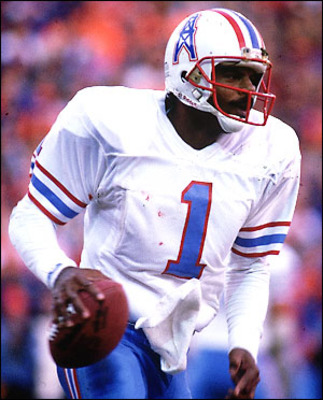
Warren Moon


It still is an amazing fact that Moon went undrafted in 1978. Despite leading his college team to a Rose Bowl win the year before, some NFL teams wanted him to switch positions. His refusal was followed by an apparent blacklisting.

Instead, he joined the Canadian Football League and stayed there until 1983. He led his team to an unprecedented five titles and is now a member of the Canadian Football Hall of Fame.

The NFL couldn't keep on their blinders any longer, and a bidding war began for his services.

Bud Adams, the owner of the Houston Oilers, gained an upper hand by hiring Hugh Campbell as head coach. Campbell had coached Moon in the CFL.

Moon started setting team records for the Oilers almost as soon as he donned their uniform. Houston had an explosive offense, led by Moon, but always seemed to just fall short of reaching a Super Bowl.

After 10 years and six Pro Bowls, Moon was traded to the Minnesota Vikings before the 2004 season. He lasted three years there, making the Pro Bowl twice.

At 41-years old, Moon signed with the Seattle Seahawks as a free agent. He went to the Pro Bowl again. He joined the Kansas City Chiefs in 1999, retiring after two years at 44-years old.

Moon was inducted into the Pro Football Hall of Fame in 2006, making him the first Canadian Football Hall of Famer, first undrafted quarterback, and the first African-American quarterback to achieve this.

His free agency signing wasn't just great for the Oilers, NFL or football, but society as well.


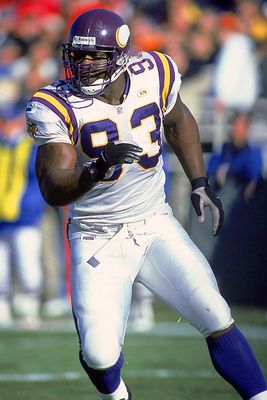
John Randle


Randle went undrafted in 1990, so he tried to join the Tampa Bay Buccaneers because his brother Ervin was entering his fifth season with them. The Buccaneers though he was too small, so they declined. The Minnesota Vikings then gave him a try out and was impressed.

Randle made the team and earned a starting job midway into his second season. He was a quick player who was excellent at rushing the passer.

Starting in 1992, he had eight straight years of double-digit sacks. From 1993 to 1998, he went to the Pro Bowl.

His 1997 was probably his best. Randle led the NFL with 15.5 sacks and had a career high 58 tackles.

He became a free agent after the 2000 season, so he joined the Seattle Seahawks. He scored the only touchdown of his career, off a fumble recovery, in his first season in Seattle. He also had 11 sacks, but missed the first game of his career in what would be his final Pro Bowl season.

Randle missed four games the next year. His five games missed with Seattle were the only games he missed in a 14-year career. He would retire after the 2003 season.

His 137.5 sacks are the sixth most ever, and the most ever by a defensive tackle. Steve McMichael is second with 95.

For a player nobody wanted, the Vikings sure were lucky and blessed to sign this free agent that got inducted into the Pro Football Hall of Fame in 2010.


Gary Zimmerman


Zimmerman was selected in the first round of the 1984 Supplemental Draft by the New York Giants, but he chose to join the United States Football League instead. When the USFL folded two years later, he was a free agent.

The Minnesota Vikings signed him and plugged him in at left tackle right away. Zimmerman stayed with the Vikings for seven years, going to the Pro Bowl four times. At the end of the 1992 season, he became a free agent again.

He signed with the Denver Broncos, who needed someone to protect Hall of Fame quarterback John Elway's blind side. Though still mobile at 33-years old, Elway was slowing down some after years of hits.

Zimmerman was the glue of an excellent offensive line, and one of the most important pieces to the Broncos attack. In his five years with Denver, he was a Pro Bowler three times.

He made his last Pro Bowl in 1996 despite missing the first two games of his career. He missed two games again the next year, but Denver would go on and win Super Bowl XXXII. He retired after that.

Zimmerman is on both the 1980s and 1990s NFL All-Decade Team, one of just a few players to make two teams. He is also on the USFL All-Time Team.

Inducted into Canton in 2008, Zimmerman is one of the very best free agent signings for both the Vikings and Broncos.


Reggie White


The Philadelphia Eagles made him their first draft pick in the 1984 Supplemental draft. Steve Young, Mike Rozier and Gary Zimmerman were selected ahead of him.

All decided to go play in the United States Football League. White was named the USFL Man of the Year in 1985, and he is a member of the USFL All-Time Team.

When the USFL folded after 1985, he joined the Eagles. He played eight seasons for them, going to the Pro Bowl each season except his first.

He was widely known as the best defensive end in all of football, and he was dubbed the "Minister of Defense" because he was also an Evangelical minister.

He became a free agent after the 1992 season, and a bidding war started to attain his services. The Green Bay Packers won by giving him an airplane to use whenever White desired.

In his six seasons as a Packer, White went to the Pro Bowl every year. He led them to Super Bowl XXXI, where the Packers defense and special teams carried them to victory.

After being named the NFL Defensive Player of the Year in 1998, he retired. But the Carolina Panthers coaxed him out of retirement in 2000, the only year of his career he was not a Pro Bowler except for his first year. He retired for good after that.

His 198 sacks are the second most ever since the stat started to get recorded in 1982. He retired as the Packers leader in sacks, but now ranks second. He still heads the Eagles list.

Not only was his free agent signing good for the USFL, but Green Bay's signing him won them a championship.

Inducted into Canton in 2006, almost two years after his unexpected death, White is one of the truly great free agent signings in NFL history.

Saturday, March 26, 2011

United Football League : Time To Burn Out Or Fade Away


The United Football League started operations in 2009, becoming America's first alternative to the National Football League since 1987. While the UFL has no connections to the NFL. some in the media thought that it would eventually serve as a developmental league.


Others speculated the UFL was born at the time it was to swoop in when the NFL and their players would lock out after the 2010 season. Now that this has happened, the UFL is on the cusp of doing something only one other league has done before. Competing against the NFL has been more a losing proposition.


There have been many leagues formed to oppose the NFL. The first was the American Football League in 1926, created by Hall of Famer Red Grange and his agent after Chicago Bears owner George Halas reneged on monies owed to Grange.


The AFL tried to capitalize on a messy 1925 season for the NFL. Commissioner Joe Carr had just stolen the Championship Trophy from the Pottsville Maroons and handed it to the Chicago Cardinals. The Cardinals owner, NFL co-founder Chris O'Brien, refused the trophy, but the Bidwell family bought the Cardinals in 1933 and have claimed the trophy since.


Grange started the New York Yankees Football Club. A charter NFL team, the Rock Island Independents, joined the AFL and the league played one game in Canada that year. One team, the Brooklyn Horsemen, merged with the Detroit Lions.


This AFL folded after just one season due to financial issues. The second AFL formed in 1936, lasting two years before folding. This league had a team, the Los Angeles Bulldogs, that was the first professional team to play home games on the West Coast. The league had a team called the Cincinnati Bengals, who Hall of Famer Paul Brown named his 1967 expansion team after.


The lasting legacy of the second AFL was the Cleveland Rams, who are now known as the Saint Louis Rams in the NFL. The Rams had a rookie by the name of Sid Gillman on their 1936 team. Gillman is a Hall of Famer known as the "Father of the Modern Day NFL Offense". A second Yankees team was founded as well, and starred Hall of Fame running back Ken Strong.


Though the Los Angeles team drew fans, the rest of the league only garnered local interests in their respective areas. The financial strains of trying to compete against the NFL caused them to fold after 1937, but the dream of competition lived on.


The third AFL formed in 1940. They had a third version of the Yankees, a team that has lineage tied to the Indianapolis Colts, and Bengals. The Yankees called themselves the Americans in 1941, creating a coup by signing 1940 Heisman Trophy winner Tom Harmon over the Chicago Bears. The league folded after just two years because World War II emptied most of their rosters.


The All-American Football Conference was born after the war. The Cleveland Browns, Baltimore Colts, and San Francisco 49ers were teams born from the AAFC that would later join the NFL, though this Colts team has no ties to the current version. The Browns dominated the league, once going a record 29 games without defeat.


The AAFC is most remembered for breaking the color line professional sports employed in that era. The Browns signed Bill Willis and Marion Motley, two men who would later be inducted into the Pro Football Hall of Fame. The AAFC drew well at first, and helped the NFL get more viewers as well.


The increasing popularity of pro football led to salary increases for the players. Only two NFL teams had profits in 1946. The AAFC instilled the use of the face mask, refining pass route running, shuttling players with plays called from the sideline, a year-round coaching staff, and classroom sessions that broke down games on a chalkboard and film.


The league folded when the Browns, Colts, and 49ers merged with the NFL. A fourth AAFC team, the Buffalo Bills, had their large fan base unsuccessfully campaigned for their teams inclusion but failed. Ralph Wilson, then a part-owner of the Detroit Lions saw this rabid fan base and would reward them a decade later.


The fourth American Football League was founded in 1960. Owners like Wilson, Bud Adams, and Lemar Hunt made the league work even despite their initial struggles. The AFL took an aggressive approach. They did not only line their rosters with ex-NFL players, but they held their own annual drafts and offered college kids more money than the NFL.


They made a few huge signings, starting with 1959 Heisman winner Billy Cannon. Adams recruited him in the end zone of his final collegiate game. Cannon would help lead the Houston Oilers to the first two championship wins in AFL history.


Others soon followed Cannon to the AFL. Hall of Famers like Joe Namath, Lance Alworth, Ron Mix, and Johnny Robinson were all first-round draft picks of the NFL who opted for the AFL. All are inducted into the Pro Football Hall of Fame except Robinson, who should be as well. The AFL put 31 men in the Hall of Fame, so far, and should have more.


The AFL brought an exciting brand of big play football without castrating the defenses. The offenses were exciting, as opposed to the grind-it-out style of the NFL then. Despite their fun play, the NFL considered them inferior and called them a "Mickey Mouse League."


When the AFL beat the NFL in the third Super Bowl, opinions changed. Secret meetings between Hunt and NFL owners in 1966, that were held without the knowledge of league commissioners Pete Rozelle and Al Davis, bred a merger that was agreed upon in 1970.


The AFL won the Super Bowl one more time in 1969 before it happened. Most of the AFC teams of today started in the AFL and no AFL team is in the NFC.


Since then, the World Football League, United States Football League, and XFL tried to compete with the NFL. The WFL signed several NFL stars and even took a few out of college.


Hall of Famers Larry Csonka and Paul Warfield were joined by Pat Haden, Danny White, Alfred Jenkins, Greg Latta, Jim Fassell, and Vince Papale, along with coaches like Jack Pardee, Marty Shottenheimer, Lindy Infante, and John McVay, to play two years with the WFL until it folded.


The XFL lasted one year before folding. They tried to bring in old school fans by allowing the bump and run defense, except they let defenders hit the receiver at any time. After four weeks, they adopted the NFL's five-yard chuck rule to increase scoring. They only allowed the two-point conversion after touchdowns, which the WFL also had, and they did not flip a coin to begin games to determine possession. They had a player from each team run 20 yards to gain possession of the ball laying on the 50-yard line.


The XFL put 33 players in the NFL and seven played in Super Bowls. Five won Super Bowl rings and Tommy Maddox, Bobby Singh, and Rob Carpenter won both an XFL and NFL championship.


The USFL had some successes in their three years of play. The league has six men in the Pro Football Hall of Fame and several others who later became stars in the NFL. They were aggressive in bidding for NFL free agents and college stars. Some of their biggest signing were Hall of Famers Jim Kelly and Steve Young out of college, as well as 1982 Heisman winner Hershel Walker, 1983 winner Mike Rozier, and 1984 winner Doug Flutie.


The USFL also attained the services of Hall of Famers Reggie White and Gary Zimmerman by offering them more money. Despite all of this, they could not keep up financially and teams began folding before they suspended play after 1985 and took the NFL to court. After losing their lawsuit, the USFL folded in 1987.


The UFL has all of this history to learn from. To see what works and what is a risk for failure. They are struggling some already, having their New York team move to Connecticut and Florida team move to Virginia and become owned by the league.


The league has just five teams right now and plans to play on Sundays starting in August. If they receive an influx of NFL players, there is a possibility of a sixth team. The UFL allows celebrations by players and have a "No Tuck Rule".


Several NFL coaches are in the UFL. Jim Fassel, Marty Shottenheimer, Jerry Glanville and Dennis Green lead teams. Joe Moglia, the Ameritrade CEO who was an unpaid assistant at Nebraska University, will coach the other team. The UFL has had 27 of their players go on and play in the NFL.


The UFL appears to be restricted financially. They borrowed $5 million from Mark Cuban last year and now have been taken to court by Cuban for failure to re-pay him on time. Cuban was once rumored to be interested in owning a UFL team and broadcasted their games on his HDnet network the first two years of their existence.


With the NFL appearing a long time away from solving their differences, the UFL could benefit. There is also a chance the lock out can hurt them. NFL players are trying to convince college players to skip the draft, so owners have been said to consider using replacement players like they did in 1987 during a players strike. The UFL could see most of their players in NFL uniforms.


Getting NFL players to join them could take time, as many may prefer to sit back and observe the negotiations. The UFL also does not appear to have the maverick leadership the AFL in the 1960's enjoyed. But it could work.


If an influx of bored NFL players decides to go to the UFL to collect a paycheck, their popularity could increase. It may increase already, considering they are the only game in town right now. In this tenuous situation, the next few months can define the legacy of the United Football League.

Wednesday, February 16, 2011

The Almost All-Time New Orleans Saints


REMEMBER : This Is A Team Of Greats Who Are Not, And Maybe Never Will Be, Inducted into The Pro Football Hall of Fame.

Quarterback : Archie Manning

In the very first nationally televised college football game ever in 1969, Archie Manning gained 540 yards. It is still a SEC record and Manning would later be inducted into the College Football Hall of Fame.

The Saints used their first round draft pick, the second overall selection, in 1971 to attain his services. New Orleans was entering into their fifth season of professional football, and most experts considered them severely undermanned in talented players.

Manning was looked upon to be the savior of a franchise that did not seem interested in getting enough talent surrounding him by putting together terrible drafts yearly. Manning would spent much of his time running for his life in New Orleans.

While he led the NFL in passing attempts and completions in his second year, Manning was also sacked more than any other quarterback in three of his first five seasons. What made the statistic even more astonishing was the fact that Manning was extremely mobile and not easy to tackle.

With seemingly 11 defenders jumping on his back virtually every time he dropped back to pass, the Saints lost more games than they won. Manning was only able to suit up for every game in an entire season once up until 1978 because he was getting destroyed on the gridiron weekly.

Things got so bad that defenders like Hall of Fame defensive end Jack Youngblood were telling reporters that they were trying to take it easy on Manning because he was so poorly protected. Manning's toughness and desire to keep lifting his carcass off the turf every play garnered the respect of every NFL player.

With New Orleans losing so much, fans called the team the "Aint's". They wore paper bags over their heads as the team seemed to lose on a weekly basis. The team won more than five games only twice in Manning's career.

He made his first Pro Bowl in 1978 after New Orleans set a franchise record with seven wins. He was named the NFC Most Valuable Player by the Sporting News and UPI. Manning went back to the Pro Bowl the next season after the Saints posted their first non-losing season in franchise history.

After the Saints won one game in 1980 and three games in 1981, they traded Manning to the Houston Oilers during the 1982 season. Like the Saints, Houston had fallen on hard times and were in the process of rebuilding. He started in eight games over two seasons, failing to win once. He was then traded to the Minnesota Vikings during the 1983 season and retired at the end of 1984.

When the novice fan sees that he win just 35 of 139 starts, they may fail to realize the talented quarterback never had the chance to prosper with the teams he played with. Manning was sacked 340 times in his 11 seasons in New Orleans.

He has two sons, Peyton and Eli, playing quarterback in the NFL and both were also first round draft picks who have gone to the Pro Bowl. Unlike their father, they have been surrounded by exceptional talent and both have won a Super Bowl. Their father never appeared in even a playoff game.

While Peyton is headed for Canton one day, and Eli still has an outside chance of accomplishing this as well, their father had the stronger throwing arm and was much more athletic than either child. He did not get to enjoy the rules heavily slanted in the offenses favor like his sons have.

He and his favorite passing target, Danny Abramowicz, were the very first players inducted into the Saints Hall of Fame. He has stayed in New Orleans and is an ambassador of the team and community, much beloved and respected by all in the Big Easy.

Not only is he probably the greatest quarterback in Saints history, but he could be the very best Manning to play in the NFL.

Billy Kilmer, Bobby Hebert, Jim Everett, and Aaron Brooks deserve mention.


Fullback : Tony Galbreath


Galbreath was the Saints second round draft pick in 1976. New Orleans had drafted Chuck Muncie in the first round and the pair was called "Thunder and Lightening". While Muncie got the majority of the carries, Galbreath was used in many different ways.

He led the team with seven rushing touchdowns and 54 receptions, which was the sixth most in the NFL that year. He also returned a team leading 20 kickoffs and a pair of punts.

Though the roles remained the same the next year, Galbreath continued to be an excellent blocker and pass catcher. He snagged a career best 74 balls in 1978, which was the second most in the NFL that year. He followed that up with 58 more receptions and a career high 708 rushing yards the next season.

The Saints were decimated by injuries in 1980, causing them to win just one game all year. Galbreath caught 57 passes, but was then traded to the Minnesota Vikings at the end of the year. Though he didn't carry the ball much for the Vikings, he caught 45 passes one year.

A free agent in 1984, Galbreath signed with the New York Giants in 1984. Mainly used as a blocker for Pro Bowl halfback Joe Morris, he did average 32 receptions over four seasons before retiring at the end of the 1987 season. The highlight of his career came in 1986 when the Giants won Super Bowl XXI.

Galbreath wasn't just a great blocker and pass catcher, he was a versatile athlete. He made two of three field goal attempts, as well as an extra point, when called upon i an emergency situation during the 1979 season. He also threw seven career passes, completing three.

When he left the Saints, he was the second leading rusher and pass catcher in team history. He is currently ranks sixth in receptions and seventh in rushing. Galbreath is a member of the Saints Hall of Fame and the greatest fullback in franchise history.

Wayne Wilson, Lorenzo Neal, and Tony Baker deserve mention.


Halfback : George Rogers


After a Heisman Trophy winning collegiate career that eventually got him inducted into the College Football Hall of Fame, Rogers was the first draft pick of the 1981 draft and the Saints leaned on him heavily.

He was named Rookie of the Year, First Team All-Pro, and to the Pro Bowl after leading the NFL with a whopping 378 carries for 1,674 yards at an average of 104,6 rushing yards per game. He also scored 13 times

Rogers was on his way to duplicating his rookie year when a players strike derailed his 1982 season. He was named to the Pro Bowl. He gained 1,144 yards the next year despite missing three games. After 914 rushing yards in 1983, he was traded to the Washington Redskins.

He shared carries with Hall of Famer John Riggins and halfback Keith Griffin in his first season with the Redskins, but still gained 1,093 yards and scored seven times. Washington made him the primary ball carrier the next year, after Riggins retired, and he led the NFL with a career high 18 rushing touchdowns while gaining 1,203 yards.

His last season was in 1987, which was marred by a players strike and nagging injuries. Rogers still led the team in rushing as Washington went on to win Super Bowl XXII.

Though he still ranks second on the Saints all-time rushing yards list for a career, his 1,674 yards in 1981 is still the best in team history. His 13 rushing touchdowns that year is tied with Deuce McAllister and Dalton Hilliard as the most for a single season in Saints history. The 83.7 yards he averaged per game with New Orleans is also a team record.

Though Rogers lasted just four years with the Saints, his impact lasted much longer. New Orleans spent many years in last place in their division before his arrival. The team steadily improved and the previous losing culture that had dogged the franchise soon became a thing of the past.

He is a member of the Saints Hall of Fame and Rogers is the only Saints running back to be named First Team All-Pro. His two Pro Bowls is still tied as the most in franchise history by a running back. On a franchise that has had many excellent running backs, Rogers may be the best.

Deuce McAllister, Rueben Mayes, Chuck Muncie, Dalton Hilliard, Andy Livingston, Fred McAfee, and Ricky Williams deserve mention.


Wide Receiver : Eric Martin


Martin was drafted by the Saints in the seventh round of the 1985 draft. He was initially used as both a return specialist and wide receiver, but he stopped being the primary punt returner after his third season.

The 1988 season was his best, making his only Pro Bowl after catching a career high 85 passes. He gained a career best 1,090 yards and caught a career high eight touchdown passes the next year. He caught 63 or more passes between 1989 to 1993.

Martin joined the Kansas City Chiefs in 1994, but was seldom used. He retired at the end of the season. His 532 receptions for 7,854 yards are still the most in Saints history, and his 48 touchdowns and 18 100-yard receiving games are the second most in team history.

He is a member of the Saints Hall of Fame and there are several New Orleans fans who consider him the best wide receiver in team history.


Wide Receiver : Joe Horn


Horn was drafted in the fifth round of the 1996 draft by the Kansas City Chiefs after having played a year in the Canadian Football League. He was rarely used in his first three seasons with the Chiefs, catching 18 balls total, but the Saints signed the free agent after a promising fourth season that accrued 35 receptions.

New Orleans put Horn to work immediately in 2000, having him catch a career best 94 balls in the first of three consecutive Pro Bowl years. He duplicated that reception total in 2004, his last Pro Bowl season, but added a career high 11 touchdowns and 1,399 receiving yards.

His next two years saw his production decline greatly, as Horn dealt with nagging injuries along the way. He was cut by New Orleans, but signed a big contract with the Atlanta Falcons. Soon he was not producing and asked to be traded. Atlanta cut him and no other team was interested in his services, so Horn retired.

Fans either loved or hated him for a style of play and clothing that earned Horn the nickname "Hollywood". He once hid a cell phone in the padding of a goalpost during a nationally televised game, pulling it out upon scoring to call his children to share in the celebration. He was fined heavily by the league for his antics.

Horn caught 50 touchdowns in his seven years with New Orleans, which is a team record. He is tied for the most touchdown receptions in a season with Marques Colston, and his 1,399 yards in one year is also a team record. Horn also ranks second in Saints history in catches and receiving yards.

Inducted into the Saints Hall of Fame in 2010, his four Pro Bowl appearances is a franchise record for wide receivers. No other Saint receiver has gone to the Pro Bowl more than once. It is safe to say that Joe Horn is one of the best wide receivers in Saints history.

Wes Chandler, Jeff Groth, Quinn Early, and Danny Ambramowicz, a Saint Hall of Famer who is the only New Orleans receiver to be named First Team All-Pro and once held the NFL record for consecutive games with at least one catch. deserve mention.


Tight End : Hoby Brenner


Brenner was drafted in the third round of the 1981 draft by New Orleans. Though he was used sparingly as a rookie, Brenner became the primary starter from his second season on for the Saints.

While he was very good at stretching the seam, especially in the first seven years of his career, blocking was something Brenner was exceptional at. He refined this skill in college blocking for two Heisman Trophy winning running backs named Charles White and Marcus Allen on the 1978 National Champion USC Trojans.

He caught a career high 42 passes in 1985, but he exceeded 34 reception just three times in his career. He was such a respected blocker that Brenner was named to the Pro Bowl in 1987. Brenner and Henry Childs are the only Saints tight ends to go to the Pro Bowl.

Brenner retired at the end of 1993 having appeared in 1975 games, the most in team history by a Saints pass catcher.. He still ranks fifth all-time in team history with 267 career receptions, the most ever by a Saints tight end. He is a member of the Saints Hall of Fame and may be the best tight end in team history.

Henry Childs and John Tice deserve mention.


Tackle : Willie Roaf


With the eighth overall pick in the first round of the 1993 draft, New Orleans selected Roaf. They started him immediately at left tackle and he would remain there the rest of his career. He made the first of seven consecutive Pro Bowls in his second season, including two straight First Team All-Pro nods in his second and third seasons.

While he was considered amongst the very best left tackles in the NFL, Roaf hurt his knee in 2001 and missed nine games. New Orleans made the mistake of thinking Roaf was in decline, so they traded him to the Kansas City Chiefs for a conditional draft choice.

Roaf showed immediately that he had lost nothing to his game, and he went to the Pro Bowl in each of his four seasons with the Chiefs. He was honored with his final First Team All-Pro nod in 2004, then retired at the end of the 2005 season.

Not only is he a member of the Saints Hall of Fame, but he is a member of the NFL's 1990's First Team All-Decade Team and a member of the Second Team on the 2000's All-Decade Team.

It is a matter of time before he is inducted into the Pro Football Hall of Fame. The 11-time Pro Bowler was a finalist in the 2011 vote, and it seems likely he will go in the next year.

His seven Pro Bowls with the Saints is the most in franchise history, as is his two First Team All-Pro honors. He is the best blocker to ever wear a New Orleans Saints uniform.


Tackle : Stan Brock


Brock was the Saints first round draft pick in 1980. He played college football for head coach Chuck Fairbanks, who coached his older brother Pete with the New England Patriots.

He earned the starting job in the fifth game of his rookie year at right tackle and held onto it for the rest of his Saints career. Though he missed 11 games in two years, because of injury, Brock started and played in every game for 10 years.

Brock became a free agent after 1992, then joined the San Diego Chargers for three years. The highlight of his career was playing in Super Bowl XXIX for San Diego. He retired after the 1995 season.

Brock was dependable, playing in 186 games over 13 seasons for New Orleans. He is considered by many to be one of the finest blockers in team history and he is a member of the Saints Hall of Fame.

Kyle Turley, Don Morrison, and Jammal Brown deserve mention.


Guard : Jim Dombrowski


The Saints used the sixth pick of the first round to draft Dombrowski in 1986 after a collegiate career that was so outstanding that Virginia University retired his number and he would later be inducted into the College Football Hall of Fame.

After playing just three games as a rookie, the Saints put him in as the starting left tackle. for almost three years before deciding guard might be his best position. He stayed entrenched there until 1993, where he spent most of the season as a reserve due to injuries.

Starting every game the following two season, Dombrowski was forced to miss six games in 1996 because of an injury. They were the first games he missed since the strike-shortened season of 1987, which caused him to retire at seasons end.

Dombrowski is a member of the Saints Hall of Fame. His versatility, toughness, and durability helped make him play a team record 147 straight games and become one of the best blockers the Saints ever had.


Guard : Jake Kupp


Kupp was drafted by the Dallas Cowboys in the ninth round of the 1964 draft. He earned a starting job for the last ten games of his rookie season and held the job until he was traded to the Washington Redskins before the start of the 1966 season.

He was a reserve for the Redskins, but they like Kupp's athleticism enough to toss him four passes for 28 yards that year. He joined the Atlanta Falcons the next year, but was released after six games. New Orleans grabbed him and Kupp spent the last five games on the year with them.

Earning the starting job in 1968, Kupp became a top blocker for the team. He became the first Saints offensive lineman ever to go to the Pro Bowl in 1969. He continued to start until the end of the 1975 season when he retired.

Not only is Kupp a member of the Saints Hall of Fame, he is one of the very best offensive guards in tam history.

LeCharles Bentley, Del Williams, Emanuel Zanders, and Brad Edelman deserve mention.


Center : Joel Hilgenberg


Hilgenberg was drafted in the fourth round of the 1984 draft by the Saints. He spent his rookie year as a reserve, but started five games the next year. He earned the starting job in 1987 then was moved to guard for the 1988 season. He went back to center the next year and stayed there for the rest of his career.

He was named to the Pro Bowl in 1992, marking the eighth consecutive year a Hilgenberg played for the NFL in a Pro Bowl. His older brother, Jay, had went the previous seven times as a member of the Chicago Bears. Jay Hilgenberg joined the Cleveland Browns in 1992, opening the way for Joel to get honored.

The Hilgenberg brothers were both members of the Saints in 1993. When Joel was injured after nine games, his older brother finished the season in his place. Both Hilgenberg brothers retired together at the end of the year.

Though the Saints have had many fine centers in the history of their franchise, including Saints Hall of Famer John Hill, Joel Hilgenberg was the first to ever go to the Pro Bowl. LeCharles Bentley is the only other one to have accomplished this. Hilgenberg is a member of the Saints Hall of Fame and may be the est center the team has ever employed.

John Hill, Jerry Fontenot, and LeCharles Bentley deserve mention.


Defensive Tackle : La'Roi Glover


Glover was a fifth round draft pick of the Oakland Raiders in 1996. Oakland had a pair of productive 27-year old Pro Bowlers named Chester McGlockton and Russell Maryland as their starting defensive tackles, so Glover appeared in just two games that year and was released just before the season ended.

The Saints grabbed him in the off season and had him play in NFL Europe. He stood out as his team, the Barcelona Dragons, won World Bowl V. He then returned to New Orleans to come off the bench and collect 6.5 sacks.

He earned the staring job by his third season and remained entrenched there the rest of his career. He quickly became a star, getting 10 sacks, an interception, forced a career best three fumbles, and had a career high 67 tackles in 1998. After an excellent 1999 season, Glover was considered one of the best defensive tackles in the NFL.

The 2000 season was the first of six consecutive Pro Bowl nods for Glover, and it was the best of his career. He led the league with 17 sacks, the second most ever in a single season by a defensive tackle, and matched his career high totals on forced fumbles and tackles. He also earned his only First Team All-Pro honor.

Despite another productive season that had him named a Pro Bowler in 2001, New Orleans released Glover instead of picking up the option of his contract. The Dallas Cowboys quickly signed him. He played four years in Dallas and went to the Pro Bowl each year.

Dallas went to a 3-4 defense in 2005, forcing Glover to play nose tackle. Though he made the Pro Bowl, his 6'2" 285 pound frame was not thought to be conducive to play that position. He became a free agent and was signed by the Saint Louis Rams. He lasted three years with the Rams before retiring.

Only seven defensive tackles have more sacks than the 83.5 Glover had in his career. The 50 he had with the Saints is the seventh most in franchise history and the most by a defensive tackle. His two Pro Bowls as a Saint are the most by a defensive tackle in team history, and he is the only Saint defensive lineman ever to be named First Team All-Pro.

New Orleans lucked into signing him in 1996, and obviously made a mistake letting him go in 2002. He was superb in his short time with them and might be their best defensive tackle ever.


Defensive Tackle : Derland Moore


Moore was a walk-on player at Oklahoma University who stood out enough to be drafted in the second round by the Saints in 1973. He was the highest drafted walk-on in NFL history at the time.

He played all over the defensive line as a reserve, during his rookie season, and picked off the only pass of his career. He was named a starter the next season and would remain there the rest of his Saints career.

Moore was a tall, rangy player who was athletic enough to start at defensive end the entire 1981 season after New Orleans switched to a 3-4 base defense. Moore was plugged in at nose tackle the next year. After collecting six sacks in 1983, Moore went to the Pro Bowl as an injury replacement.

Playing in just 18 games the next two years, New Orleans cut him at the end of the 1985 season after he appeared in only six games. He suited up for one game with the New York Jets the next season then retired.

The 170 games Moore played with New Orleans was a team record at the time by a defensive player, and it is still the fifth most. He is a member of the Saints Hall of Fame and is considered one of their finest defensive lineman ever.

Bob Pollard, Elex Price, Tony Elliott, and Norman Hand deserve mention.


Defensive End : Wayne Martin


New Orleans used their first round draft pick, 19th overall, by selecting Martin in 1989. After spending his rookie year coming off the bench, Martin started in every game he played in the rest of his career. He missed five games in 1990, then never missed a game again.

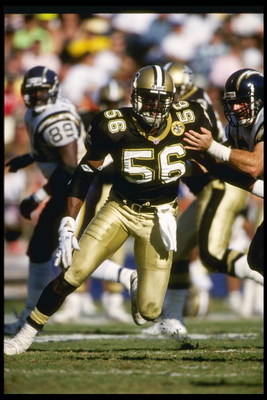
He exploded with a career best 15.5 sacks in 1992. Martin made the Pro Bowl in 1994, and had double digit sacks in five of six seasons starting in 1992. He was a key component of the famous "Dome Patrol", which saw all four starting linebackers for New Orleans go to the Pro Bowl on a top-rated defense that is considered one of the finest in modern football history.

The Saints moved him to defensive tackle in 1995, and he responded with three consecutive years of double digit sacks and had a career best 88 tackles in 1996. He had a safety in 1998, then retired after the following season.

The 82.5 sacks Martin had is the most by any Saints defensive lineman and is second behind Hall of Fame linebacker Ricky Jackson for New Orleans. His 171 games played are the fourth most by a Saints defender. The 531 tackles he had are the most ever by a Saints defensive lineman and ranks fourth best overall in franchise history.

Not only is he a member of the Saints Hall of Fame, but Martin is probably the best defensive end the team has ever had. His 144 straight starts are the most by any Saints player.


Defensive End : Frank Warren


New Orleans drafted Warren in the third round of the 1981 draft. He was a key reserve of an improving Saints defense until 1987. He could play any position along the defensive line and be productive. When he was named a starter in 1988, Jumpy Geathers also started a few games.

He had perhaps his best season in 1989. Jim Wilks, his bookend, was now starting at nose tackle and Geathers replaced him at defensive end. Warren piled up a career best 9.5 sacks, 50 tackles, and collected a safety. The versatility of the Saints defensive line often gave opponents problems.

Continuing to start, he was moved from the left to the right side the next year and had seven sacks. New Orleans then moved him to nose tackle in 1994. Warren retired at the end of the season. Though sacks were not a recognized statistic until 1982, the 52.5 sacks Warren had ranks fifth best in team history.

Warren is a member of the Saints Hall of Fame and the 189 games he played in are the most ever by a Saints defensive lineman. He was athletic, versatile, and durable. He is certainly one of the best defensive linemen the franchise ever had.

Jim Wilks, Joe Johnson, Darren Howard, Bruce Clark, Jumpy Geathers, Willie Whitehead, and Elois Grooms deserve mention.


Outside Linebacker : Pat Swilling


After a legendary collegiate career that eventually ended with induction into the College Football Hall of Fame, Swilling somehow lasted until the third round of the 1986 draft until the Saints selected him.

He spent his rookie year coming off the bench but was named a starter from his second season on. Swilling's specialty was rushing the passer, getting double digit sack totals in five of his seven years with the Saints.

Swilling made the first of five consecutive Pro Bowls in 1989 after getting 16.5 sacks and forcing five fumbles.He had perhaps his best season in 1991 when he led the NFL with a career best 17 sacks. He also forced a career high six fumbles, scored a touchdown off his only interception, and was named First Team All-Pro and NFL Defensive Player of the Year.

He was named First Team All-Pro again the next year, but the Saints traded him to the Detroit Lions at the end of the season. His first with the Lions was his best, as well as the last Pro Bowl year of his career. Swilling picked off a career best three balls and forced five fumbles. He left Detroit after the 1994 season to join the Oakland Raiders.

Oakland put Swilling at defensive end for them and he responded with 13 sacks in his first year with them. He retired after playing two more years with them. Though he played on some very good teams, Swilling is the only player in NFL history to play in six playoff games without ever winning once.

Swilling is the only Saints player ever to have won the Defensive Player of the Year Award. Of his 107.5 career sacks, which is the 17th most in NFL history, 76.5 came with the Saints. That is the third most in team history. He forced 24 fumbles with New Orleans, which is the second most in team history.

Though Rickey Jackson is often the first named mentioned on the famous "Dome Patrol" linebackers corp, Swilling is the only one to be named First Team All-Pro with the team. With a career that had one less Pro Bowl than Jackson, some fans feel Pat Swilling should also be inducted into the Pro Football Hall of Fame.


Middle Linebacker : Sam Mills


Mills went undrafted in 1981, then tried out with the Cleveland Browns and was cut. He then tried out with the Toronto Argonauts of the Canadian Football League and was cut again.

The United States Football League began playing in 1983 and Mills tried out for the Philadelphia Stars. Not only did he make the team, he became an instant success. Nicknamed the "Field Mouse", the 5'9" Mills was known for his leadership and intensity both on and off the field.

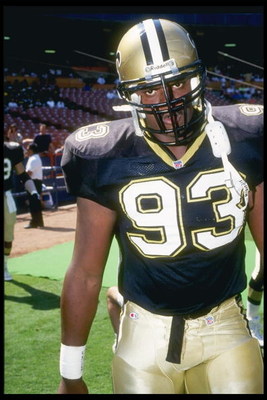
The USFL folded after 1985, but it did have many successes. Six members of the USFL are inducted into the Pro Football Hall of Fame, including four players. Mills played in the USFL Championship Game all three seasons, winning twice. He is a member of the USFL All-Time Team, and was named All-USFL, their version of the Pro Bowl, all three years.

David Dixon created the USFL. He also was instrumental in bringing the Saints to New Orleans. His connections with the USFL proved to be valuable when that league folded as he signed many former USFL personnel.

He hired Jim Mora Sr. as his head coach, Bobby Hebert as his starting quarterback, Chuck Commiskey as a starting offensive guard, Buford Jordan as the starting fullback, Antonio Gibson as the starting strong safety, Mel Gray as the return specialist, and Mills and Vaughn Johnson as his starting inside linebackers. Mora had coached Mills, Commiskey, and Gibson in the USFL.

The Saints already had Hall of Famer Ricky Jackson at one outside linebacker slot, and had just drafted future Pro Bowler Pat Swilling to bookend him. Teamed with Mills and Johnson, New Orleans has one of the best linebacker corps in NFL history. The group was so devastating that they were called "The Dome Patrol".

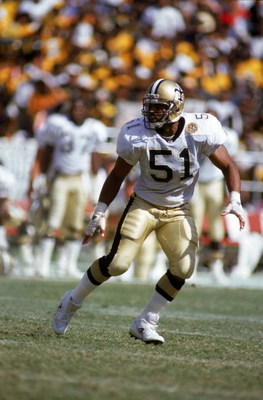
Mills was the leader of the group and made his first Pro Bowl in his second season. He was always around the ball and averaged almost 100 tackles a year in his nine season with the Saints. He also took two fumble recoveries in for touchdowns and made the Pro Bowl four times total.

When his contract expired in 1994, the Saint allowed the 36-year old to leave despite the fact he had just piled up a career high 155 tackles that year for them. Mills signed with the expansion Carolina Panthers determined to show he had a lot of football still in him. He became an instant hero for the Panthers.

The 1996 season was one of his best. He was named to the Pro Bowl and was also given his only First Team All-Pro honor. Mills had a career best 5.5 sacks to go with 122 tackles and became the oldest player in NFL history to recover a fumble and return it for a score.

He retired after the 1997 season and became a linebackers coach for Carolina. He found out he had intestinal cancer and only had a few months to live in 2003, but kept coaching and pleading for his players to "keep pounding". This inspired Carolina to reach Super Bowl XXXVIII that year.

Mills died in 2005 and the Panthers have a statue of him outside of their stadium in his honor. He is a member of the Panthers Hall of Honor, the Saints Hall of Fame, the Louisiana Sports Hall of Fame, the Sports Hall of Fame of New Jersey, and the College Football Hall of Fame.

There is still a good chance Mills will be inducted into the Pro Football Hall of Fame one day. Though critics may say his five Pro Bowls with the NFL isn't enough for induction, that means they are discounting what he did in the USFL.

The USFL was professional football, and Mills was a huge star in that league. The building in Canton has the words Pro Football" engraved on their buildings, signs, and letterheads everywhere. The USFL obviously had tremendous impact and influence on the NFL as well.

His is a story of perseverance. The "American Dream" that became reality. Even if Mills never gets into Canton, he is probably the greatest inside linebacker the Saints franchise ever had wear their jersey.

Joe Federspiel, Vaughn Johnson, Charlie Clemons, and Winfred Tubbs deserve mention.


Outside Linebacker : Keith Mitchell


The Saints signed Mitchell as an undrafted free agent rookie in 1997. He was used sparingly as a rookie, but still accrued four sacks. He won the starting job the next year and would remain in the starting lineup the remainder of his time in New Orleans.

Mitchell had a propensity of making the big play. After scoring off a fumble recovery in 1998, he repeated that event in 2000 and scored again on an interception while getting a career high 6.5 sacks. He was named to the Pro Bowl for his efforts.

He started to get phased out by Charlie Clemons in 2001, so Mitchell asked to be released. He signed with the Houston Texans but spent one injury filled season with them. Joining the Jacksonville Jaguars in 2003, he got hurt for the year early on then retired.

Mitchell was a pass rusher who was quite a find for the Saints. He was productive and became just the fourth outside linebacker, along with Mark Fields, to go to the Pro Bowl representing New Orleans.

Reynaldo Turnbull, Whitney Paul, Mark Fields, Wayne Colman, and Jim Merlo deserve mention.


Strong Safety : Sammy Knight


Knight joined the Saints as an undrafted free agent rookie in 1997. He quickly won a starting job at free safety and intercepted 11 passes over two years. He also scored twice, one coming off a 91-yard interception return.

New Orleans moved him to strong safety in 1999 and he responded with 102 tackles. He had 100 tackles, two sacks, five interceptions, and two touchdowns the next year, which put him amongst the best strong safeties in the NFL.

His 2001 was his lone Pro Bowl year after matching his career high of six interceptions. The Saints moved him back to free safety the next year and Knight piled up a career best 107 tackles.

Now a free agent, Knight joined the Miami Dolphins for two years and recorded a safety. He moved on to the Kansas City Chiefs in 2005 and spent two years as their starting strong safety. Joining the Jacksonville Jaguars in 2007, he moved onto the New York Giants the next year for a hefty contract.

He spent much of the year hurt, the first time he missed a game since1998. The Giants released him, so he retired. Not only is Knight the first Saint strong safety to ever go to a Pro Bowl, but his impact was significant.

Knight ranks third in franchise history in interceptions and sixth in tackles. His four touchdowns off interceptions is also a team record. Though some Saint fans might prefer Gene Atkins here, Knight was more productive in a shorter amount of time and may be the best strong safety in team history.

Gene Atkins, Brett Maxie, Jay Bellamy, Benny Thompson, Chuck Crist, and Hugo Hollas deserve mention.


Free Safety : Tom Myers


Myers was drafted by the Saints in the third round of the 1972 draft. He worked his way into the starting lineup by mid-season and held onto that honor the remainder of his career.

The NFL knew of him as a big play artist in 1975, when he took a fumble recovery in for a score. He duplicated that feat the next year as well. He was at the top of his game by 1978.

He intercepted six balls that year for a career best 167 yards. He took one ball a then-team record 97 yards for a score, which was the longest interception return of the year. He followed that up with an even better performance the next season.

Myers became the first Saints safety ever to be named to the Pro Bowl in 1978. He was also the first Saint defender ever to be named First Team All-NFL. Myers picked off a career high 7 passes that season, returning one for a score.

He played two more years before retiring, but his final season saw him attempt two passes. He completed one for an eight yard touchdown. The 36 interceptions Myers had was a Saints record at the time, and it still ranks second. He was inducted into the teams Hall of Fame in the second year it existed.

Though he played on some truly awful teams in his career, Myers still was able to excel and garner a lot of respect along the way. He is probably the best defensive back in team history.

Gene Atkins, Frank Wattelet, and Josh Bullocks deserve mention.


Cornerback : Dave Waymer


Waymer was a second round pick of the Saints in 1980. He started ten games at right cornerback as a rookie, but was switched to left cornerback the next year. He stayed there for eight seasons, becoming the teams top cornerback.

After getting a career best nine interceptions in b1986, he made his only Pro Bowl the following year. The 1987 season saw him play 12 games because of a players strike, but that did not prevent Waymer from swiping five balls.

He made a seamless transition to free safety in 1989, intercepting six passes. Waymer then joined the San Francisco 49ers for the next two years to play mostly strong safety. He then went to the Los Angeles Raiders for the 1992 season, then passes away during the off season at 34-years old.

Of his 48 career interceptions, 37 came with the Saints. It is the most in franchise history. His 149 games in New Orleans are the most ever by a Saints defensive back. Waymer is a member of the Saints Hall of Fame.

The Saints have had three cornerbacks go to the Pro Bowl. Waymer was the second to accomplish this, but he might be the best cornerback the team ever had.


Cornerback : Dave Whitsell


Whitsell was drafted in the 24th round of the 1958 draft by the Detroit Lions. He played in Detroit until 1960, then joined the Chicago Bears. He lasted six years there, intercepting 26 passes.

Joining the expansion Saints in 1967, Whitsell became the first star in Saints history. Leading the NFL with 10 interceptions, returning them for 178 yards and two scores, he became the first player in team history to be named to the Pro Bowl.

New Orleans had him play free safety the next two years mostly, and he responded with nine passes picked off. He then retired and is a member of the Saints Hall of Fame. Not only did he lead the team in interceptions in each of his three seasons, but the 19 Whitsell had as a Saint ranks the fifth most in team history.

When the Saints started out as a franchise, they were not a team full of talent. Of the excellent players they did have, Dave Whitsell stood out perhaps the most.

Fred Thomas, Toi Cook, Johnnie Poe, Ernie Jackson, Ashley Ambrose, Vince Buck, and Mike McKenzie deserve mention.


Kicker : Morten Andersen


Drafted in the fourth round of the 1982 draft by the Saints, Andersen spent the next 13 years with New Orleans becoming the greatest kicker in team history.

He made the first of his seven career Pro Bowls in 1985, then was named First Team All-Pro the next two seasons. He led the NFL in field goal attempts twice, field goals and field goal percentage once with New Orleans. He was known for a very strong kicking leg, once hitting a 60-yard field goal that is three yards short of the NFL record set by Saints legend Tom Dempsey.

After the 1994 season, the Saints felt that the man called "Mr. Automatic" and "The Great Dane" was no longer quite as effective at 34-years old. They let him go into the free agency pool. The Atlanta Falcons would end up signing Andersen.

Named to the Pro Bowl and his final First Team All-Pro in his first year with Atlanta, he showed the Saints he has plenty of leg left by becoming the first player in NFL history to kick three field goals of 50-yards or more against them. Andersen spent six years with the Falcons. His highlight was kicking a game-winning field goal in the NFC Championship Game in 1998 to send the Falcons to their only Super Bowl appearance.

He joined the New York Giants in 2001, then the Kansas City Chiefs the next year. He signed with the Minnesota Vikings in 2004, then rejoined the Falcons the next season. He stayed with Atlanta for two years before retiring at the age of 47-years old.

Andersen in the leading scorer in NFL history. He is also the leading scorer in both Saints and Falcons history. No one has attempted or made more field goal in NFL history, nor played in as many games. He is a member of both the 1980's and 1990's NFL All-Decade Team.

He holds 22 NFL records four Pro Bowl records, and is the only player to set records for two team, the Saints and Falcons, in both field goals and extra points attempted and made. He is also second in six other NFL records for kicking. When he retired, he was just two days away from passing Hall of Famer George Blanda as the oldest person to play an NFL game in the modern era.

It seems inevitable that he will be in Canton, especially after the great Jan Stenerud broke the barrier for allowing kickers to be inducted. There was little Andersen couldn't do kicking a football. Not only did he possess a big leg, but his NFL record of 103 game winning kicks show nerves of steel. He may be the greatest kicker in NFL history, but he is the best in Saints history.

Tom Dempsey, Doug Brien, Charlie Durkee, and Rich Szaro deserve mention.


Punter : Tommy Barnhardt


Barnhardt was a ninth round draft pick by the Tampa Bay Buccaneers, selected ahead of notable players like Clyde Simmons and Vai Sikahema. Tampa Bay decided to go with veteran Frank Garcia and cut Barnhardt.

He joined the Saints and Chicago Bears for a total of five games the next season, then for four games with the Washington Redskins in 1988. The Saints were dissatisfied with the performance of George Winslow after five games in 1989, so they replaced him with Barnhardt.

Staying with the Saints the next six years, Barnhardt was known for his consistency and leg strength. He led the NFL with 3,743 punting yards in 1991. He joined the Carolina Panthers for just the 1995 season, punting the ball a career high 95 times.

Barnhardt spent the next three seasons with the Buccaneers before rejoining the Saints in 1999. He went back to the Redskins in 2000, then retired at the end of the season His 515 punts for 21,880 yards are the most in team history.

His career average of 42.5 yards per punt with New Orleans shows his leg strength. It is the most by any Saint with at least 228 attempts. Though Brian Hansen and Mitch Berger went to the Pro Bowl for New Orleans, both spent just four and three years respectively with the team as opposed to the eight that Barnhardt did.

Tom Blanchard, Brian Hansen, Mitch Berger, and Russell Erxleben deserve mention.


Kick Returner : Michael Lewis


Lewis was driving a beer truck when he made the team at 30-years old in 2001 after playing semi-pro football for several years. He was rarely used by the Saints as a wide receiver, catching 28 balls over three years, but he did average nearly 20 yards per reception.

Used mainly as a kick returner as a rookie, Lewis exploded on his second year and made the Pro Bowl. He led the NFL in kickoff returns, kickoff return yards, punt return yards, and all purpose yards. His two scores on kickoff returns also led the league, and he scored once more on a punt return..

He returned 114 kicks and punts that year for 2,432 yards, both of which are NFL records. His 625 punt return yards that year are the 12th most in NFL history, and his 1,807 kickoff return yards are the third most ever. His 2,647 all-purpose yards are the second most in NFL history, and his 70 kickoff returns are the fourth most.

Unable to stay healthy enough to play an entire season the next four years, Lewis remained New Orleans' primary return specialist. He joined the San Francisco 49ers in 2007 and was used primarily as a punt returner before retiring at the end of the season.

He has remained popular with the Saints organization since and was given a Super Bowl ring in 2010 after the Saints won Super Bowl XLIV. He is most likely the greatest return specialist in team history. Lewis holds the team records in both punt and kickoff returns in attempts and yards gained.

Tyrone Hughes, Mel J. Gray, Eric Guliford, Wayne Wilson, Aaron Stecker, and Rich Mauti deserve mention.


Punt Returner : Tyrone Hughes


Hughes was drafted by the Saints in the fifth round in 1993. He made the Pro Bowl immediately, leading the league in punt return yards, two touchdowns, and a 13.6 yards per return average. He also scored off a kickoff return.

Though the Saints did not use him much on defense, he had the only four interceptions of his career the next two years. He recovered three fumbles in 1994, returning them for a league leading 128 yards and two scores.

He also tied an NFL record that year by returning two kickoffs for scores in one game. He would lead the NFL in kickoff returns and yards in each of the next three years. Hughes left New Orleans after 1996 and then played a season each for the Chicago Bears and Dallas Cowboys the next two years before retiring. He even caught eight balls for the Bears.

Hughes ranks second in Saints history in punt and kickoff return yardage but first in touchdowns scored. Lewis could hold this slot too, but I gave it to Hughes because he was such a productive and exciting player.

Michael Lewis, Jeff Groth, Mel J. Gray, Howard Stevens, and Eric Guliford deserve mention.

Friday, October 22, 2010

The Almost All-Time Tampa Bay Buccaneers


The Tampa Bay Buccaneers and Seattle Seahawks started their franchises the old fashioned way of having to earn every success they garnered.

Starting in 1976, in an era where free agency did not exist, they had to build a team through tryouts, the regular NFL draft, and the expansion draft. The expansion draft of 1976 consisted of players the other teams planned on cutting anyway. The biggest names were guys considered washed up, while rest were players most people had never heard of.

Seattle did a bit better in the expansion draft, but Tampa Bay did get players like Dave Reavis, Mark Cotney, Louis Carter and Dave Pear who would help the team improve over the next few seasons.

Their first head coach John McKay, a legend at the University of Southern California who is in the College Football Hall of Fame after winning four National Championships, even drafted his own son in that expansion draft.

J.K. McKay lasted three years with them, and currently the Associate Athletic Director at USC under Pat Haden, the man he caught touchdown passes from at USC in the 1970's.

John McKay is said to have regretted leaving USC. His son Rich, currently the president of the Atlanta Falcons and a former Buccaneer general manager, said his dad knew within his first week at Tampa that he made a mistake.

Dick Vermeil called McKay "Dial-a-Quote." One of his most famous quips came a loss that had reporters asking him about the team's play, in particularly their execution. "I'm in favor of it." was his reply.

Though he may have regretted the move, McKay quickly built a winner out of a team that lost their first 26 games. He had them one game away from the Super Bowl in 1979 with a team built on a tough defense and powerful ground game.Tampa Bay was the first post-merger expansion team to win a division title, win a playoff game, and to host and play in a conference championship game.

One obstacle McKay had working against him was an owner reluctant to spend money on the team.

Hugh Culverhouse was set to own the Los Angeles Rams, only to see Robert Irsay buy the team at the last minute. He was then offered the Seattle franchise, but declined because he resided in Florida. Culverhouse then was awarded the Tampa franchise after the man initially planning on buying the team backed out.

While the Buccaneers struggled on the field, Culverhouse was a favorite of the NFL front offices. He helped find a solution in both players' strikes in the 1980's, brought the use of computers into the league, and was heavily involved in NFL finances.

He became the scorn of Buccaneer fans for more than losses. When he raised ticket prices, fans complained to a marketing director on the team who had opposed the hike. Culverhouse made the marketing director the scapegoat, then fired him.

After years of jettisoning good players to save money, or unable to sign top draft picks like Bo Jackson, Culverhouse died in 1994 with questions about the actual financial state of the team that showed it very close to bankruptcy. The Bucs were almost sold to Baltimore Orioles owner Peter Angelos for $200 million with the understanding the team would relocate to Maryland.

It was sold to Malcolm Glazer at the last minute for $8 million less. Under the Glazer regime, the team has won a Super Bowl, and had just six losing seasons. He also got rid of the uniforms colors and logo of the team in 1996, replacing them with the colors and logo you see today.

It has been a fun team for many reasons since entering the league. It boasts one Hall of Famer in defensive end Lee Roy Selmon, but that is expected to change in the coming decade.

This is a team of the best Buccaneers ever to play each position. While a few may end up in Canton soon, they were included here because they are not there yet.

The rest of the squad is full of excellent players who may never find induction into more than their own team's Ring of Honor.


Quarterback : Doug Williams

Long before he became known worldwide as the first African-American quarterback to start in and win a Super Bowl, Williams was the Buccaneers first round draft pick in 1978.

He started immediately, yet was brought along very slowly in an offense that relied on running back Ricky Bell's legs.

He threw just five passes in his debut. In the fourth game, he threw for over 300 yards in a season that saw him miss six games because of injuries in between struggles on a team that won five games. He led them to four of the victories.

For a team that started in 1976, then lost their first 26 games, the 1979 season was magical. Tampa Bay won the NFC Central by going 10-6 behind the top rated scoring defense in the league. Though the offense still relied on Bell, who churned out a career best 1,263 yards on the ground, Williams started to develop a repertoire with tight end Jimmie Giles.

The Bucs won their first ever playoff game, beating a favored Philadelphia Eagles that went to the Super Bowl the next year, reaching the NFL Championship's before losing to the Los Angeles Rams.

Williams next three seasons saw his completion percentage and yards passing per game increase each as his sack totals decreased while leading them to the playoffs twice .

After the 1982 season, that was shorted by a players strike, he asked for a pay raise. His wife had just passed away and when his request was spurned, he quickly signed a contract with the Oklahoma Outlaws of the fledgling United States Football League.

He did not play for a year, because the team started in 1984. The Tampa Bay fans were irate at the teams ownership, and the Buccaneers would lose at least 10 games in nine of their next 10 years and not return to the playoffs until 1997.

After two seasons on a struggling team that had moved to Arizona in their second year, he returned to the NFL in 1985 as a member of the Washington Redskins because of his relationship with Joe Gibbs.

Gibbs, a Hall of Fame head coach, was an offensive coordinator in Williams' rookie year. He had a propensity for putting a veteran quarterback on his bench, as he had done with NFL greats like Jim Hart and Steve Bartkowski before.

Williams was supposed to help develop young Jay Schroeder in the 1987 season, but found himself coming off the bench for the injured Schroeder on opening day to lead the team to victory. He had to start the next week for the injured youngster, but Washington lost to the Atlanta Falcons on a late touchdown run by future Redskin Gerald Riggs.

Schroeder started in the third game and got hurt, forcing Williams to come off the bench and lead the team to victory again. Williams did not see action again until the tenth game, when Schroeder was unable to go. The Redskins lost, and it would be until week 15 that Williams would see action again. He came off the pine to help Washington win.

When Washington made the playoffs, Gibbs decided that Williams would start because his 94 rating was better than the 71 Schroeder had. The Redskins would reach Super Bowl XXII, where history would be made in several ways.

The Redskins exploded for five touchdowns in the second quarter against the Denver Broncos, and Williams threw for four scores in that quarter. Both are Super Bowl records that still stand, and he was named MVP of the game.

What made his game so special was the fact that the day before he had undergone root canal surgery under full anesthesia after losing sleep for several days. Though much is made of the fact that his skin color is different than previous Super Bowl-winning quarterbacks, it is more amazing he threw for 340 yards after having dealt with such a health issue.

He started 10 games the next year, but eventually gave way to a young Mark Rypien. When Rypien, a future Super Bowl MVP himself, made the Pro Bowl in 1990, Williams retired.

Though most of his team records in Tampa Bay have now been surpassed, Doug Williams holds more importance to the franchise over maybe any offensive player in team history. He took a team that only knew losing and led them to three playoff appearances in his five seasons.

He did it as both he and the team itself developed, and was a fan favorite of many. He had one of the strongest arms in the league, as one exhibited in the pour rains of Florida one game.

He drifted back to pass on his opponents 25-yard line, but slipped and fell. He sat up and fired a perfect strike to the corner of the end zone for a score while still seated. A move very few players in NFL history could attempt to duplicate.

When one talks of the Buccaneer greatest quarterback ever, it should start and end with Williams.

Brad Johnson, Vinny Testeverde, Trent Dilfer, and Jeff Garcia deserve mention.


Fullback : Mike Alstott
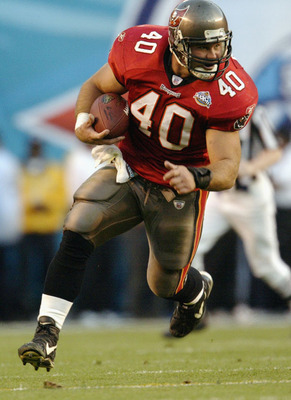

Alstott was drafted by Tampa Bay in the second round of the 1996 draft, and was put in the starting lineup immediately. Though he did not carry the ball much as a rookie, he did catch 65 passes for 557 yards and three touchdowns. All are career high marks for him.

Tampa Bay decided to hand him the ball more often the next year, and he scored ten times while establishing himself as a bruising runner between the tackles. He made the first three consecutive First Team All-Pro nods that year, as well as the first of his six consecutive Pro Bowls.

The 1998 Buccaneers loved to run the ball. Led by Warrick Dunn's 1,026 yards, Alstott chipped in an additional 846 yards and eight scores. They used the formula again the next year, and won their division. Alstott led the team with a career best 949 yards rushing, as the Buccaneers reached the NFC Championship before losing to the Rams, now in Saint Louis, again 11-6 on a late touchdown pass by Kurt Warner.

After missing three games in 2000, he came back to lead the team with 680 yards and a career best ten rushing touchdowns. Tampa Bay then fired Tony Dungy as head coach, replacing him with Jon Gruden.

The move paid off as they won a franchise best 12 games in 2002. They reached Super Bowl XXXVII, where Alstott score the first Super Bowl touchdown in franchise history in their 48-21 win over the Oakland Raiders, the team Gruden had coached the previous season.

After suiting up for just four games in 2003, because of a neck injury, Alstott was never quite the same player again. The last three years of his career was spent mostly as a blocker and occasional short-yardage specialist and receiver.

He retired after the 2006 season. The Buccaneers have since retired his jersey, an honor only shared by Hall of Famer Lee Roy Selmon.

Alstott is still the only offensive player in team history to earn First Team All-Pro honors, and his six Pro Bowls are tied with Selmon as the third most in team history.

He ranks second in team history in rushing and is fourth in receptions, just 16 catches away from second place.

There is also a very good chance Alstott could find himself joining Selmon and inducted into Canton as well.

His versatility and leadership helped the Bucs enjoy the most successful era in their franchise history so far.

William Howard, Ed Williams, and Vince Workman deserve mention.


Halfback : James Wilder
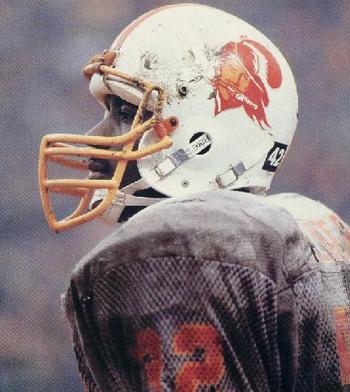


Wilder was the Bucs second round draft pick in 1981 and was moved to fullback for the first three years of his career. After leading the team in rushing and receiving in his second and third seasons, they moved him to halfback.

He led the NFL with 407 carries, a team record, in 1984, gaining 1,544 yards, scoring 13 times, and catching a career best 85 passes. His 2,229 combined yards was second in the league and 15 yards behind Hall of Fame running back Eric Dickerson.

It still is a team record, and it was the sixth best total in NFL history at the time. It still ranks 42nd, and Wilder was named to his only Pro Bowl, the first Buccaneer running back ever to attain this honor, for his efforts.

The following season saw him run for 1,300 yards, catch 53 balls, and score ten times. It would be his last 1,000 yard season, because he gained 704 yards and grabbed 43 passes in 1986 after missing four games because of injury.

Tampa Bay moved him back to fullback in 1987, and he once again led the team in rushing yards and receptions. After missing nine games the next year due to injuries, Wilder was a backup in 1989.

He started the 1990 year with the Washington Redskins, but went unused and was released after one game. The Detroit Lions picked him up, but rarely used him. He retired at the conclusion of the season.

Not only are his two 1,000-yard seasons the highest totals in franchise history, he is the Buccaneers all-time leader in rushing attempts and yards.

His 430 receptions still is a franchise most, over 100 more than wide receiver Mark Carrier in second place.

James Wilder is not only the most productive running back in Buccaneer history, but he is the most versatile. Though he had two exceptional seasons still firmly entrenched in the teams record books, he gave the team nine excellent years where he mostly carried the offense by himself.

Ricky Bell, Warrick Dunn, Jerry Eckwood, Errict Rhett, Reggie Cobb, Michael Pittman, Louis Carter, and Gary Anderson deserve mention.


Wide Receiver : Kevin House
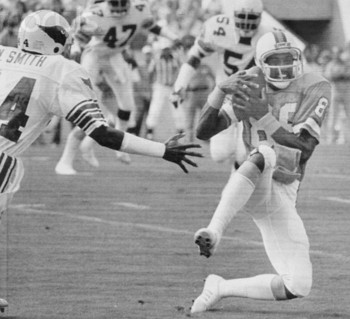


House was drafted in the second round of the 1980 draft by Tampa Bay. He was used as an extra receiver that year, but established himself as a deep threat by averaging 22.1 yards on 24 catches.

He was starting the nest year, and exploded on the NFL by grabbing 56 balls at a 21 yards per catch average. His 1,176 yards and nine touchdowns were career high marks, as was an 84-yard reception that was the longest in team history at the time.

After 28 receptions in the strike-shortened season of 1982, followed by 47 the next year, he had one of his finest seasons in 1984 by catching a career high 76 passes for 1,005 yards. It was a team record at the time, and remained one for wide receivers until Mark Carrier surpassed it in 1989.

After getting 803 yards on 44 catches the next year, House began the 1987 strike-shortened season by averaging 18.7 yards on 11 catches over seven games before he was suddenly released.

The Los Angeles Rams grabbed him off the waiver wire. He spent most of his eight games that year backing up Pro Bowler Henry Ellard and Olympic sprinter Ron Brown, he did start three times and averaged 25.4 yards on seven catches.

After missing four games due to injury in a season he was seldom used, he retired at the conclusion of the 1988 season. When he left the team in 1986,

House was the franchises all-time leader in pass receptions, yards, and touchdowns with 286 for 4,928 and 31 scores when he left the team. He still ranks second in yards and touchdowns, and sixth in receptions. His 84-yard catch is still second longest in team history.

Though his career average of 17.3 yards per catch show House was an effective deep threat, he also had excellent hands and was usually the teams only reliable wide receiver.

He may be the best wide receiver in team history.


Wide Receiver : Mark Carrier

Carrier was drafted by Tampa Bay in the third round of the strike-shortened 1987 season. He worked his way into the starting lineup about halfway into the season, and would remain these most of his Buccaneer career.

After getting 970 yards on 57 receptions in 1988, he had the best year of his career the next season when he became first Buccaneer wide receiver to make the Pro Bowl.

Only two others, Kennan McCardell and Keyshawn Johnson, have attained that honor since then.

He had 86 receptions for 1,422 yards and nine scores. All are career best marks, as was a 78-yard reception.

After 152 receptions and ten touchdowns over the next three years, he joined the Cleveland Browns in 1993. Carrier was used in a variety of ways in Cleveland. He returned a punt for a score, ran for two more, and had eight more on 72 receptions.

He was then drafted by the Carolina Panthers in an expansion draft, where his career was briefly reborn. He led the team with 66 receptions for 1,002 yards in 1995. He also scored three times, one that was the first NFL touchdown in North Carolina.

After 58 receptions the next year, he spent the next two years as a reserve until retiring at the conclusion of the 1998 season.

The 5,018 receiving yards he had in Tampa Bay is the most in franchise history. His 321 receptions is the second most, yet the most ever by a Buccaneer receiver.

He also ranks fourth best in receptions and receiving yards in Panthers franchise history. Carrier was productive and consistent.

Not only was he an excellent route runner, he also was enough of a deep threat to average 15.6 yards per catch. His versatility as a player was underrated.

Keyshawn Johnson, Joey Galloway, Gerald Carter, Mike Carrier, Bruce Hill, Lawrence Dawsey, Keenan McCardell, Isaac Hagins, and Morris Owens deserve mention.


Tight End : Jimmie Giles
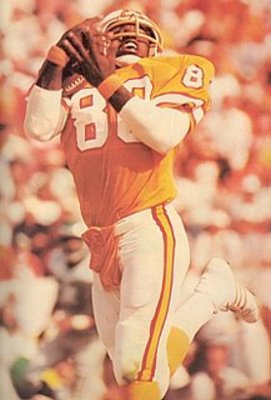


Giles was drafted in the third round of the 1977 draft by the Houston Oilers. He spent most of the season backing up Mike Barber, and actually almost doubled him in receptions. The Oilers decided to keep Barber and traded Giles to Tampa Bay.

It was the rookie year of quarterback Doug Williams, but the two quickly developed a repertoire. After making his first Pro Bowl in 1980, from averaging a career high 18.2 yards on 33 receptions, his best season may have been in 1981. He caught 45 balls for 786 yards, both career best marks, while making his second Pro Bowl.

He made the Pro Bowl in the strike shortened season of 1982, then spent the next two years underused and intermittently injured. He then rebounded with his last Pro Bowl year in 1985 after grabbing a career best eight scores on 45 catches.

The 1986 Buccaneers won two games. They had a weak-armed quarterback named Steve Young who has a problem getting the ball deep when he wasn't being sacked 47 times. He would be traded at the end of the year to the San Francisco 49ers, where he enjoyed a Hall of Fame career.

The head coach, Leeman Bennett, was frustrated by an anemic offense that was near the bottom in many categories. The season was already a failure before they played, because first round draft pick Bo Jackson refused to play with them.

Bennett cut Giles and Kevin House, their two best receivers, after the seventh game. His reason was "their collective lack of performance", but some felt it was the owner Culverhouse pinching pennies.

Giles was quickly signed by the Detroit Lions and lasted there until the fourth game of the strike shortened 1987 season. He was released and signed by the Philadelphia Eagles for the final eight games. Giles stayed with the Eagles until the end of 1989, when he retired.

His 34 touchdown catches with the Bucs are the most in team history. The 4,300 receiving yards he accrued are still third most, and easily to most by a tight end, as is his 279 catches, which ranks eight best overall.

Giles was not just a reliable receiver who could catch the ball in crowds over the middle, but he was also an excellent deep threat. He averaged 15.4 yards per catch, which is impressive for a tight end. His 81-yard catch is tied as the second longest in team history.

He was an excellent blocker, but underused as a receiver. If Tampa Bay had thrown him the ball more, he could very well be in the Pro Football Hall of Fame right now.

This was a sentiment echoed by all those who played with and against him. He is not only the first Buccaneer tight end to go to the Pro Bowl, but he is easily the best they ever had wear their jersey.

Jackie Harris, Calvin Magee, Jerry Bell, Dave Moore, Jim Obradovich, Alex Smith, Ken Dilger, and Ron Hall deserve mention.


Tackle : Paul Gruber
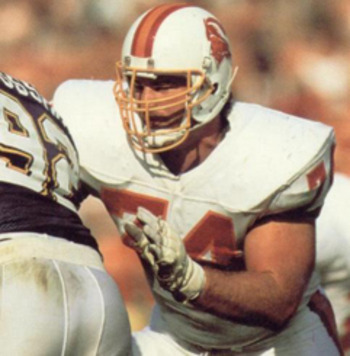


Gruber was the fourth player picked overall in 1988 when the Bucs selected him. They started him at left tackle right away, and he would hold that job the rest of his career.

The 1993 season would see him miss the first games of his career, missing six because of injury, and he missed three more in 1996 for the same reasoning. They would be the only games Gruber would not play in. He also played the first five years of his career without missing a snap.

When he retired after the 1999 season, Gruber had played in 183 games, starting in each game, over 12 years. This was a franchise record until future Hall of Famer Derrick Brooks broke it in 2006. Yet even Brooks never started in each game he played like Gruber did.

Though he was never selected to the Pro Bowl, there were few NFL left tackles in the 1990's more respected than Paul Gruber. He was technically solid, consistent, and reliable.

He is also easily the best offensive tackle in Buccaneers history.


Tackle : Rob Taylor
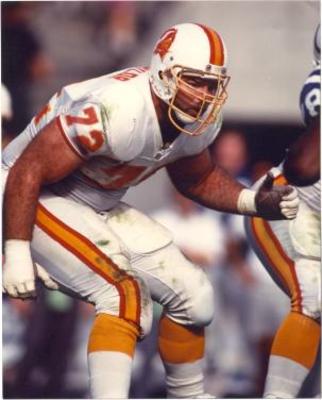


Taylor was drafted in the 12th round of the 1982 draft by the Philadelphia Eagles, but did not make the team. He was out of the NFL for the next four years.

He resurfaced with Tampa Bay in 1986, and made the team. He ended up starting in 13 games as well, and would start in every game he played in over the next four seasons.

After starting in 25 of the next 41 games he played in, Taylor retired at the end of the 1993 season.

He came from virtually nowhere and gave the Bucs 91 starts in 110 games in a career few expected that he would have.

Dave Reavis, Charley Hannah, Gene Sanders, Jerry Wunsch, Scott Dill, Kenyatta Walker, and Ron Heller deserve mention.


Guard : George Yarno


Yarno has this spot until Davin Joseph retires.

He was an undrafted player in 1979 who made the Bucs roster, playing in 15 games as a reserve as a rookie. After starting in 10 games in 1980, he went back to being a valuable reserve and spot starter, starting in eight of the teams next 27 games.

He then started full time the next three years, missing six due to injury. Yarno also converted the only extra point kick of his career in 1983. He also showed his versatility playing both guard spots and even started at left tackle for the 12 games he played in 1985.

He joined the Atlanta Falcons in 1986, starting five games at center, before joining the Houston Oilers the next year and retiring at the conclusion of it.

Yarno was a valuable member of the Buccaneers for eight years, and his ability to play several positions was crucial to the teams successes.

He is currently a respected offensive line coach for the Detroit Lions.

Greg Roberts, Sean Farrell, Arron Sears, and Ray Snell deserve mention.


Guard : Ian Beckles


Beckles was drafted in the fifth round of the 1990 draft by Tampa Bay and started immediately, not missing a start for two years.

His remaining time with the team saw him battle nagging injuries. He missed five games in 1993, starting in just seven. He started in every game he played in from then on, but missed five games over the next four years.

Beckles joined the Philadelphia Eagles as a free agent in 1997, but played in just nine games that year. After starting all 16 games the next year, he signed a deal with the New York Jets for the 1999 season.

The Jets head coach criticized Beckles conditioning and cut him. He tried to sign on with the Denver Broncos the next year, but was cut and forced to retire.

Since then, he has been a popular radio host in Tampa Bay.

Tampa Bay does not have a rich history of great guards.

Beckles started in 98 of the 102 games he played with them over seven years, which most likely makes him the best guard who ever played for the franchise over a long period of time.


Center : Tony Mayberry


Mayberry was a fourth round pick by Tampa Bay in 1990, and he spent his rookie year on the bench learning.

He earned the starting job the next year, and would start in 144 consecutive games until he retired after the 1999 season.

The fact is that Mayberry is the most accomplished offensive lineman in team history.

He became the first Buccaneer blocker to make a Pro Bowl in 1997. It was the first of three consecutive appearances.

He is the only Buccaneer offensive lineman with more than one Pro Bowl honor.

Not only is he the greatest center the team has ever had, but he may be their best blocker ever.

Jeff Christy, Steve Wilson, and Randy Grimes deserve mention.


Nose Tackle : Dave Logan


Logan was drafted in the 12th round by Tampa Bay in 1979, and played in five games as a reserve.

He earned the starting job in the third game of the next year, and would hold onto it the rest of his Buccaneers career.

He also scored a touchdown on a career long 60-yard fumble recovery in 1980, and scored again off of a 21-yard return the following season.

In the strike-shortened season of 1982, the NFL began recording sacks as an official statistic, and he was credited with 4.8 sacks in the nine games he played.

His best year may have been in 1983, where he had 9.5 sacks and scored off of a 54-yard fumble recovery. He was named First Team All-Conference by Pro Football Weekly, and would attain that honor again the next year after getting 5.5 sacks and scoring the last touchdown of his career off of a 27-yard interception.

Though he was not named to the Pro Bowl, he was named First Team All-NFL by the Sporting News that year.

After two more years, he left the team and joined the Green Bay Packers in 1987. He played in just two games, got hurt, then retired.

Dave Logan was an incredible physical specimen who relied on intelligence and technique to excel. He weighed just 250 lbs. while playing the most demanding position in football.

He played, and started in, every game in the last six of his eight years with the team. Besides his rookie year, he never missed a game with the Bucs.

He had 39 sacks in his career, which would be the fourth most in franchise history, but the NFL only has him officially with 28.3. That ranks as fifth best, yet it needs to be noted the NFL only recognizes 23 of the 78.5 career sacks Hall of Famer Lee Roy Selmon had with the team.

Logan also had 624 tackles in his career, showing he was more than a pass rusher.

His three fumble recovery touchdowns are the most ever by a Buc defensive lineman, and second in team history to the four defensive back Ronde Barber has. He is tied with 30 other players as the fourth most in NFL history in that category.

He is easily the greatest nose tackle in Buccaneers history.

Dave Pear, the only nose tackle in team history to be named to the Pro Bowl, Brad Culpepper, Anthony McFarland, and Randy Crowder deserve mention.


Defensive End : Warren Sapp


We had to get Sapp on the team, so he goes to defensive end in the 3-4 defense. He won't be here long, because he will be inducted into Canton one day.

He was drafted in the first round by Tampa Bay in 1995, and was brought along slowly as a rookie. He started in eight games, yet scored the only touchdown of his career from a interception return of five yards.

He was named a full-time starter the next year, and would remain so the remainder of his career. He made the first of seven consecutive Pro Bowl appearances in 1997, and was widely known as a productive players who first move was almost as quick as his mouth.

He was named First Team All-Pro in 1999, and would continue to gain that honor until 2002.

His best season came in 2000, where he had a career high 16.5 sacks and 52 tackles. It was just six tackles short of his career best set in 1997.

Sapp became a free agent after his final Pro Bowl season in 2003, and signed a gigantic contract with the Oakland Raiders for seven years. He lasted four in Oakland before retiring at the conclusion of the 2007 season. He played all over the defensive line, getting 19.5 sacks for the Raiders.

Sapp's 77 sacks are the most in Buccaneers history. His six Pro Bowls and four First Team All-Pro nods are the second most in team history. His 96.5 career sacks rank 28th all-time in NFL history, and are the second most ever by a defensive tackle.

Warren Sapp was an excellent pass rusher and a decent run defender. He is the greatest defensive tackle in Buccaneers history. He and Derrick Brooks are the only Buccaneers ever to be named to an NFL All-Decade First Team, which they were for the 2000's decade.

Wally Chambers, John Cannon, Santana Dotson, Chidi Ahanotu, Greg Spires, and Regan Upshaw deserve mention.


Defensive End : Simeon Rice
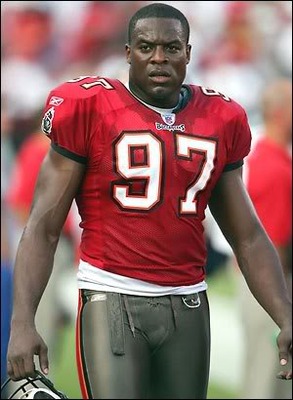


The Arizona Cardinals made Rice the third overall selection in the 1996 draft. He was the Defensive Rookie of the Year and went to one Pro Bowl for the Cardinals over five seasons.

His 51.5 sacks with them is the second most in their franchises history.

Rice signed with Tampa Bay as a free agent in 2001. His best season with them was 2002, where he was named First Team All-Pro and went to the Pro Bowl after Tampa Bay won Super Bowl XXXVII. He was second in MVP voting that game after collecting two sacks.

He also recorded the only safety of his career that season on a stingy defense that allowed just 12.2 points per game, which led the NFL. He made his last Pro Bowl the next year after grabbing a career high two interceptions to go with 15 sacks.

He continued to be a force off the edge until he injured his shoulder in 2006 and missed half the season. Tampa Bay asked him to take a reduction in pay, but Rice refused. They released him, and the Denver Broncos signed him. He lasted six games with them before asking to be released because he was unhappy on how he was being used.

The Indianapolis Colts signed him, but he lasted just two games before they cut him. He got the last sack of his career with them. He tried to revive his career with the New York Sentinels, now know as the Hartford Colonials, of the UFL in 2009, then retired.

The 69.5 sacks Rice accrued over six seasons with the Bucs ranks as the second most in team history. He got to 100 career sacks in just nine seasons, the second fastest to do so in NFL history behind Hall of Famer Reggie White.

His 122 career sacks still ranks 13th best in NFL history.

There have been few players as good as Simeon Rice at rushing the quarterback. He was a valuable member of some excellent Buccaneer teams, and he had a propensity of coming up big when his team needed him most.

He is the second defensive end in Buccaneers history to be an All-Pro and Pro Bowler, and is the second best defensive end the franchise ever had.


Linebacker : Hugh Green
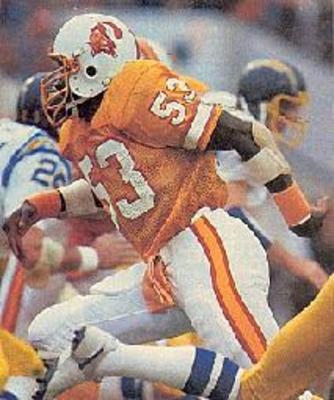


Green was the seventh player chosen overall in the 1981 draft by the Buccaneers after finishing second in the vote for the Heisman Trophy the year before.

He was named a starter immediately, and would remain there his entire time with Tampa Bay. He quickly became known as a big play linebacker who was equally adept in stopping the run as he was rushing the passer.

He made his first Pro Bowl in the strike-shortened 1982 season. The 1983 year was his best. Green made his last Pro Bowl after leading the NFL with two touchdowns off of interceptions.

He was considered one of the best linebackers in the game, then his career was derailed by a car crash in 1984 that ended his season after eight games because of an orbital fracture.

After five games of the 1984 season, Green was traded to the Miami Dolphins and finished the season with a career high 7.5 sacks. His next two years were bereft with nagging injuries, but he came back strong in 1988 to start every games for the next three years. After playing mostly as a reserve in 1991, he retired.

Until Derrick Brooks joined the Buccaneers, Green was considered by many to be the best linebacker to ever play for them. His two Pro Bowls are still the second most ever by an outside linebacker in Buccaneers history. He was very valuable to the team.

His coach, John McKay, was once asked about what weaknesses Green had as a player. All McKay could think of saying was, "He's not twins.''


Linebacker : Hardy Nickerson
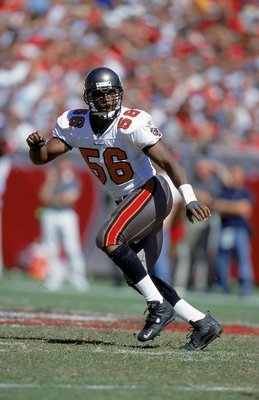


Nickerson was drafted in the fifth round of the 1987 draft by the Pittsburgh Steelers. After spending his rookie year as a reserve, he soon moved into the starting lineup and became a solid member of the team.

He signed with the Buccaneers as a free agent in 1993, and blossomed in the 4-3 base defense that head coach Tony Dungy ran.

He was named First Team All-Pro and to the Pro Bowl in his first season after setting a team record with a whopping 214 tackles that still stands today.

Though he never exceeded 147 tackles in a season for the rest of his career, Nickerson was the fiery, intelligent leader of the defense and was called "The Dragon" by teammates and fans.

In 1996, he went to the Pro Bowl again, something he would continue to do until 1999. He also was named First Team All-Pro in 1997, and was honored with the Byron "Whizzer" White NFL Man of the Year Award for his work in the community and country.

He became a free agent after his last Pro Bowl season of 1999, so he signed a contract with the Jacksonville Jaguars. He got hurt after six games, missing the rest of the season. The 2001 season saw him get a career high three interceptions and nine defended passes. He then signed with the Green Bay Packers in 2002, then retired at the end of the season.

Hardy Nickerson is a member of the NFL 1990's All-Decade Second Team. No other Buccaneers middle linebacker has been to the Pro Bowl, and none have more tackles than him.

"The Dragon" is easily the best middle linebacker in team history.

Dewey Selmon, Richard Wood, Eugene Marve, Jeff Davis, and Scot Brantley deserve mention.


Linebacker : Dave R. Lewis


Lewis was drafted in the second round of the 1977 draft by Tampa Bay. He quickly became a starter and was known for his well rounded game in all facets of his position.

After scoring the only touchdown of his career, which came off a fumble recovery, he became the first linebacker in Buccaneer history to be named to the Pro Bowl in 1980.

Lewis was at the zenith of his game until he was injured in 1981. He was traded to the San Diego Chargers the next year, then was traded to the Los Angeles Rams in 1983. After spending most of the year as a reserve, he retired.

Though his Buccaneers career was cut short, it should not be forgotten. Lewis was solid against the run and pass. He helped the 1979 team lead the NFL in points allowed, with a paltry 14.8 points per game, as they won their first ever divisional title and finished one game away from the Super Bowl.

Cecil Johnson, Broderick Thomas, Winston Moss, Kevin Murphy, and Shelton Quarles deserve mention.


Linebacker : Derrick Brooks
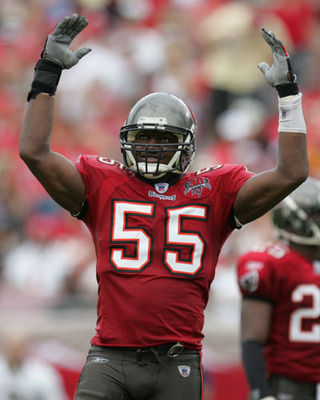


Derrick Brooks was already a legend in the state of Florida before the Bucs used the 28th pick of the 1995 on him. He had grown up in the state, then starred at Florida State University before spending 14 more years starring for Tampa Bay.

He was brought along slowly as a rookie, starting in 13 games. He would never miss a game in his career, and never miss a start from his second season on.

In 1997, he made the first of 10 consecutive Pro Bowl appearances. Though excellent at stopping the run, he was just as exceptional in pass defense. Three times in his career he had 11 passes defended in a season.

He was not just a gridiron star in Florida, but he was a community leader. He shared the 2000 Walter Payton Man of the Year Award with Jim Flanigan Jr. of the Chicago Bears.

The best year he had was the Buccaneers Super Bowl-winning season of 2002. Brooks had a career best five interceptions, and returned three for an NFL-best three touchdowns. One went for 97 yards, the second longest in franchise history.

He also scored on a fumble recovery, making his four touchdowns the most be any defensive player that season. It is the most by a linebacker and the second most by any defender in NFL history.

He was named NFL Defensive Player of the Year, but he was not done. In Super Bowl XXXVII, he picked off a pass and returned it 44 yards for a score.

In 2003, he won both the Byron "Whizzer" White NFL Man of the Year Award and the Bart Starr Man of the Year Award for his community service. He also won the Pro Bowl MVP in 2006 after returning an interception for a touchdown.

Though he failed to make the Pro Bowl in 2007, after having the only season in his career he failed to get a sack, interception, or fumble recovery, he did pile up 109 tackles. The last season of his career was 2008, and he somehow was named to the Pro Bowl despite a career low 73 tackles.

Tampa Bay released him, and he retired in 2010 when he found no suitable offers to play again. No other Buccaneer has made more Pro Bowls or been named First Team All-Pro more than Brooks. He and Warren Sapp are the only Bucs ever to be named to an NFL All-Decade First Team, which they were for the 2000's decade.

His 1,715 tackles are the most in team history, and his 25 interceptions are the most ever by a Buccaneer linebacker.. His six touchdowns for touchdowns, as well as seven total scores, are second in team history to Ronde Barber.

Brooks will own this spot temporarily, because he is destined for the Pro Football Hall of Fame. He is the greatest linebacker in Buccaneers history, and one of their best players ever. He embodies what a Hall of Famer should be on and off the field.


Strong Safety : John Lynch
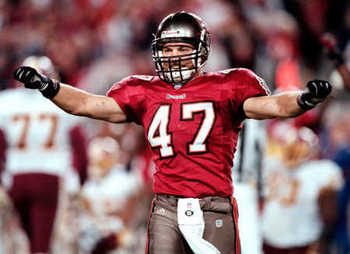

Lynch was drafted in the third round of the 1993 draft by Tampa Bay. He spent his first three years in the NFL primarily as a reserve, starting in 10 of the 40 games he played in.

The 1996 was his first as a starter, and he responded with 103 tackles and three interceptions. He also ran a fake punt for 40 yards. He made the Pro Bowl the next year after getting 109 tackles.

The best season of his career may have come in 1999, where he made his second Pro Bowl and attained his initial First Team All-Pro honor after piling up a career high 127 tackles. He would never get more than 87 tackles in a season for the rest of his career.

Lynch made the Pro Bowl in each of the next four years, and was named First Team All-Pro once more. He was an important member of a Tampa Bay team that won Super Bowl XXXVII in 2002.

After failing to make the Pro Bowl in 2002, Tampa Bay released him. The Denver Broncos signed him and decided to move him to free safety. He lasted four years with the Broncos, getting three interceptions and 271 tackles over that time.

Yet, despite the less than mediocre production, he was named to the Pro Bowl in every season with the team. He missed three games in 2007 and saw he was being phased out. He requested his release, then signed with the New England Patriots. After being cut in training camp, he retired.

His five Pro Bowls are tied as the most ever by a Buccaneers defensive back, and the most by a safety. His two First Team All-Pro nods are the most by any Tampa Bay safety. He ranks fourth in tackles and sixth in interceptions in Buccaneers history after 11 seasons with the team.

John Lynch may only temporarily own this spot, because he has a legitimate chance of being inducted into Canton. Not based on his actual numbers, because there is huge list of safeties waiting for induction who surpass his by quite a bit.

He was extremely popular with the media, then in turn with the fans. This showed by all the Pro Bowls he made despite being outperformed by others at his position many times. The fact that he was on a Super Bowl winning team will help his cause as well.

Regardless, he is the best strong safety the Buccaneers ever had.

Mark Cotney and Marty Carter deserve mention.


Free Safety : Cedric Brown

Brown was drafted in the 12th round of the 1976 draft by the Oakland Raiders, but did not make the team. He was later picked up by Tampa Bay and played in one game that year.

He was named a starter the next year, and would remain one his remaining eight years with the team. He quickly became the glue of the secondary, rarely making errors and generally in the right place at the right time.

He had six interceptions for 110 yards in 1978, both of which led the team. He scored a touchdown on a 80-yard lateral return off a fumble recovery in 1980, thus continuing his reputation as a big play defender in the NFL.

The best season he has was in 1981, getting nine interceptions for 215 yards and two touchdowns. He was somehow not chosen for the Pro Bowl, as Nolan Cromwell, of the Los Angeles Rams, and Dwight Hicks, of the San Francisco 49ers, were instead.

Though he had the same amount of interceptions as Hicks, for just 24 yards less, he easily outperformed Cromwell. Including Brown, six players had nine or more interceptions that year, but only Hicks and Everson Walls went to the Pro Bowl.

After the strike-shortened 1982 season, Brown dealt with injuries. He was able to play in just 17 games over the next two years. He decided to retire after the 1984 season.

The 29 career interceptions he accrued are the most by any safety in Buccaneers history, and it ranks as the third most overall. Though his true impact will never be done justice, because the NFL did not count statistics like tackles, passes defended, and forced fumbles in his era. Cedric Brown's impact can still be seen through other statistics, thus displaying he was one of the most underrated free safeties of his era.

He is in the top-76 in NFL history in fumble return yards in a season, interceptions in a season, interception return yards in a season, and interceptions returned for touchdowns in a season.

He is the best free safety Tampa Bay ever had, one of the very few original Bucs that can claim that at their position.

Curtis Jordan and Harry Hamilton deserve mention.


Cornerback : Donnie Abraham
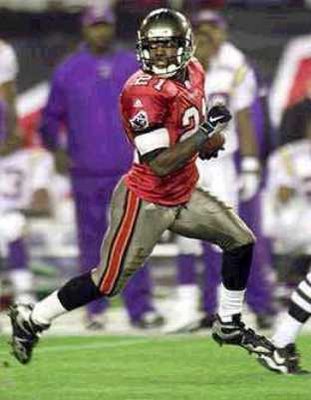

Abraham was drafted in the third round of the 1996 draft by Tampa Bay. He soon earned a starting job as a rookie, picking off five balls. He duplicated that feat the next season.

The best season of his career came in 1999.He led the NFL with seven interceptions and two interceptions returned for touchdowns. He gained a career high 115 yards off the interceptions, recorded the only two sacks of his career, and had a career best 79 tackles.

He had seven picks the next year, and was named to his only Pro Bowl. He became the second Tampa Bay cornerback to ever be named a Pro Bowler.

After six interceptions in 2001, he signed with the New York Jets as a free agent in 2002. After a productive first year with the Jets, he missed half of the 2003 season because of injury and started in only two games. He contemplated retiring, but decided to not leave the game on that note.

His 2004 season saw him start all 16 games and score a touchdown off both a fumble recovery and interception. Abraham then decided to retire.

His 31 interceptions are the second most in Buccaneers history.

Donnie Abraham may have been the first true lockdown cornerback in team history, and he certainly is one of their best ever.


Cornerback : Ricky Reynolds
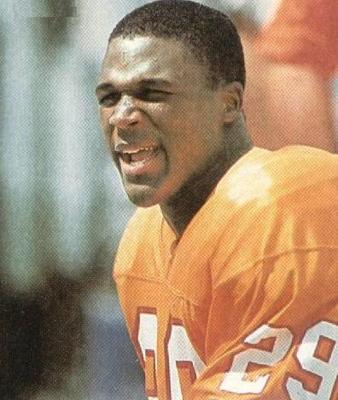


Reynolds was drafted by the Bucs in the second round of the strike-shortened 1987 season. He started right away, and would continue to do so his entire Tampa Bay career.

After four swipes in 1988, he grabbed a career best five interceptions for 87 yards the next year. He also scored on a 68-yard return. He would score again in 1992 off of a fumble recovery.

He signed with the New England Patriots as a free agent in 1994, and scored the last touchdown of his career off of a fumble recovery. After getting a career best 2.5 sacks, along with three interceptions in 1995, he spent parts of the next year hurt and missed four games. He then retired.

Of the 23 career interceptions Reynolds had, 17 came in his seven years in Tampa Bay. Eight of his 12 fumble recoveries came with them too.

He ranks second in franchise history for tackles and fumble recoveries by a cornerback. He still ranks tenth in interceptions, the fifth most by a Bucs cornerback. He was always around the ball. He not only got the ball back a lot for his team, he was in on tackles often.

Ricky Reynolds is easily one of the very best cornerbacks in team history. Ronde Barber will move into this spot when he retires, but Reynolds moves back in if Barber is one day inducted into Canton.

Wayne Haddix, the first Buc to lead the NFL in interceptions and their first Pro Bowl cornerback, Jeris White, Jeremiah Castille, Mark Washington and Brian Kelly deserve mention.


Kicker : Martin Gramatica
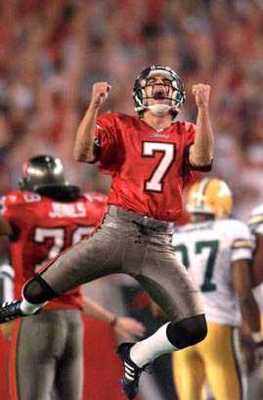


Gramatica was drafted in the third round of the 1999 draft by Tampa Bay. He rookie year was solid. He missed just five field goal attempts the entire season.

The 2000 season saw him become the only placekicker in Buccaneers history to be names to the Pro Bowl. He scored 126 points, made five field goals of over 50 yards, and missed just six field goal attempts.

The Bucs won Super Bowl XXXVII in 2002, as he made five more field goal attempts over 50 yards and led the NFL with 32 field goals made. He also scored a career best 128 points, the last time in his career he would score more than 81 points in a season.

Gramatica's accuracy then began to wane. After having never missed an extra point in his career, he missed one in each of his next three years. His field goal accuracy dropped a great deal.

After 11 games in 2004, Tampa Bay cut him. The Indianapolis Colts signed him for four games, where all he did was kickoff.

After sitting out in 2005, he played eight games in 2006 for both the Colts and Dallas Cowboys. He then played eight games over two seasons for the New Orleans Saints.

No Buccaneer has attempted and made more extra points and field goals than Gramatica. His 592 points are also the most in franchise history. His 15 field goals of over 50 yards also is a Buccaneers record.

Besides being the only Pro Bowl kicker Tampa Bay ever had, Martin Gramatica is the best kicker the team ever had.

Michael Husted, Donald Igwebuike, and Matt Bryant deserve mention.


Punter : Mark Royals


Royals spent his rookie season splitting time between the Saint Louis Cardinals and Philadelphia Eagles as an undrafted free agent rookie. He joined the Bucs the next year, staying with them until the end of the 1991 season.

He joined the Pittsburgh Steelers in 1992, and left them for the Detroit Lions in 1995 for two years. Royals then joined the New Orleans Saints in 1997, and led the NFL with a 45.9 yards per punt average that season. After averaging 45.6 the next year, he rejoined Tampa Bay in 1999.

He left for the Miami Dolphins in 2002, then was released after three games in 2003. He then played 11 games for the Jacksonville Jaguars and retired afterward.

Josh Bidwell, the only Pro Bowl punter in Buccaneers history, will get this spot when he retires.

Royals ranks second in Buccaneers history in punt attempts and yards. It also be noted he never had a punt blocked in 414 attempts with the team.

Dave Green, Tom Tupa, and Frank Garcia deserve mention.


Kick Returner : Clifton Smith
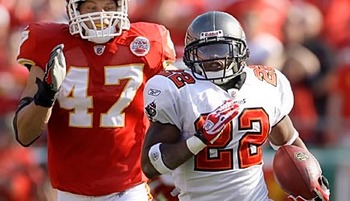

Though Smith is still active, he gets this spot because the well known woes Buccaneer kick returners suffered before his arrival as an undrafted free agent in 2008.

Tampa Bay had went from 1976 to 2007 without once having a player return a kickoff for a touchdown on their behalf until Michael Spurlock broke the 32-year drought.

The proverbial floodgates opened in the ninth week of the 2008 season, his second as a pro, when Smith took one 97 yards for a score, the second in team history.

Two weeks later, he took a punt return 70 yards for another score.

He is the only Buccaneer to ever score off both a kickoff and punt return in the same season.

Despite playing just nine games, he became the first and only Buccaneer return specialist to be named to the Pro Bowl. He had gained a career best 992 yards on a career high 36 kickoff returns, and averaged an excellent 14.1 yards on 23 punt returns.

His 2009 season was cut short by a vicious hit that left Smith with a concussion and the culprit ejected in the 11th game of the season. At the time, he was averaging an impressive 29.1 yards on 31 kickoff returns, and had returned 23 punts for 232 yards.

Called "Peanut" by his teammates, Tampa Bay decided to cut him a week before the beginning of the 2010 season. He signed with the Miami Dolphins, but was cut after hardly playing over two games.

Right now he is the active leader in yards per return average on kickoffs, and he ranks fifth all-time.

He may be Tampa Bay's best kickoff return specialist ever.

Aaron Stecker, Bobby Joe Edmonds, Michael Morton, Donnie Elder, Gary Anderson, Phil Freeman, Torrie Cox, Michael Spurlock, Sammie Stroughter, and Reidel Anthony deserve mention.


Punt Returner : Karl Williams
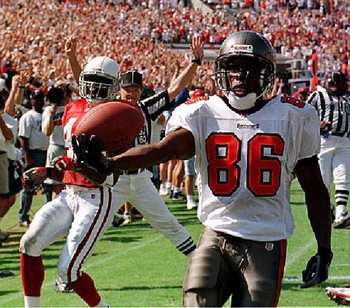


Williams made the Bucs in 1997 as a 25-year-old free agent. He spent the year as an extra receiver but was asked to return just 27 punts and kickoffs. He took one punt for a career long 88-yard score, and Tampa Bay quickly found their punt returner.

He returned a career high 46 punts the next year, at a very impressive 13 yards per return average, while scoring again. He also returned 15 kickoffs and started seven games at wide receiver, setting career high marks of 33 receptions for 486 yards and four scores.

Tampa Bay had him only return 10 punts the next year, while starting six times at receiver. He had nagging injuries that saw him miss three games each year until 2000. Yet the 2000 season was one of his finest as a returner. He returned another punt for a score, and returned a career high 19 kickoffs at a 23.8 yards per return average.

Williams returned a punt for a score every year until 2002, when the Buccaneers won Super Bowl XXXVII.

After just 15 punt returns the next year, he joined the Arizona Cardinals in 2004 and was released at the end of the season.

Nicknamed "The Truth" by his teammates, no Buccaneer has ever returned more punts for more yards and touchdowns than Karl Williams. His five touchdowns off punt returns ranks as 13th best in NFL history, and is the sixth most ever. He also caught 137 passes for seven scores for Tampa Bay.
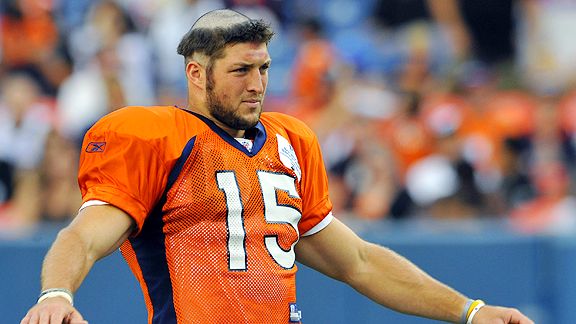
There has never been a punt returner for the Bucs better than him, and that is the truth.

Danny Reece, Willie Drewrey, Clifton Smith, and Jacquez Green deserve mention.